How we make this list: we compare pricing pages, product documentation and public user reviews. Ratings come from G2, Capterra or Trustpilot, with the date we checked them.
Key takeaways
- Datadog and Dynatrace are the platform answers: synthetic tests live beside your real user data, traces, and logs, so a failed test and its cause sit in one console.
- Catchpoint is the outside in specialist, with the deepest global test network for catching regional and ISP level failures your own cloud checks miss.
- Checkly brings monitoring as code to engineering teams: tests written in Playwright, versioned with the application, priced from a reported $24 per month.
- Grafana Cloud Synthetic Monitoring is the accessible entry, with a free tier and per check pricing inside the observability stack many teams already run.
- Judge every tool on the same three things: test locations that match your users, alerting that fires before customers complain, and per test pricing at your real test frequency.
Quick comparison
Is your product missing or out of date?
We review this list regularly. Vendors can request a listing, send updated pricing or ask about featured placement.
Starting priceSee website
Free planNo
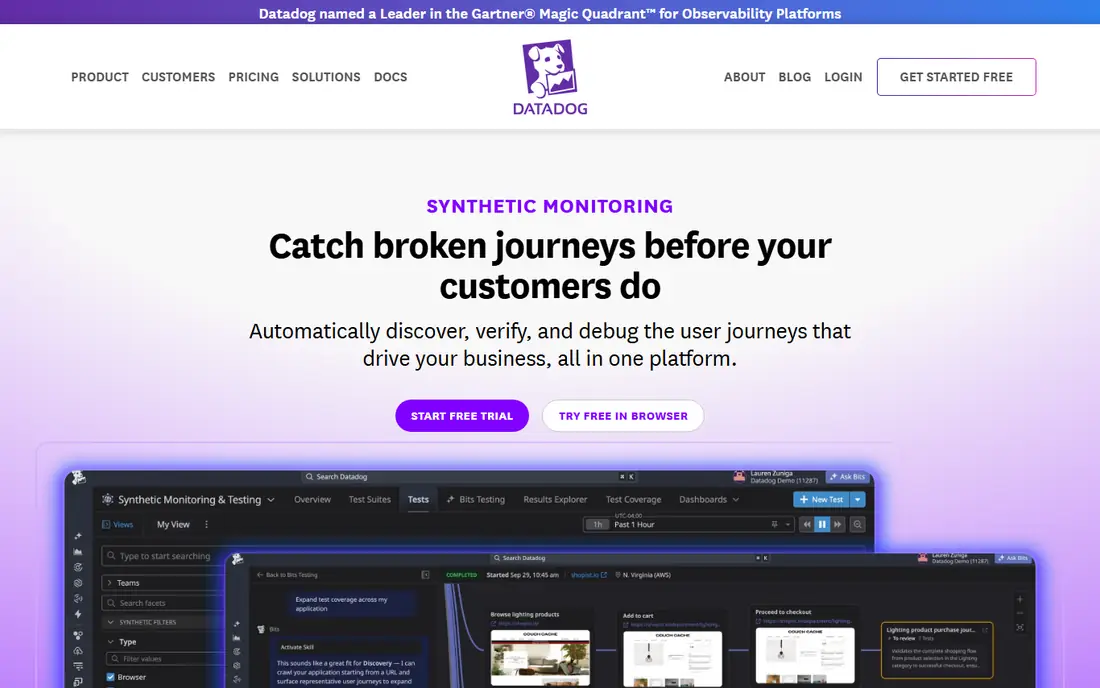
Datadog is the synthetic tool most platform teams already have access to: API checks and full browser journeys running from global locations, wired into the same dashboards and alerts as the rest of the estate. When a checkout test fails, the trace of that exact test run is one click away, which shortens incidents in a way standalone tools cannot match.
The trade off is integration against run cost. Datadog charges per test run, and a large suite at one minute frequency becomes a serious line item. Datadog fits engineering organisations standardised on its platform that will use the correlation, not just the checks.
What we like- Browser and API tests inside the Datadog platform, so a failure links straight to traces, logs, and real user data
- Strong multi step journey tests
- Test locations across clouds and regions
- CI testing hooks for deployments
Watch out for- Per test run pricing adds up quickly at high frequencies
- The platform bill as a whole needs active management
- Depth of features takes learning
Starting priceSee website
Free planNo
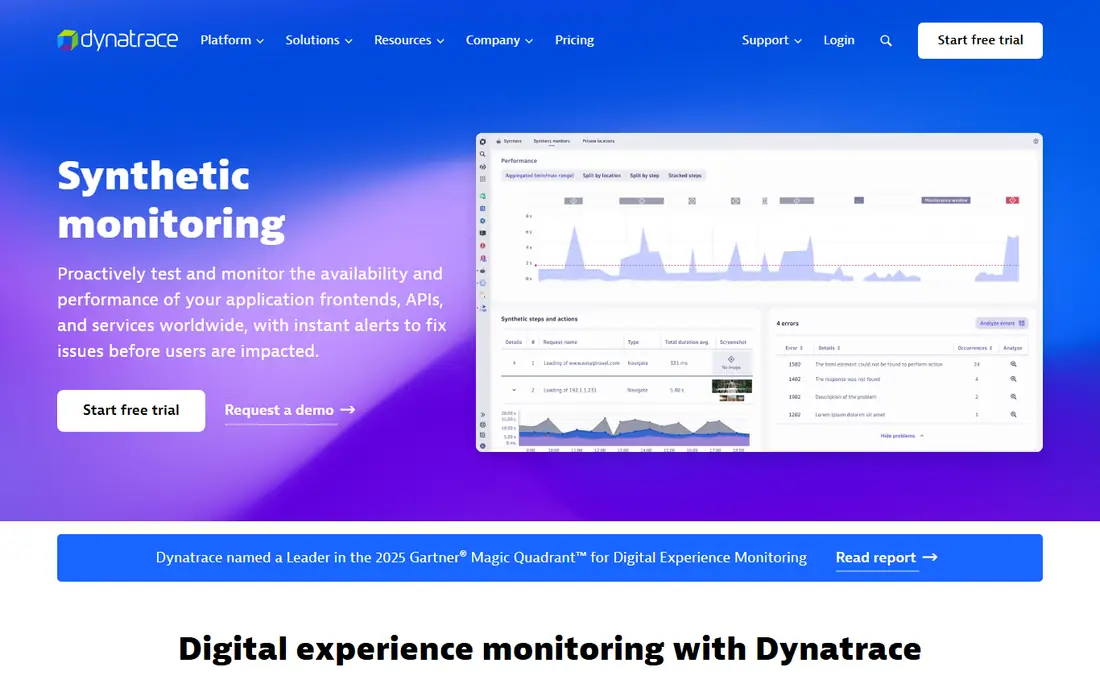
Dynatrace treats synthetics as one sense in a body that also watches infrastructure, applications, and real users, with its AI correlating a failed synthetic journey with the deployment or host problem behind it. Private synthetic locations let enterprises test applications that never face the internet.
The trade off is platform power against weight. Dynatrace fits large enterprises already invested in the platform that need synthetic, real user, and infrastructure evidence in one problem record.
What we like- Browser and HTTP monitors tied into Dynatrace's full stack monitoring and its Davis AI problem detection
- Private locations for internal applications
- Strong for enterprise estates with strict governance
- Good third party and SLA reporting
Watch out for- Enterprise pricing and platform commitment
- Configuration depth assumes a Dynatrace skilled team
- Smaller teams find the platform heavy
Starting priceSee website
Free planNo
New Relic Synthetics is the natural in house choice for the many teams already running its APM: checks billed within the platform's usage model, scripted monitors for real journeys, and alerts that sit next to the application data they protect.
The trade off mirrors Datadog's: value concentrates inside the platform. New Relic fits its existing customers and engineering teams comfortable writing monitor scripts who want synthetics without a new vendor.
What we like- Scripted browser and API monitors inside the New Relic platform
- Generous check allowances have historically been part of its usage pricing
- Good alerting tied to APM data
- Straightforward to adopt for existing users
Watch out for- Pricing is usage based across the platform and takes modelling
- Scripted test authoring is code first
- Standalone buyers get less than platform users
Starting priceSee website
Free planNo
Catchpoint is the outside in authority: hundreds of test locations on real networks, including consumer ISPs, so it sees the regional outage, the bad BGP route, and the DNS failure that cloud based checks sail past. Its evidence grade data settles arguments with providers.
The trade off is depth against price and scope. Catchpoint fits global businesses, commerce, media, SaaS with SLAs, whose revenue depends on reachability from everywhere their customers are, and who need proof when a third party fails them.
What we like- One of the largest and most varied test node networks in the industry, including last mile ISP nodes
- Deep network and DNS diagnostics with every test
- The tool enterprises use to prove a problem is a provider's, not theirs
Watch out for- Enterprise pricing by quote
- Specialist depth is wasted on a simple site
- Platform breadth beyond testing is narrower than Datadog

#5
Splunk Synthetic Monitoring
Best for: Splunk observability estates
Visit splunk.com
Starting priceSee website
Free planNo
Splunk's synthetic product grew from Rigor, a respected web performance testing tool, and it shows in the waterfalls and page level detail. Inside Splunk Observability Cloud it links synthetic journeys to traces and infrastructure the way its platform rivals do.
The trade off is ecosystem logic again: full value lands for Splunk shops. Splunk Synthetic Monitoring fits enterprises standardised on Splunk that want performance testing depth with their observability contract.
What we like- Built on the Rigor platform Splunk acquired
- Browser tests with detailed performance waterfalls
- Ties into Splunk's observability and incident stack
- Strong API test support
Watch out for- Makes most sense inside a Splunk estate
- Pricing by quote
- Smaller community mindshare than Datadog among web teams

#6Checkly
Best for: Monitoring as code for developers4.6/5 on
G2 (33 reviews, checked Oct 2026)
Visit checklyhq.com
Starting price$24 per month
Free planYes
Checkly is what happens when monitoring is built for the team that ships the app: write the checkout test in Playwright, deploy it with the release, and let it run from global regions as code, not as a console configuration nobody remembers. Pricing is published and modest, reported from $24 per month above a free tier.
The trade off is developer fit against enterprise apparatus. Checkly fits product engineering teams that want monitoring reviewed in pull requests and priced in the open.
What we like- Tests written in Playwright and kept in your repository with the code they test
- API and browser checks plus uptime monitoring in one developer friendly tool
- Reported pricing from $24 per month with a free tier
- Fast setup, no console clicking
Watch out for- Assumes a team comfortable owning tests as code
- Enterprise governance and locations trail Catchpoint
- Browser test minutes meter the higher tiers

#7
Grafana Cloud Synthetic Monitoring
Best for: Accessible entry on Grafana
Visit grafana.com
Starting priceSee website
Free planYes
Grafana Cloud's synthetic monitoring is the low friction start: checks defined in the same world as your dashboards, a free allowance to begin with, and pricing that scales by checks run. For teams on Grafana it removes the vendor decision entirely.
The trade off is maturity against convenience. Complex user journeys and the deepest location networks live elsewhere. Grafana fits teams already on its cloud that need solid uptime and journey checks without a procurement exercise.
What we like- A free tier makes starting genuinely costless
- HTTP and multi step checks from global probes
- Results land in Grafana dashboards beside your metrics and logs
- Per check pricing keeps small suites cheap
Watch out for- Browser test depth is younger than the specialists
- Advanced journey scripting is more limited
- Value depends somewhat on living in Grafana
Starting priceSee website
Free planNo
ThousandEyes answers the question synthetics alone cannot: the site is slow from Chicago and the path shows why. Its tests ride on an agent network that maps the internet's behaviour, which is why network teams at large companies treat its maps as ground truth during outages.
The trade off is network specialisation against web focus. ThousandEyes fits large organisations where the argument is usually with a network, a provider, or a cloud region rather than with the application itself.
What we like- Cisco's platform sees the network path itself: ISP, BGP, and cloud network faults shown hop by hop
- Synthetic tests run from cloud, enterprise, and endpoint agents
- The evidence standard for proving where a failure lives
Watch out for- Enterprise pricing
- Network depth exceeds what a web team alone needs
- Best as part of a network operations function
How we chose
We compared the synthetic monitoring tools across the platform and specialist split, requiring multi step browser tests and multi region locations from every entry. Pricing in this category is dominated by per run and per check models quoted per account, so we published only the figures vendors state openly: Checkly's tiers and Grafana's free entry, and marked volume priced platforms as See website. Location network depth was weighted heavily, because a synthetic tool that only tests from two clouds cannot see the failures that hurt real users.
Write the journeys before the vendor demos: the five to ten flows that make or lose money, login, search, checkout, the API your mobile app depends on, and insist every tool runs those exact flows in the trial. Compare locations against your analytics: test from where your users are, on networks like theirs, which is where Catchpoint and ThousandEyes justify themselves. Model the run cost honestly: a browser test every minute from ten locations is over four hundred thousand runs a month, and per run pricing turns that into real money, so set frequencies by journey value. Wire the alerts into the same rota and incident tool as your other monitoring, and rehearse one failure end to end. Finally, decide platform or specialist by where the 3 a.m. investigation will happen: if the team lives in Datadog, Splunk, or Grafana, synthetics inside that console will be used; a separate best of breed tool that nobody opens loses to the integrated one every time.
Frequently asked questions
What is the difference between synthetic and real user monitoring?
Synthetic monitoring runs scripted tests on a schedule from test locations, so it works before traffic arrives and at 3 a.m. Real user monitoring records actual visitors, which shows real experience but only when users are present and suffering. Serious teams run both and compare them.
How often should synthetic tests run?
Critical journeys every one to five minutes from key locations, secondary pages every fifteen to thirty. Frequency multiplies cost on per run pricing, so spend it where a failure loses money fastest, and use cheap HTTP checks for the long tail.
Can synthetic tests handle login and checkout?
Yes. Every tool here scripts authenticated, multi step journeys including payment sandboxes. Store credentials in the tool's vault, use test accounts with no real value, and keep the scripts maintained like production code, because a stale test that fails nightly trains the team to ignore alerts.
How much does synthetic monitoring cost?
Developer tools publish prices: Checkly reports plans from $24 per month, and Grafana Cloud includes a free tier with per check pricing above it. Platform and specialist tools price by test volume and locations on quote; enterprise contracts commonly reach five figures a year.
Where should tests run from?
From the regions and network types your users actually use, including at least one consumer ISP location per major market. Cloud only testing misses last mile and DNS problems, which is the entire selling point of Catchpoint's and ThousandEyes' networks.
Do synthetic tests replace uptime monitoring?
They include it. A simple HTTP check is the cheapest synthetic test, and the tools here run those alongside browser journeys. A dedicated uptime tool may still be cheaper for hundreds of simple endpoints, but the journey data is what synthetic platforms add.
Sources we checked (0)
Is your product missing or out of date?
We review this list regularly. Vendors can request a listing, send updated pricing or ask about featured placement.

Shihab Mia · Founder, Rankite
Shihab has 5+ years in B2B and SaaS SEO. He writes Rankite's software buying guides from pricing pages, documentation and public user reviews. More about Shihab.
 Datadog Synthetic Monitoring
 Dynatrace Synthetic
 New Relic Synthetics
 Catchpoint
 ThousandEyes