How we make this list: we compare pricing pages, product documentation and public user reviews. Rankite is independent; if a vendor ever pays for a featured spot, that listing is clearly labeled Partner.
Key takeaways
- ShulCloud is the clear market leader, used by more than a thousand synagogues, with published pricing from $161.99 per month for the Standard plan.
- ShalomCloud is the budget pick at $36 per month for small congregations, with a two-month free trial, which makes it the easiest low-risk starting point.
- Chaverware and MM2000 are the legacy options: deep synagogue-specific features built over decades, but desktop-era software that shows its age.
- TempleTools is the modern challenger, built on Stripe with automated dues collection and a website builder, aimed at synagogues that want simplicity.
- Large congregations should look at Congregation Connect, the only Salesforce-based option, while Chabad organizations have their own purpose-built platform in Chabad Suite.
Most software categories have dozens of vendors fighting for your attention. Synagogue management has about seven that matter, and the stakes are oddly high: this system holds your membership roster, your dues billing, your yahrzeit records, and your High Holiday seat assignments. Get it wrong and the office staff pays for it every single day. Get it right and nobody thinks about it, which is the point.
This is a small, specialized market, so buy for fit rather than feature-count. A 150-family congregation and a 2,000-family congregation need different tools. Below are the real options, from the dominant cloud platform to the legacy desktop systems still running in offices across the country.
Quick comparison
| Tool | Best for | Starting price | Free plan |
|---|
 ShulCloud ShulCloud | most synagogues of any size | $161.99 per month (Standard) | No |
 Chaverware Chaverware | synagogues staying on proven desktop software | See website | No |
 TempleTools TempleTools | synagogues that want modern simplicity | See website | No |
 ShalomCloud ShalomCloud | small congregations watching every dollar | $36 per month | Free trial (2 months) |
 MM2000 MM2000 | synagogues committed to on-premise software | See website | No |
 Congregation Connect Congregation Connect | large synagogues needing Salesforce power | See website | No |
 Chabad Suite Chabad Suite | Chabad centers and organizations | See website | No |
Is your product missing or out of date?
We review this list regularly. Vendors can request a listing, send updated pricing or ask about featured placement.
The best synagogue management software
Starting price$161.99 per month (Standard)
Free planNo
ShulCloud is the default answer in this category for a reason: it was built specifically for synagogues and now serves well over a thousand of them. Membership management, dues billing, event registration, High Holiday seating, yahrzeit tracking, school modules, and a website builder all live in one system, with a Jewish calendar and zmanim baked in rather than bolted on. When your treasurer asks for something unusual, chances are another ShulCloud synagogue already solved it.
Pricing is published and tiered: Standard at $161.99 per month without financials, Premium at $313.99 with billing and payments, and Enterprise at $464.99 with fundraising and school management. The honest catch is that the interface reflects years of accumulated features, and new staff need training time. Still, for most congregations, this is where the search starts and often ends.
What we like- Deepest synagogue-specific feature set
- Website, calendar, and billing in one
- Large user community for peer advice
Watch out for- Pricing climbs with the financial tiers
- Older interface in places
Starting priceSee website
Free planNo
Chaverware has been in synagogue offices since 1993, and in this market that longevity counts for something. It handles the full back-office load, membership, billing, contributions, yahrzeits, with the thoroughness you would expect from thirty years of refinement. ChaverWeb gives members an online portal for payments, donations, and event registration on top of the desktop core.
The trade is architectural. This is fundamentally desktop software with web extensions, not a cloud-native platform, which affects remote work, automatic updates, and the general feel of daily use. Synagogues that have run it for years tend to stay, because migration means moving decades of financial history. If you are choosing fresh today, weigh that future migration cost honestly.
What we like- Decades of synagogue-specific depth
- Strong reputation for support
- Companion web portal for members
Watch out for- Desktop-era product in a cloud world
- Migration to anything else is a project
Starting priceSee website
Free planNo
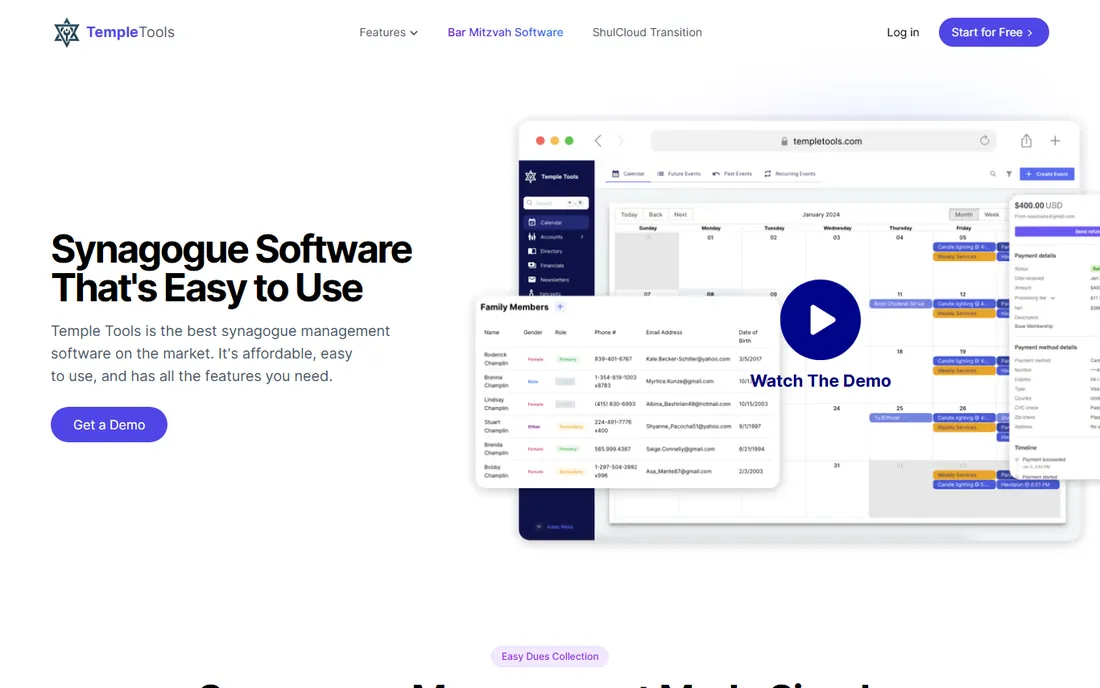
TempleTools reads like a response to every complaint about legacy synagogue software: it is clean, it is simple, and dues collection runs on Stripe with recurring payments and automated reminders for members who fall behind. The pitch is that you can learn it in a day, and the feature set covers the essentials, member portal, events, High Holiday tickets, yahrzeits, school modules, newsletters, and a website builder, without the clutter.
Being newer cuts both ways. Support is famously responsive, and the product evolves quickly, but it cannot match ShulCloud's depth in edge cases yet. Pricing is not published, and third-party write-ups suggest it sits above the budget tier. For a synagogue frustrated by complexity, TempleTools is the refreshing alternative worth a demo.
What we like- Stripe-based payments with automated dues collection
- Drag-and-drop website builder
- Fast, responsive support
Watch out for- Younger platform with a smaller feature footprint
- Pricing not published
Starting price$36 per month
Free planFree trial (2 months)
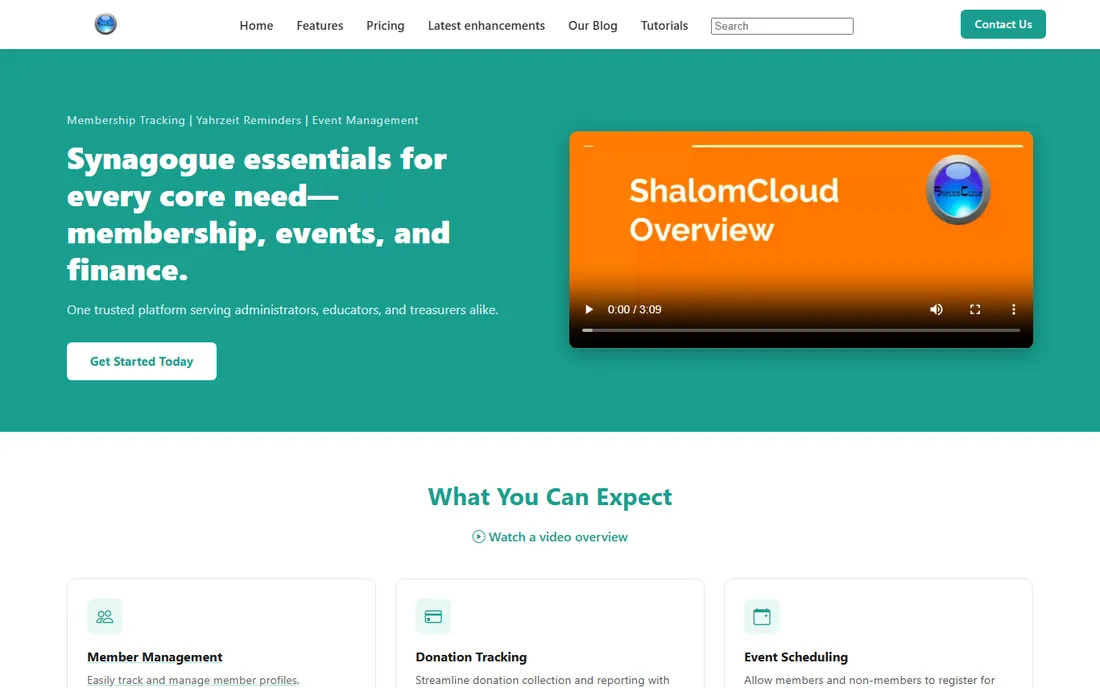
ShalomCloud is priced for the congregations the big platforms overlook. Small plans start at $36 per month for up to 125 member families, medium at $54 for up to 250, and large at $72 above that, with a two-month free trial and no credit card required. For a small shul, that is a fraction of ShulCloud's entry price, and the core needs are covered: membership tracking, yahrzeit reminders, events, finances, and a member portal.
The compromise is depth. You will not find the school modules, advanced fundraising, or extensive customization of the bigger systems. Support tiers also affect price, with premium support roughly doubling each plan. But for a small congregation that needs dues billing and member records without enterprise overhead, ShalomCloud is the value pick.
What we like- Genuinely affordable with published pricing
- Two-month free trial
- Human support emphasized
Watch out for- Simpler feature set than the leaders
- Priced by family count, so growth raises cost
Starting priceSee website
Free planNo
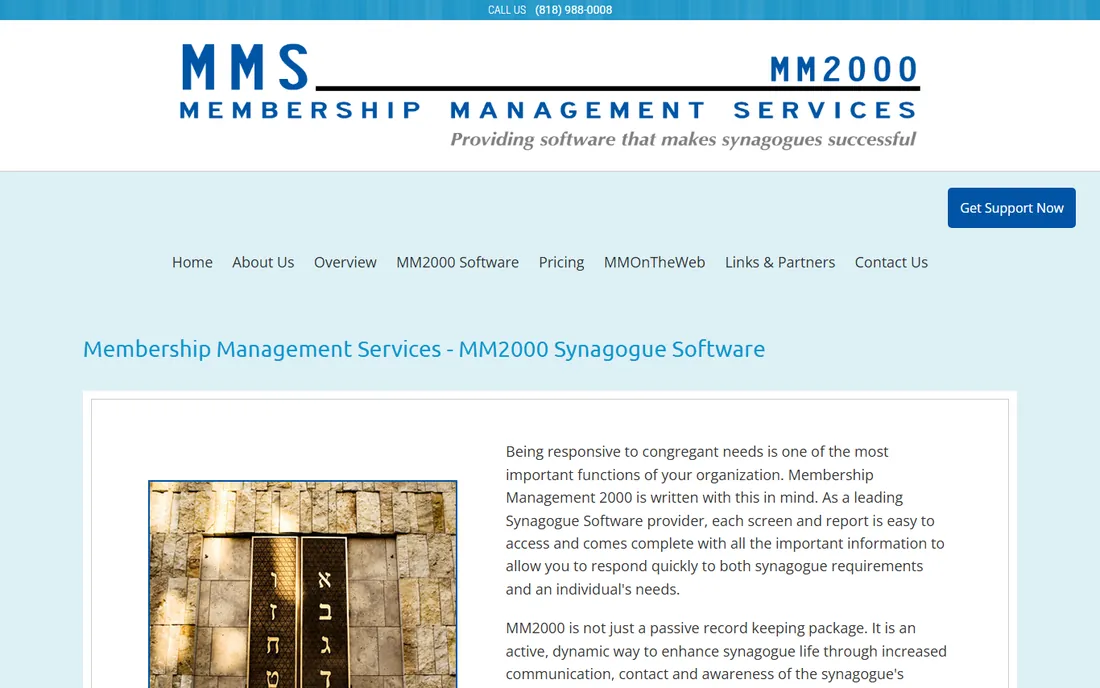
Membership Management 2000, MM2000, is the classic on-premise synagogue system: installed software with detailed modules for membership, contributions, and communications, plus MMOnTheWeb for online access. Synagogues that have used it for years value its reporting depth and the control of keeping data in-house.
The honest reality is that on-premise membership software is a shrinking island. You manage the server, the backups, and the upgrades, and remote access is a workaround rather than a design principle. MM2000 still serves its installed base well, and for an office with no appetite for cloud migration it remains functional. New buyers should compare total cost, including IT time, against cloud alternatives before committing.
What we like- Purpose-built membership management with deep reporting
- Companion web module
- Long track record
Watch out for- On-premise model with local infrastructure needs
- Dated technology base
Starting priceSee website
Free planNo
Congregation Connect is the only synagogue platform built on Salesforce, and that defines everything about it. Large congregations get enterprise-grade customization, workflow automation, volunteer tracking, marketing automation, and reporting that smaller platforms cannot touch. If your synagogue operates at a scale where off-the-shelf tools feel constraining, this is the answer.
Everything about it says enterprise: implementation is a project, pricing is quote-based, and the vendor positions it for 750-plus households. A 200-family shul would drown in it. For the big congregations, though, the Salesforce foundation means integrations, permissions, and analytics that grow with complexity instead of fighting it.
What we like- Built on Salesforce with deep customization
- 360-degree member view
- Automation and advanced reporting
Watch out for- Enterprise complexity and cost
- Overkill below 750 households
Starting priceSee website
Free planNo
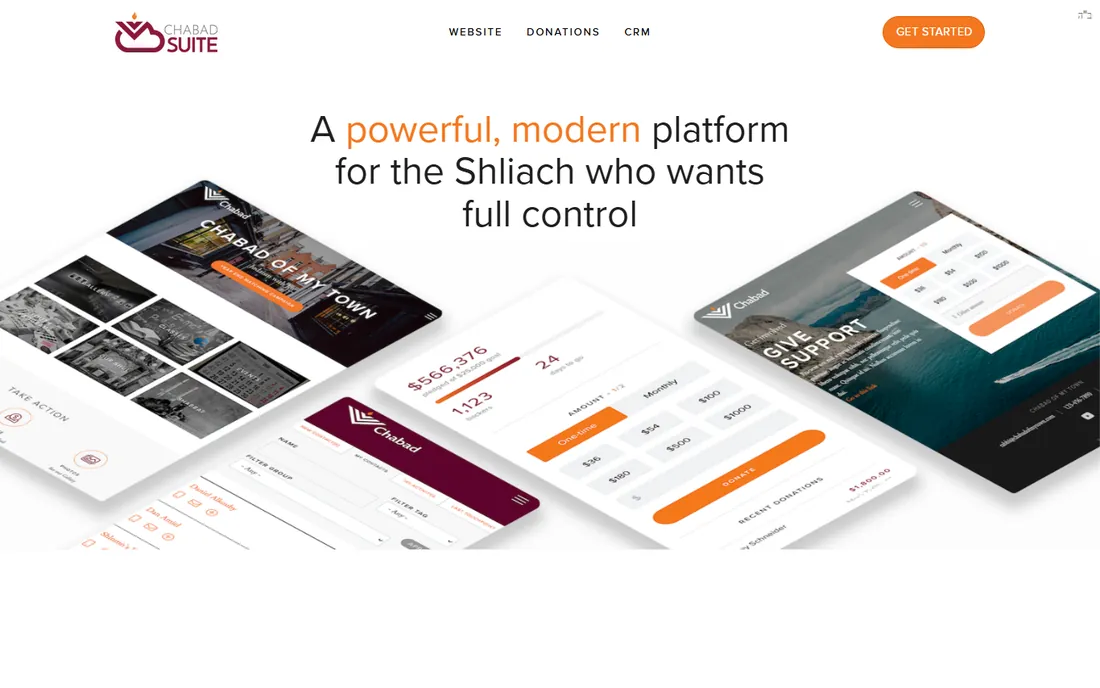
Chabad Suite is the specialist: a platform built for Chabad organizations rather than adapted for them. It combines a mobile-responsive website builder, CRM with member search and filtering, one-time and recurring donations, event management, and automated birthday and yahrzeit emails. The workflows reflect how Chabad centers actually operate, which generic synagogue software sometimes misses.
The niche focus is both the strength and the limit. A Chabad house will find it fits like a glove; a Conservative synagogue will find it irrelevant. Pricing is not published on the homepage, so expect a sales conversation. If you run a Chabad organization, this belongs on your shortlist alongside the general platforms.
What we like- Built specifically for Chabad workflows
- Website, CRM, and donations in one
- Automated lifecycle emails
Watch out for- Niche focus limits appeal outside Chabad
- Smaller vendor with less public documentation
How we chose
We researched this category the way a synagogue administrator would: reading vendor sites and pricing pages, checking public reviews and community discussions, and comparing feature lists against the actual jobs synagogue offices do, dues billing, High Holiday seating, yahrzeit tracking, school management, and member communications. We favored products with verifiable current websites and real synagogue-specific functionality over generic nonprofit tools. No vendor paid for placement, and we did not claim hands-on testing.
What synagogue software has to get right
Generic membership tools fail synagogues on the specifics. Here is what to verify before you commit.
Dues billing and financials
Dues structures are genuinely complicated: family units, individual members, tiered categories, adjustments, and arrears. Your system must handle recurring billing, online payments, statements, and tax letters without spreadsheet sidecars. Ask how it handles your specific dues model, not dues in general.
The Jewish calendar
High Holidays, yahrzeits, and lifecycle events run on the Hebrew calendar. Confirm the platform calculates yahrzeit dates, displays zmanim, and handles holiday scheduling natively. This is the single clearest line between synagogue software and generic nonprofit CRMs.
High Holiday operations
Seat assignments, ticket sales, and guest management spike once a year and stress every weakness in the system. Ask how the platform handles assigned seating and whether it has survived a real High Holiday season at your size. References from similar congregations matter more here than anywhere.
The member portal
Members should pay bills, update their information, register for events, and see their yahrzeit records without calling the office. A weak portal means the office does the work the software was supposed to eliminate. Test the portal as a member would, on a phone.
Switching systems without losing your office staff
Migration is where synagogue software projects succeed or fail, and it is mostly about people, not data. Office staff who have run the old system for a decade need training, patience, and a reason to believe the new one helps them.
Start with data cleanup before you migrate, not during. Decide what historical data actually moves: full financial history, or balances plus a few years of transactions. Most vendors offer migration services from common predecessors, ShulCloud lists Rakefet, Chaverware, MM2000, and QuickBooks, and TempleTools imports from ShulCloud and Chaverware via CSV.
Run the old and new systems in parallel for one billing cycle if you can. Time the cutover away from the High Holidays and membership renewal season. And budget for training as a line item, not an afterthought: the best software fails when the staff using it never got proper onboarding.
Frequently asked questions
Cloud or desktop: which is better for a synagogue?
Cloud platforms win for most synagogues today: no server to maintain, access from anywhere, automatic updates, and built-in member portals. Desktop systems like Chaverware and MM2000 still work and keep data in-house, but they need local IT attention and make remote work harder. Unless you have a specific reason to stay on-premise, choose cloud.
How much does synagogue management software cost?
It ranges widely. ShalomCloud starts at $36 per month for small congregations, ShulCloud's published plans run $161.99 to $464.99 per month, and enterprise options like Congregation Connect are quote-based. Expect a one-time conversion or migration fee on top, commonly a few hundred dollars.
Who owns our data if we switch vendors later?
Ask before you sign. Reputable vendors export your membership and financial data in standard formats like CSV. Confirm export capabilities, any fees, and how long you retain access after cancellation. Data portability is a standard question; a vendor that hesitates is telling you something.
How long does implementation take?
Cloud platforms typically go live in weeks: data import, configuration, staff training, and a soft launch. Complex migrations with decades of history or enterprise implementations like Congregation Connect take months. Avoid cutting over right before the High Holidays.
Do we still need QuickBooks?
It depends on the platform tier. Systems with full financials, like ShulCloud Premium and above, handle dues, donations, and statements internally, and some synagogues drop separate accounting software. Others keep QuickBooks for general ledger work and integrate. Ask each vendor exactly where their financials stop.
Sources we checked (8)
- https://www.shulcloud.com/
- https://www.chaverware.com/
- https://templetools.com/
- https://shalomcloud.com/
- https://mm2000.net/
- https://congregationconnect.com/
- https://chabadsuite.com/
- https://shulware.com/blog/synagogue-management-software
Is your product missing or out of date?
We review this list regularly. Vendors can request a listing, send updated pricing or ask about featured placement.

Shihab Mia · Founder, Rankite
Shihab has spent more than a decade helping SaaS and e-commerce brands grow through search. He writes Rankite's software buying guides from pricing pages, documentation and public user reviews. More about Shihab.