How we make this list: we compare pricing pages, product documentation and public user reviews. Rankite is independent; if a vendor ever pays for a featured spot, that listing is clearly labeled Partner.
Key takeaways
- Carbon accounting specialists (Watershed, Persefoni, Sweep, Normative, Plan A) focus on measuring emissions; ESG platforms (Workiva, Novata, Pulsora, IBM Envizi, Salesforce) focus on managing and reporting data.
- Almost nobody publishes prices: only Salesforce Net Zero Cloud lists pricing (from $48,000/org/year). Everything else is quote-based.
- Free trials are effectively nonexistent in this category; expect demo-led sales and proofs of concept.
- The market is consolidating fast: Normative is merging with Greenly, Plan A was acquired by Diginex, and Emitwise was absorbed by Green Project Technologies.
Quick comparison
| Tool | Best for | Starting price | Free plan |
|---|
 Watershed Watershed | Large enterprises running full climate programs | See website | No |
 Persefoni Persefoni | Audit-grade carbon data with financial rigor | See website | No |
 Salesforce Net Zero Cloud Salesforce Net Zero Cloud | Salesforce customers unifying ESG data | From $48,000/org/year (Starter, billed annually) | Free trial |
 Sweep Sweep | Collaborative carbon management across value chains | See website | No |
 Normative Normative | Science-backed accounting with advisor support | See website | No |
 IBM Envizi IBM Envizi | Enterprises needing deep ESG data infrastructure | See website | No |
 Plan A Plan A | EU-focused firms prioritizing decarbonization plans | See website | No |
 Pulsora Pulsora | All-in-one ESG and carbon management | See website | No |
 Workiva Workiva | Regulated reporting alongside financial filings | See website | No |
 Novata Novata | Private market investors and portfolio companies | See website | No |
Is your product missing or out of date?
We review this list regularly. Vendors can request a listing, send updated pricing or ask about featured placement.
The best sustainability software
Starting priceSee website
Free planNo
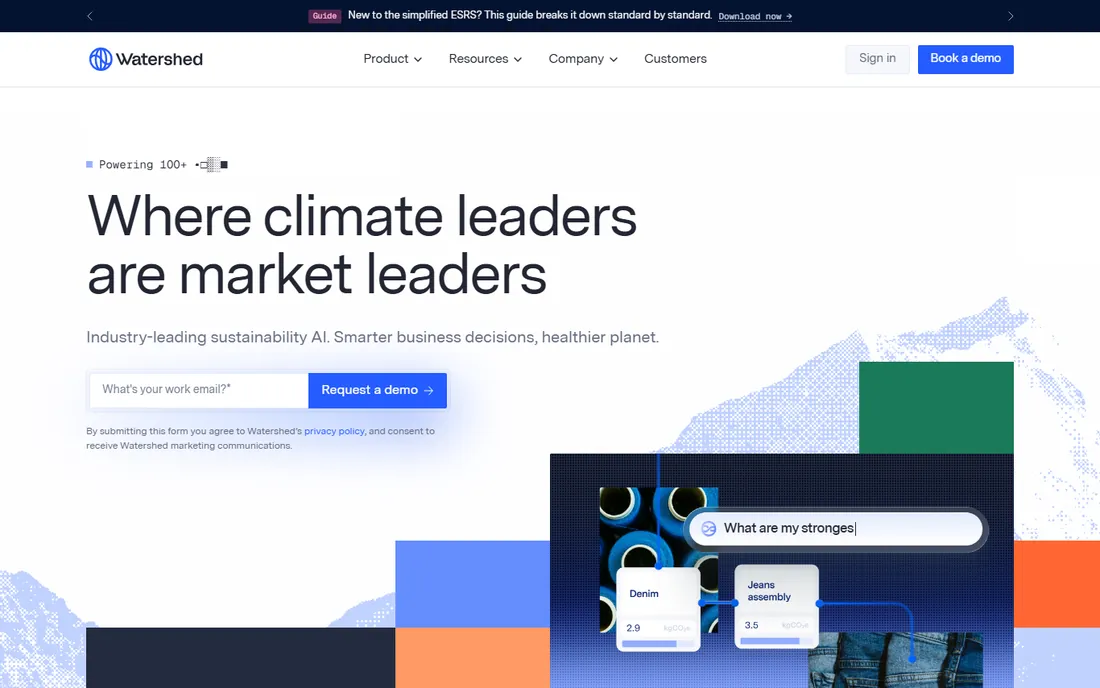
Watershed is the most decorated name in carbon accounting software, named a leader in the 2026 Forrester Wave for Sustainability Management Software and in Verdantix's Green Quadrant. The platform covers the full job: measure emissions across Scope 1, 2, and all 15 Scope 3 categories, draft disclosures with AI assistance, and act on reductions through a marketplace of vetted carbon projects. Recent releases added AI agents that clean data, map emissions factors, and draft reports for frameworks like California's SB 253 and SB 261.
The catch is who it is built for. Watershed targets large enterprises with in-house sustainability teams and mature data infrastructure, and pricing is custom-quoted, with third-party estimates placing typical deals well into five or six figures annually. Smaller companies will find the sales process and the price out of reach. If you are a large company facing mandatory disclosure, though, Watershed is the benchmark.
What we like- Market-leading analyst recognition (Forrester, Verdantix)
- AI agents for data cleaning and report drafting
- Manages over 4 gigatonnes of emissions data
Watch out for- Enterprise pricing with no public figures
- Built for large companies, not small teams
Starting priceSee website
Free planNo
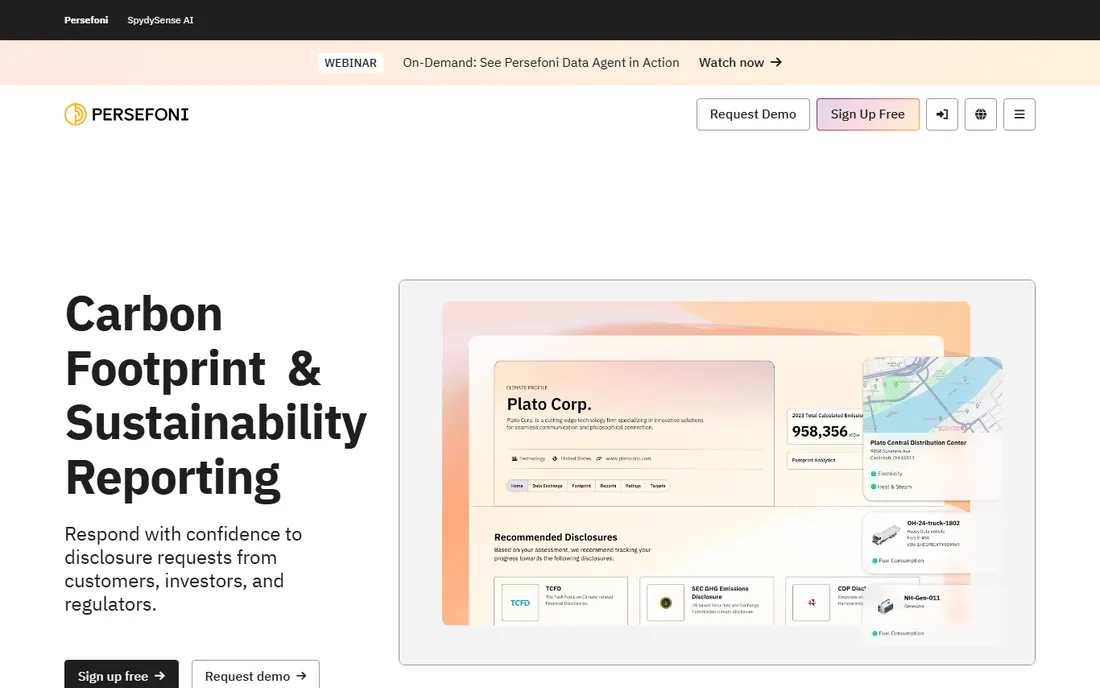
Persefoni calls itself the ERP of carbon, and the positioning is deliberate: every calculation is built to be audit-ready, with the same discipline as financial reporting. The platform handles Scope 1, 2, and 3 footprints, net-zero target setting, reduction modeling, and supplier engagement, plus financed emissions measurement for banks and asset managers under the PCAF standard. Persefoni AI adds anomaly detection on large datasets and natural-language emission factor mapping.
Financial institutions are a particular strength, with portfolio-level emissions analytics that few rivals match. Like Watershed, Persefoni sells quote-based enterprise plans, with reported deals ranging widely by scope. Companies that need their carbon numbers to survive the same assurance process as their financials will appreciate the rigor; companies that just need a first footprint will find it heavy.
What we like- Treats carbon data with financial-accounting rigor
- Strong in financed emissions for investors
- Embedded AI for anomaly detection and factor mapping
Watch out for- Quote-based enterprise pricing
- Complexity exceeds what small companies need
Starting priceFrom $48,000/org/year (Starter, billed annually)
Free planFree trial
Net Zero Cloud is Salesforce's sustainability offering, built on the Salesforce platform to pull environmental, social, and governance data into one place. It automates carbon inventory calculations using preloaded emissions factors from the EPA, IEA, IPCC, and others, manages Scope 3 supplier data, and offers framework-specific report builders for CSRD, SASB, GRI, and CDP. Agentforce, Salesforce's AI layer, drafts disclosure responses and flags missing information.
It is also the only tool on this list with transparent pricing: Starter at $48,000 per organization per year (including 3 CRM licenses), Growth at $210,000. That honesty is welcome, though the entry price confirms this is enterprise software. For companies already running Salesforce, the integration value is real: ESG data sits alongside customer, sales, and service data. Everyone else is buying into an ecosystem they may not want.
What we like- Only vendor here with published pricing
- Native to the Salesforce ecosystem
- Agentforce AI drafts disclosures and finds data gaps
Watch out for- Expensive entry point
- Requires comfort with the Salesforce platform
#4
Sweep
Best for: Collaborative carbon management across value chains
Visit sweep.net
Starting priceSee website
Free planNo
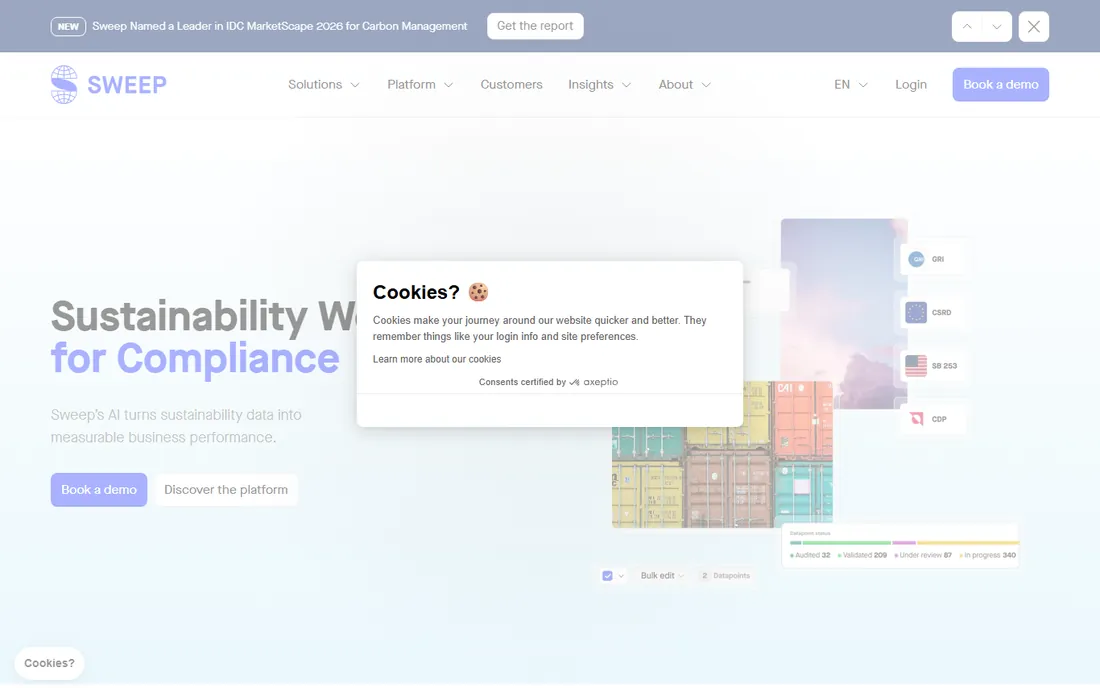
Sweep's founding idea is that carbon data should be collaborative: instead of one team chasing spreadsheets, employees, subsidiaries, and suppliers each contribute their data to a shared platform. The mapping tool visualizes the full emissions tree so companies can see where data is missing and where the hotspots are. The platform covers measurement, target setting, reduction actions, and reporting, with an integrated marketplace for carbon contribution projects.
The AI assistant Sweepy handles practical work like mapping purchase data, answering questionnaires, and drafting disclosures. Sweep is a certified B Corp and a member of the World Bank's Carbon Pricing Leadership Coalition. Pricing is quote-based and there is no free trial. Companies with complex value chains and many contributors get the most from the collaborative model; a single-site business may not need it.
What we like- Network approach lets suppliers and subsidiaries contribute data
- B Corp certified
- AI assistant Sweepy works across mapping, questionnaires, and disclosures
Watch out for- Quote-based pricing
- European roots mean US regulatory content trails slightly
Starting priceSee website
Free planNo
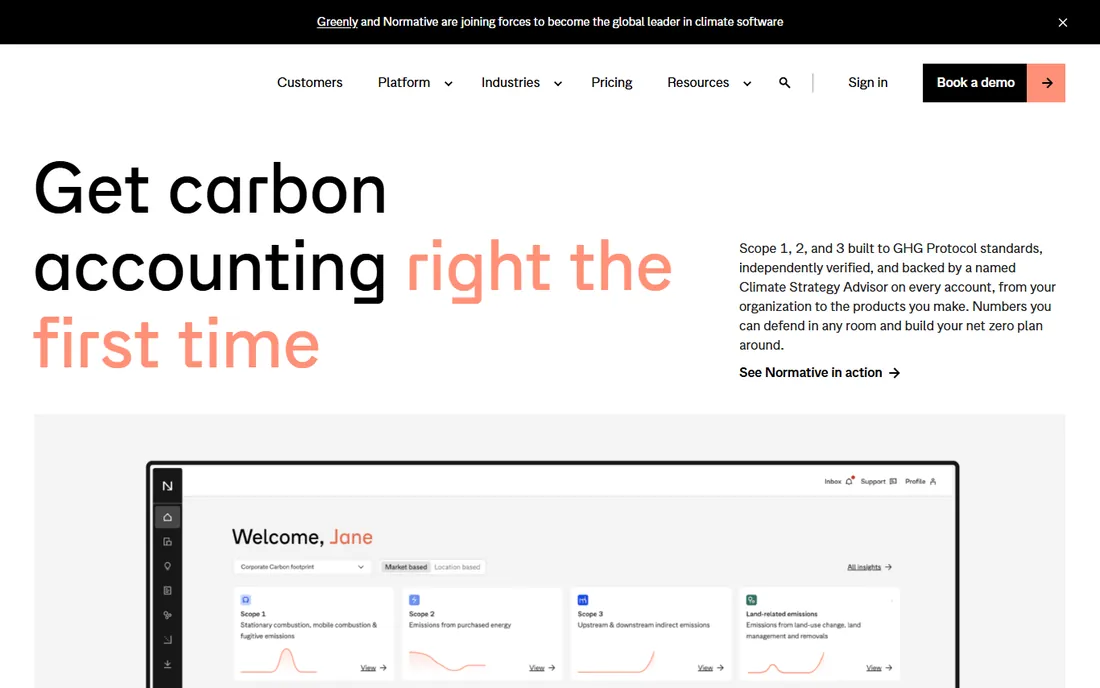
Normative's pitch is getting carbon accounting right the first time. Every calculation follows GHG Protocol standards, is independently verified by TUV SUD, and carries a full audit trail from source data to report. The differentiator is human: every account includes a named, GHG Protocol-certified Climate Strategy Advisor who reviews data, flags anomalies, and stands behind the methodology with auditors. The company claims a 100% success rate across SBTi submissions and audits.
One development to watch: Normative and Greenly are joining forces to build a combined climate software group, merging Normative's scientific rigor with Greenly's product suite and automation. The merger could strengthen the offering, but near-term buyers should ask how the product roadmap and support structure will settle. For companies that want expert guidance bundled with software, the advisor model remains distinctive.
What we like- 349,000+ verified emission factors with TUV SUD-verified methodology
- Named climate advisor on every account
- 100% SBTi submission success rate claimed
Watch out for- Quote-based pricing
- Currently merging with Greenly, so the product roadmap is in flux
#6
IBM Envizi
Best for: Enterprises needing deep ESG data infrastructure
Visit ibm.com
Starting priceSee website
Free planNo
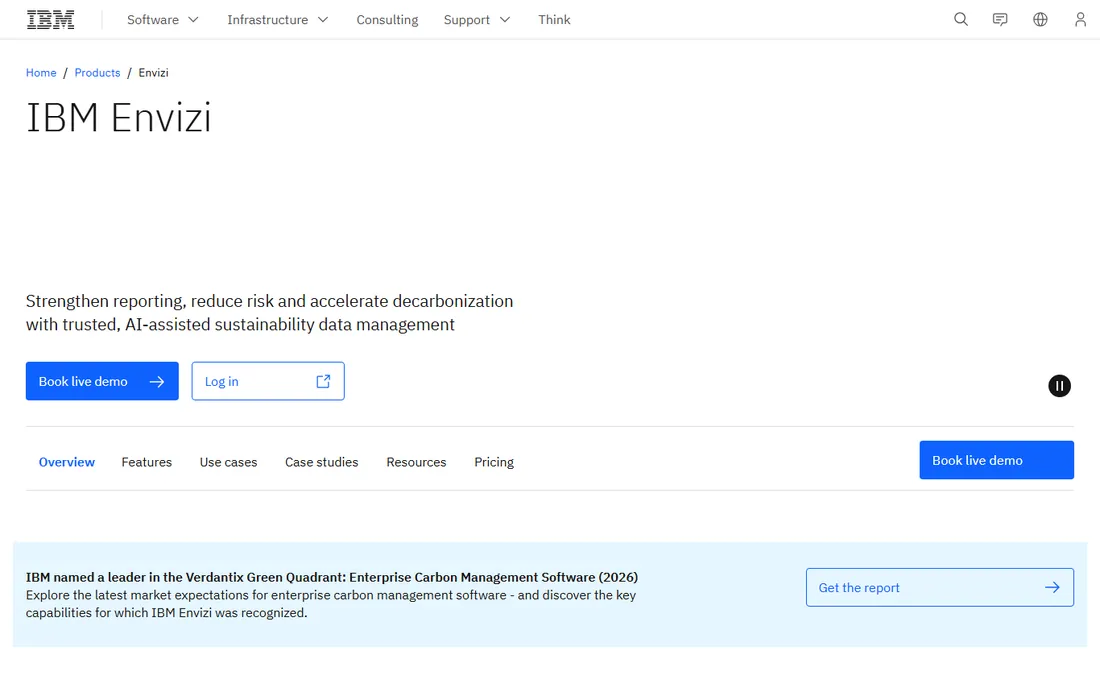
IBM acquired Envizi in 2022 and has expanded it into a full ESG data platform. The suite is modular: emissions management across Scopes 1-3, ESG reporting frameworks, supply chain intelligence, financed emissions, utility bill analytics, and decarbonization planning. Recent additions include an Emissions API that embeds GHG Protocol-aligned calculations into other software and an Excel add-in for teams still calculating in spreadsheets. Automated data ingestion pulls from ERP systems, meters, utilities, and supplier portals.
Pricing is based on the data volume you manage, scoped during the sales process with an indicative pricing calculator. That flexibility suits large, complex organizations but makes budgeting opaque for everyone else. Envizi's strength is infrastructure: if your problem is consolidating sustainability data from hundreds of sources across dozens of entities, few platforms go deeper. If your problem is a first carbon footprint, start simpler.
What we like- 15+ years of ESG data management history
- Modular suite from emissions to supply chain
- New Emissions API and Excel tools embed calculations anywhere
Watch out for- Pricing based on data volume, scoped in sales
- IBM-scale complexity for smaller buyers
#7
Plan A
Best for: EU-focused firms prioritizing decarbonization plans
Visit plana.earth
Starting priceSee website
Free planNo
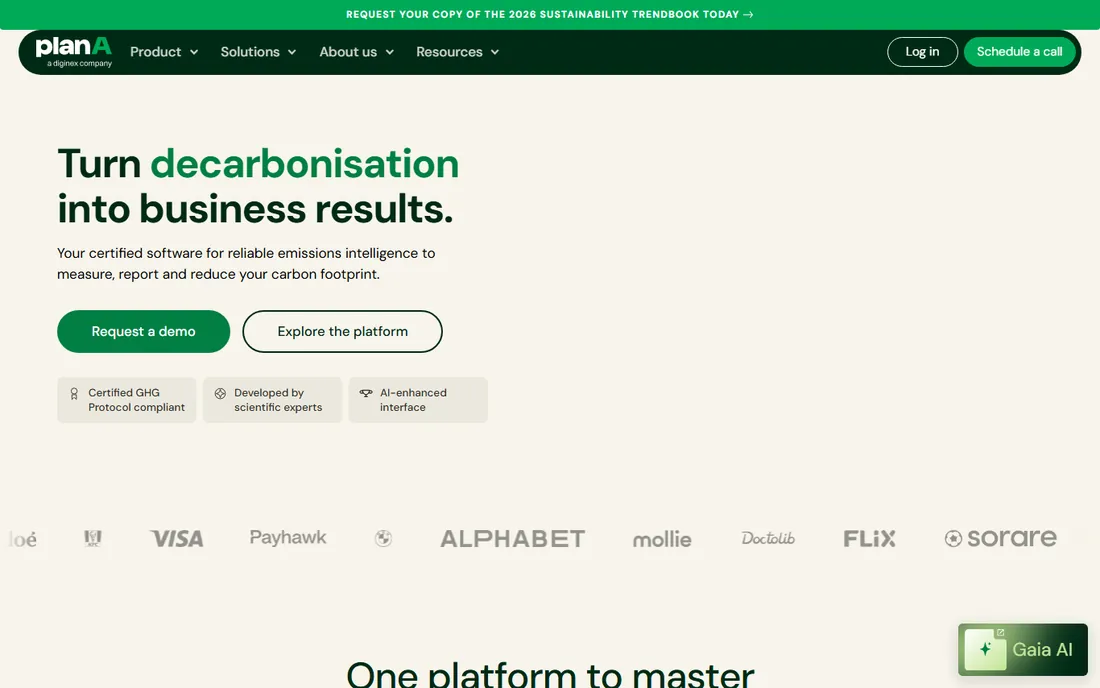
Plan A treats measurement as the input to a reduction plan rather than the end product. The Berlin-based platform automates Scope 1-3 carbon accounting, then helps companies model decarbonization scenarios and compare them on cost and feasibility before committing. The methodology is certified by TUV Rheinland, and a scientific advisory board backs the approach. More than 1,500 businesses use the platform, and it is particularly strong on EU frameworks like CSRD.
Note the ownership change: Diginex closed its acquisition of Plan A in early 2026, aiming to build an integrated ESG and decarbonization platform. The Plan A product continues to operate, but buyers should confirm the roadmap under the new owner. For companies whose real goal is a credible, costed path to net zero rather than just a compliance filing, Plan A's reduction-first orientation stands out.
What we like- Certified GHG Protocol methodology with scientific advisory board
- Strong on reduction scenario modeling
- Serves 1,500+ businesses
Watch out for- Quote-based pricing
- Acquired by Diginex in 2026, so ownership has changed
Starting priceSee website
Free planNo
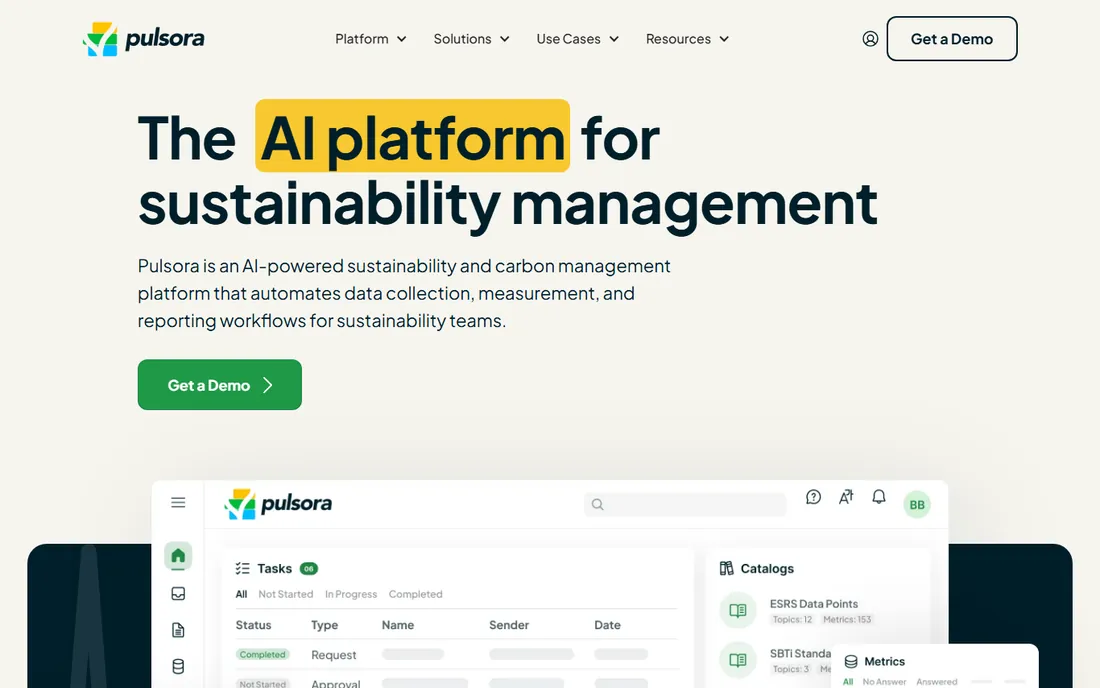
Pulsora aims to be the single platform for enterprise sustainability management: collect ESG data from systems, suppliers, and teams; calculate carbon footprints across Scopes 1-3; prepare audit-ready disclosures; set targets and track progress. It is a public benefit corporation trusted by 500+ companies, with particular strength in complex structures: one customer connects around 25 companies for CSRD and 40 for carbon management. Analyst recognition includes a Leader position in Everest Group's ESG Data Management PEAK Matrix.
The all-in-one positioning is both the appeal and the trade-off. Companies that want one vendor for everything ESG will like the consolidation; companies that need the deepest possible carbon calculation engine may prefer a specialist like Normative or Watershed alongside it. Pricing is quote-based with no trial, standard for the category.
What we like- Genuinely all-in-one: ESG data, carbon, disclosures, targets
- Strong with multi-subsidiary groups and private equity portfolios
- 98% renewal rate claimed
Watch out for- Quote-based pricing
- Breadth means carbon depth trails pure-play accounting tools
#9
Workiva
Best for: Regulated reporting alongside financial filings
Visit workiva.com
Starting priceSee website
Free planNo
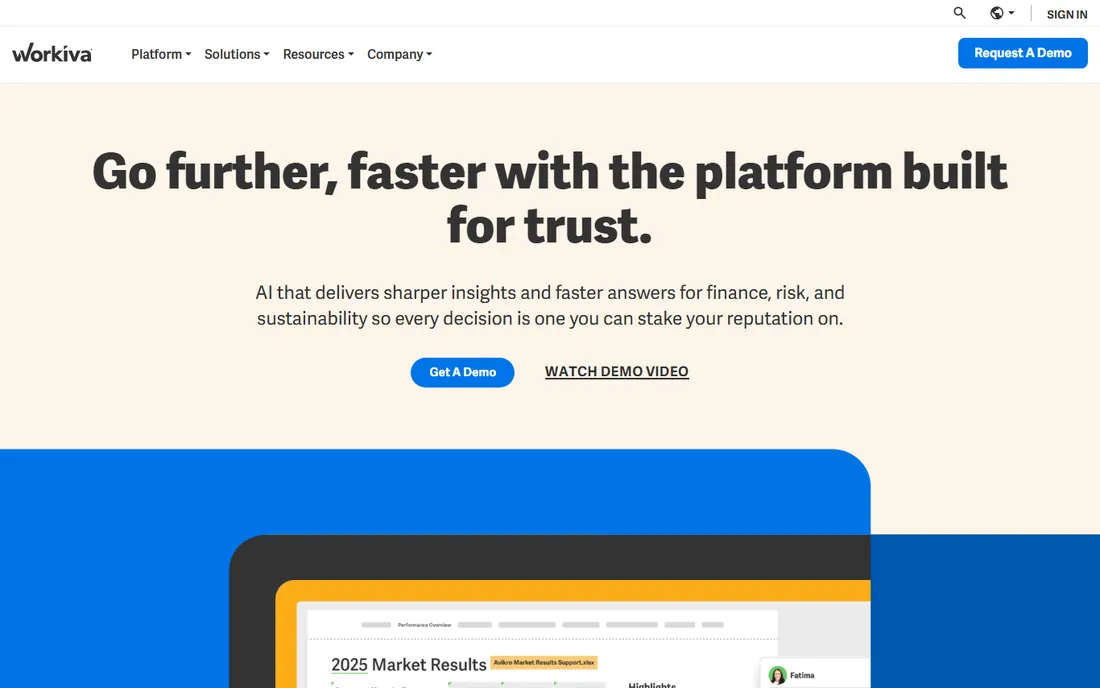
Workiva comes at sustainability from the reporting side. Thousands of companies already use it for SEC filings and financial reporting, and its ESG solution lets sustainability teams work in the same audit-ready environment: connected data, controlled permissions, full version history, and XBRL tagging for machine-readable disclosures. Carbon accounting, double materiality assessment, framework mapping, and data collection automation are built in, and AI agents draft and benchmark disclosures.
The honest framing: Workiva is where you assemble and file the disclosure, not necessarily where you do the deepest emissions math. Many customers pair it with a carbon accounting engine and use Workiva as the system of record for reporting. If your board's nightmare is an ESG restatement, Workiva's controls are the selling point. Pricing is quote-based enterprise.
What we like- ESG reporting in the same controlled environment as financial reporting
- Trusted by 6,700+ companies for filed disclosures
- Strong audit trail and XBRL support
Watch out for- A reporting platform first, not a carbon calculation engine
- Enterprise pricing
#10
Novata
Best for: Private market investors and portfolio companies
Visit novata.com
Starting priceSee website
Free planNo
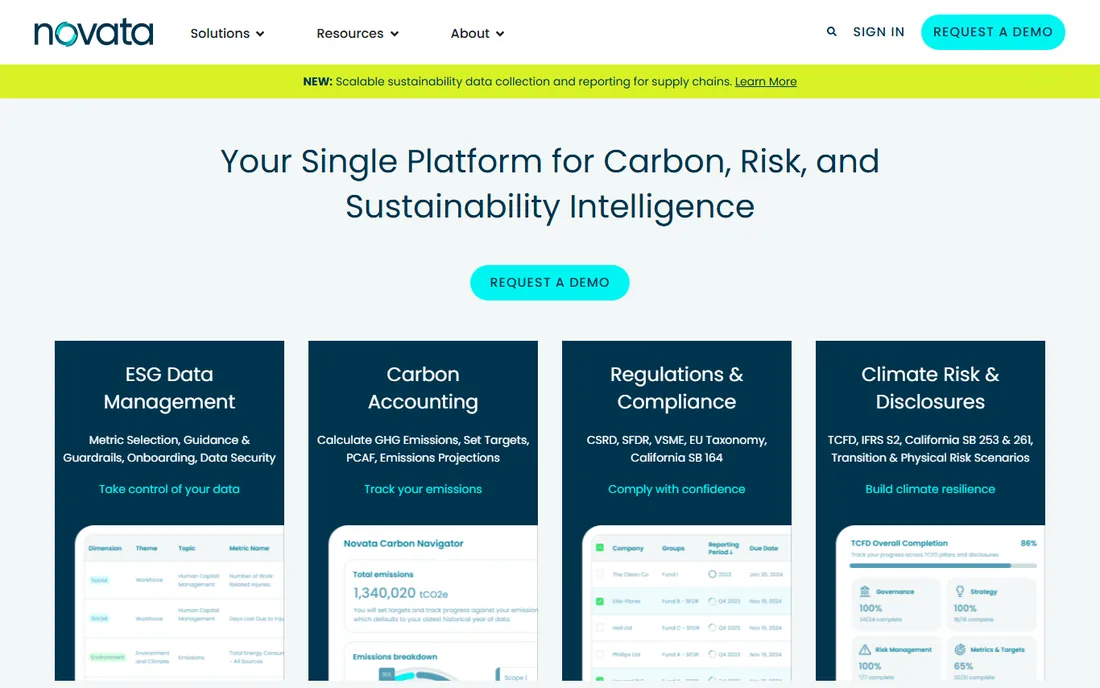
Novata was created by a consortium including the Ford Foundation, S&P Global, Hamilton Lane, and Omidyar Network to solve a specific problem: private equity firms and their portfolio companies drowning in inconsistent ESG data requests. The platform guides users to the metrics that matter, streamlines collection across portfolio companies, and produces LP-ready reporting and benchmarks. It now serves more than 5,000 companies across 20+ countries, with carbon accounting, regulatory support, and an advisory practice alongside the software.
For a PE firm managing ESG across dozens of portfolio companies, Novata's purpose-built workflows beat generic platforms. For an operating company outside private markets, the value proposition is thinner. Pricing is quote-based. If your investors keep sending different ESG questionnaires, Novata is designed to end that chaos.
What we like- Built specifically for private equity and private companies
- Guided metric selection simplifies first-time ESG
- B Corp backed by Ford Foundation, S&P Global, Hamilton Lane
Watch out for- Private-markets focus means less for public-company disclosure
- Quote-based pricing
How to buy sustainability software without overbuying
Name the job first
Are you measuring a carbon footprint, preparing a specific disclosure (CSRD, California SB 253/261, CDP), managing ESG data across entities, or all three? Carbon accounting specialists excel at measurement; reporting platforms excel at disclosure. Buying a reporting platform when you need measurement (or the reverse) is the most common expensive mistake.
Check framework coverage for your jurisdictions
List every framework and regulation you must report under, then verify each one is supported natively, not promised on a roadmap. EU companies need CSRD and ESRS depth; US companies should check California's climate laws and SEC developments; financial firms need PCAF. Vendor marketing lists frameworks loosely, so ask for the actual report builders.
Ask about audit readiness specifically
Request a sample audit trail: source data to calculation to reported figure. Ask which methodologies are independently verified and by whom. Normative uses TUV SUD, Plan A uses TUV Rheinland, and several others cite GHG Protocol alignment. If a vendor cannot show you the trail, your auditor will find that out later.
Budget for data work, not just licenses
The software license is often the smaller cost. Data collection, historical cleanup, methodology decisions, and internal staffing drive the total. Vendors that bundle advisory support (Normative's named advisors, Novata's advisory practice) can reduce the hidden consulting bill. Ask every vendor what the first year really costs including implementation.
How we chose
We compared vendor product pages, documentation, and published pricing, then cross-checked capabilities, analyst recognition, and market position against public review sources including G2, Capterra, Slashdot, and independent 2026 comparisons. We weighed carbon accounting depth, framework coverage, audit readiness, deployment fit for mid-size and large US companies, and pricing transparency. We tracked current M&A activity (Normative-Greenly, Plan A-Diginex, Emitwise-Green Project) to avoid recommending absorbed products. We did not claim hands-on testing of any product; every fact here comes from published vendor materials or public review data.
Why this market keeps consolidating
Sustainability software is consolidating because customers want fewer vendors: one platform for carbon data, ESG reporting, and decarbonization planning beats three contracts. That pressure produced three deals in the past year alone: Normative merging with Greenly, Diginex acquiring Plan A, and Green Project Technologies acquiring Emitwise (which is no longer sold standalone, so we did not list it). For buyers, consolidation cuts integration work but raises lock-in risk. Prefer vendors with open APIs and data export, keep your raw activity data independent of any one platform, and ask direct questions about product roadmaps whenever a vendor has just been acquired.
Frequently asked questions
What is sustainability software?
Sustainability software helps companies measure environmental impact (especially greenhouse gas emissions), manage ESG data, comply with disclosure regulations, and plan reductions. It ranges from carbon accounting engines to full ESG reporting platforms.
What are Scope 1, 2, and 3 emissions?
Scope 1 covers direct emissions from sources you own or control, like company vehicles. Scope 2 covers indirect emissions from purchased electricity, heat, and steam. Scope 3 covers everything else in your value chain, from suppliers to product use. Scope 3 is usually the largest share and the hardest to measure.
How much does sustainability software cost?
Most vendors use quote-based enterprise pricing. Salesforce Net Zero Cloud is the exception, publishing Starter at $48,000 per organization per year. Third-party estimates place typical enterprise carbon accounting deals in the tens to hundreds of thousands annually. Expect implementation and data work on top of the license.
Do I need carbon accounting software or an ESG reporting platform?
If your main job is measuring emissions accurately, start with a carbon accounting specialist (Watershed, Persefoni, Normative, Sweep, Plan A). If your main job is collecting ESG data across entities and filing disclosures, start with a reporting platform (Workiva, Novata, Pulsora, IBM Envizi). Many large companies end up with both.
Can small businesses use sustainability software?
Most tools on this list target mid-size and large companies, and pricing reflects that. Small businesses facing their first disclosure request should look at lighter-weight carbon tools, work with a consultant, or check whether their investors or customers accept simpler formats before buying enterprise software.
Sources we checked (12)
- https://watershed.com/
- https://persefoni.com/
- https://www.salesforce.com/products/net-zero-cloud/overview/
- https://sweep.net/
- https://normative.io/
- https://www.ibm.com/products/envizi
- https://plana.earth/
- https://pulsora.com/
- https://www.workiva.com/
- https://www.novata.com/
- https://kurums.com/carbon-accounting-software/
- https://gaiacompany.io/best-carbon-accounting-software/
Is your product missing or out of date?
We review this list regularly. Vendors can request a listing, send updated pricing or ask about featured placement.

Shihab Mia · Founder, Rankite
Shihab has spent more than a decade helping SaaS and e-commerce brands grow through search. He writes Rankite's software buying guides from pricing pages, documentation and public user reviews. More about Shihab.