How we make this list: we compare pricing pages, product documentation and public user reviews. Ratings come from G2, Capterra or Trustpilot, with the date we checked them.
Key takeaways
- Read this first: staking pays rewards in SOL, and SOL's price can fall far more in a week than a year of staking pays. Never stake money you cannot afford to lose, and treat every APY figure as a variable, not a promise.
- Native staking through a wallet like Phantom is the simplest and lowest risk route: your SOL stays in your wallet, delegated to a validator, with an unstaking wait of roughly two to three days.
- Liquid staking with Jito or Marinade pays similar rewards and gives you a tradable token, jitoSOL or mSOL, in exchange for smart contract risk and a small chance the token trades below its stake value.
- Exchange staking on Coinbase or Kraken is the easiest of all and the most custodial: the exchange holds your keys, takes a larger cut, and its terms govern your exit.
- Nothing in this guide is financial advice. It explains how the platforms differ so you can make, and own, your own decision.
Quick comparison
| Tool | Best for | Starting price | Free plan |
|---|
 Jito | Liquid staking with MEV boosted rewards | Free | Yes |
 Marinade | Decentralised liquid and native staking | Free | Yes |
 Phantom | Native staking inside your wallet | Free | Yes |
 BlazeStake | A smaller liquid staking pool | Free | Yes |
 Sanctum | Holding and swapping many liquid staking tokens | Free | Yes |
 Ledger Live | Staking from a hardware wallet | Free | Yes |
 Coinbase | Exchange staking with no wallet to manage | Free | Yes |
 Kraken | Exchange staking with flexible terms | Free | Yes |
Is your product missing or out of date?
We review this list regularly. Vendors can request a listing, send updated pricing or ask about featured placement.
Starting priceFree
Free planYes
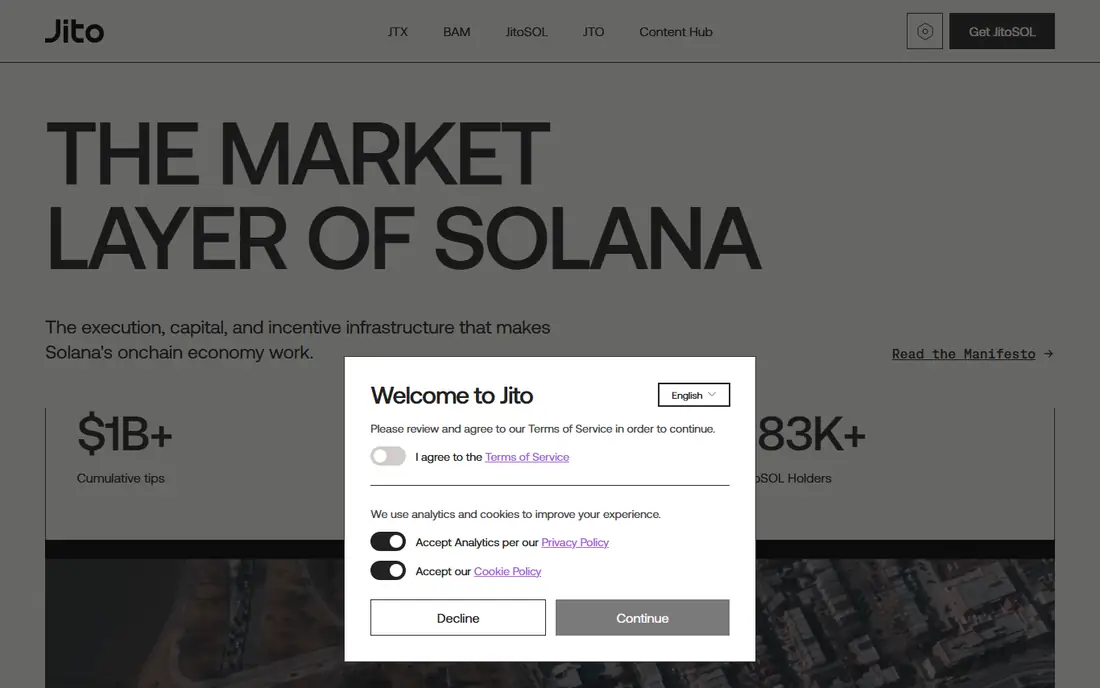
Jito is where most liquid stakers land. You deposit SOL, receive jitoSOL that grows in value against SOL as rewards accrue, and keep full freedom to sell it, lend it, or use it as collateral instead of waiting out an unstaking period. The MEV layer, extra income validators earn from transaction ordering, is its yield edge over plain delegation.
The trade off is complexity of risk. Your return now depends on a smart contract, a validator set, and a market price for jitoSOL that usually tracks its stake value but is not guaranteed to. Jito fits holders who want liquidity and DeFi options and who understand they have swapped a simple delegation for a small stack of additional risks.
What we like- The largest Solana liquid staking token, jitoSOL, usable as collateral across Solana DeFi
- Rewards include MEV income on top of base staking, through validators running the Jito client
- A 4 percent fee on rewards, after validator commissions, per its own FAQ
- No minimum stake and unstaking through the site for a small fee, or instantly by swapping
Watch out for- MEV income varies with market activity, so the reward rate swings more than plain staking
- Smart contract risk sits between you and your SOL
- Stake concentration in the Jito validator set is an ongoing decentralisation debate in the community
Starting priceFree
Free planYes
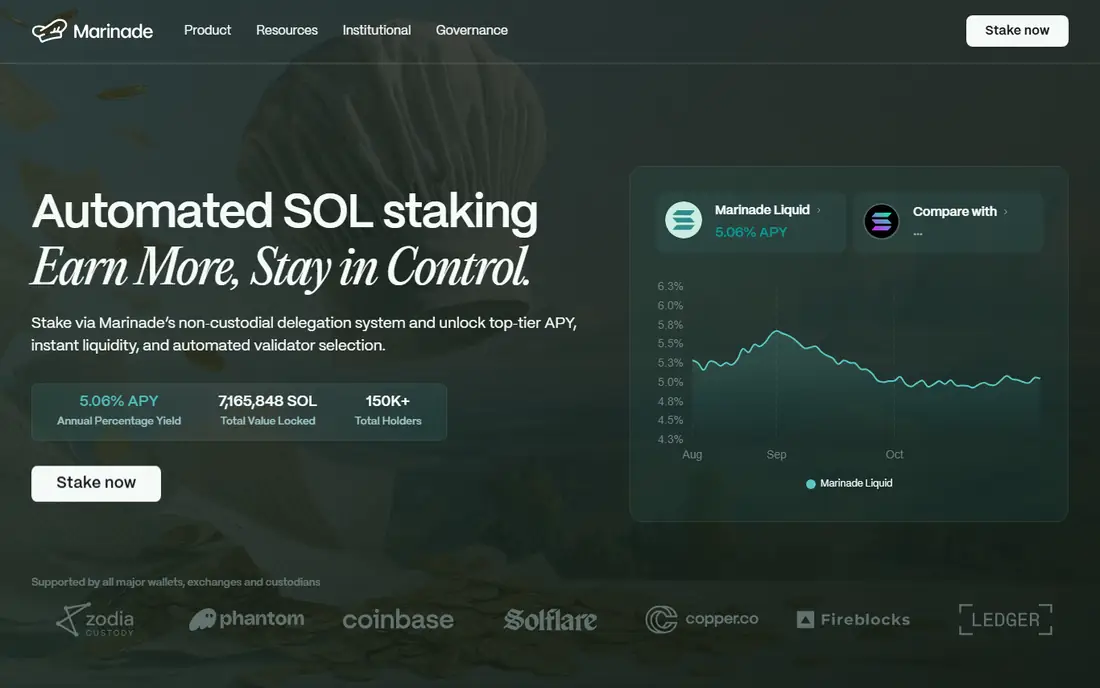
Marinade's argument is network health. Instead of chasing the highest rate, it spreads stake across a wide validator set and rebalances automatically, which supports Solana's decentralisation and smooths out any single validator's bad week. It also respects the cautious staker: its native option delegates directly, with no token in between.
The trade off is a modest yield gap against Jito in most comparisons. Marinade fits long term holders who value decentralisation and a long track record, and who accept a slightly lower expected reward as the price of both.
What we like- The original Solana liquid staking protocol, running since 2021
- Delegates across more than a hundred validators chosen by an algorithm that penalises concentration and downtime
- Offers native staking too, for users who want delegation without holding a liquid token
- MSOL is widely accepted across Solana DeFi
Watch out for- Rewards run slightly below Jito's because there is no MEV layer
- A fee of about 6 percent of rewards
- MSOL carries the same smart contract and market price risks as any liquid staking token
Starting priceFree
Free planYes
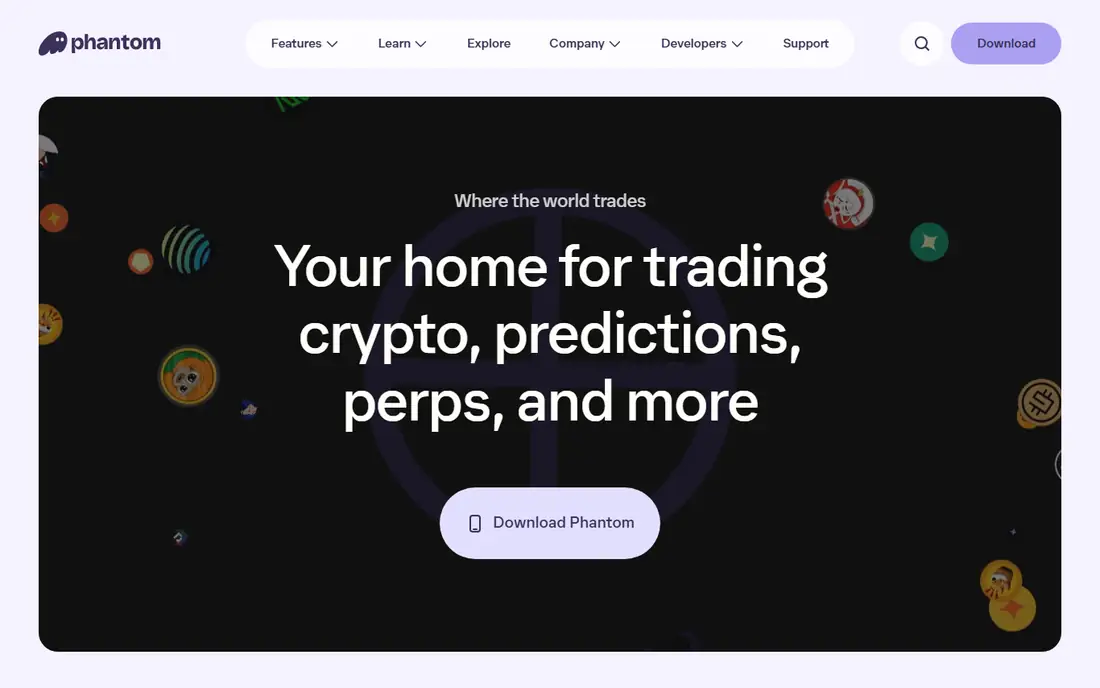
Phantom is the front door to native staking. Delegation through it is the closest thing Solana has to a default: your stake account belongs to your wallet, a validator of your choosing does the work, and rewards land each epoch. There is no extra contract and no token that can trade at a discount.
The trade off is responsibility. Wallet staking means your seed phrase is the vault, and a badly chosen validator, high commission, frequent downtime, quietly taxes your rewards. Phantom fits holders who want the simplest risk profile and will spend ten minutes picking a mid sized validator with a fair commission and a clean uptime record.
What we like- Stake in a few taps inside the wallet most Solana users already have
- Native delegation: your SOL stays in your wallet and no liquid token or protocol sits in between
- You choose the validator, or accept a suggested one
- No platform fee from Phantom itself, the validator's commission is the cost
Watch out for- Choosing a validator well takes homework most users skip
- Unstaking means the standard wait of about two to three days with no rewards during it
- Seed phrase security is entirely on you
Starting priceFree
Free planYes
BlazeStake is the independent option among the pools: same basic idea as Marinade, stake spread by a pool, token back, run by a smaller team with a loyal community. For stakers who deliberately avoid concentrating in the biggest protocols, it offers a real alternative rather than a clone.
The trade off is scale. Smaller pools mean shallower markets for the token and a shorter list of places that accept it as collateral. BlazeStake fits holders who want liquid staking with a decentralisation motive and modest amounts, and who check bSOL's market depth before staking a large sum.
What we like- A liquid staking pool issuing bSOL, spread across many validators
- A long running community protocol in the Solana ecosystem
- BSOL works across a range of Solana DeFi apps
- Simple stake and unstake interface with no minimum
Watch out for- Smaller than Jito and Marinade, so bSOL liquidity is thinner when you want to sell quickly
- The same smart contract and token price risks as any liquid staking pool
- Fewer integrations than the two market leaders
#5
Sanctum
Best for: Holding and swapping many liquid staking tokens
Visit sanctum.so
Starting priceFree
Free planYes
Sanctum is infrastructure for people already in the liquid staking world. If you hold jitoSOL and want mSOL, or want one token that samples the whole LST market, Sanctum is where that happens, and its reserves help keep LST prices near their stake values across the ecosystem.
The trade off is abstraction. Each layer between you and the underlying stake is another contract to trust and another thing to understand before you need to exit quickly. Sanctum fits experienced Solana users managing positions across several liquid staking tokens, not first time stakers.
What we like- A hub for liquid staking tokens: stake, hold, and swap between dozens of LSTs in one place
- Its Infinity pool token, INF, spreads exposure across many LSTs at once
- Useful for moving between staking tokens without unstaking to SOL first
- No subscription or account
Watch out for- An extra layer of contracts on top of the staking protocols themselves
- INF's blended nature makes its exact risk mix harder to read
- Not a staking destination for beginners who have not chosen an approach yet
Starting priceFree
Free planYes
Ledger Live answers the security first staker. Native Solana staking does not require handing keys to anyone, and a hardware wallet keeps the signing key offline while you delegate, which removes the largest single risk in self custody: a compromised computer or phone approving the wrong thing.
The trade off is convenience and the device's price. Every action takes a physical confirmation, which is the point and also the friction. Ledger Live fits holders with meaningful amounts at stake who plan to hold for years and want their keys cold while their SOL works.
What we like- Stake while your keys stay on a hardware device that never exposes them to your computer
- Native delegation to validators, choosable in the app
- The same wallet can hold and stake several other networks
- Rewards and stake accounts are visible alongside the rest of your portfolio
Watch out for- You must buy the hardware wallet itself, the only real entry cost on this list
- The app experience is slower and more deliberate than a phone wallet
- Validator choice still matters and defaults still deserve a look
Starting priceFree
Free planYes
Coinbase staking is the low effort door: buy, tap stake, watch rewards arrive. For small amounts and people who would otherwise never stake at all, the simplicity is the feature, and Coinbase's scale and US regulation are real comforts compared with offshore alternatives.
The trade off is the oldest one in crypto: not your keys, not your coins, plus a bigger cut of the rewards for the convenience. Coinbase fits beginners staking modest amounts inside an account they already trust, who accept custody as the price of simplicity.
What we like- Stake from the same account where many US users buy SOL, with no wallet setup at all
- No minimum worth worrying about and a simple one tap interface
- The exchange handles validators, unstaking queues, and reporting
- Account security tools and a regulated US platform behind it
Watch out for- Custody: the exchange holds your SOL, and its terms, not your keys, govern access
- The exchange takes a substantial commission on rewards, larger than self custody routes
- Exchange staking availability and terms vary by state and country
Starting priceFree
Free planYes
Kraken is the other major exchange route, often preferred by users who value its longevity and its clearer presentation of staking terms. Its flexible products soften the lockup complaint against exchange staking, in exchange for a lower rate, which is at least an honest trade stated up front.
The trade off mirrors Coinbase's: custody and commission for convenience, with the added homework of checking which staking products your country actually gets. Kraken fits exchange loyal users who want staking without self custody and who prefer flexible exits over maximum yield.
What we like- A long running exchange with a strong security reputation offering SOL staking in app
- Flexible staking options with shorter or no bonding on some products, at lower rates
- Clear display of rates and terms before you commit
- Withdrawals and unstaking handled inside the account
Watch out for- Custodial, like every exchange here: your SOL sits on Kraken's balance sheet while staked
- Flexible terms pay less than bonded staking, and all rates are variable
- Availability varies by country, and some regions are excluded
How we chose
We covered the routes a Solana holder actually chooses between in 2026: native wallet staking, the major liquid staking protocols, an LST hub, hardware wallet staking, and the two largest US friendly exchanges. Reward rates and fees come from current comparisons and the protocols' own documentation, and we describe rates as ranges because sources tracked them differently on the same days; when a number moves weekly, printing a single figure would be false precision. We weighted risk disclosure as heavily as yield, since in this category the differences that matter are mostly differences in what can go wrong.
The risks, stated plainly
Price risk dwarfs everything else. SOL has a history of falling 30 percent or more in bad months; a year of staking rewards near 5 to 7 percent gross does not cushion that. Stake only SOL you planned to hold anyway, never SOL bought for the yield alone, and never stake money earmarked for rent, tuition, or an emergency fund.
Lockup risk: native unstaking takes roughly two to three days to complete, during an epoch change, and earns nothing while it waits. In a fast crash your staked SOL cannot be sold until it lands. Liquid staking tokens remove the wait and replace it with market risk: in stressed markets an LST can trade below the value of its underlying stake, and selling then locks in the discount.
Validator and protocol risk: Solana does not slash stake for ordinary validator downtime the way some networks do, but a down or misbehaving validator earns you less, and a high commission quietly does the same. Liquid staking adds smart contract risk: the contracts holding pooled SOL have been audited and run for years, and a bug or exploit remains possible in a way native delegation avoids. Exchange staking adds custody risk: an exchange failure, freeze, or terms change stands between you and your coins.
Tax and record risk: in the US, staking rewards are generally taxed as income when received, and every reward is a small taxable event. Keep records from the start; your future self, or your accountant, will thank you. This guide is education, not financial or tax advice, and nothing here recommends buying SOL.
Frequently asked questions
How much can I earn staking Solana?
Late 2026 sources put gross network rewards around 5 to 7 percent a year, with liquid staking tokens tracking lower after protocol fees and native delegation depending on your validator's commission. Rates are variable and set by the network, not promised by any platform here. And the figure is paid in SOL: if SOL's price falls 20 percent, a 6 percent reward still leaves you well down in dollar terms. That arithmetic is the most important number in this guide.
Is staking Solana safe?
Safe has layers. Native delegation never gives up custody of your SOL and carries no smart contract between you and the network, which makes it the lowest risk way to stake, though the SOL itself can still lose value and your wallet's security is on you. Liquid staking adds contract and token price risk. Exchange staking adds custody risk. None of them makes SOL itself less volatile, and none is insured like a bank deposit.
How long does unstaking take?
Natively, about one epoch, roughly two days, occasionally stretching toward three, during which the SOL earns nothing and cannot be moved. Liquid staking tokens can be sold immediately on an exchange or swapped in DeFi, at the market price at that moment. Exchange unstaking follows each platform's own queue and terms, which flexible products shorten in exchange for lower rewards. Plan as if staked SOL is unavailable for a long weekend at minimum.
Native or liquid staking: which should I choose?
Choose native if you are holding for the long term, want the fewest moving parts, and can accept the unstaking wait; choose a hardware wallet if the amount is large. Choose liquid if you actively use Solana DeFi and want your stake usable as collateral, accepting contract and price risks for the flexibility. Choose an exchange only for small amounts and maximum simplicity. If you cannot explain the difference yet, native in a wallet you control is the reasonable default while you learn.
Do I pay tax on staking rewards?
In the US, yes, generally: rewards are treated as ordinary income at their value when you receive control of them, and selling later can create a capital gain or loss on top. Other countries differ. The amounts per epoch are small and frequent, which makes record keeping the real burden; most platforms and wallets here can export histories, and a crypto tax tool or an accountant is money well spent at any serious scale. This is general information, not tax advice.
Sources we checked (0)
Is your product missing or out of date?
We review this list regularly. Vendors can request a listing, send updated pricing or ask about featured placement.

Shihab Mia · Founder, Rankite
Shihab has 5+ years in B2B and SaaS SEO. He writes Rankite's software buying guides from pricing pages, documentation and public user reviews. More about Shihab.