How we make this list: we compare pricing pages, product documentation and public user reviews. Ratings come from G2, Capterra or Trustpilot, with the date we checked them.
Key takeaways
- This guide reads behavior driven governance as behavior driven development plus governance: shared specifications, traceable tests, and audit-ready results.
- Cucumber is the standard starting point, with Gherkin specifications that business, development, and testing teams can all read.
- Serenity BDD and Gauge suit teams that need living documentation and clear traceability from requirement to test result.
- Governance value comes from traceability: when a regulation or requirement changes, you should find every affected test in minutes.
Quick comparison
| Tool | Best for | Starting price | Free plan |
|---|
 Cucumber | Gherkin specifications for any stack | Free (open source) | Yes |
 SpecFlow | BDD for .NET teams | Free (open source) | Yes |
 Behave | BDD for Python teams | Free (open source) | Yes |
 JBehave | BDD for Java teams | Free (open source) | Yes |
 Serenity BDD | Living documentation and reporting | Free (open source) | Yes |
 Gauge | Lightweight BDD automation | Free (open source) | Yes |
 TestRail | Test governance and traceability | See website | Free trial |
 Xray | BDD traceability inside Jira | See website | Free trial |
Is your product missing or out of date?
We review this list regularly. Vendors can request a listing, send updated pricing or ask about featured placement.
The best software for behavior driven governance
Starting priceFree (open source)
Free planYes
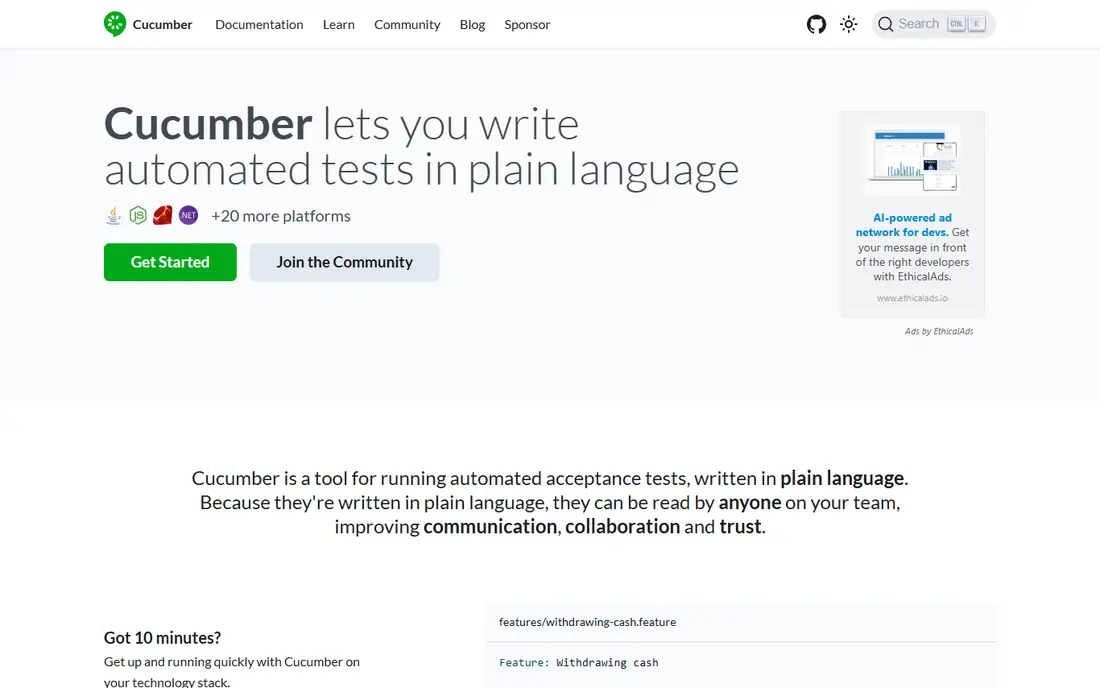
Cucumber is the reference implementation of behavior driven development: specifications written in Gherkin, using Given, When, and Then steps that non-developers can read and challenge. Implementations exist for Java, JavaScript, Ruby, Python, .NET, and more, so most teams can adopt it without changing stacks. That breadth, plus a large community, makes it the default starting point.
The governance risk is spec decay: vague scenarios, duplicated steps, and brittle selectors turn a living specification into a maintenance burden. Teams need step-design rules, shared step libraries, and regular pruning, plus a rule that no scenario merges without a business-readable title and a linked requirement. Cucumber fits any team that wants business-readable specifications with the widest ecosystem behind them.
What we like- Widest language support
- Plain-language Gherkin
- Large community
Watch out for- Needs discipline to avoid brittle specs
- Reporting needs add-ons
Starting priceFree (open source)
Free planYes

SpecFlow brings Cucumber-style BDD to .NET, with Gherkin feature files, step bindings in C#, and Visual Studio integration that .NET teams already know. It plugs into the Microsoft test ecosystem, including MSTest, NUnit, and xUnit, and it supports living documentation through add-ons. For .NET shops, it removes the friction of adopting a Java-centric tool, and its scenario outline support handles data-driven cases cleanly.
The limit is scope: SpecFlow serves .NET only, so polyglot organizations need a second tool elsewhere. Its community is also smaller than Cucumber's. SpecFlow fits .NET teams that want BDD with native tooling and no stack change.
What we like- Native .NET integration
- Visual Studio tooling
- Gherkin support
Watch out for- .NET only
- Smaller community than Cucumber
Starting priceFree (open source)
Free planYes
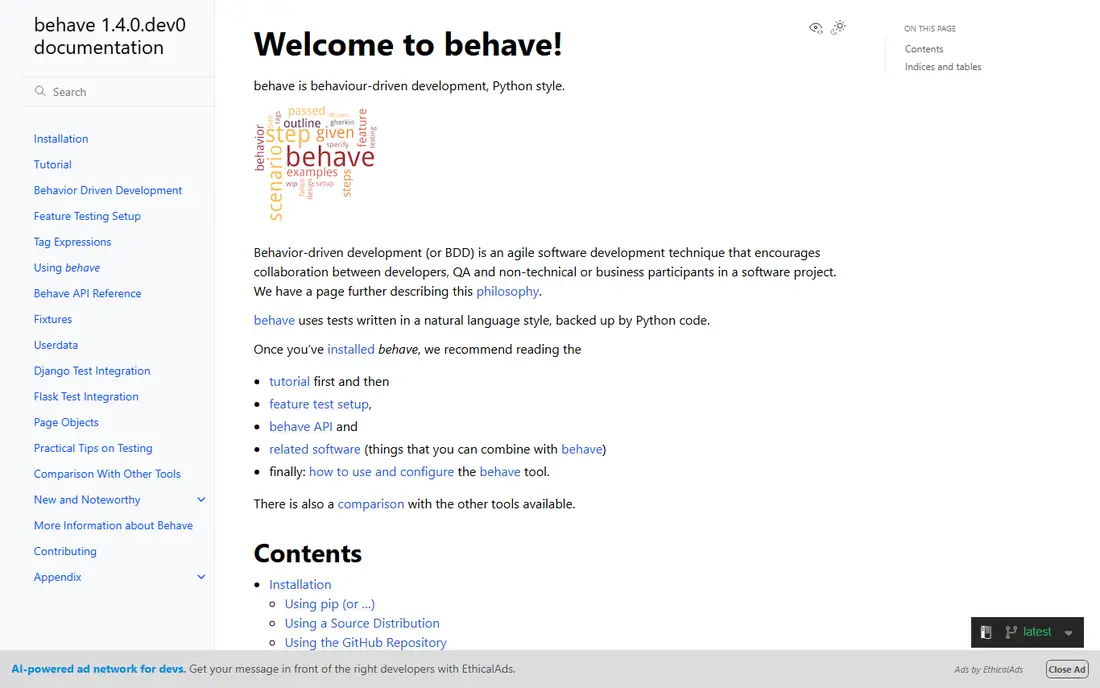
Behave is the Python-native BDD framework, using Gherkin feature files with step definitions in Python. Setup is simple, and it pairs naturally with Python's testing and data tooling, which suits API testing, data pipelines, and web automation with Selenium or Playwright. Teams already writing Python test code adopt it with little learning curve.
The ecosystem is smaller than Cucumber's, and rich reporting needs plugins such as Allure. Behave fits Python teams that want BDD in their own language, especially for API and data-heavy systems where Python already dominates.
What we like- Python-native
- Simple setup
- Good for data and API testing
Watch out for- Smaller ecosystem
- Reporting needs plugins
Starting priceFree (open source)
Free planYes
JBehave is the Java-native BDD framework, using story files rather than Gherkin, with steps written in Java and reports that map stories to results. It integrates with Maven, Jenkins, and the wider Java test ecosystem, and its reporting helps governance-minded teams show which stories passed, failed, or were skipped. Long Java shops value its stability.
Its community is smaller than Cucumber-JVM's, and its story syntax differs from Gherkin, so teams moving between tools face a translation step. JBehave fits Java teams that prefer a Java-first BDD tool with solid reporting over the broader Cucumber ecosystem.
What we like- Java-native
- Story-based specifications
- Good reporting
Watch out for- Smaller community than Cucumber-JVM
- Story syntax differs from Gherkin
Starting priceFree (open source)
Free planYes
Serenity BDD layers reporting and documentation on top of BDD frameworks, producing living documentation that links requirements, features, scenarios, and results in browsable reports. That traceability is the governance payoff: auditors and product owners can see exactly which requirements have passing tests and which do not, without reading code. It works with Cucumber and JBehave, among others.
Setup is heavier than plain Cucumber, and the focus is Java and JavaScript, so other stacks gain less. Serenity also aggregates manual and automated results into the same reports, which matters for teams whose coverage mixes both. Serenity fits teams in regulated or audit-heavy environments where living documentation is a requirement, not a nice extra.
What we like- Excellent living documentation
- Traceability reports
- Works with Cucumber and JBehave
Watch out for- Java and JavaScript focus
- Setup heavier than plain Cucumber
Starting priceFree (open source)
Free planYes
Gauge is a lightweight, open source test automation framework from Thoughtworks, using Markdown specifications that read like plain documents. It supports Java, JavaScript, Python, Ruby, C#, and Go, with parallel execution and plugin-based reporting. Its simplicity appeals to teams that find Cucumber's ecosystem heavier than they need.
The community is smaller, and enterprise governance features such as built-in traceability dashboards are thinner than Serenity's. Gauge also supports parallel execution out of the box, which keeps large suites fast without extra configuration. Gauge fits teams that want readable specifications and fast execution with minimal ceremony, especially in polyglot environments.
What we like- Light and fast
- Markdown specifications
- Multi-language support
Watch out for- Smaller community
- Fewer enterprise governance features
#7TestRail
Best for: Test governance and traceability4.4/5 on
G2 (611 reviews, checked Oct 2026)
Visit testrail.com
Starting priceSee website
Free planFree trial
TestRail is the governance layer in this list rather than a BDD runner: it manages test cases, plans, runs, and results, with traceability linking requirements to tests and defects. Teams pair it with Cucumber, SpecFlow, or Gauge, pushing automated results into TestRail so managers and auditors see coverage in one place. Its reporting suits release decisions and compliance evidence.
It does not execute BDD specifications itself, so it adds a second tool rather than replacing one, and pricing is per user. TestRail also offers defect tracking links and milestone reporting, which help release managers judge readiness across many test runs. TestRail fits teams that need central test governance, audit trails, and release reporting on top of their BDD automation.
What we like- Central test case management
- Traceability to requirements
- Strong reporting
Watch out for- Not a BDD runner itself
- Per-user pricing
- Needs integration for automation
#8Xray
Best for: BDD traceability inside Jira4.2/5 on
G2 (19 reviews, checked Oct 2026)
Visit getxray.app
Starting priceSee website
Free planFree trial
Xray brings test management into Jira, with native support for Cucumber and Gherkin specifications, manual tests, and automated results. Requirements, tests, and defects link inside Jira issues, so traceability lives where product teams already work. Its reports show coverage by requirement, epic, or release, which supports governance reviews without a separate system.
Xray only makes sense for Jira shops, and pricing scales with Jira users, which can surprise large instances. It fits teams standardized on Jira that want BDD traceability and test governance without leaving their project tool.
What we like- Native Jira integration
- Cucumber and Gherkin support
- Traceability reports
Watch out for- Jira-only
- Pricing scales with Jira users
How we chose
We compared pricing pages, product documentation, and public user reviews for behavior driven development and test governance tools that are actively maintained in 2026. We favored tools with readable specifications, traceability from requirement to result, and current releases. We stated our interpretation plainly, since behavior driven governance is not a standard product category, and we left out tools that no longer ship current versions.
Governance means traceability, not paperwork
Behavior driven governance works when a requirement change leads, in minutes, to every affected specification and test. That requires three habits: write specifications in business language, link each scenario to a requirement or regulation, and publish results where non-developers can read them. Tools like Serenity, TestRail, and Xray exist to make that chain visible; without them, BDD specs drift from the requirements they claim to cover.
Write specifications people will actually read
A specification that only developers understand fails the governance test. Use concrete examples with real data, avoid technical jargon in scenario titles, and keep scenarios short: one behavior each, with clear expected outcomes. Review specifications with product and compliance colleagues before automating them, since a misunderstood scenario automated well is still wrong.
Keep specifications under version control
Specifications are code, and they deserve the same treatment: version control, pull request review, and change history. When a requirement changes, the specification change and the test change should land together, with a reviewer who understands the business rule. That discipline turns the specification suite into a reliable record of what the system should do, rather than a folder of documents nobody trusts.
Treat failing scenarios as governance signals
A failing BDD scenario is not just a broken test; it is evidence that behavior drifted from the agreed specification. Triage failures by requirement impact, not by test count, and fix the specification first when behavior intentionally changed. Teams that auto-retry or delete failing scenarios lose the audit trail that makes BDD valuable.
Keep the suite fast enough to run often
A governance suite that runs weekly is a report, not a control. Parallel execution, stable selectors, and test data management keep suites fast enough for every pull request. When the suite slows, prune duplicated scenarios and move slow end-to-end checks behind the faster unit and API layers.
Frequently asked questions
What does behavior driven governance mean?
In this guide, it means using behavior driven development specifications as governance evidence: shared, readable specifications linked to requirements, with test results that prove behavior matches intent. It is an interpretation, since no standard product category carries that exact name.
Is Cucumber enough for governance on its own?
For small teams, often yes, with good spec discipline and basic reporting. Larger or regulated teams usually add Serenity, TestRail, or Xray for traceability reports, requirement links, and audit-ready evidence that plain Cucumber does not produce alone.
Which tool should a .NET team pick?
SpecFlow, for native .NET integration and Visual Studio tooling. Pair it with TestRail or Xray if you need central governance reporting beyond SpecFlow's own outputs.
How do I keep Gherkin specifications from decaying?
Set step-design rules, share step libraries, review specs with non-developers, and prune duplicates regularly. Treat scenario count as a cost: every new scenario adds maintenance, so each one should map to a real requirement.
Can BDD tools prove regulatory compliance?
They can provide strong evidence: specifications mapped to requirements, plus passing results over time. They cannot replace legal review or compliance sign-off, and auditors may still ask for process documents beyond test reports. Keep specification history, review records, and release decisions alongside test evidence, since auditors usually ask how a requirement was approved, not only whether a test passed.
Sources we checked (8)
- https://cucumber.io
- https://specflow.org
- https://behave.readthedocs.io
- https://jbehave.org
- https://serenity-bdd.info
- https://gauge.org
- https://www.testrail.com
- https://www.getxray.app
Is your product missing or out of date?
We review this list regularly. Vendors can request a listing, send updated pricing or ask about featured placement.

Shihab Mia · Founder, Rankite
Shihab has 5+ years in B2B and SaaS SEO. He writes Rankite's software buying guides from pricing pages, documentation and public user reviews. More about Shihab.