How we make this list: we compare pricing pages, product documentation and public user reviews. Ratings come from G2, Capterra or Trustpilot, with the date we checked them.
Key takeaways
- Hourly rates in this list range from $25 to $149, with most US focused firms between $50 and $99 per hour.
- A founder led product team suits a first MVP, while a larger firm suits compliance heavy or enterprise scale work.
- Ask who owns the code, the documentation, and the deployment pipeline from day one, because a handover gap is expensive later.
- Multi tenant design, billing, and onboarding should be in the first scope, not added after launch.
- Fixed price MVP proposals look tidy, but scope changes are common, so check how change requests are priced.
Quick comparison
| Tool | Best for | Starting price | Free plan |
|---|
 DevSquad | Founder led SaaS MVPs with a managed team | $50 per hour | No |
 Vention | Scaling engineering capacity without hiring | $50 per hour | No |
 ScienceSoft | Compliance heavy SaaS in healthcare and finance | $50 per hour | No |
 Simform | Cloud native modernization on Azure | $25 per hour | No |
 Railsware | Funded teams that prioritize engineering quality | $100 per hour | No |
 Upsilon | Startups that need a fast, sprint priced MVP | $25 per hour | No |
 Azumo | AI native SaaS built by a nearshore team | $25 per hour | No |
 Saritasa | SaaS products needing IoT or AR and VR integration | $100 per hour | No |
Is your product missing or out of date?
We review this list regularly. Vendors can request a listing, send updated pricing or ask about featured placement.
The best SaaS development companies
Starting price$50 per hour
Free planNo
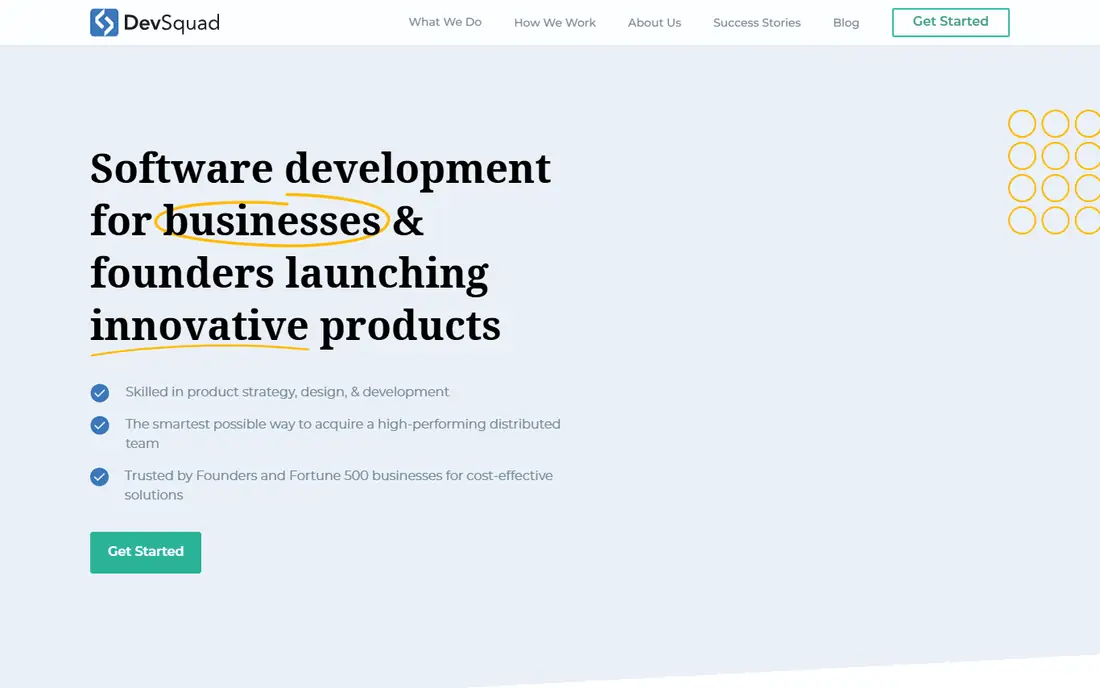
DevSquad works as a managed product team, which means product management, design, and engineering arrive together. For a founder without a technical co founder, that structure removes the hardest hiring problem: finding a product manager who can turn a business idea into a buildable scope. The team runs discovery, designs the MVP, and keeps building after launch, so the product does not stall when the first version ships.
The cost reflects that completeness. At $50 to $99 per hour, a multi month MVP is a serious budget commitment, and founders should compare the total team cost, not a single developer rate. DevSquad suits founders who want one accountable partner and are ready to fund a full team. If you already have product management in house and only need extra engineers, a staff augmentation firm may be cheaper.
What we like- Fully managed product team, not just developers
- Product management included
- US based in Salt Lake City
Watch out for- Hourly band starts at $50, so a long build adds up
- Best suited to founders who want a partner, not a staff extension
Starting price$50 per hour
Free planNo
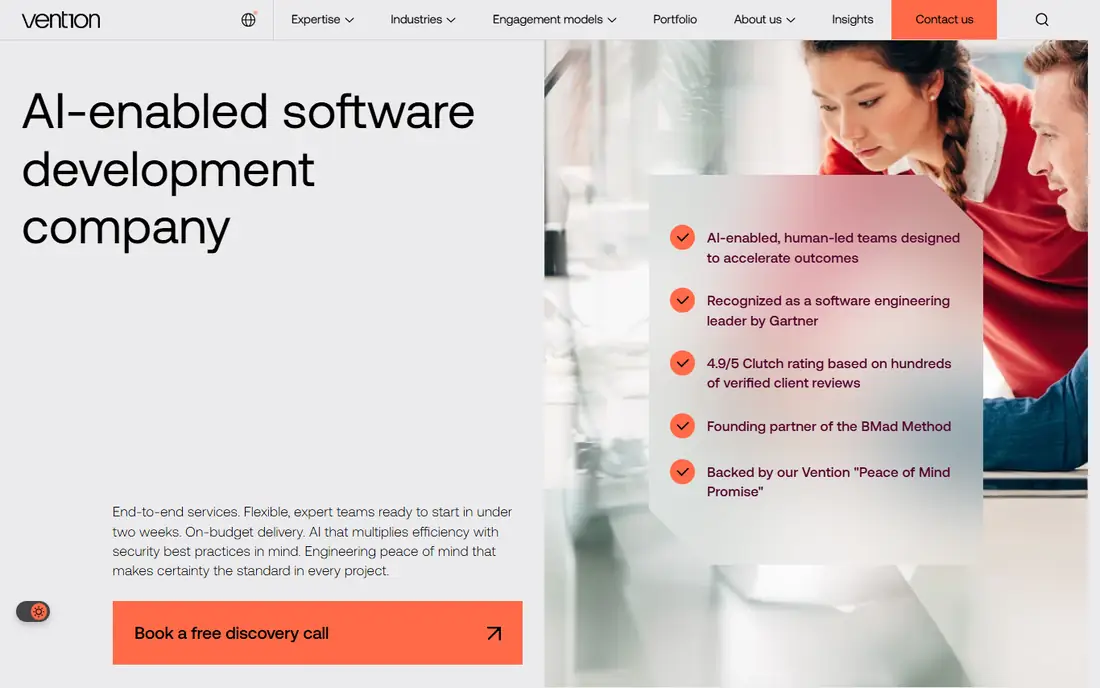
Vention is built for companies that already have a product and need more engineering capacity fast. Rather than hiring one developer at a time, you add a team that can take on a roadmap, a platform migration, or a new module. The New York headquarters and a broad bench make it a natural choice for US companies that need time zone overlap and a partner that can staff multiple roles at once.
Scale is also the drawback. A large partner needs clear product ownership on your side, or the added team can drift from your priorities. Hourly rates in the $50 to $99 band mean a dedicated team is a major line item, so define success measures, sprint cadence, and code review standards before the engagement starts. For a scaling SaaS company with a clear roadmap, Vention is a practical way to grow engineering without a long hiring cycle.
What we like- Large engineering bench in New York
- Can scale teams up or down
- Experience across industries
Watch out for- Less founder led than a boutique studio
- Onboarding a large team takes planning
#3ScienceSoft
Best for: Compliance heavy SaaS in healthcare and finance4.7/5 on
G2 (4 reviews, checked Oct 2026)
Visit scnsoft.com
Starting price$50 per hour
Free planNo
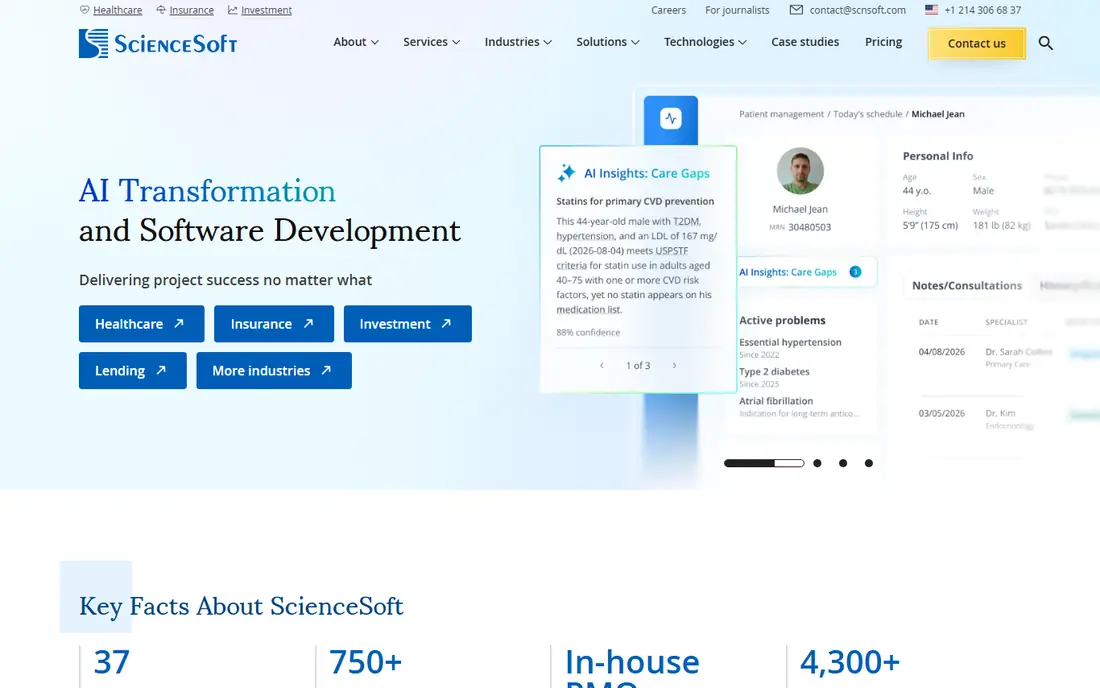
ScienceSoft suits SaaS products where compliance is not an afterthought. Healthcare, finance, and other regulated markets need audit trails, access controls, data residency planning, and documentation that a generalist team may not produce by default. ScienceSoft, headquartered in McKinney, Texas, has worked in those markets for decades, and that experience shows in how it scopes security and testing from the start.
That strength makes it a weaker fit for a founder who wants a quick, cheap MVP. Enterprise process, documentation, and review gates add time, and the team is priced for sustained engagements rather than a two week prototype. If your SaaS product handles health data, payment data, or regulated workflows, ScienceSoft is worth the premium. If you are still validating an idea, a smaller MVP studio will move faster.
What we like- Long history since 1989
- Healthcare and fintech compliance experience
- Large team for enterprise work
Watch out for- Enterprise process can feel slow for a startup MVP
- Rates sit in the mid band, not the budget band
Starting price$25 per hour
Free planNo
Simform is a useful choice when the job is not a greenfield MVP but a product that needs to move to the cloud, scale, or shed technical debt. Its Azure focus suits Microsoft shops, and its $25 to $49 hourly band makes a longer modernization project more affordable than a US only team at twice the rate. The Orlando office gives US clients a domestic contact point while delivery draws on a wider team.
Modernization carries a specific risk: legacy code often hides dependencies that only appear during migration, so a fixed estimate can slip. Ask Simform how it handles discovery, what it does when it finds undocumented integrations, and how it prices that extra work. For a SaaS company replatforming or scaling on Azure, Simform offers a good balance of cost and cloud depth.
What we like- Lower hourly band at $25 to $49
- Azure and cloud native strength
- US office in Orlando
Watch out for- Lower rate still needs scope control
- Modernization projects can uncover legacy complexity
Starting price$100 per hour
Free planNo
Railsware charges more, and it is open about why: senior engineers, product design, and a quality bar aimed at products that must scale cleanly. For a funded team that has validated the market and now needs a product that can handle growth, that quality focus can save money later, because a rewrite costs far more than a higher hourly rate now. The firm has a long record with startups that went on to scale, which is a useful signal when you are choosing a partner for a multi year product.
The price rules out many bootstrapped founders. At $100 to $149 per hour, even a small team becomes a large monthly commitment, and the firm is not built for a quick, cheap prototype. If you have funding, a validated product, and a roadmap that demands clean architecture, Railsware is a strong pick. If you are still testing an idea, start cheaper and upgrade later.
What we like- Strong product engineering reputation
- Design and engineering under one roof
- Experience with funded startups
Watch out for- $100 to $149 hourly band is the highest here
- Minimum engagement suits funded teams, not bootstrapped founders
Starting price$25 per hour
Free planNo
Upsilon focuses on early stage and growth stage startups that need to move fast without losing stability. Its sprint based pricing tells you the cost for each two week block, which removes the uncertainty that makes many founders dread agency billing. The team covers discovery, MVP development, SaaS architecture, and generative AI features, so a founder can add AI assisted workflows without hiring a separate specialist.
Speed has a condition: the founder must be available for feedback, decisions, and user testing, or the sprint pace stalls. Upsilon is also smaller than an enterprise partner, so a very large, multi team program may outgrow it. For a startup that wants a clear sprint price, a modern stack, and a team that treats the MVP as a product rather than a demo, Upsilon is a compelling option.
What we like- Sprint based pricing for cost clarity
- MVP and generative AI integration focus
- $25 to $49 hourly band
Watch out for- Smaller team than enterprise firms
- Rapid MVP pace needs a founder who can give fast feedback
Starting price$25 per hour
Free planNo

Azumo, headquartered in San Francisco, builds AI native SaaS products with nearshore teams working in US time zones. That combination matters for founders who want AI features, such as copilots, document processing, or recommendation logic, without paying a full US rate for every engineer. Time zone overlap keeps standups, reviews, and incident response practical, which is often the weak point of offshore hiring.
AI work also needs more than model access. You need clean data, evaluation criteria, and a plan for what happens when the model gives a wrong answer in production. Ask Azumo how it tests AI features, how it handles data privacy, and how it prices model usage separately from engineering time. For a SaaS product where AI is a core feature, not a marketing line, Azumo is a well matched partner.
What we like- Nearshore delivery in US time zones
- AI native product focus
- $25 to $49 hourly band
Watch out for- Nearshore model still needs clear communication routines
- AI features need data and evaluation planning
#8
Saritasa
Best for: SaaS products needing IoT or AR and VR integration
Visit saritasa.com
Starting price$100 per hour
Free planNo
Saritasa suits SaaS products that touch the physical world. If your product connects to devices, sensors, mobile apps, or AR and VR experiences, a general web team may struggle with hardware constraints, connectivity, and app store processes. Saritasa, based in Newport Beach, California, covers that range, with product design, mobile, and IoT work under one roof, so the SaaS platform and the device layer are designed together.
That specialist depth comes at a premium rate, and a straightforward web only SaaS may not need it. For a plain B2B dashboard, a cheaper generalist will do the same job for less. If your roadmap includes connected devices, AR and VR, or complex mobile work alongside the SaaS backend, Saritasa is the specialist in this list, and its higher rate buys expertise that is hard to hire piecemeal.
What we like- IoT, mobile, and AR and VR experience
- US based in Newport Beach
- Full product team
Watch out for- $100 to $149 hourly band
- Specialist focus means a plain web SaaS may be over served
How we chose
We compared service pages, hourly rate bands published on review platforms such as Clutch, team locations, industry focus, and product stage fit, alongside public case studies and client reviews. We favored firms with a clear SaaS focus, multi tenant and subscription experience, and a published engagement model, and we treated hourly bands as guides, because final proposals depend on team size and scope.
Choosing the right engagement model
Start by naming your stage. A pre revenue founder needs discovery and an MVP, a scaling company needs capacity and platform work, and a regulated company needs compliance and documentation. Those three jobs call for different partners, and a firm that excels at one may be average at another. Write a one page brief with your target user, your pricing model, your must have integrations, and your launch deadline, then ask each firm to respond to that brief, not to a generic pitch.
Next, compare proposals on the same basis. Ask for team roles, seniority mix, weekly hours, sprint length, code ownership, documentation, testing coverage, and what happens at handover. Ask for two references in your industry and stage, and speak to them about communication, missed deadlines, and how change requests were handled. A firm that is vague on any of those points is telling you how the engagement will feel in month three.
Questions to ask before you sign
- Who owns the code, repositories, and infrastructure accounts.
- What is the seniority mix on my team, and who is my day to day contact.
- How are change requests scoped and priced.
- What testing, security review, and documentation are included.
- What happens if I pause or end the engagement.
Frequently asked questions
How much does it cost to build a SaaS MVP?
Cost depends on scope and team, but a small MVP with a managed team commonly runs into tens of thousands of dollars, while a larger, multi feature product can run into six figures. Hourly bands in this list range from $25 to $149, so a four person team for three months can vary widely. Get a scoped proposal with team roles and sprint length before you budget.
Should I choose a fixed price or an hourly engagement?
Fixed price suits a tightly defined MVP with little expected change. Hourly or sprint based pricing suits a product that will evolve with user feedback, which most SaaS products do. Whichever model you choose, agree in writing how scope changes are priced and approved.
Do I need a US based team?
Not always, but time zone overlap, language, and legal familiarity help for product decisions and incident response. Nearshore teams in US time zones, such as Azumo, offer a middle path, while fully offshore teams can work if you have strong product management in house.
Who owns the code when an agency builds my product?
You should own the code, repositories, and documentation, with that ownership stated in the contract from day one. Confirm access to repositories, deployment pipelines, and third party accounts before the first sprint, not at handover.
How long does a SaaS MVP take?
A focused MVP commonly takes 10 to 16 weeks, depending on features, integrations, and design complexity. Discovery, billing, onboarding, and testing often take longer than founders expect, so treat any promise of a full product in a few weeks with caution.
What should be in the first scope?
Include multi tenant architecture, authentication, subscription billing, onboarding, basic analytics, and admin tools, even if the feature list is small. Those foundations are painful to retrofit, and they shape how your product scales and how support handles customer issues.
Sources we checked (10)
- https://devsquad.com
- https://ventionteams.com
- https://www.scnsoft.com
- https://www.simform.com
- https://railsware.com
- https://upsilonit.com
- https://azumo.com
- https://saritasa.com
- https://cieden.com/best-saas-development-companies-usa
- https://www.raftlabs.com/blog/top-saas-development-companies
Is your product missing or out of date?
We review this list regularly. Vendors can request a listing, send updated pricing or ask about featured placement.

Shihab Mia · Founder, Rankite
Shihab has 5+ years in B2B and SaaS SEO. He writes Rankite's software buying guides from pricing pages, documentation and public user reviews. More about Shihab.