How we make this list: we compare pricing pages, product documentation and public user reviews. Ratings come from G2, Capterra or Trustpilot, with the date we checked them.
What is the best rotating proxy service in 2026?
Bright Data is the best rotating proxy service for most enterprise buyers, thanks to the largest residential pool, strict compliance checks and granular geo targeting. Decodo is the best value alternative for small teams, with pay-as-you-go traffic from $4 per GB and a low $11.25 monthly entry plan. IPRoyal suits buyers who want traffic that never expires.
A rotating proxy service sends your traffic through a pool of IP addresses and switches the exit IP on a schedule you control, per request or on a timer. That rotation makes these services useful for web scraping, price monitoring, ad verification and market research at scale, because a single fixed IP would quickly attract rate limits. One provider from older roundups is missing on purpose: NetNut was removed after the FBI seized its domains on 2 July 2026, and Storm Proxies takes its place.
Key takeaways
- Bright Data leads on pool size and compliance, with 400 million plus IPs and a human-reviewed KYC gate.
- Decodo is the cheapest way to start with a major provider, at $11.25 a month for 3 GB or $4 per GB pay as you go.
- IPRoyal is the only provider here whose purchased traffic never expires, which suits sporadic workloads.
- Rayobyte offers the lowest volume rate, falling to $0.70 per GB at 1,000 GB.
- Storm Proxies is the only flat-rate option, with unlimited bandwidth per port.
How we picked
We compared published pricing pages and product documentation, using third-party rate checks dated July to November 2026 where a vendor page hid its entry price. Every website listed here loaded successfully when checked on 14 November 2026. Pool sizes and country counts are vendor claims unless a third-party benchmark is named. We favoured transparent per-GB pricing, published sourcing policies and self-serve sign-up, and weighted entry price above volume discounts because most buyers start small.
Rotating proxy services compared
| Tool | Best for | Starting price | Free plan |
| Bright Data | Enterprise scraping and compliance | $8 per GB pay as you go | Free trial with limited credit |
| Oxylabs | High-volume data pipelines | $30 per month for 5 GB ($6 per GB) | $5 welcome credit for verified companies |
| Decodo | Best value all-rounder | $11.25 per month for 3 GB ($3.75 per GB) | 3-day free trial with 100 MB |
| IPRoyal | Non-expiring traffic and long sessions | $7.35 per GB pay as you go for 1 GB | No free trial |
| SOAX | Geo-tiered pricing and mobile pools | $5 per GB on the Sandbox plan | Paid $1.99 trial for 3 days |
| Rayobyte | Low cost per GB at volume | $3.50 per GB for 1 to 49 GB | Free trial on self-serve products |
| Webshare | Budget buyers and side projects | $3.50 per GB on a 1 GB plan | 10 free datacenter proxies and 1 GB per month |
| Storm Proxies | Flat-rate unlimited bandwidth | $19 per month for one residential port | 24-hour trial |
What is a rotating proxy service and how does rotation work?
A rotating proxy service is a network of proxy servers that assigns a different exit IP address to your requests, either automatically on a timer or with every new request. Rotation matters because repeated requests from one IP are easy to rate limit, while requests spread across thousands of residential IPs look like ordinary visitors. Most providers offer two modes: per-request rotation, which changes the IP with every connection, and sticky sessions, which hold one IP for minutes or hours and suit logins and multi-step forms. Before you buy, check how the provider controls rotation, because some rotate on a fixed timer you cannot change.
Residential, datacenter or mobile: which proxy type should you buy?
Residential proxies suit most scraping and price monitoring, because they route traffic through real home connections and are the hardest to distinguish from ordinary visitors. Datacenter proxies are far cheaper and much faster, but their IP ranges are widely known, so they are blocked more often on defended sites. Mobile proxies route through carrier networks and carry the highest trust, which suits social media and app testing, but they cost the most per GB. Match the proxy type to the difficulty of the target: datacenter for easy targets and internal testing, residential for ecommerce and price monitoring, and mobile only where a target blocks residential traffic.
How much does a rotating proxy service cost per month?
A rotating proxy service costs about $11 to $500 a month for a small to mid-size workload, depending on the provider and your traffic volume. Entry prices run from $11.25 a month at Decodo to $30 a month at Oxylabs, while pay-as-you-go rates run from $3.50 to $8 per GB. The headline rate is rarely the whole story: some providers add VAT at checkout, some charge different rates by country tier, and some show a promotional price that lapses after three months. Bright Data lists $8 per GB pay as you go and shows $4 per GB under a three-month promotion, while SOAX prices residential traffic in three geo tiers, so US traffic costs more.
What does 10 GB of rotating proxy traffic cost in practice?
A 10 GB monthly scraping workload costs $35 at Decodo, $40 at Bright Data on its promotional rate and $55.10 at IPRoyal on pay as you go, using the published rates checked on 14 November 2026. Decodo is cheapest because its 10 GB plan is priced at $3.50 per GB, giving a $35 monthly total before VAT. Bright Data charges $4 per GB while its three-month promotion lasts, which comes to $40 for 10 GB, but the same traffic costs $80 at its $8 list price once the promotion ends. IPRoyal charges $5.51 per GB for a 10 GB pay-as-you-go purchase, or $52.50 on subscription, and that traffic never expires.
How do you check that a rotating proxy service sources its IPs ethically?
Check ethical sourcing by reading the provider's sourcing policy and compliance requirements, not by trusting a marketing claim on the homepage. Reputable providers state that residential IPs come from device owners who opted in, and they publish the details of how consent is obtained. Bright Data and Oxylabs both publish sourcing documentation and require buyers to pass a KYC check, with Bright Data limiting residential access to verified companies. A provider that cannot explain where its IPs come from is a warning sign. Also check whether the provider belongs to an industry body such as the Ethical Web Data Collection Initiative, and whether it restricts the targets you may access.
Quick comparison
| Tool | Best for | Starting price | Free plan |
|---|
 Bright Data | Enterprise scraping and compliance | $8 per GB pay as you go (list price; $4 per GB under a three-month promotion), checked 14 Nov 2026 | Free trial with limited credit |
 Oxylabs | High-volume data pipelines | $30 per month Starter plan for 5 GB ($6 per GB), checked 14 Nov 2026 | $5 welcome credit for verified companies |
 Decodo | Best value all-rounder | $11.25 per month for 3 GB ($3.75 per GB); $4 per GB pay as you go, checked 14 Nov 2026 | 3-day free trial with 100 MB of traffic |
 IPRoyal | Non-expiring traffic and long sessions | $7.35 per GB pay as you go for 1 GB; $7 per GB on subscription, checked 14 Nov 2026 | No free trial |
 SOAX | Geo-tiered pricing and mobile pools | $5 per GB on the Sandbox plan; $200 per month Builder plan at $3 per GB for Tier-1 geos, checked 14 Nov 2026 | Paid $1.99 trial for 3 days with 400 MB |
 Rayobyte | Low cost per GB at volume | $3.50 per GB for Premium Residential at 1 to 49 GB, checked 14 Nov 2026 | Free trial on self-serve products |
 Webshare | Budget buyers and side projects | $3.50 per GB on a 1 GB rotating residential plan (50 percent off the $7 list price), checked 14 Nov 2026 | 10 free datacenter proxies and 1 GB of residential traffic per month |
 Storm Proxies | Flat-rate unlimited bandwidth | $19 per month for one rotating residential port, checked 14 Nov 2026 | 24-hour trial on the smallest package of each proxy type |
Is your product missing or out of date?
We review this list regularly. Vendors can request a listing, send updated pricing or ask about featured placement.
The 8 best rotating proxy services in 2026
#1Bright Data
Best for: Enterprise scraping and compliance4.6/5 on
G2 (272 reviews, checked Oct 2026)
Visit brightdata.com
Starting price$8 per GB pay as you go (list price; $4 per GB under a three-month promotion), checked 14 Nov 2026
Free planFree trial with limited credit
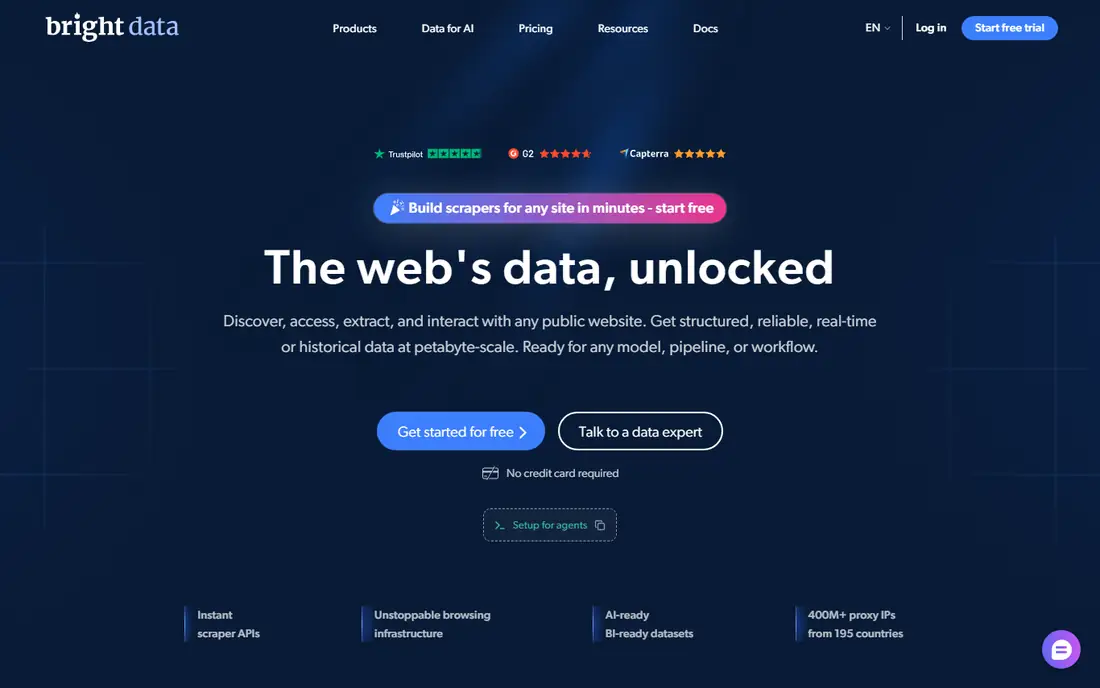
Bright Data is the default enterprise answer for rotating proxies, and its scale is the reason. The residential pool covers more than 400 million IPs across 195 countries, with targeting down to ZIP code and ASN. Compliance is the strongest in this guide: residential access is gated behind human-reviewed KYC and sourcing is documented as opt-in. The Web Unlocker handles JavaScript-heavy targets on a per-request basis.
What we like- Largest pool here at 400 million plus IPs across 195 countries
- Strict KYC and opt-in sourcing
- ZIP code and ASN targeting
Watch out for- The $4 per GB promo lapses after three months, so budget on the $8 list price
- Residential access needs company verification
#2Oxylabs
Best for: High-volume data pipelines4.5/5 on
G2 (420 reviews, checked Oct 2026)
Visit oxylabs.io
Starting price$30 per month Starter plan for 5 GB ($6 per GB), checked 14 Nov 2026
Free plan$5 welcome credit for verified companies
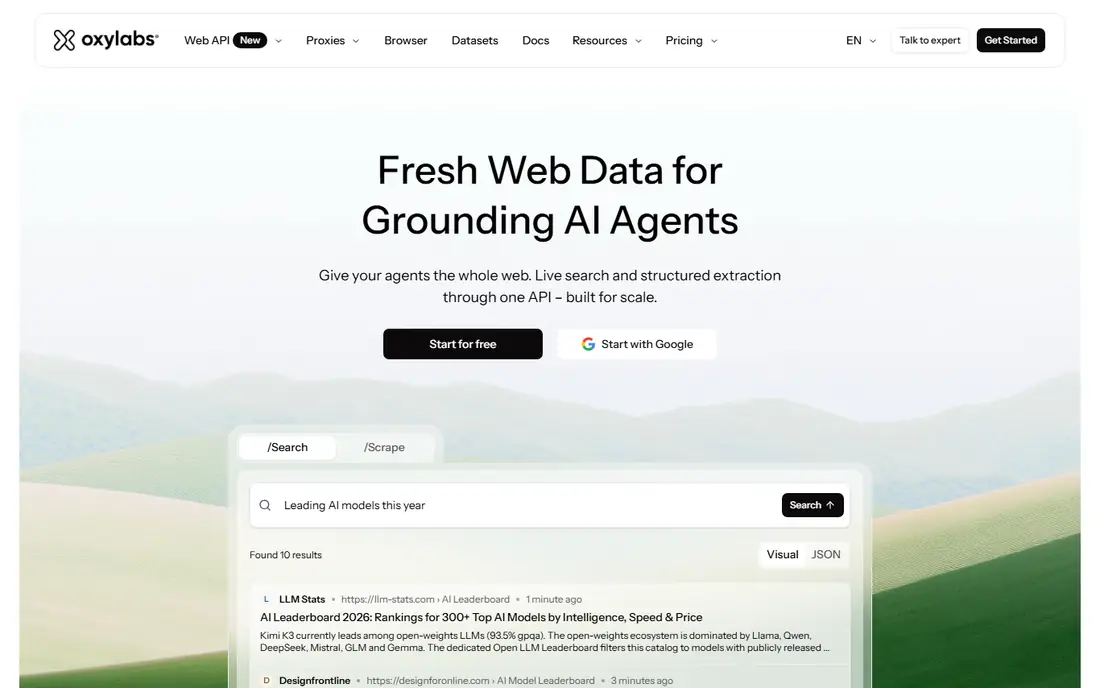
Oxylabs goes head to head with Bright Data on pool size and success rates, and it wins on simplicity for teams that want one bill. A single subscription covers residential, mobile, ISP and datacenter proxies alongside its scraper API and unblocker, which removes the need to manage several vendors. Residential pricing starts at $6 per GB, falls to $4 per GB at 125 GB and reaches $2.50 per GB at 1 TB.
What we like- 177 million plus IPs across 195 countries
- Sticky sessions up to 24 hours
- One subscription covers proxies, scraper API and unblocker
Watch out for- No pay-as-you-go option, so every buyer commits to a monthly plan
- Some third-party pages cite an $8 per GB rate, conflicting with the $6 Starter rate
#3Decodo
Best for: Best value all-rounder4.6/5 on
G2 (763 reviews, checked Oct 2026)
Visit decodo.com
Starting price$11.25 per month for 3 GB ($3.75 per GB); $4 per GB pay as you go, checked 14 Nov 2026
Free plan3-day free trial with 100 MB of traffic
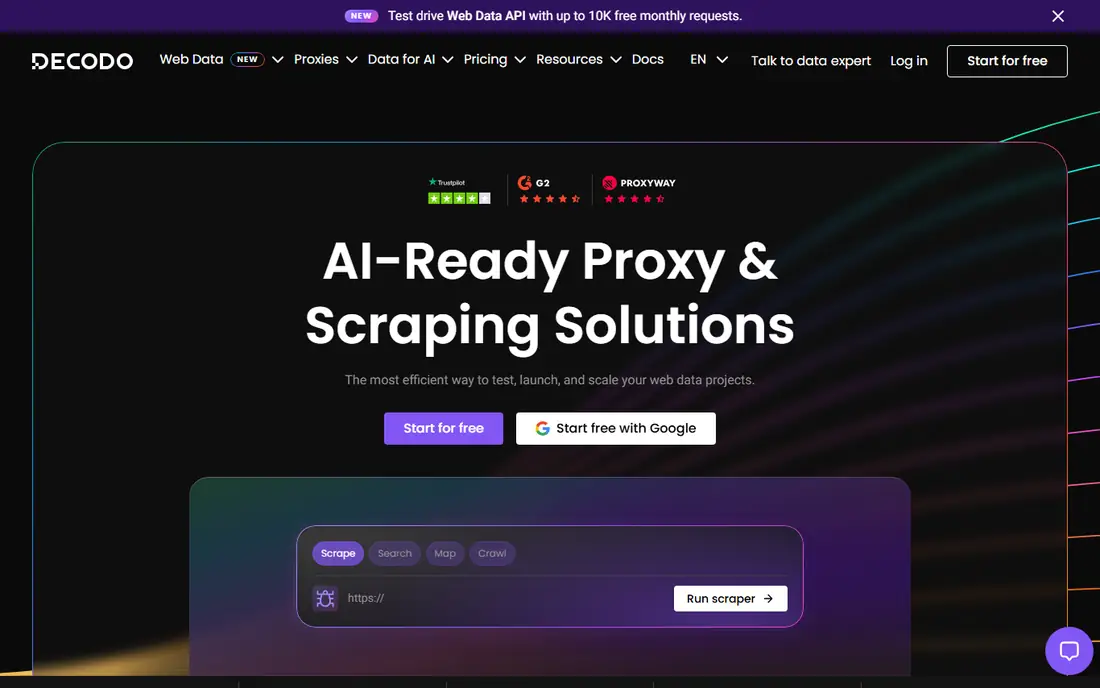
Decodo is the new name for Smartproxy, which rebranded in April 2025, and the rebrand changed nothing underneath. The residential pricing ladder is the clearest in this guide: 3 GB for $11.25 a month, 10 GB for $35, 25 GB for $81.25 and 100 GB for $275, with enterprise plans reaching $2 per GB at 1 TB. The pool of 125 million plus IPs spans 195 countries, and sticky sessions last up to 30 minutes.
What we like- Lowest entry price among the major providers
- Clear pricing ladder from $3.75 to $2 per GB
- 125 million plus IPs
Watch out for- Taking the free trial cancels the 14-day money-back guarantee
- Subscription traffic normally expires at renewal
#4IPRoyal
Best for: Non-expiring traffic and long sessions4.7/5 on
G2 (1,071 reviews, checked Oct 2026)
Visit iproyal.com
Starting price$7.35 per GB pay as you go for 1 GB; $7 per GB on subscription, checked 14 Nov 2026
Free planNo free trial
IPRoyal is the budget provider that does not feel like one, and its non-expiring traffic is the feature that defines it. Pay as you go starts at $7.35 per GB for 1 GB and falls to $5.51 per GB at 10 GB, while subscriptions run about 5 percent cheaper at every tier. The pool covers 64 million plus residential IPs across 195 countries, with HTTP, HTTPS and SOCKS5 support. Note that the $1.75 per GB rate in some roundups belongs to custom plans from 10 TB.
What we like- Purchased traffic never expires
- Sticky sessions last up to 24 hours
- 64 million plus residential IPs
Watch out for- The $1.75 per GB rate in some roundups applies only to custom plans from 10 TB
- No free trial and refunds cover provider-side failures only
#5SOAX
Best for: Geo-tiered pricing and mobile pools4.8/5 on
G2 (66 reviews, checked Oct 2026)
Visit soax.com
Starting price$5 per GB on the Sandbox plan; $200 per month Builder plan at $3 per GB for Tier-1 geos, checked 14 Nov 2026
Free planPaid $1.99 trial for 3 days with 400 MB
SOAX sells its residential proxies as prepaid credits priced by plan and by exit-IP geo tier, which makes it the most flexible and the most confusing provider in this guide. US traffic costs $5 per GB on the Sandbox plan, $3 per GB on the $200 Builder plan and from $0.85 per GB on Enterprise plans from $3,000 a month. Traffic in Tier-2 and Tier-3 countries costs less, falling to $0.25 per GB at the highest volumes.
What we like- 155 million plus residential IPs plus a dedicated 33 million plus mobile 4G and 5G network
- Carrier-level ASN targeting
- Geo tiers reach $0.25 per GB at volume
Watch out for- Prices vary by geo tier and VAT is added at checkout, so the blended rate is hard to predict
- Some third-party pages list a different $4 per GB Starter plan
Starting price$3.50 per GB for Premium Residential at 1 to 49 GB, checked 14 Nov 2026
Free planFree trial on self-serve products
Rayobyte, formerly Blazing SEO, is the provider to shortlist when volume is the deciding factor. Premium Residential starts at $3.50 per GB for 1 to 49 GB, falls to $2 per GB at 50 to 249 GB and $0.70 per GB at 1,000 to 4,999 GB. A separate Scale Residential product sells 6,600 GB for $100 a month, but it caps concurrency at one request per dollar of plan and offers no geo targeting.
What we like- Cheapest volume rate here at $0.70 per GB for 1,000 to 4,999 GB
- Scale Residential offers 6,600 GB for $100 a month
- 40 million plus IPs
Watch out for- The $0.50 per GB homepage headline belongs to the 5,000 GB tier, so a first-time buyer pays seven times that rate
- No stated expiry or rollover policy
#7Webshare
Best for: Budget buyers and side projects4.0/5 on
G2 (5 reviews, checked Oct 2026)
Visit webshare.io
Starting price$3.50 per GB on a 1 GB rotating residential plan (50 percent off the $7 list price), checked 14 Nov 2026
Free plan10 free datacenter proxies and 1 GB of residential traffic per month
Webshare is the provider most developers try first, and the free tier is the reason. Ten datacenter proxies are free forever, and rotating residential traffic starts at $3.50 per GB for a single gigabyte, falling to $2.25 per GB at 100 GB and $1.40 per GB at 3,000 GB. The residential pool holds 80 million plus IPs across 195 countries, with targeting by country, state, city, ZIP code and ASN. The limits are real: there are no mobile proxies, and unused residential gigabytes do not roll over.
What we like- Genuine free tier with 10 datacenter proxies and 1 GB a month
- 80 million plus residential IPs
- Self-serve dashboard with no sales call
Watch out for- Rotating residential traffic does not carry over, so the allowance resets monthly
- The page does not say whether the 50 percent discount is permanent
Starting price$19 per month for one rotating residential port, checked 14 Nov 2026
Free plan24-hour trial on the smallest package of each proxy type
Storm Proxies takes a different approach from every other provider in this guide: it bills by port, not by gigabyte. One residential port costs $19 a month, five ports cost $50 and 100 cost $550, and every port supports up to 50 concurrent threads with unlimited bandwidth. Each port rotates its IP automatically every five minutes, which suits social media work and basic scraping but can interrupt a task that needs a longer stable session. Coverage is US and EU only.
What we like- Flat monthly billing with no per-GB metering and no overage charges
- Unlimited bandwidth on every plan
- Operating since 2016
Watch out for- Coverage is limited to the United States and Europe
- The provider's own pages disagree on pool size, claiming 20 million plus or 700,000 IPs
- No SOCKS5 support
Frequently asked questions
What is the cheapest rotating proxy service for a small workload?
Decodo is the cheapest major provider for a small workload, with a 3 GB plan at $11.25 a month and pay-as-you-go traffic at $4 per GB. Webshare and Rayobyte both start at $3.50 per GB, but Webshare needs a monthly plan and Rayobyte charges that rate only up to 49 GB. IPRoyal looks cheap in some roundups at $1.75 per GB, but that rate applies only to custom plans from 10 TB.
How many IPs do I need in a rotating proxy pool?
Pool size matters less than pool quality, but a larger pool still helps. A pool of 40 million plus IPs, like Rayobyte, is enough for most scraping jobs, while enterprise buyers who need rare locations should favour Bright Data at 400 million plus or Oxylabs at 177 million plus. What matters more is how many unique IPs the provider actually returns in practice.
Are rotating residential proxies legal to use?
Rotating residential proxies are legal to buy and use for legitimate data collection in most jurisdictions, provided the IPs are sourced with the consent of the device owners and the use itself is lawful. The risk sits in how the service is used, not in the tool. Providers in this guide restrict certain targets and require KYC, and reputable sellers publish sourcing policies.
Should I choose pay as you go or a monthly plan?
Choose pay as you go if your volume is irregular or you are still testing, and choose a monthly plan once your volume is steady and predictable. Pay as you go costs more per GB at most providers, but you pay only for what you use and, at IPRoyal, unused traffic never expires. Monthly plans cut the per-GB rate by 20 to 50 percent, yet unused traffic usually expires at renewal, so a quiet month wastes money.
What happened to NetNut, and should I still consider it?
No, you should not consider NetNut. Its domains were seized by the FBI on 2 July 2026 as part of a botnet investigation, its parent company paused the service, and its website has served a seizure notice since. Customers lost access, and the service cannot be tested, priced or recommended. If you were a NetNut customer, migrate to one of the providers in this guide.
Sources we checked (9)
- https://proxyfacts.com/blog/bright-data-pricing
- https://proxy-seller.com/blog/oxylabs-review-2026-tested-features-pricing-pros-and-cons/
- https://proxyfacts.com/blog/decodo-pricing
- https://proxyfacts.com/blog/iproyal-review
- https://serpproxies.com/pricing/soax
- https://marketintelligencetools.com/reports/proxy-pricing/
- https://proxyaxis.com/blog/webshare-pricing-explained
- https://suevu.com/stormproxies/
- https://use-apify.com/blog/best-rotating-proxy-service-2026
Is your product missing or out of date?
We review this list regularly. Vendors can request a listing, send updated pricing or ask about featured placement.

Shihab Mia · Founder, Rankite
Shihab has 5+ years in B2B and SaaS SEO. He writes Rankite's software buying guides from pricing pages, documentation and public user reviews. More about Shihab.