How we make this list: we compare pricing pages, product documentation and public user reviews. Rankite is independent; if a vendor ever pays for a featured spot, that listing is clearly labeled Partner.
Key takeaways
- Productboard and Aha! Roadmaps are the two enterprise leaders, with Productboard winning on customer-feedback-driven planning and Aha! on complete product strategy suites.
- ProductPlan and Roadmunk (now Tempo) are the visual roadmapping specialists: fast to learn, easy to share, ideal for communicating plans.
- airfocus and Craft.io bring prioritization science to roadmapping, for teams that want the ranking to be defensible.
- ProdPad and Canny cover the idea-to-roadmap pipeline, with Canny doubling as a customer feedback portal.
Quick comparison
| Tool | Best for | Starting price | Free plan |
|---|
 Productboard Productboard | Teams that plan from customer feedback | See website | Free trial |
 Aha! Roadmaps Aha! Roadmaps | Organizations wanting the full product suite | See website | Free trial |
 ProductPlan ProductPlan | Teams that need roadmaps everyone understands | See website | Free trial |
 Roadmunk Roadmunk | Presentation-quality roadmaps inside Tempo | See website | Free trial |
 airfocus airfocus | Teams that want prioritization to be rigorous | See website | Free trial |
 Craft.io Craft.io | End-to-end product management in one platform | See website | Free trial |
 ProdPad ProdPad | Idea management flowing into roadmaps | See website | Free trial |
 Canny Canny | Public roadmaps driven by customer votes | See website | Yes |
Is your product missing or out of date?
We review this list regularly. Vendors can request a listing, send updated pricing or ask about featured placement.
The best roadmap software
Starting priceSee website
Free planFree trial
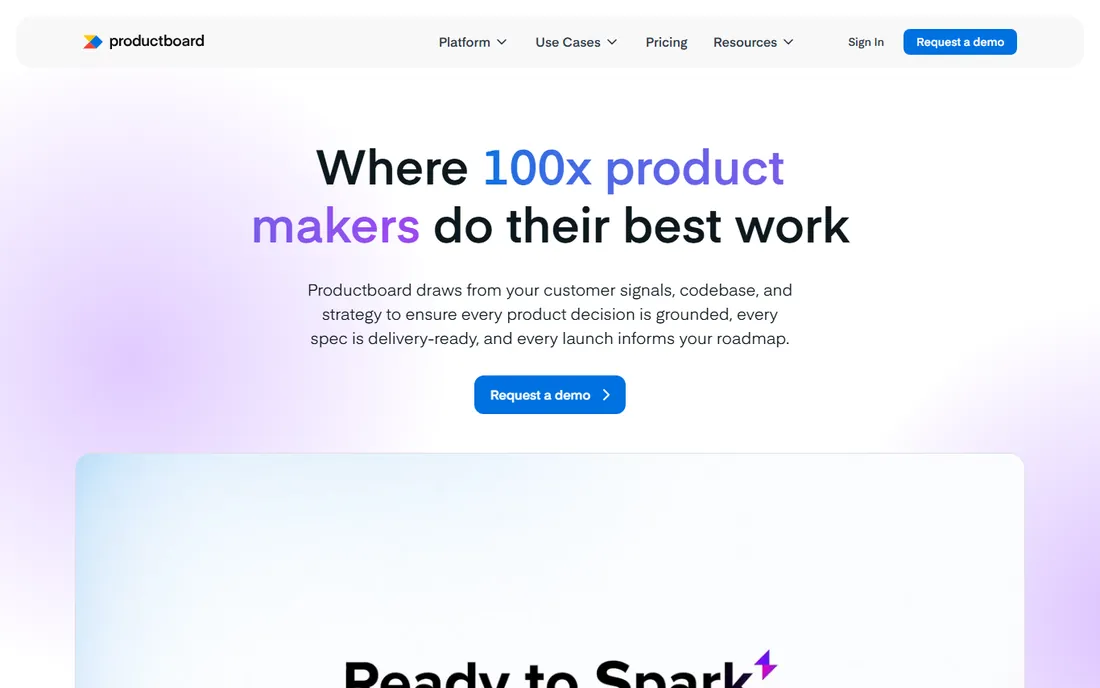
Productboard's core idea is that roadmaps should be built from customer feedback, not opinions. Feedback from support tickets, sales calls, surveys and user interviews flows into one system, gets organized by theme and connects directly to features on the roadmap. When priorities change, the evidence for why is visible to everyone.
The pricing is aimed at product organizations with budget, and smaller teams may find it heavy. But for companies where the roadmap is constantly questioned by stakeholders, Productboard's feedback-to-feature traceability ends the arguments with data.
What we like- Feedback centralization is excellent
- Roadmaps update from real insights
- Strong integrations
Watch out for- Enterprise pricing
- Can be more than small teams need
#2
Aha! Roadmaps
Best for: Organizations wanting the full product suite
Visit aha.io
Starting priceSee website
Free planFree trial
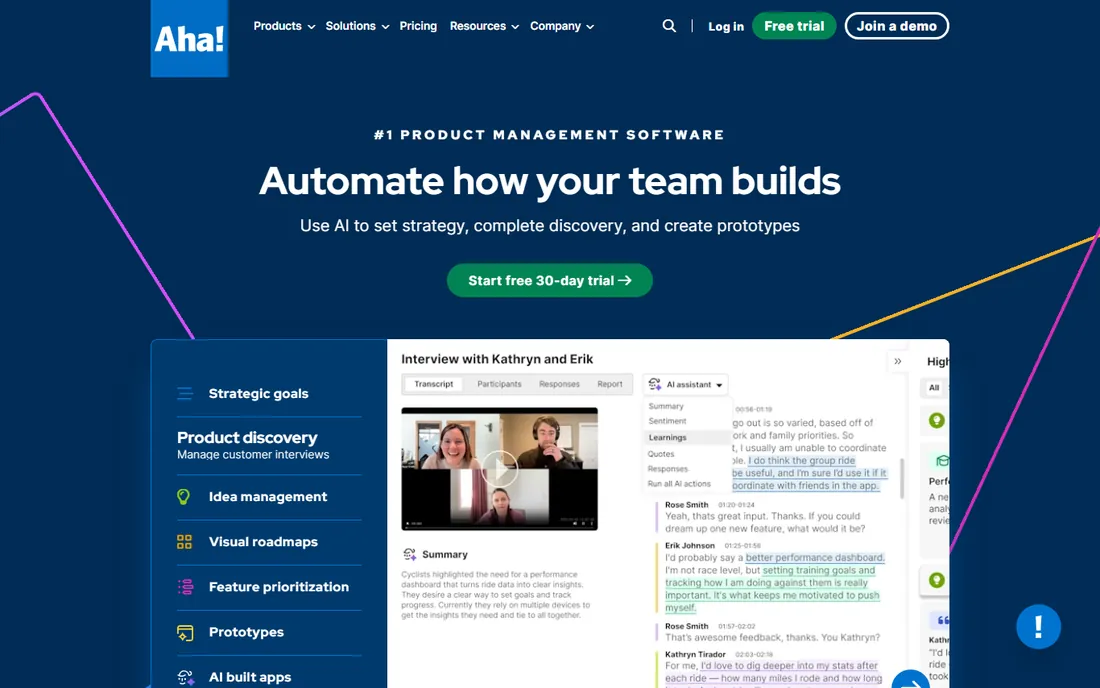
Aha! Roadmaps is part of the most complete product management suite in the market: strategy, ideas, roadmaps, releases and competitive analysis in one system. The roadmaps themselves are presentation-ready, with timeline, kanban and portfolio views that executives actually enjoy reading. It is the safe enterprise choice with a decade of refinement behind it.
The suite's breadth is also its weight: learning the full system takes time, and pricing is quoted. Teams that only need a simple visual roadmap should look at ProductPlan instead. But for product organizations standardizing how strategy becomes software, Aha! is the reference implementation.
What we like- Complete strategy-to-execution coverage
- Beautiful presentation-ready roadmaps
- Mature and stable
Watch out for- Quote-based pricing
- Learning curve for the full suite
Starting priceSee website
Free planFree trial
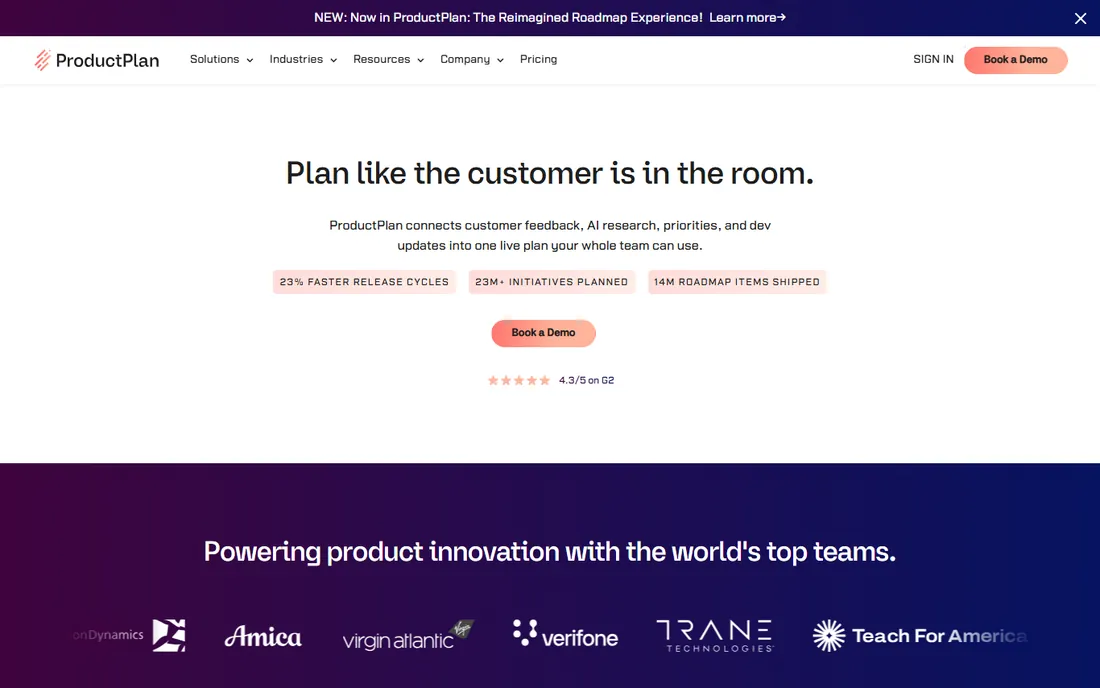
ProductPlan does one thing very well: beautiful, easy-to-understand roadmap visualizations. Product managers drag bars onto a timeline, color-code by initiative and share a live link with stakeholders who always see the current plan. The learning curve is measured in minutes, not weeks.
It is not a feedback management system or a development tracker; it is a communication tool for the plan itself. Teams that need the full idea-to-delivery pipeline pair it with other tools. But for the specific job of making the roadmap legible to the whole company, ProductPlan is the fastest path.
What we like- Extremely easy to build and share
- Clean visual roadmaps
- Good collaboration
Watch out for- Less depth in feedback management
- Not a full PM suite
#4
Roadmunk
Best for: Presentation-quality roadmaps inside Tempo
Visit tempo.io
Starting priceSee website
Free planFree trial
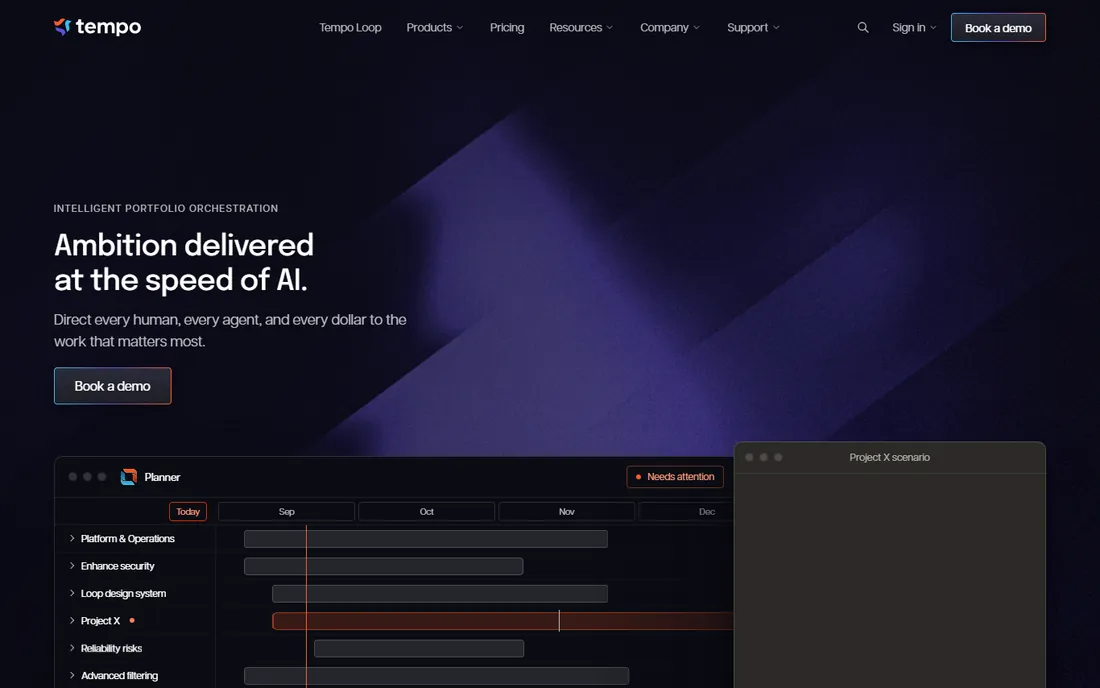
Roadmunk built its name on roadmaps that look like they were designed by a design team: polished templates, timeline and swimlane views, one-click sharing. Following its acquisition by Tempo, the product now sits inside Tempo's planning portfolio, and roadmunk.com redirects into tempo.io.
Buyers should evaluate the combined Tempo offering rather than expecting Roadmunk to remain standalone forever. For teams already in the Tempo ecosystem, the roadmapping capabilities come as part of a coherent planning suite. For everyone else, the visual quality that made Roadmunk famous is still there.
What we like- Gorgeous roadmap templates
- Easy stakeholder sharing
- Now backed by Tempo
Watch out for- Future is the Tempo platform
- Less of a standalone product
Starting priceSee website
Free planFree trial
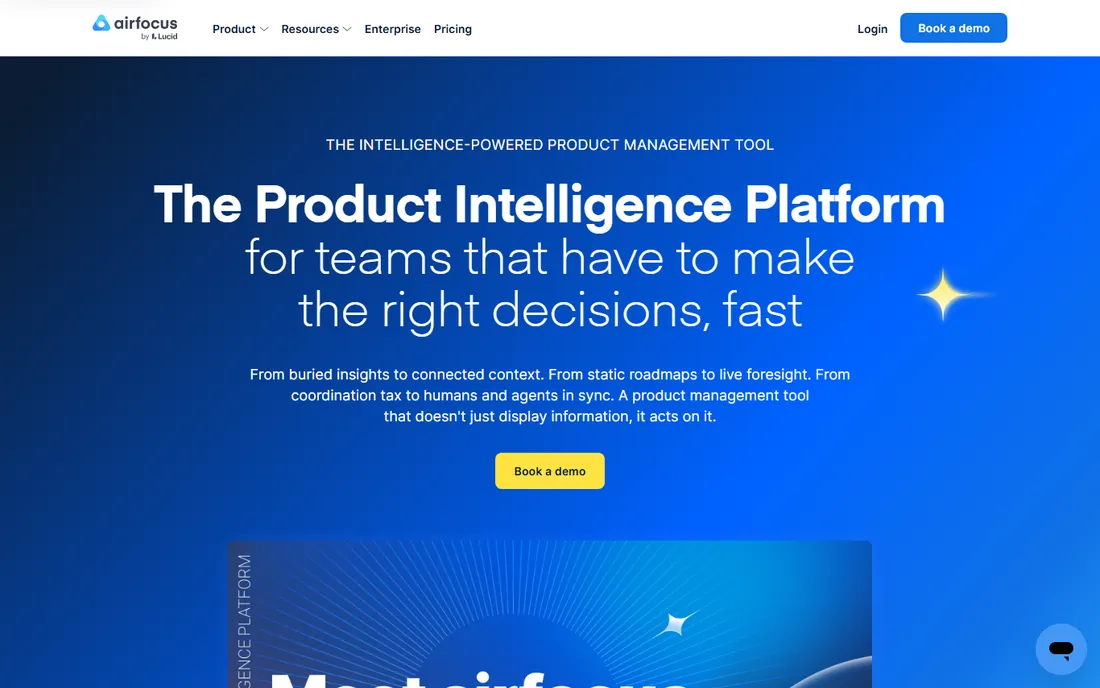
airfocus starts from the hardest part of roadmapping: deciding what matters. Priority poker, RICE scoring, value-versus-effort matrices and custom frameworks make the ranking process explicit and defensible. The roadmaps themselves are clean and modular, so teams use the views they need.
Teams that just need a timeline may find the prioritization machinery more than necessary. Pricing is quoted. But for product teams tired of roadmap debates settled by the loudest voice, airfocus turns prioritization into a process instead of a politics.
What we like- Strong prioritization frameworks
- Modular and flexible
- Modern UX
Watch out for- Prioritization depth can overwhelm simple needs
- Pricing by quote
#6
Craft.io
Best for: End-to-end product management in one platform
Visit craft.io
Starting priceSee website
Free planFree trial
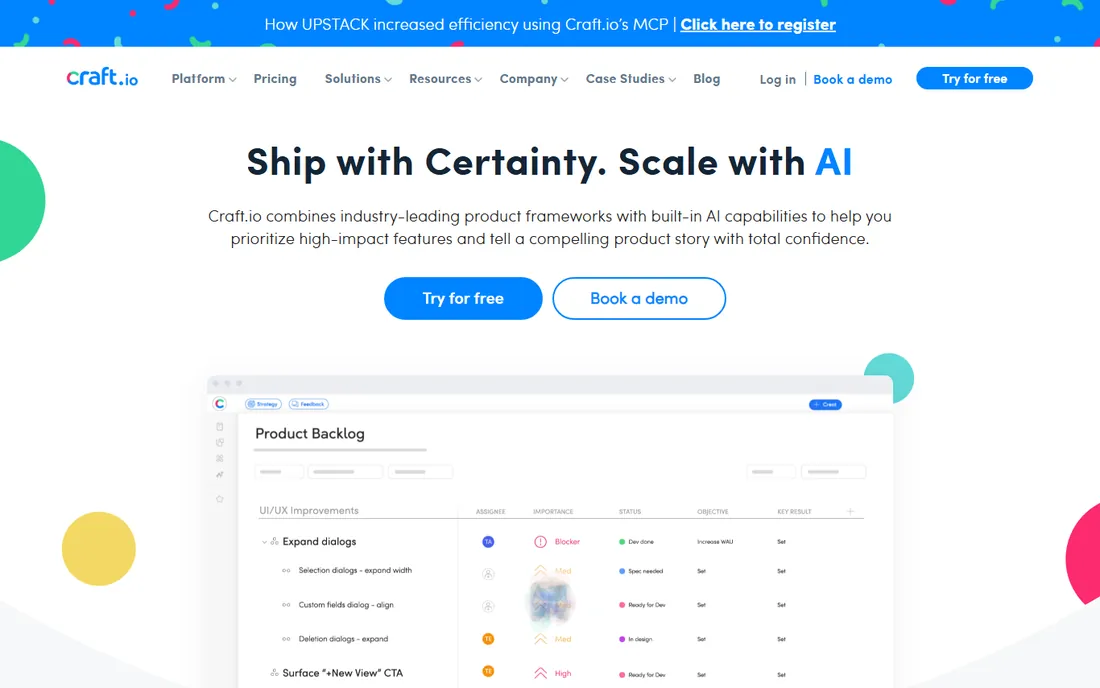
Craft.io offers the full product management lifecycle: discovery, strategy, roadmaps, prioritization, delivery tracking and portfolio management in one platform. The emphasis on outcome-based roadmaps, planning around business results rather than feature lists, matches how mature product organizations think.
The company is smaller than Productboard or Aha!, so the integration catalog and US market presence are thinner. But for enterprises consolidating fragmented product tooling onto one platform, Craft.io's breadth at a competitive price point is compelling.
What we like- Covers strategy to delivery
- Outcome-based roadmaps
- Good for enterprises becoming product-led
Watch out for- Smaller vendor with fewer integrations
- Less known in the US
Starting priceSee website
Free planFree trial
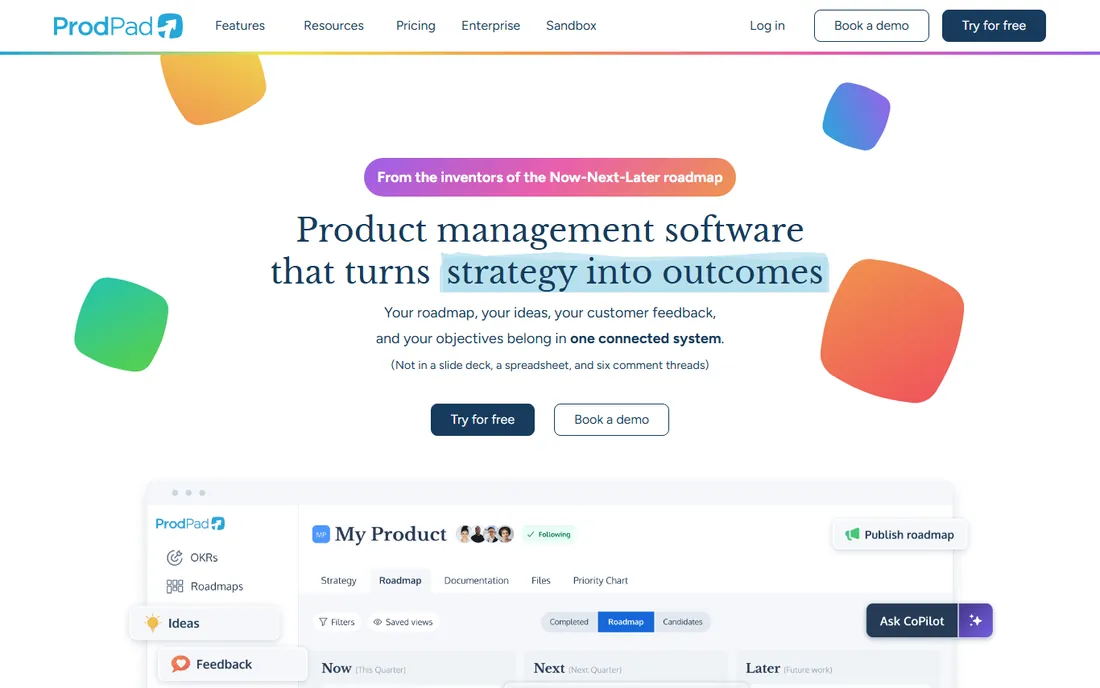
ProdPad starts earlier in the process than most roadmap tools: capturing ideas from everywhere, triaging them, speccing the good ones and only then putting them on a roadmap. Product managers who live in the messy front end of product work appreciate that the tool respects the whole workflow, not just the pretty timeline.
The roadmap visuals are functional rather than stunning. The company is small. But for teams whose problem is too many ideas and too little structure, ProdPad's idea-to-roadmap pipeline is the most thoughtful in the category.
What we like- Great idea capture and triage
- Lean roadmapping
- Loved by product managers
Watch out for- Less visual polish than Roadmunk
- Smaller company
#8
Canny
Best for: Public roadmaps driven by customer votes
Visit canny.io
Starting priceSee website
Free planYes
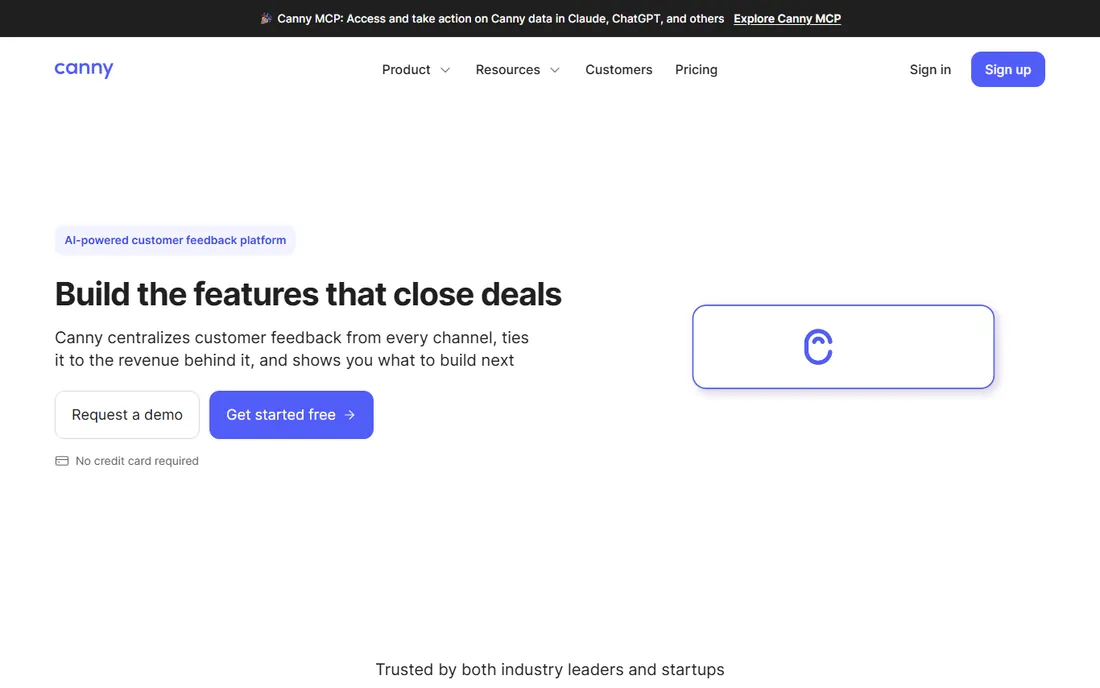
Canny is the feedback portal that grew roadmapping features: customers submit and vote on feature requests, and the public roadmap shows what is planned, in progress and shipped. For SaaS companies that want transparency with users, the hosted portal is the product as much as the internal planning.
The roadmap functionality is simpler than ProductPlan or Aha!, and it is organized around feedback rather than strategy. The free tier covers getting started. For companies whose roadmap is a conversation with customers, Canny's public-facing approach is unique.
What we like- Customer feedback portals
- Public roadmaps
- Free tier available
Watch out for- Roadmapping is simpler than specialists
- Feedback-centric, not strategy-centric
How we chose
We looked for software built for product roadmapping in 2026, from visual timeline tools to full product management suites. We verified each product is actively offered, checked documentation and reviews, and accounted for the Roadmunk acquisition by Tempo. Pricing is quote-based for most of the category, so we compared on planning workflow, visualization quality and audience fit. Generic project management tools were excluded. We checked current public reviews on G2, Capterra and Reddit to confirm how each tool holds up in real use.
What makes a roadmap useful
The best roadmap tool cannot fix a bad roadmap. Useful roadmaps show outcomes and direction, not just feature lists with dates. They are honest about uncertainty: near-term items are committed, later items are directional. They change visibly when priorities change, because a roadmap nobody updates is a roadmap nobody trusts.
When evaluating tools, test the stakeholder view. Can an executive open the shared link and understand the plan in sixty seconds? Can a customer success manager answer "when is X shipping" without asking product? The tools that make the roadmap truly legible to non-product people, ProductPlan, Roadmunk, Canny's public view, earn their keep in reduced status meetings alone.
Prioritization frameworks worth knowing
Several tools on this list bake in prioritization methods, and it helps to know the vocabulary. RICE scores reach, impact, confidence and effort. Value-versus-effort plots items on a simple matrix. Priority poker gets the team estimating together. Weighted scoring lets leadership encode what the business values.
No framework replaces judgment; they structure it. The value of airfocus or Craft.io's prioritization features is not the math but the conversation: making assumptions explicit so the team argues about evidence instead of opinions. Pick the framework your team will actually use consistently, not the most sophisticated one.
Document the reasoning behind each prioritization decision, not just the score. Six months later, when someone asks why a feature was deprioritized, the notes matter more than the number. The tools that attach context to rankings, Productboard's feedback links, airfocus's custom criteria, make the roadmap defensible long after the planning meeting ends and the participants have forgotten the details.
Frequently asked questions
What is roadmap software?
It is software for planning and communicating product direction: visualizing what will be built and when, connecting the plan to customer feedback and business goals, and sharing it with stakeholders. It ranges from simple timeline tools to full product management suites.
How much does roadmap software cost?
Most tools are priced by quote or with published tiers starting in the tens of dollars per user per month. Enterprise suites like Aha! and Productboard are quote-based. Canny offers a free tier. Always price for your actual team size, since per-user costs add up fast.
What is the difference between a roadmap and a project plan?
A roadmap communicates product direction and priorities over quarters; it is allowed to change. A project plan tracks the execution of specific work with dates and owners. Roadmaps answer "what and why"; project plans answer "who and when". Confusing the two is the most common roadmapping mistake.
Should our roadmap be public?
It depends. Public roadmaps (Canny's specialty) build trust with customers and reduce "when is X coming" support load. But they also create commitments that are hard to walk back. Many companies share direction publicly while keeping dates and details internal. Never publish dates you cannot defend.
How often should we update the roadmap?
Review it at least monthly and update it whenever priorities change. A roadmap that does not reflect current thinking actively misleads the entire organization. The tools on this list make updates cheap; the discipline has to come from the product team.
Do we need dedicated roadmap software or can we use Jira?
Jira tracks execution well but communicates plans poorly to non-technical stakeholders. Teams often use both: Jira for the development backlog, a roadmap tool for the strategic view. If your roadmap lives in Jira and nobody outside engineering ever reads it, you need the dedicated tool.
Sources we checked (8)
- https://www.productboard.com
- https://www.aha.io
- https://www.tempo.io
- https://www.productplan.com
- https://airfocus.com
- https://craft.io
- https://www.prodpad.com
- https://canny.io
Is your product missing or out of date?
We review this list regularly. Vendors can request a listing, send updated pricing or ask about featured placement.

Shihab Mia · Founder, Rankite
Shihab has spent more than a decade helping SaaS and e-commerce brands grow through search. He writes Rankite's software buying guides from pricing pages, documentation and public user reviews. More about Shihab.