How we make this list: we compare pricing pages, product documentation and public user reviews. Ratings come from G2, Capterra or Trustpilot, with the date we checked them.
Key takeaways
- Retargeting works best when it is segmented: cart abandoners, product viewers, and past buyers should see different ads, not the same generic banner.
- Privacy changes have reshaped the field, so favor platforms with strong first-party data tools and cookieless targeting rather than ones built only on third-party cookies.
- Dynamic product ads usually beat static banners for ecommerce, because they show the exact item a visitor viewed.
- Frequency caps and burn pixels matter: showing the same ad twenty times annoys people and wastes budget, and converted buyers should stop seeing acquisition ads.
- Start with the platforms where your audience already is, usually Google and Meta, then add a programmatic DSP for wider reach.
Quick comparison
| Tool | Best for | Starting price | Free plan |
|---|
 AdRoll | Multichannel retargeting for growing brands | See website | No |
 Criteo | Dynamic retargeting powered by commerce data | See website | No |
 Google Ads | Search and display remarketing at scale | See website | No |
 Meta Ads | Social retargeting on Facebook and Instagram | See website | No |
 The Trade Desk | Enterprise programmatic retargeting | See website | No |
 StackAdapt | Multi-channel retargeting for agencies | See website | No |
 Simpli.fi | Location-based retargeting for local advertisers | See website | No |
 Quantcast | AI-driven audience retargeting | See website | No |
Is your product missing or out of date?
We review this list regularly. Vendors can request a listing, send updated pricing or ask about featured placement.
The best retargeting companies
#1AdRoll
Best for: Multichannel retargeting for growing brands4.1/5 on
G2 (789 reviews, checked Oct 2026)
Visit adroll.com
Starting priceSee website
Free planNo
AdRoll built its name on retargeting and has grown into a multichannel advertising platform where a growing brand can run display, native, video, mobile, social, connected TV, and digital out-of-home campaigns from one dashboard. Its pitch is consolidation: instead of logging into several ad managers, you manage retargeting and prospecting together, with machine learning built on more than 17 years of campaign data. For ecommerce brands, integrations with major store platforms make it easy to sync product catalogs for dynamic ads.
The trade-off is that pricing depends on plan and spend, and the self-serve experience suits brands with some advertising experience better than complete beginners. AdRoll ABM, formerly RollWorks, extends the platform to B2B account-based retargeting. For direct-to-consumer brands that want retargeting plus prospecting in one place, AdRoll remains the most accessible specialist option.
What we like- One dashboard for display, native, video, social, connected TV, and digital out-of-home
- Strong ecommerce integrations
- ABM option for B2B
Watch out for- Pricing varies by plan and ad spend
- Smaller advertisers may find managed options limited
#2Criteo
Best for: Dynamic retargeting powered by commerce data3.8/5 on
G2 (242 reviews, checked Oct 2026)
Visit criteo.com
Starting priceSee website
Free planNo
Criteo's advantage is data. Its commerce graph draws on billions of users and trillions in yearly transactions, which lets its AI predict which products a shopper is likely to buy and serve dynamic ads showing those exact items. Its retargeting runs across premium publishers worldwide, and its performance media and retail media products let brands reach shoppers both on retailer sites and across the open web. Published case work includes a 168 percent sales increase for a media group using dynamic retargeting.
Criteo is built for commerce, so B2B or lead generation advertisers will find less fit here than ecommerce brands. Managed service minimums can also exclude very small advertisers. For retailers and brands with real catalog depth, Criteo's dynamic retargeting is among the strongest performers in the market.
What we like- Commerce data from 2.5 billion users and over $1 trillion in yearly sales
- Dynamic retargeting across premium publishers
- Retail media options
Watch out for- Best suited to commerce advertisers
- Smaller brands may face minimums through managed service
#3Google Ads
Best for: Search and display remarketing at scale4.3/5 on
G2 (2,047 reviews, checked Oct 2026)
Visit ads.google.com
Starting priceSee website
Free planNo
Google Ads is the default starting point for retargeting because of reach: remarketing lists built from site visitors can be shown ads across Search, YouTube, and millions of Display Network sites, and Performance Max campaigns fold retargeting into broader AI-driven buying. Connecting Analytics and Tag Manager lets the platform learn from your own signals, and new advertisers can claim ad credits after meeting a minimum spend. For most businesses, Google remarketing is the highest-intent retargeting available, since it can catch people actively searching again.
The platform's breadth is also its difficulty: choosing between standard display remarketing, Performance Max, and Demand Gen campaigns takes real expertise, and competitive categories can be expensive. For any business already running Google Ads, adding remarketing lists is the single highest-return retargeting move available.
What we like- Largest reach across Search, YouTube, and the Display Network
- Remarketing lists from Analytics and Tag Manager
- New-advertiser credits
Watch out for- Complexity grows fast across campaign types
- Costs rise in competitive categories
#4Meta Ads
Best for: Social retargeting on Facebook and Instagram4.2/5 on
G2 (1,457 reviews, checked Oct 2026)
Visit facebook.com
Starting priceSee website
Free planNo
Meta's advertising platform reaches people where they spend leisure time, which makes it ideal for retargeting that feels like discovery rather than pursuit. The Meta Pixel and Conversions API let you build audiences from site visitors, cart abandoners, and past buyers, then serve them tailored ads on Facebook and Instagram. Meta reports that 59 percent of people discover new products and brands on its technologies, and its AI tools now generate and optimize creative automatically.
Attribution is the weak point: since Apple's privacy changes, tracking a sale back to a specific ad is harder, so advertisers should judge Meta retargeting on blended results rather than last-click numbers. Creative also fatigues quickly in feeds, so budget for regular new ads. For ecommerce and consumer brands, Meta retargeting is nearly mandatory.
What we like- Huge audiences on Facebook and Instagram
- Meta Pixel and Conversions API for accurate retargeting
- AI-driven Advantage+ campaigns
Watch out for- Attribution has weakened since iOS privacy changes
- Creative fatigue sets in fast without fresh ads
#5The Trade Desk
Best for: Enterprise programmatic retargeting4.4/5 on
G2 (186 reviews, checked Oct 2026)
Visit thetradedesk.com
Starting priceSee website
Free planNo

The Trade Desk is the largest independent demand-side platform, and its retargeting strength is omnichannel reach: the same audience can be retargeted with display on the web, video on connected TV, audio ads, and digital out-of-home, all from one platform, with measurement from independent partners rather than the platform grading its own homework. Its identity and data marketplace tools help advertisers build privacy-safe audiences as cookies fade.
This is an enterprise tool. Minimums and complexity put it out of reach for small advertisers, and most users access it through an agency or a managed service. For brands and agencies running serious programmatic budgets, The Trade Desk is the standard against which other DSPs are measured.
What we like- Omnichannel reach across audio, connected TV, display, video, and digital out-of-home
- Objective measurement partnerships
- Strong identity tools
Watch out for- Enterprise orientation and minimums exclude small advertisers
- Learning curve for new buyers
#6StackAdapt
Best for: Multi-channel retargeting for agencies4.7/5 on
G2 (905 reviews, checked Oct 2026)
Visit stackadapt.com
Starting priceSee website
Free planNo
StackAdapt connects planning, audiences, creative, channels, and measurement into one AI-driven platform, with an emphasis on multi-channel campaigns that agencies can run at scale. Its Ivy Studio hub brings planning, forecasting, optimization, and execution together, and its platform covers connected TV, video, display, native, audio, digital out-of-home, email, and direct mail. Client surveys cited by the company report higher click-through rates for multi-channel campaigns than single-channel ones.
The platform leans toward agencies and mid-size teams rather than solo advertisers, and pricing requires a conversation. For agencies managing retargeting across many clients and channels, StackAdapt's consolidation and AI forecasting are strong reasons to choose it.
What we like- Native, display, video, connected TV, audio, and email from one platform
- AI planning and forecasting
- Trusted by more than 40,000 brands and agencies
Watch out for- Agency-leaning design may overwhelm solo advertisers
- Pricing is quote-based
#7Simpli.fi
Best for: Location-based retargeting for local advertisers4.5/5 on
G2 (154 reviews, checked Oct 2026)
Visit simpli.fi
Starting priceSee website
Free planNo
Simpli.fi is built around a simple idea: connect digital ads to real-world behavior. Its household-level targeting reaches audiences at the address level, and its platform is designed for advertisers with many locations, letting them run locally customized campaigns across every storefront from one place. It measures success in store visits as well as online conversions, which matters for retailers, restaurants, and service businesses whose goal is foot traffic.
For a purely online business, Simpli.fi's location strengths add less value than a commerce-focused platform like Criteo. Its distribution is also agency and reseller oriented, so direct self-serve access varies. For local and multi-location advertisers, Simpli.fi's location-based retargeting is a distinctive and practical choice.
What we like- Household-level location targeting
- Multi-location campaign management
- Real-world visit measurement
Watch out for- Location focus is less useful for purely online businesses
- Platform is agency and reseller oriented
#8Quantcast
Best for: AI-driven audience retargeting4.2/5 on
G2 (193 reviews, checked Oct 2026)
Visit quantcast.com
Starting priceSee website
Free planNo
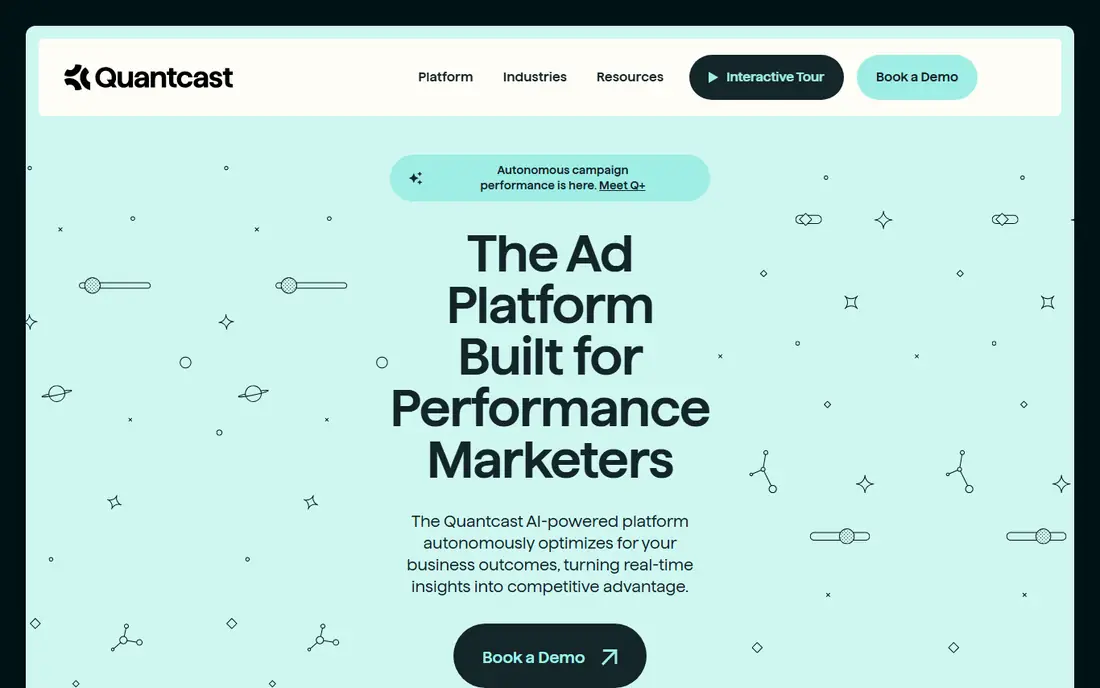
Quantcast's platform uses its Audience Graph, an AI system built on two decades of audience intelligence, to find people most likely to convert and to optimize campaigns autonomously through its Q+ product. It positions itself as the performance marketer's DSP: real-time insights, cross-device reach, and cookieless solutions for a privacy-first web. Advertisers praise its workflow simplicity and its ability to surface audiences that keyword or demographic targeting would miss.
Quantcast cannot match Google's or Meta's raw reach, and its AI optimization works best once campaigns generate enough data to learn from. For performance marketers who want an independent DSP with strong AI optimization and a privacy-forward approach, Quantcast is a solid alternative to the giants.
What we like- Audience Graph built on two decades of data
- Autonomous AI optimization with Q+
- Cookieless audience solutions
Watch out for- Smaller inventory footprint than Google or Meta
- Best results need meaningful campaign data
How we chose
We picked platforms that genuinely run retargeting at scale, covering the main retargeting styles: site retargeting, dynamic product ads, social retargeting, programmatic DSP retargeting, and location-based retargeting. We favored platforms with documented reach, first-party data tools, and privacy-safe targeting options, since cookie-based retargeting alone is a shrinking strategy. Pricing is spend-based or quote-based across this market, so every starting price is listed as "See website." We did not test campaigns ourselves, so treat vendor performance claims as marketing until your own tests confirm them.
What to check before you hire
Start with your audience and your data. Confirm you can build the segments you need: site visitors, cart abandoners, product viewers, and past buyers, with exclusion lists for people who already converted. Ask how the platform handles privacy: first-party data onboarding, consent management, and cookieless targeting should be concrete features, not vague promises.
Set frequency caps and creative rotation from day one. A cap of a few impressions per day per user and a fresh creative every few weeks prevents the ad fatigue that makes retargeting feel intrusive. Define success before launch: return on ad spend for ecommerce, cost per lead for B2B, or store visits for local businesses. Finally, test one platform at a time against a holdout group that sees no retargeting, so you can measure true lift instead of taking credit for sales that would have happened anyway.
Frequently asked questions
What is retargeting?
Retargeting shows ads to people who already visited your website, viewed a product, or interacted with your brand but did not convert. It uses a tracking pixel, a customer list, or a platform audience to recognize those visitors on other sites and apps and remind them to come back.
Is retargeting still effective without third-party cookies?
Yes, but the methods changed. Platforms now rely on first-party data, customer lists, contextual signals, and modeled audiences. Retargeting built only on third-party cookies is fading, while first-party and platform-based retargeting on Google, Meta, and major DSPs remains effective.
How much should I spend on retargeting?
Start with 10 to 20 percent of your paid media budget for retargeting and adjust based on audience size and return. Small audiences saturate quickly, so a huge retargeting budget on a tiny visitor pool wastes money. Grow spend only when your site traffic grows.
How do I avoid annoying people with retargeting ads?
Set frequency caps, rotate creative regularly, exclude people who already bought, and set membership durations so visitors stop seeing ads after a reasonable window, such as 30 days. Segmented, relevant ads annoy far less than the same generic banner shown everywhere.
What is the difference between retargeting and remarketing?
The terms are often used interchangeably. Strictly, retargeting usually means showing display or social ads to past visitors, while remarketing often means email follow-ups to known contacts, such as cart abandonment emails. Google uses "remarketing" for its display audience product, which adds to the confusion.
Sources we checked (8)
- https://www.adroll.com
- https://www.criteo.com
- https://ads.google.com
- https://www.facebook.com/business
- https://www.thetradedesk.com
- https://www.stackadapt.com
- https://simpli.fi
- https://www.quantcast.com
Is your product missing or out of date?
We review this list regularly. Vendors can request a listing, send updated pricing or ask about featured placement.

Shihab Mia · Founder, Rankite
Shihab has 5+ years in B2B and SaaS SEO. He writes Rankite's software buying guides from pricing pages, documentation and public user reviews. More about Shihab.