How we make this list: we compare pricing pages, product documentation and public user reviews. Ratings come from G2, Capterra or Trustpilot, with the date we checked them.
Key takeaways
- Five of the eight tools publish no price at all, so expect a sales conversation before you can budget for Iron Mountain, Zasio, FileTrail, Gimmal or iManage.
- Only three tools show a starting price: Laserfiche from $73 per user per month, M-Files at $65 per seat per month, and DocuWare from $30 per user per month.
- A retention schedule is only as good as its citations, which is why Zasio and Iron Mountain lead on schedule depth.
- Legal holds must freeze disposition automatically, and every tool in this guide supports holds in some form.
- Pick the tool that fits the records you actually hold, not the one with the longest feature list.
What does records retention software actually do?
Records retention software manages the full life of a record, from creation to final disposition. It applies a retention schedule that says how long each record type must be kept, then triggers review or destruction when that period ends. The best tools also track physical boxes alongside digital files, so one schedule governs both. If a tool only stores files and cannot enforce a schedule, it is storage, not retention software.
A legal hold freezes disposition for records tied to litigation, an investigation or a regulatory request. When a hold is placed, the retention clock stops and the records cannot be deleted, even if their schedule says the time is up. Holds can apply by matter, custodian or record type, and are released when the matter closes. Good hold support also logs who placed the hold, when it was placed and when it was released, so the organization can show that nothing was destroyed while the hold was active.
What makes a deletion defensible?
A deletion is defensible when the organization can prove it followed its own published schedule, applied holds correctly and kept a record of the decision. That means three things: a schedule based on real regulations, an approval step before destruction, and a certificate or log that shows what was destroyed, when and by whom. Tools that automate these steps reduce the risk of keeping records too long, which raises discovery costs, or deleting them too early, which can look like spoliation.
How much should you expect to pay?
Expect a wide range. Three tools publish starting prices: DocuWare from $30 per user per month, M-Files at $65 per seat per month, and Laserfiche from $73 per user per month on its Professional plan. The other five publish no price and quote per organization, based on user count, record volume and deployment. Implementation, migration and training are usually priced separately, so ask for the full first-year cost in writing before you sign.
Small teams should start with the tools that publish prices, because a quote-only enterprise platform can absorb a budget before the evaluation is done. Laserfiche Cloud Starter and DocuWare Cloud 4 are built for small user counts, while M-Files Essentials works when the team files by client or matter. Zasio Versatile Retention suits a small team that needs a researched schedule more than a large platform. The other four suit larger estates and regulated industries.
Quick comparison
| Tool | Best for | Starting price | Free plan |
|---|
 Iron Mountain | Regulated organizations with paper and digital records that need defensible disposition | quote (Iron Mountain publishes no price; pricing is available only on request, checked 21 Nov 2026) | No |
 Zasio | Organizations that want an attorney-researched retention schedule as the core of the program | quote (Zasio publishes no price on its website, checked 21 Nov 2026) | No free plan; a free trial is offered for Versatile Retention |
 FileTrail | Law firms that need governance across physical files and electronic repositories | quote (FileTrail publishes no price; pricing is by quote, checked 21 Nov 2026) | No |
 Gimmal | Microsoft 365 and SharePoint shops that need retention governance without moving content | quote (Gimmal does not publish pricing on its website, checked 21 Nov 2026) | No |
 Laserfiche | Mid-size organizations that want retention inside a broader document and process platform | $73 per user per month (Professional, billed annually; Business at $93 per user per month adds records lifecycle management, checked 21 Nov 2026) | No |
 DocuWare | Teams that want retention rules inside a document management and workflow system | From $30 per user per month (vendor stated typical range $30 to $125+ per user per month for DocuWare Cloud, checked 21 Nov 2026) | No |
 M-Files | Professional firms that file by client, matter or contract and need governance on top | $65 per seat per month (Essentials, billed annually; Enterprise by quote, checked 21 Nov 2026) | No |
 iManage | Law firms that need matter-centric records with retention and disposition built in | quote (iManage does not publish pricing on its website, checked 21 Nov 2026) | No |
Is your product missing or out of date?
We review this list regularly. Vendors can request a listing, send updated pricing or ask about featured placement.
#1
Iron Mountain
Best for: Regulated organizations with paper and digital records that need defensible disposition
Visit ironmountain.com
Starting pricequote (Iron Mountain publishes no price; pricing is available only on request, checked 21 Nov 2026)
Free planNo

Iron Mountain Policy Center is a cloud platform that holds retention schedules built from real regulations across jurisdictions, so a team does not have to research how long to keep each record type. It also supports legal holds that freeze disposition for selected records, and it covers both physical and digital records in one schedule. The physical side is the differentiator: Iron Mountain stores boxes offsite, retrieves them on request and destroys them on schedule with a certificate. The trade-off is scope, since the platform is built for organizations with a large records estate.
What we like- Regulation-based retention schedules in Policy Center
- Legal holds that freeze disposition
- One schedule covers physical and digital records
- Certified destruction with a full audit trail
Watch out for- No public price, so budgeting needs a sales conversation
- The service model suits larger records estates better than a small office
- Setup needs real policy work before the schedule does anything useful
#2
Zasio
Best for: Organizations that want an attorney-researched retention schedule as the core of the program
Visit zasio.com
Starting pricequote (Zasio publishes no price on its website, checked 21 Nov 2026)
Free planNo free plan; a free trial is offered for Versatile Retention
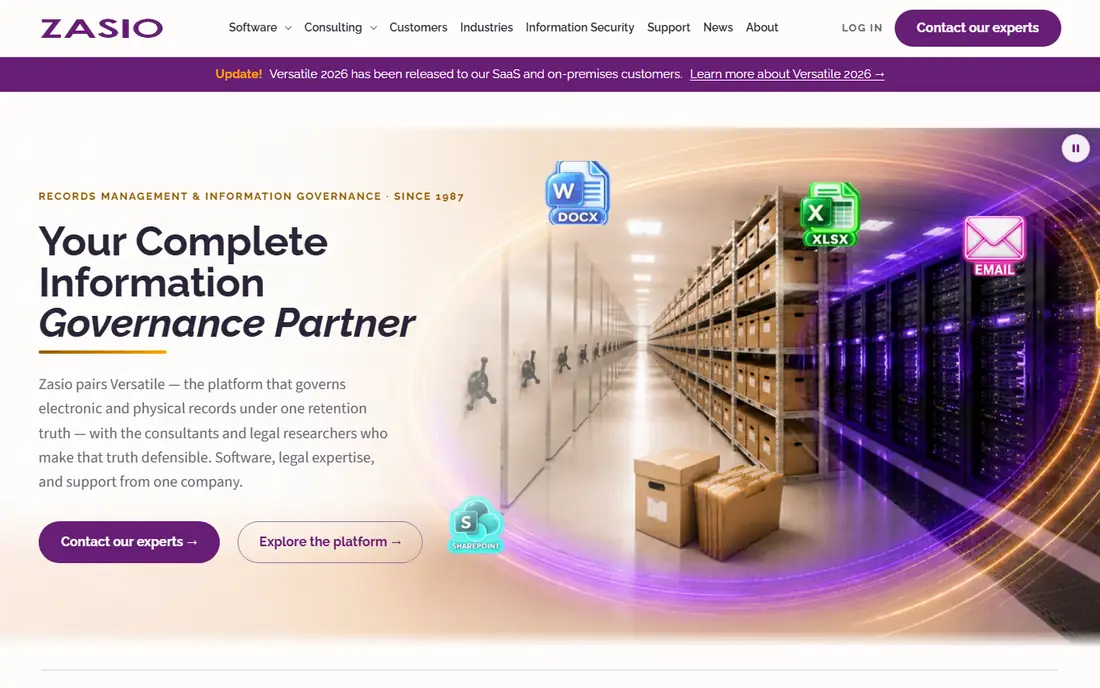
Zasio is the schedule specialist in this guide. Its Versatile Retention product is a schedule management and research solution, and its Domestic subscription carries more than 73,000 US federal and state records-related requirements, with an optional North American subscription and an international subscription that reaches 140 countries. A team of full-time legal researchers and licensed attorneys keeps the citations current. Versatile Enterprise then applies that schedule to electronic and physical records. It is the right pick when the quality of the schedule itself is the main risk.
What we like- Domestic subscription covers more than 73,000 US federal and state requirements
- International coverage reaches 140 countries
- Versatile governs electronic and physical records under one schedule
- In-house legal researchers keep citations current
Watch out for- No published price makes comparison shopping slow
- The product is specialized, so teams that also need broad document management will need a second tool
- Implementation is a project, not a quick install
#3
FileTrail
Best for: Law firms that need governance across physical files and electronic repositories
Visit filetrail.com
Starting pricequote (FileTrail publishes no price; pricing is by quote, checked 21 Nov 2026)
Free planNo
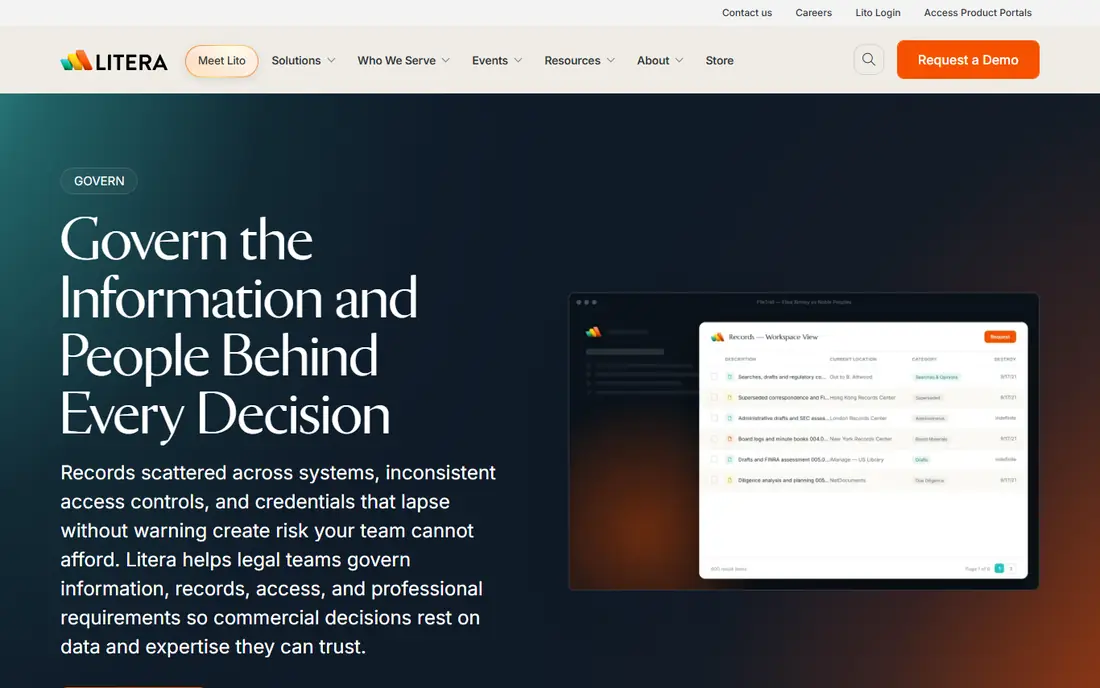
FileTrail is an enterprise records management and information governance platform designed for law firms, built around physical file tracking and electronic disposition. Its FileTrail GPS suite works as a control plane for legal information governance, applying retention rules to files in the office, in storage and in connected repositories. Electronic disposition reaches into multiple repositories rather than forcing every document into one system. The limits are commercial: pricing is quote-based with no public figures and no free trial, so a firm must engage sales to learn the cost.
What we like- FileTrail GPS unifies physical tracking with multi-repository electronic disposition
- Built for law firms and highly regulated markets
- Barcode and RFID tracking for physical files
- Disposition workflows with approval steps
Watch out for- Quote-based enterprise pricing with no public figures
- No free trial is offered
- Now part of Litera, so buyers should confirm the product roadmap during evaluation
#4
Gimmal
Best for: Microsoft 365 and SharePoint shops that need retention governance without moving content
Visit gimmal.com
Starting pricequote (Gimmal does not publish pricing on its website, checked 21 Nov 2026)
Free planNo
Gimmal adds the governance layer that Microsoft 365 does not fully provide on its own. Its Records product governs records across repositories with retention schedules and lifecycle automation, using connectors so content stays where it lives. A central dashboard shows what is held, what is due for review and what is under hold. The SharePoint focus cuts both ways: outside a Microsoft environment there is little reason to consider it, and pricing is quote-based with no public figures and no free trial.
What we like- Manages records in place across repositories with connectors
- Retention schedules and disposition workflows without migration
- Strong fit for SharePoint environments
- Centralized dashboard for governance
Watch out for- Little reason to choose it outside a Microsoft environment
- No public price and no free trial, so evaluation means engaging sales
- Narrower scope than full document management suites
#5Laserfiche
Best for: Mid-size organizations that want retention inside a broader document and process platform4.7/5 on
G2 (1,249 reviews, checked Oct 2026)
Visit laserfiche.com
Starting price$73 per user per month (Professional, billed annually; Business at $93 per user per month adds records lifecycle management, checked 21 Nov 2026)
Free planNo
Laserfiche is a document management and process automation platform, and its records management features sit on the Business and Business+ tiers. Those plans include automated retention schedules, disposition workflows and legal hold support, alongside audit logging, granular permissions and role-based access controls. The Professional plan starts at $73 per user per month billed annually, while Business is $93 per user per month and Business+ is $42 per user per month at 500 users or more. The catch is that a buyer who needs retention must pay for Business, not the entry tier.
What we like- Records lifecycle management with retention schedules, disposition workflows and legal hold support on Business plans
- Strong automation and AI classification
- Audit logging and granular permissions
- Cloud Starter option for small teams
Watch out for- Retention features sit on the Business tier, not the entry plan
- The per-user price climbs fast as headcount grows
- Implementation and professional services are priced separately
#6DocuWare
Best for: Teams that want retention rules inside a document management and workflow system4.4/5 on
G2 (251 reviews, checked Oct 2026)
Visit docuware.com
Starting priceFrom $30 per user per month (vendor stated typical range $30 to $125+ per user per month for DocuWare Cloud, checked 21 Nov 2026)
Free planNo
DocuWare is a document management and workflow automation platform offered in the cloud and on premises. Its cloud plans are sold in tiers of 4, 15, 40 and 100 named users, and its own pricing FAQ states that cloud plans typically cost about $30 to $125 or more per user per month depending on plan size, user type and needs. Retention rules sit inside a system that also handles capture, indexing, forms and workflow. The trade-off is that no full rate card is printed, and specialized modules cost extra.
What we like- Cloud tiers sized for 4, 15, 40 and 100 users
- Workflow users available at a lower cost for approvals and read-only access
- Full-text search, version control and access controls
- On-premises option for firms that need it
Watch out for- No full rate card is published, so the final number comes only from a quote
- Add-ons such as intelligent document processing cost extra
- Tier sizes can force a jump when headcount passes a threshold
#7M-Files
Best for: Professional firms that file by client, matter or contract and need governance on top4.4/5 on
G2 (273 reviews, checked Oct 2026)
Visit m-files.com
Starting price$65 per seat per month (Essentials, billed annually; Enterprise by quote, checked 21 Nov 2026)
Free planNo
M-Files organizes documents by what they are, such as client, project or contract type, instead of by folder, which makes the same file findable from several contexts without duplication. Essentials costs $65 per seat per month and includes Microsoft 365 native experiences, the Aino AI assistant for everyday document tasks, secure collaboration and lifecycle management. Enterprise adds secure external collaboration, an extended audit log and custom versioning for regulated work, but it is priced by quote. It suits firms whose filing logic is the product, less so buyers whose main need is a researched schedule.
What we like- Metadata-first filing makes records findable by what they are
- Lifecycle management is included in Essentials
- Aino AI and Microsoft 365 integration in the entry plan
- Strong versioning and audit trail
Watch out for- At $65 a seat it is the priciest entry plan in this guide
- Enterprise has no public price
- Implementation is sold as a separate service
- Retention depth is thinner than in dedicated records tools
#8
iManage
Best for: Law firms that need matter-centric records with retention and disposition built in
Visit imanage.com
Starting pricequote (iManage does not publish pricing on its website, checked 21 Nov 2026)
Free planNo
iManage Work is the document and email management system used by many large law firms, and its records management capabilities are built for matter-centric work. Records are filed by client and matter, retention rules follow the matter lifecycle, and legal holds fit naturally into litigation workflows where a hold must freeze disposition across a whole matter. The costs are the drawback: there is no public pricing, implementation is a large project with significant services cost, and the learning curve is steep for staff who do not work in legal teams.
What we like- Built for legal work, with matter-centric filing and records management
- Legal holds and disposition fit litigation workflows
- Deep integration with Microsoft 365 and legal applications
- Strong security and governance controls
Watch out for- No public pricing, so costs surface only through a sales process
- Implementation is a large project with significant services cost
- The learning curve is steep for staff outside legal teams
Comparison table
| Tool |
Best for |
Starting price |
Free plan |
Legal holds |
| Iron Mountain |
Defensible retention at scale |
quote |
No |
Yes |
| Zasio |
Attorney-researched schedules |
quote |
No, free trial |
Yes |
| FileTrail |
Law firm governance |
quote |
No |
Yes |
| Gimmal |
SharePoint and Microsoft 365 governance |
quote |
No |
Yes |
| Laserfiche |
Retention inside a document platform |
$73 per user per month |
No |
Yes, Business plans |
| DocuWare |
Retention inside document workflows |
From $30 per user per month |
No |
Yes |
| M-Files |
Metadata-first filing for professional firms |
$65 per seat per month |
No |
Yes |
| iManage |
Matter-centric records for law firms |
quote |
No |
Yes |
How we picked
We checked each vendor pricing page on 21 Nov 2026 and recorded the published starting price, or marked the tool quote where the vendor publishes no price. We kept the scope tight to retention schedules, legal holds, disposition and defensible deletion, and we left out general storage tools that cannot enforce a schedule. We favored tools with regulation-based schedules, in-place governance and an audit trail for destruction, and we weighed the fit for law firms, regulated industries and Microsoft shops separately. We did not invent prices, ratings or user counts, so confirm the final price and the retention features on the tier you plan to buy.
Last verified: 21 Nov 2026. Prices were checked on the vendor pricing pages on 21 Nov 2026.
Frequently asked questions
What is the difference between records retention software and records management software?
Records management covers the whole life of a record, including capture, storage, search and retrieval. Records retention software is the narrower discipline inside it: it applies a schedule that says how long each record type must be kept, freezes disposition under a legal hold, and proves that each deletion followed the rules. A tool can manage records without enforcing retention, but it cannot do retention properly without a schedule, a hold mechanism and an audit trail for destruction.
How long should a business keep financial records?
It depends on the record type and the jurisdiction, so there is no single number that fits every business. Tax records are commonly kept for seven years in the United States, while employment and payroll records have their own rules, and regulated industries often face longer periods. Your schedule should come from the regulations that apply to your industry and location, which is why tools with researched citation libraries make good starting points for building one.
Can records retention software handle paper records as well as digital files?
Yes, and the better tools treat paper and digital records under one schedule. Iron Mountain stores physical boxes offsite and destroys them on schedule with a certificate, while Zasio and FileTrail track physical files with barcodes or RFID alongside electronic records. A single schedule matters because a retention rule that only covers digital files leaves the paper archive ungoverned. Ask any vendor how physical disposition is approved and logged before you buy.
What happens when a legal hold is placed on a record?
A legal hold stops the retention clock, so the record cannot be deleted even if its schedule says the time is up. The hold usually applies by matter, custodian or record type, and it stays in place until the matter closes and the hold is released. The system should log who placed the hold, when it was placed and when it was released, so the organization can show that nothing was destroyed while the hold was active.
How much does records retention software cost?
Three tools in this guide publish starting prices: DocuWare from $30 per user per month, M-Files at $65 per seat per month, and Laserfiche from $73 per user per month. The other five publish no price and quote per organization, based on user count, record volume and deployment. Implementation, migration and training are usually priced separately, so ask for the full first-year cost in writing. A low per-user price means little if retention features sit on a higher tier.
Sources we checked (8)
- https://www.ironmountain.com
- https://www.zasio.com
- https://www.filetrail.com
- https://www.gimmal.com
- https://www.laserfiche.com/products/pricing/
- https://www.docuware.com
- https://www.m-files.com/editions/
- https://www.imanage.com
Is your product missing or out of date?
We review this list regularly. Vendors can request a listing, send updated pricing or ask about featured placement.

Shihab Mia · Founder, Rankite
Shihab has 5+ years in B2B and SaaS SEO. He writes Rankite's software buying guides from pricing pages, documentation and public user reviews. More about Shihab.