How we make this list: we compare pricing pages, product documentation and public user reviews. Ratings come from G2, Capterra or Trustpilot, with the date we checked them.
Key takeaways
- Configuration management tools keep servers and infrastructure in a desired state, installing software, applying settings, and correcting drift automatically.
- Ansible is the best starting point for most teams because it is agentless and free, rating 4.8 out of 5 on G2, while Terraform rates 4.9 for cloud provisioning.
- Puppet and Chef lead for enterprise governance and compliance, with Puppet rating 4.7 and Chef 4.6, but enterprise pricing runs into five figures per year for 100 nodes.
- Terraform provisions infrastructure while Ansible configures it, so teams commonly use both together rather than choosing one.
- Licensing matters since 2023: Terraform uses BUSL 1.1, while OpenTofu offers an MPL 2.0 alternative for teams avoiding BUSL restrictions.
Quick comparison
| Tool | Best for | Starting price | Free plan |
|---|
 Ansible | Agentless automation at scale | Free | Yes |
 Puppet | Enterprise governance and compliance | $120 per month | No |
 Chef | Policy-driven workflow automation | Free | Yes |
 SaltStack | Large-scale event-driven automation | Free | Yes |
 Terraform | Cloud infrastructure as code | Free | Yes |
 CFEngine | Lightweight security and compliance | Free | Yes |
 Rudder | Centralized management UI | See website | No |
 Pulumi | Multi-language infrastructure scripting | $40 per month | Yes |
Is your product missing or out of date?
We review this list regularly. Vendors can request a listing, send updated pricing or ask about featured placement.
The best software config management solutions
#1Ansible
Best for: Agentless automation at scale4.6/5 on
G2 (377 reviews, checked Oct 2026)
Visit ansible.com
Starting priceFree
Free planYes
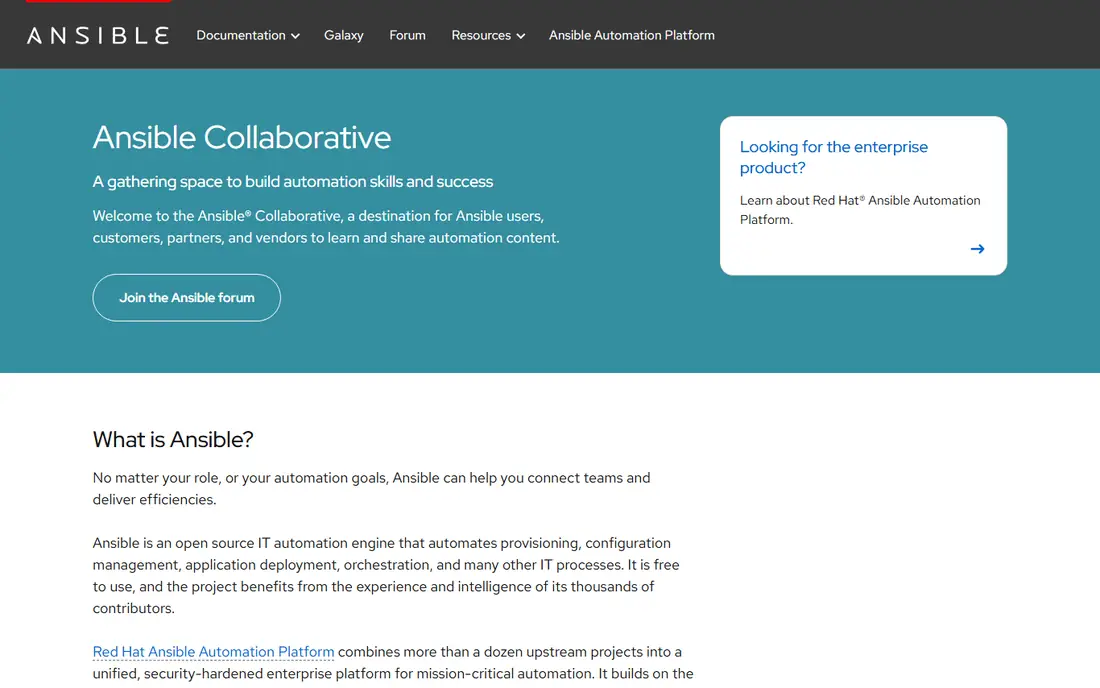
Ansible is the best starting point for most teams because it is agentless and free, using YAML-based playbooks that are easy to read and learn. Its agentless architecture means no software to install on managed nodes, which speeds adoption, and it runs on Linux, macOS, and Windows. The open-source engine is free, while Red Hat Ansible Automation Platform adds support, hardening, event-driven automation, and AI features for large enterprise teams, with a 60-day free trial.
The drawbacks are enterprise cost and enforcement style. Enterprise figures run near 10,000 dollars per year for 100 nodes in some comparisons, with Automation Platform from 3,000 dollars per year, and Ansible lacks the native continuous enforcement of Puppet. Ansible suits DevOps and sysadmin teams that want simple, agentless automation at scale.
What we like- Agentless architecture with YAML-based playbooks
- Free open-source engine supported by thousands of contributors
- 4.8 rating on G2
- 60-day free trial for enterprise platform
Watch out for- Enterprise pricing by quote, with figures near 10,000 dollars per year for 100 nodes
- Red Hat Ansible Automation Platform from 3,000 dollars per year
- Less native enforcement than Puppet
#2Puppet
Best for: Enterprise governance and compliance4.2/5 on
G2 (43 reviews, checked Oct 2026)
Visit puppet.com
Starting price$120 per month
Free planNo
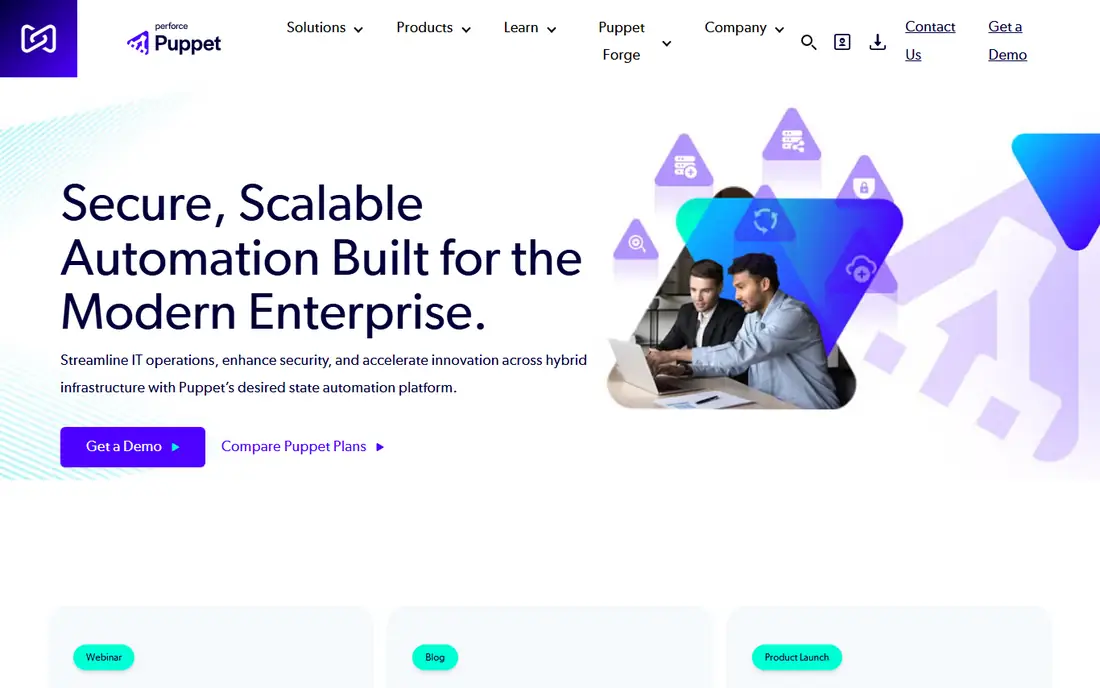
Puppet emphasizes continuous enforcement and compliance reporting, with a model-driven approach and an extensive module ecosystem for managing hybrid infrastructure. Its client-server architecture supports custom configurations and templates, with a strong focus on compliance and reporting, and it handles both software and hardware configurations at large scale. It rates 4.7 out of 5 on G2, reflecting enterprise satisfaction with governance features.
The drawbacks are price variance and agent requirements. Starting prices range from 120 dollars per month to 1,200 dollars per year across sources, with enterprise figures from 11,200 to 19,900 dollars per year for 100 nodes depending on features, and it requires agents on managed nodes. Puppet suits large enterprise IT teams that need governance, compliance, and continuous enforcement.
What we like- Model-driven approach with extensive module ecosystem
- Strong compliance and reporting
- Continuous enforcement of desired state
- 4.7 rating on G2
Watch out for- Starts at 120 dollars per month, or 1,200 dollars per year in some comparisons
- Enterprise figures from 11,200 to 19,900 dollars per year for 100 nodes
- Requires agents on managed nodes
#3Chef
Best for: Policy-driven workflow automation4.3/5 on
G2 (136 reviews, checked Oct 2026)
Visit chef.io
Starting priceFree
Free planYes
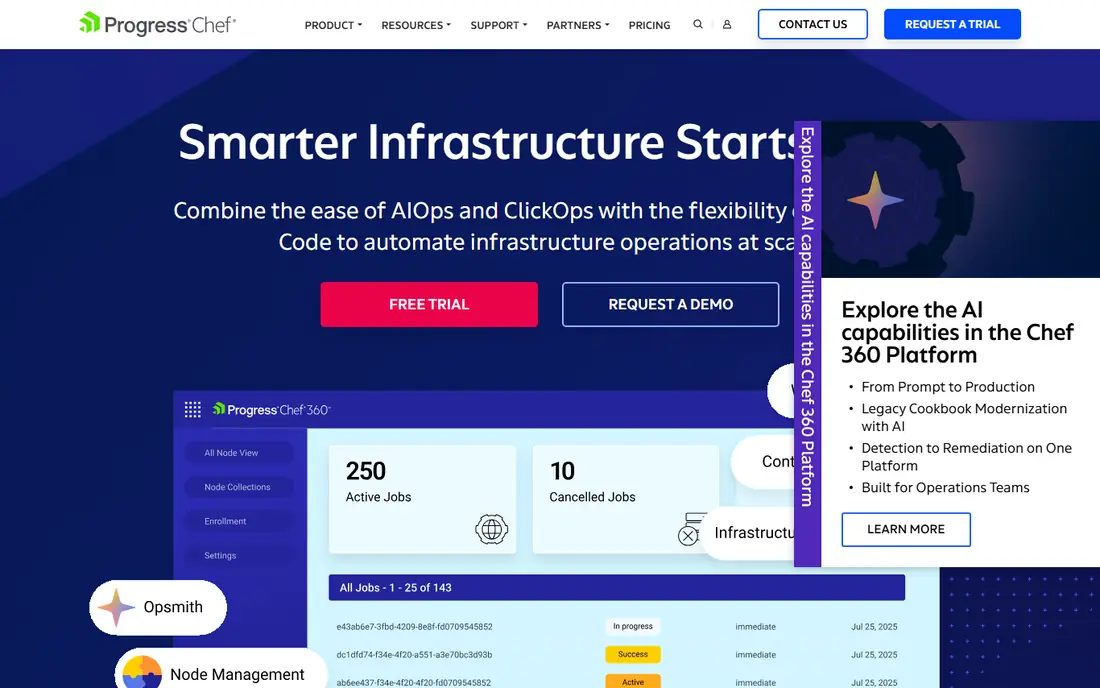
Chef emphasizes policy-as-code and DevOps workflows, with a customizable Ruby-based DSL that gives infrastructure teams deep flexibility for custom infrastructure. Its continuous delivery with automated workflow, compliance and security management, and infrastructure automation suit enterprises with custom needs, and its large active community supports a free open-source version. It rates 4.6 out of 5 on G2.
The drawbacks are price and skill needs. Enterprise pricing ranges from 137 dollars per month to 3,000 dollars per year, with figures up to 13,700 dollars per year for 100 nodes, and per-node pricing near 59 dollars per node per month in one comparison, while Ruby skills are needed for full use. Chef suits DevOps and infrastructure teams with custom infrastructure and Ruby expertise.
What we like- Customizable Ruby-based DSL
- Policy-as-code and DevOps workflows
- Large active community
- Free open-source version
- 4.6 rating on G2
Watch out for- Enterprise pricing from 137 dollars per month, or 3,000 dollars per year, up to 13,700 dollars per year for 100 nodes
- Per-node pricing near 59 dollars per node per month in some comparisons
- Ruby skills needed
Starting priceFree
Free planYes
SaltStack, now the Salt Project, is best known for strong orchestration and event-driven automation, with speed and scalability for large, distributed environments. Its event-driven model reacts to infrastructure events in real time, which suits large-scale automation where timing matters, and it runs on Linux, macOS, and Windows. The Salt Project continues as an open-source project with documentation, releases, and a community, and it rates 4.6 out of 5 on G2.
The drawbacks are enterprise cost and community size. Enterprise pricing is custom, with figures near 15,000 dollars per year in some comparisons, its community is smaller than Ansible or Puppet, and Broadcom ownership of VMware, which stewards Salt, means the roadmap reflects that ownership. SaltStack suits large, distributed environments that need event-driven automation at scale.
What we like- Event-driven automation with real-time speed and scalability
- Free open-source project
- Strong orchestration
- 4.6 rating on G2
- SaltStack Enterprise for real-time automation
Watch out for- Enterprise pricing custom, with figures near 15,000 dollars per year in some comparisons
- Smaller community than Ansible or Puppet
- Broadcom ownership roadmap needs evaluation
#5Terraform
Best for: Cloud infrastructure as code4.6/5 on
G2 (120 reviews, checked Oct 2026)
Visit terraform.io
Starting priceFree
Free planYes
Terraform is the default multi-cloud provisioning tool, creating servers, networks, and cloud resources as code across AWS, GCP, and Azure, with state and drift handling that previews changes before applying them. It rates 4.9 out of 5 on G2, the highest on this list, and its provider and module ecosystem is the broadest for cloud provisioning. Teams commonly pair Terraform with Ansible, since Terraform provisions infrastructure and Ansible configures the servers inside it.
The drawbacks are licensing and scope. Since 2023 Terraform uses BUSL 1.1 under IBM, which is not fully open source, and teams avoiding BUSL restrictions use OpenTofu under MPL 2.0 as an alternative, while Terraform alone does not configure servers inside provisioned resources. Terraform suits cloud infrastructure teams that need multi-cloud provisioning as code.
What we like- Multi-cloud provisioning across AWS, GCP, and Azure
- Infrastructure as code with state and drift handling
- 4.9 rating on G2, highest on this list
- Usage-based cloud pricing
Watch out for- BUSL 1.1 license since 2023, not fully open source
- Provisions infrastructure but does not configure servers inside it
- Cloud pricing usage-based and variable
Starting priceFree
Free planYes
CFEngine is a lightweight configuration management tool ideal for large-scale systems and clusters, with a declarative configuration language, built-in monitoring and compliance checking, and cross-platform support with a focus on Linux environments. Its lightweight agent suits performance-critical applications where heavier agents cost resources, and its security and compliance focus appeals to enterprises with strict audit needs. It rates 4.5 out of 5 on G2.
The drawbacks are platform limits and learning curve. Some comparisons note limited support for non-Linux platforms, its community is smaller with fewer troubleshooting resources, and it can be difficult for new users to set up and maintain. CFEngine suits enterprise IT and sysadmin teams that need lightweight, compliant configuration at scale.
What we like- Lightweight agent ideal for performance-critical applications
- Security and compliance focus
- Scalable for large clusters
- Declarative configuration language
- 4.5 rating on G2
Watch out for- Limited support for non-Linux platforms in some comparisons
- Smaller community and fewer troubleshooting resources
- Difficult for new users to set up
#7Rudder
Best for: Centralized management UI4.3/5 on
G2 (18 reviews, checked Oct 2026)
Visit rudder.io
Starting priceSee website
Free planNo
Rudder offers centralized management with a web UI for enterprises and sysadmins, covering configuration management with compliance and reporting features. Its centralized UI suits teams that want visibility and control from one console, rather than managing playbooks only from the command line. It runs on Linux and macOS, with a focus on enterprise compliance needs.
The drawbacks are price opacity and ecosystem size. Pricing is custom with no published figures, its ecosystem is smaller than Ansible or Puppet, and it is less user-friendly than some alternatives for new teams. Rudder suits enterprises and sysadmins that want a centralized management UI with compliance reporting.
What we like- Centralized management UI for enterprises and sysadmins
- Compliance and reporting focus
- Runs on Linux and macOS
- 4.3 rating on G2
Watch out for- Custom pricing with no published figures
- Smaller ecosystem than Ansible or Puppet
- Less user-friendly than some alternatives for new teams
#8Pulumi
Best for: Multi-language infrastructure scripting4.8/5 on
G2 (25 reviews, checked Oct 2026)
Visit pulumi.com
Starting price$40 per month
Free planYes
Pulumi lets teams write infrastructure as code in real programming languages such as TypeScript, Python, and Go, rather than learning a domain-specific language, which appeals to developer-heavy teams. It offers a free plan, pricing from 40 dollars per month up to 2,000 dollars per month for teams, and an Apache 2.0 license that avoids BUSL concerns. Its multi-language approach suits teams that want infrastructure code reviewed, tested, and versioned like application code.
The drawbacks are ecosystem maturity and scope. Its ecosystem is newer than Terraform, team pricing rises to 2,000 dollars per month, and its infrastructure focus means server configuration depth trails Ansible and Puppet. Pulumi suits teams who want real programming languages for infrastructure as code.
What we like- Real programming languages instead of DSLs
- Apache 2.0 license
- Free plan available
- From 40 dollars per month up to 2,000 dollars per month for teams
- Multi-cloud support
Watch out for- Newer ecosystem than Terraform
- Team pricing rises to 2,000 dollars per month
- Infrastructure focus over server configuration depth
How we chose
We compared configuration management tools on automation model, agent requirements, licensing, enterprise governance, and published pricing, using 2026 DevOps comparisons and G2 ratings. We favored tools with clear model positioning, whether agentless, model-driven, event-driven, or infrastructure-as-code, while noting where enterprise pricing varies widely across sources. We also flagged licensing changes, since Terraform BUSL versus OpenTofu MPL affects long-term choice.
How to choose the best-rated software config management solutions
Start by separating provisioning from configuration: Terraform or Pulumi provision cloud resources, while Ansible, Puppet, Chef, or Salt configure servers inside them, and most teams need both. Next, match the model to your team: Ansible for simplicity and agentless start, Puppet for continuous enforcement and compliance, Chef for policy-as-code with Ruby skills, and Salt for event-driven scale. Then check licensing, especially Terraform BUSL versus OpenTofu MPL, and confirm enterprise pricing for 100 nodes before committing, since figures range from 10,000 to 19,900 dollars per year. Finally, pilot with one environment and measure drift correction, since enforced desired state matters more than feature lists.
Frequently asked questions
What is configuration management software?
It is software that defines infrastructure as code, installs software, applies settings, and enforces desired state on servers, correcting drift when reality differs from code. It keeps large fleets consistent without manual changes per server.
Is Ansible really free?
Yes, Ansible open-source engine is free to use, supported by thousands of contributors, while Red Hat Ansible Automation Platform is the paid enterprise tier with support, hardening, event-driven automation, and AI features.
What is the difference between Terraform and Ansible?
Terraform provisions infrastructure: it creates servers, networks, and cloud resources. Ansible configures them: it installs software and settings inside those resources. Teams commonly use both together.
Which is better, Puppet or Chef?
Both are mature enterprise platforms. Puppet emphasizes continuous enforcement and compliance reporting, while Chef emphasizes policy-as-code and DevOps workflows. Evaluate both against your team skills and audit requirements.
Do I need configuration management if I use Docker and Kubernetes?
You need less of it, but you still need it. Containers reduce server-level configuration, but hosts, networks, and non-containerized systems still drift. Many teams use Terraform and Kubernetes for new workloads and Ansible or Puppet for what remains.
Is Salt still maintained after the Broadcom acquisition?
Yes, the Salt Project continues as an open-source project with documentation, releases, and a community. Broadcom owns VMware, which stewards Salt, so evaluate the roadmap accordingly before committing.
Sources we checked (0)
Is your product missing or out of date?
We review this list regularly. Vendors can request a listing, send updated pricing or ask about featured placement.

Shihab Mia · Founder, Rankite
Shihab has 5+ years in B2B and SaaS SEO. He writes Rankite's software buying guides from pricing pages, documentation and public user reviews. More about Shihab.