How we make this list: we compare pricing pages, product documentation and public user reviews. Ratings come from G2, Capterra or Trustpilot, with the date we checked them.
Key takeaways
- Databricks suits teams that build data and AI workloads on a lakehouse, while Dataiku suits business and data teams that want visual plus code workflows.
- Alteryx and KNIME suit analysts who prefer visual, low-code data preparation, while H2O.ai suits teams that want automated machine learning.
- Domino suits enterprises that need governance and reproducibility for model work, while SageMaker and Vertex AI suit teams already on AWS or Google Cloud.
- Data science platform pricing is often usage-based or quote-based, so model total cost at your data volume and team size before committing.
Quick comparison
| Tool | Best for | Starting price | Free plan |
|---|
 Databricks | Lakehouse data and AI | See website | Free trial |
 Dataiku | Visual plus code teams | See website | Free trial |
 Alteryx | Visual data preparation | See website | Free trial |
 KNIME | Free visual analytics | Free | Yes |
 H2O.ai | Automated machine learning | See website | Free trial |
 Domino | Governed model work | See website | No |
 SageMaker | AWS machine learning | See website | Free trial |
 Vertex AI | Google Cloud AI | See website | Free trial |
Is your product missing or out of date?
We review this list regularly. Vendors can request a listing, send updated pricing or ask about featured placement.
#1Databricks
Best for: Lakehouse data and AI4.6/5 on
G2 (1,383 reviews, checked Oct 2026)
Visit databricks.com
Starting priceSee website
Free planFree trial
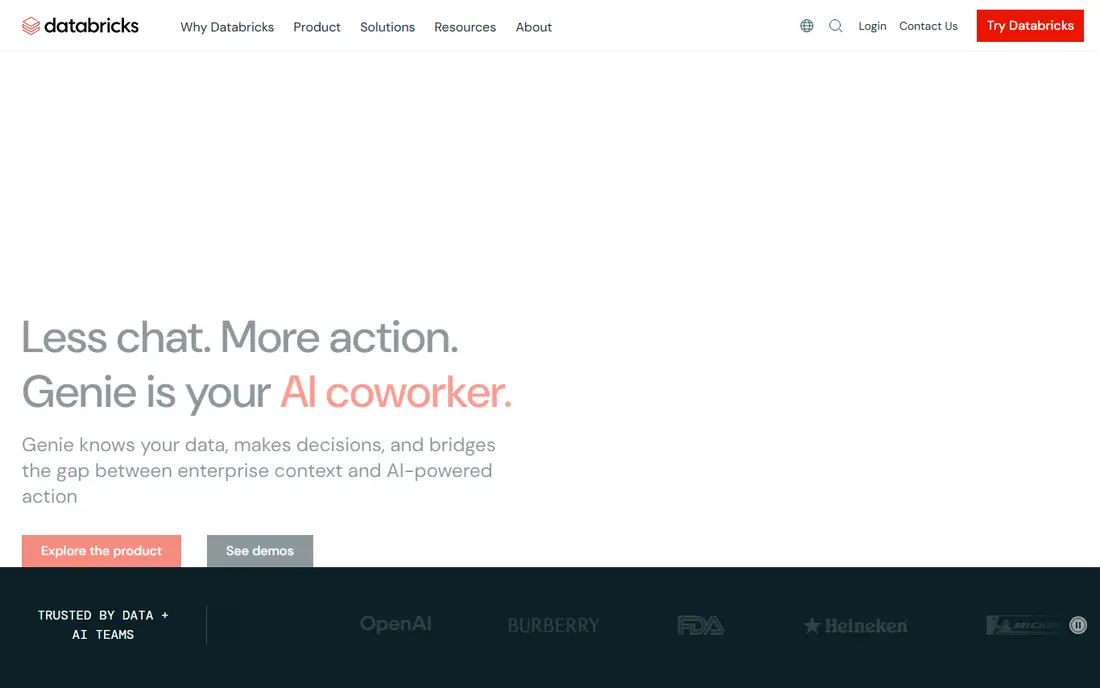
Databricks suits a team that builds data pipelines, analytics and AI models on shared data. The lakehouse combines data warehouse and data lake strengths, so engineers, analysts and data scientists work from the same tables rather than copying data between systems. Notebooks support Python, SQL, Scala and R, with collaboration, versioning and job scheduling built in. For an organization standardizing on a modern data platform, Databricks offers the broadest foundation.
Usage-based pricing for compute and storage can rise quickly with large workloads, so cost monitoring matters. New teams also face a learning curve across Spark, Delta Lake and platform administration. For a data team building production AI workloads at scale, Databricks is a leading platform.
What we like- Unified lakehouse for data engineering, analytics and AI
- Strong Spark and notebook workflows
- Large enterprise adoption
Watch out for- Usage-based pricing can rise with workloads
- Learning curve for new data teams
#2Dataiku
Best for: Visual plus code teams4.4/5 on
G2 (266 reviews, checked Oct 2026)
Visit dataiku.com
Starting priceSee website
Free planFree trial
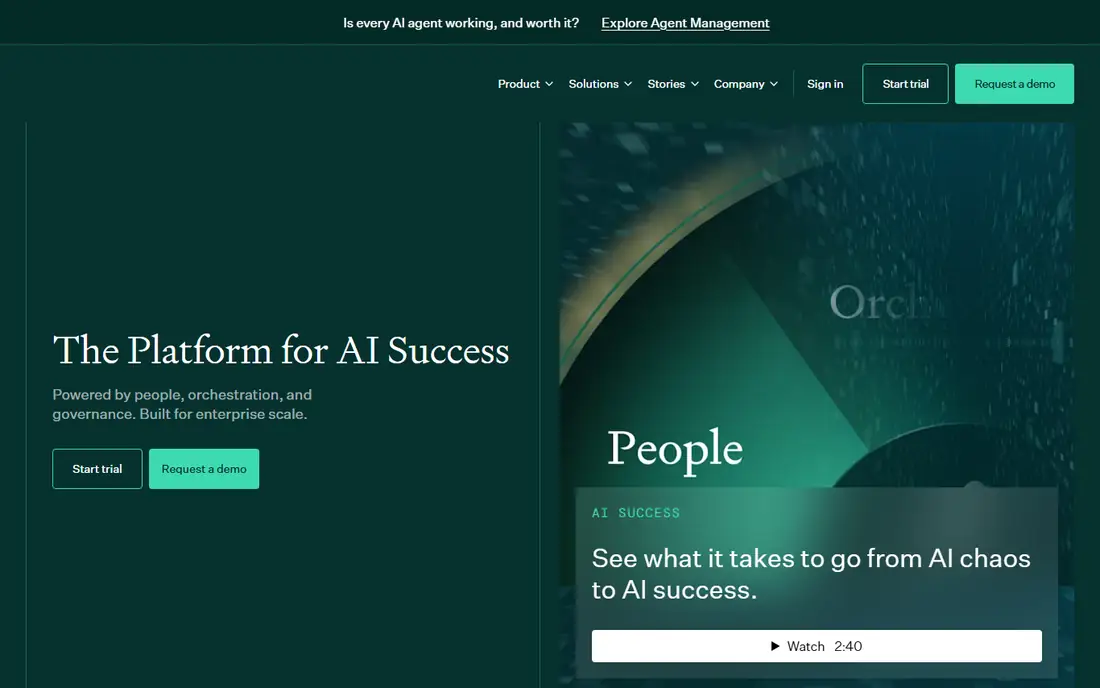
Dataiku suits an organization where business analysts and data scientists must work together. Visual flows let analysts prepare data and build models without code, while data scientists can drop into Python or R notebooks in the same project. Governance tools track datasets, models and permissions, which helps regulated industries show how a model was built. For a team that needs both accessibility and control, Dataiku bridges the gap well.
Enterprise pricing suits larger organizations, and code-first teams may find the Databricks community larger for Spark work. A small team may also find Dataiku heavy for simple analysis. For collaborative, governed data science across business and technical teams, Dataiku is a top choice.
What we like- Visual flows plus code notebooks
- Strong governance and collaboration
- Good for business and data teams together
Watch out for- Enterprise pricing
- Smaller community than Databricks for code-first teams
#3Alteryx
Best for: Visual data preparation4.6/5 on
G2 (951 reviews, checked Oct 2026)
Visit alteryx.com
Starting priceSee website
Free planFree trial
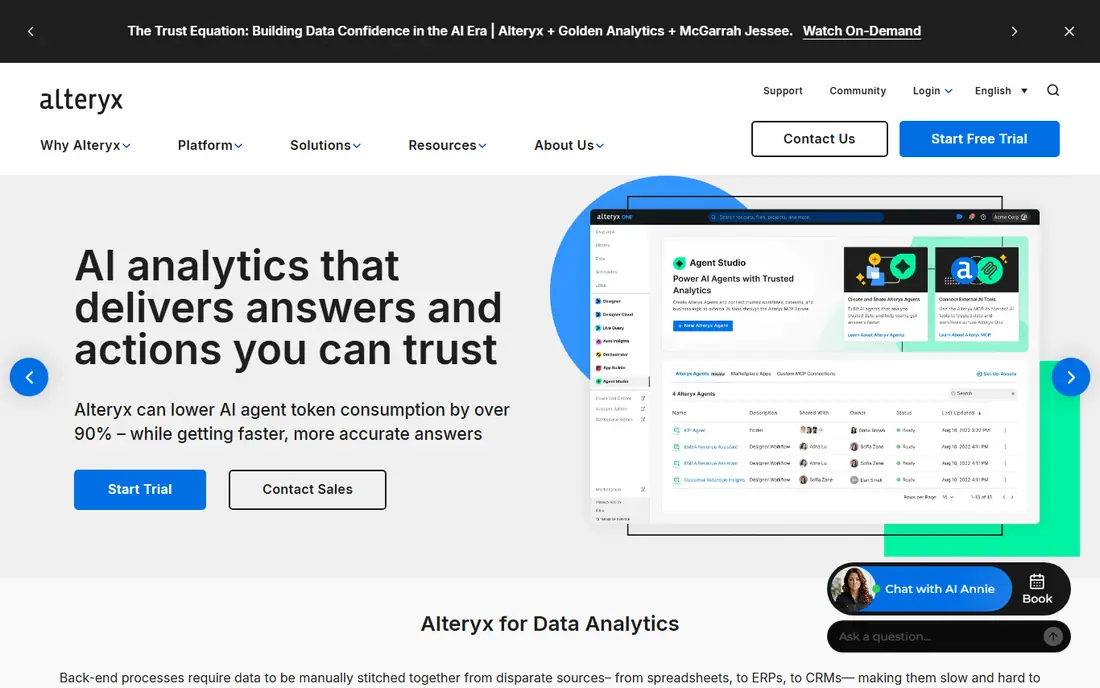
Alteryx suits an analyst who prepares, blends and analyzes data visually without writing code. Drag-and-drop tools clean, join, transform and model data, with scheduling and automation for recurring workflows. That approach helps finance, marketing and operations analysts who need answers fast without waiting for a data engineering team. For a business analyst audience, Alteryx is the most accessible serious data tool in this list.
Licensing costs add up per user, and deep code-first machine learning fits less naturally than on Databricks or SageMaker. A team of data scientists may prefer a code platform. For visual data preparation and analyst-led analytics, Alteryx remains a strong pick.
What we like- Visual drag-and-drop data preparation
- Strong for analysts without coding
- Good automation and scheduling
Watch out for- Licensing costs add up
- Less suited to deep code-first machine learning
#4KNIME
Best for: Free visual analytics4.5/5 on
G2 (118 reviews, checked Oct 2026)
Visit knime.com
Starting priceFree
Free planYes
KNIME suits a learner, student or small team that wants visual analytics for free. The open-source platform offers a large library of nodes for data access, cleaning, modeling and visualization, all connected in visual workflows. That makes KNIME excellent for teaching data science concepts and for small projects that do not justify a paid platform. Community extensions add many more capabilities at no cost.
The interface feels technical for a pure business user, and enterprise features such as server scheduling and collaboration cost extra. Performance on very large data also trails cloud platforms. For free, visual data science and learning, KNIME is unmatched.
What we like- Free open-source visual analytics
- Large node library
- Good for learning and small teams
Watch out for- Interface feels technical for pure business users
- Enterprise server features cost extra
#5H2O.ai
Best for: Automated machine learning4.6/5 on
Capterra (10 reviews, checked Oct 2026)
Visit h2o.ai
Starting priceSee website
Free planFree trial
H2O.ai suits a team that wants to build and compare machine learning models fast. Automated machine learning trains many models, tunes them and ranks results, which helps a team move from data to a credible baseline quickly. The open-source H2O core is free, while the enterprise platform adds collaboration, deployment and governance. For a team that needs strong models without hand-tuning every algorithm, H2O.ai saves significant time.
Enterprise pricing applies to the full platform, and the product range across open-source and cloud versions can confuse new users. A team that needs end-to-end data engineering may still need Databricks or Dataiku alongside H2O. For automated machine learning, H2O.ai is a leading specialist.
What we like- Strong automated machine learning
- Open-source H2O core
- Good for fast model building and comparison
Watch out for- Enterprise platform pricing
- Interface and docs vary across open-source and cloud products
#6Domino
Best for: Governed model work4.3/5 on
G2 (28 reviews, checked Oct 2026)
Visit domino.ai
Starting priceSee website
Free planNo
Domino suits an enterprise data science team that must prove how models were built, tested and deployed. Reproducibility tools capture code, data, environments and results for every run, while governance features control access, review and deployment. That audit trail matters in finance, healthcare and other regulated industries, where a model decision may need explaining months later. For a governed enterprise team, Domino offers control that lighter platforms lack.
Pricing suits enterprises, and a small team without governance pressure may find Domino heavy. A team that mainly needs notebooks and pipelines may prefer Databricks. For governed, reproducible model work at enterprise scale, Domino is a strong choice.
What we like- Strong reproducibility and governance for models
- Collaboration for data science teams
- Audit trails
Watch out for- Enterprise pricing
- Best for larger teams with governance needs
Starting priceSee website
Free planFree trial
Amazon SageMaker suits a team already running on AWS. Notebooks, data preparation, training, tuning, deployment and monitoring cover the full machine learning lifecycle inside one AWS service, with scaling handled by cloud infrastructure. Integration with S3, Redshift and other AWS services keeps data close to models, which helps performance and governance. For an AWS organization, SageMaker is the natural machine learning platform.
AWS complexity and usage billing require care, since compute, storage and endpoint costs can rise with model traffic. Teams new to cloud may face a steep learning curve across IAM, networking and service limits. For AWS-based machine learning at scale, SageMaker offers the deepest integration available.
What we like- Full machine learning lifecycle on AWS
- Notebooks, training, deployment and monitoring
- Scales with AWS services
Watch out for- AWS complexity and usage billing
- Learning curve for teams new to cloud
Starting priceSee website
Free planFree trial
Vertex AI suits a team already running on Google Cloud. It covers data preparation, AutoML, custom training, deployment and monitoring, with access to Google foundation models including Gemini, plus BigQuery integration for large-scale analytics. That combination helps a team move from warehouse data to deployed models without leaving Google Cloud. For a Google Cloud organization, Vertex AI is the natural AI platform.
Cloud complexity and usage billing apply, since model training and endpoint traffic drive costs that vary by model size. Teams new to Google Cloud may need time to learn IAM and project structure. For Google Cloud AI work, Vertex AI offers a complete and well-integrated platform.
What we like- Full AI lifecycle on Google Cloud
- Strong AutoML and Gemini model access
- BigQuery integration
Watch out for- Google Cloud complexity
- Usage billing varies with models and endpoints
How we chose
We compared vendor product pages, feature lists and public reviews for data science platforms serving US teams. We looked for data preparation, notebook and visual workflows, model building, deployment, governance and honest pricing. We did not claim hands-on testing, and we used "See website" where pricing is usage-based or quote-based, since data platform costs depend on workloads and team size.
Start with your team and your cloud. A code-first team on a lakehouse should evaluate Databricks, while a mixed business and data team should evaluate Dataiku. An analyst-led team should trial Alteryx or KNIME, while an AWS or Google Cloud team should start with SageMaker or Vertex AI for integration. A regulated enterprise should add Domino to the shortlist for governance.
Next, run a real project end to end in a trial, from raw data to a deployed model or report, and measure time, cost and team effort. Check data governance, access controls and model monitoring early, since those features are painful to add later. Finally, model total cost at realistic data volumes, including compute, storage, user licenses and support, before committing to a platform for a year or more. Plan model monitoring from day one, since data drift can quietly degrade a deployed model, and set alerts for accuracy drops, data changes and endpoint failures before users notice problems. Document each model decision in plain language, so a future teammate can rebuild it without guessing.
Frequently asked questions
Which data science platform is best for beginners?
KNIME is best for a free, visual start, since it teaches data workflows without code or cost. Dataiku also suits beginners on a team, with visual flows plus code options as skills grow, while Alteryx suits business analysts who want visual preparation.
Do I need to code to use a data science platform?
No, not always. KNIME, Alteryx and Dataiku visual flows let analysts build data workflows without code, while Databricks, SageMaker and Vertex AI suit code-first teams. Most real projects mix visual and code work as team skills vary.
How much does a data science platform cost?
It varies widely. KNIME open source is free, while Databricks, SageMaker and Vertex AI bill by usage, and Dataiku, Alteryx, H2O.ai and Domino price by quote or license. Model cost at your data volume and team size before choosing.
What is AutoML?
AutoML, or automated machine learning, trains and compares many models automatically, tuning settings and ranking results. H2O.ai, Vertex AI AutoML and SageMaker Autopilot offer AutoML, which helps teams reach a strong baseline model faster than manual tuning alone.
Can I use more than one platform?
Yes, and many teams do. A team might prepare data in Databricks, build models in H2O.ai, and govern deployment in Domino, or use SageMaker for training and Dataiku for business collaboration. Integration and data movement costs matter, so keep the stack as simple as the work allows.
Sources we checked (8)
- https://www.databricks.com
- https://www.dataiku.com
- https://www.alteryx.com
- https://www.knime.com
- https://h2o.ai
- https://domino.ai
- https://aws.amazon.com
- https://cloud.google.com
Is your product missing or out of date?
We review this list regularly. Vendors can request a listing, send updated pricing or ask about featured placement.

Shihab Mia · Founder, Rankite
Shihab has 5+ years in B2B and SaaS SEO. He writes Rankite's software buying guides from pricing pages, documentation and public user reviews. More about Shihab.