How we make this list: we compare pricing pages, product documentation and public user reviews. Ratings come from G2, Capterra or Trustpilot, with the date we checked them.
Key takeaways
- Retail content is product content first: titles, attributes, images, and prices that must stay identical across your store, Amazon, Walmart, and every marketplace.
- Salsify and Akeneo manage that product data core. Salsify adds the largest retailer syndication network and digital shelf analytics; Akeneo is the mid market to enterprise PIM standard.
- Amplience, Contentstack, and Contentful manage the experience layer: the pages, campaigns, and content wrapped around the product data.
- Plytix and Pimcore give smaller retailers a route in, with a freemium PIM and an open core platform respectively.
- Buy the data layer first. Beautiful pages fed by wrong product data convert worse than plain pages fed by right data.
Quick comparison
| Tool | Best for | Starting price | Free plan |
|---|
 Salsify | Syndication and the digital shelf | See website | No |
 Akeneo | Product information management | See website | No |
 Amplience | Retail content and experience management | See website | No |
 Contentstack | Headless content for retail brands | See website | No |
 Plytix | Small catalogues getting organised | Free | Yes |
 Pimcore | Owning PIM, DAM, and CMS in one platform | See website | Yes |
 Bynder | Product and brand asset management | See website | No |
 Contentful | Content across store, app, and channels | $300 per month | Yes |
Is your product missing or out of date?
We review this list regularly. Vendors can request a listing, send updated pricing or ask about featured placement.
The best content platforms for retail
#1Salsify
Best for: Syndication and the digital shelf4.4/5 on
G2 (129 reviews, checked Oct 2026)
Visit salsify.com
Starting priceSee website
Free planNo

Salsify is built around a simple retail truth: the brand does not control the shelf, the retailer does, and the brand's job is to feed every shelf perfectly. Its product experience management platform holds the product content, enriches it per retailer template, syndicates it to the major retail and marketplace network, and then measures the result with digital shelf analytics, search rank, content compliance, availability, and pricing, so a brand can see its products as shoppers see them.
The prices are enterprise and the implementations measured in months, which confines Salsify to brands and retailers with serious channel counts. It also carries an ownership note worth knowing: private equity firm Cinven agreed to acquire Salsify in July 2026. For consumer brands whose revenue depends on how they show up at Walmart and Amazon, Salsify is the category reference.
What we like- Product experience management built for brands selling through retailers
- Syndication network reaching the major retailers and marketplaces
- Digital shelf analytics show how products rank, price, and appear
- Enhanced content support for rich retailer product pages
Watch out for- Enterprise pricing and implementation timelines
- Best value lands for brands with many retail endpoints
- DAM and syndication modules layer into a bigger suite
- Ownership is changing, Cinven agreed to acquire Salsify in July 2026
#2Akeneo
Best for: Product information management4.4/5 on
G2 (248 reviews, checked Oct 2026)
Visit akeneo.com
Starting priceSee website
Free planNo
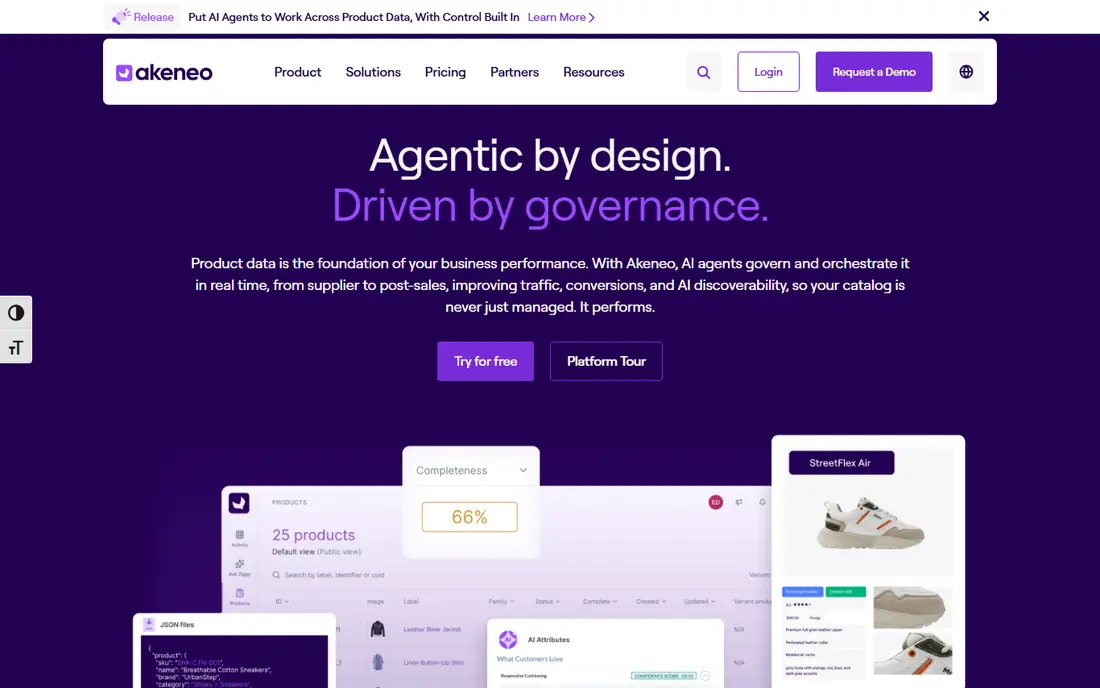
Akeneo is the product information management system retailers name first. It collects product data from suppliers and spreadsheets into one governed model, attributes, families, locales, and channels, enriches it with workflows and completeness scores, and exports it to the store, the marketplaces, and the print catalogue. Its multilingual strength suits retailers selling across markets.
Akeneo's honesty is its scope: it manages product content, not experiences, so it pairs with a storefront or CMS rather than replacing one. Pricing is quoted by edition and catalogue scale. For a retailer whose core pain is product data chaos, spreadsheet versions, missing attributes, marketplaces rejecting feeds, Akeneo is the standard prescription, and 2026 reviews continue to place it as the PIM benchmark.
What we like- The widely adopted PIM for mid market to enterprise catalogues
- Strong multilingual and multi channel product data modelling
- AI assisted enrichment features and a large partner ecosystem
- Editions scale from growth companies to global retailers
Watch out for- A data platform, it does not design or publish your storefront pages
- Pricing by quote
- Enrichment and governance discipline still required from your team
- Some AI features are newer additions to an older core
Starting priceSee website
Free planNo
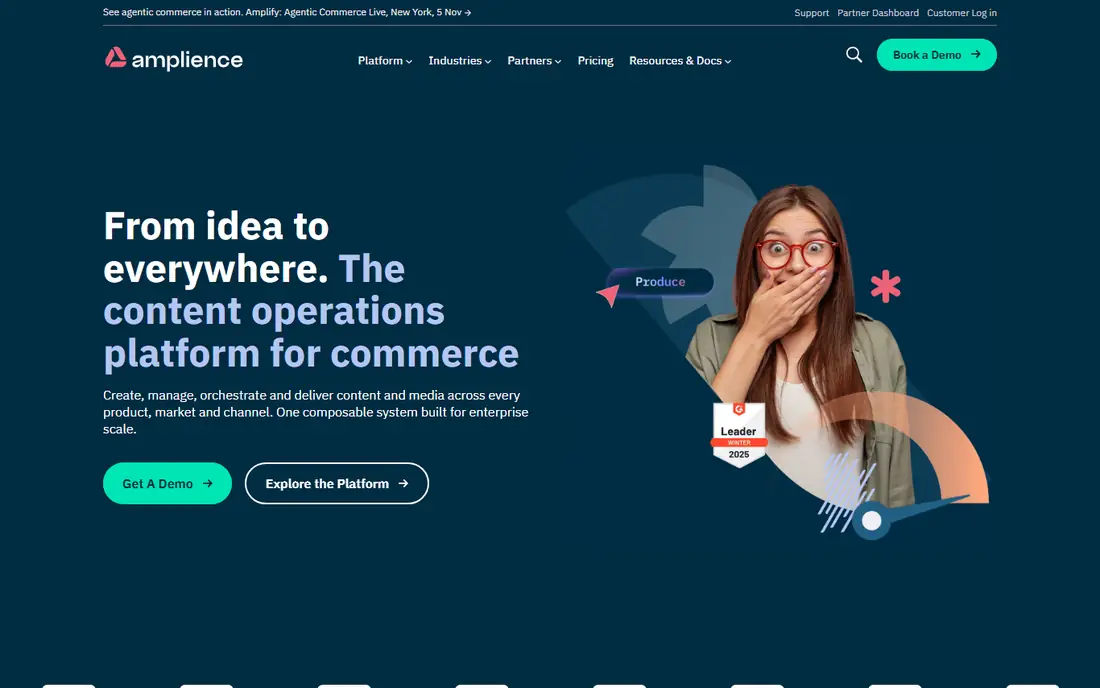
Amplience is the retail specialist on the experience side. Where generalist CMS vendors serve everyone, Amplience serves retailers: campaign content, lookbooks, product media, and promotional scheduling, delivered through APIs to the storefront, the app, and store screens. Its dynamic media engine resizes and optimises images and video per device, which matters when one product shoot becomes forty channel formats.
Retailers pick Amplience when the trading calendar is the content problem, weekly campaigns, seasonal drops, sale events, each needing content staged, approved, and published on schedule across channels. Pricing is quoted. Pair it with Akeneo or Salsify underneath and the two layers cover the retail content stack between them.
What we like- Built specifically for retail content and media at scale
- Dynamic media delivery optimises product imagery and video automatically
- Content scheduling suits campaigns, drops, and trading calendars
- Headless APIs feed store, app, and screens from one library
Watch out for- Experience layer only, product data still lives in a PIM or commerce platform
- Enterprise pricing by quote
- Smaller name outside retail than generalist CMS vendors
- Value depends on content volume and campaign pace
Starting priceSee website
Free planNo
Contentstack is the headless CMS large retail brands choose for the experience layer: brand sites, campaign hubs, loyalty content, and editorial that sits around the catalogue. Its pitch to retailers is agility, marketers publish without developer tickets, while governance keeps multi brand, multi region estates consistent, and automation features handle the repetitive publishing work.
Like the other enterprise entries, Contentstack publishes no price list; contracts scale with users, projects, and traffic. It does not replace a PIM: the product record still lives in Akeneo or Salsify, and Contentstack presents the story around it. For a retail group running several brands and markets, that combination is the common architecture.
What we like- Mature headless CMS with a strong retail customer base
- Visual editing and automation features reduce developer bottlenecks
- Personalisation and brand tooling for multi brand retailers
- Enterprise governance, workflows, and localisation built in
Watch out for- Pricing by quote at enterprise levels
- Front ends must be built and maintained
- Product data still belongs in a PIM for catalogue heavy retailers
- Implementation partners usually involved
#5Plytix
Best for: Small catalogues getting organised4.7/5 on
G2 (445 reviews, checked Oct 2026)
Visit plytix.com
Starting priceFree
Free planYes
Plytix is the PIM for the retailer still running the catalogue from spreadsheets. Its free plan lets a small team put product data, images, and attributes into one system and push clean feeds to Shopify, Amazon, and Google Shopping, and paid plans raise the limits as the assortment grows. Review roundups rate it the best free option for small catalogue teams.
The ceiling is scale and governance. A retailer with hundreds of thousands of SKUs, supplier portals, and compliance workflows belongs on Akeneo or Salsify. For the long tail of retail, the independent group, the growing DTC brand adding marketplaces, Plytix solves the actual problem at a price that starts at nothing.
What we like- Freemium PIM a small retailer can start today
- Centralises product data, images, and channel exports in one friendly tool
- Built in feeds for the major marketplaces and storefronts
- Fast setup measured in days, not implementation projects
Watch out for- Catalogue and channel limits grow with paid plans
- Not built for enterprise governance or huge assortments
- Experience and page building are out of scope
- Advanced analytics sit in higher tiers
#6Pimcore
Best for: Owning PIM, DAM, and CMS in one platform4.5/5 on
G2 (50 reviews, checked Oct 2026)
Visit pimcore.com
Starting priceSee website
Free planYes
Pimcore is the control choice. Instead of buying a PIM, a DAM, and a CMS separately, a retailer with developers runs one open core platform that models products, assets, and content together and builds exactly the experiences its channels need. Its Community Edition is free for non production use and for companies under the licence's revenue threshold, with Professional and Enterprise editions above it.
The trade is ownership of the build. Pimcore rewards technical teams and punishes hopeful ones; there is no vendor roadmap doing the work for you. Retailers and distributors with genuinely unusual data, configurators, spare parts, regulated attributes, keep choosing it for that reason. Budget for the developers as the real licence cost.
What we like- One open core platform for PIM, master data, assets, and content experiences
- Total control of the data model for unusual catalogues
- Community Edition free for smaller companies under its licence terms
- Self host or run on Pimcore's cloud
Watch out for- Developer led: it is a platform to build on, not a finished product
- Production use at larger revenue requires paid editions
- Implementation quality depends on your partner or team
- The breadth can tempt over engineering
#7Bynder
Best for: Product and brand asset management4.5/5 on
G2 (1,184 reviews, checked Oct 2026)
Visit bynder.com
Starting priceSee website
Free planNo
Retail content fails quietly at the asset layer: the old pack shot on a marketplace listing, the superseded video in a franchisee's hands. Bynder is the digital asset management platform that governs that library, one approved version of every image and video, with metadata, expiries, and portals where stores and partners help themselves.
Bynder does not compete with the PIMs above; it completes them, and it integrates with the commerce and CMS stack most retailers run. Pricing is quoted. For multi store and franchise retailers, where consistency across locations is the brand promise, the asset layer is not optional, and Bynder is its best known specialist.
What we like- One governed library for product images, video, and campaign files
- Versioning and rights control stop outdated assets reaching channels
- Self service portals for stores, franchisees, and partners
- Integrates with PIM and CMS layers
Watch out for- Asset layer only, it holds no product data and builds no pages
- Pricing by quote aimed at mid market and larger
- Taxonomy and migration effort upfront
- Overlaps with DAM features bundled in Salsify and Adobe class suites
#8Contentful
Best for: Content across store, app, and channels4.3/5 on
G2 (399 reviews, checked Oct 2026)
Visit contentful.com
Starting price$300 per month
Free planYes
Contentful is the default headless option when a retailer's content must appear everywhere at once: the flagship store's screens, the app, the website, and the loyalty emails, all from one structured source. Its pricing is unusually public for this category, a free plan to start and paid tiers from $300 per month, with enterprise arrangements above.
Retailers should be clear about its layer: Contentful manages content and experiences, while prices, stock, and the product record belong to commerce and PIM systems. Within that boundary it is proven at large scale and easy to hire for. For a retailer modernising the experience layer without a full replatform, Contentful is a safe, standard answer.
What we like- The best known headless content platform, with a huge developer ecosystem
- Structured content feeds store, app, email, and screens from one model
- Visible pricing tiers, free plan, then paid plans from $300 per month
- Strong localisation and workflow features for multi market retailers
Watch out for- Costs climb with spaces, users, and usage at scale
- Commerce and product data still live in your commerce platform or a PIM
- Front end build and maintenance is on your team
- Enterprise features require the premium tiers
How we chose
We assembled the retail stack as retailers buy it: product data (Salsify, Akeneo, Plytix, Pimcore), experiences (Amplience, Contentstack, Contentful), and assets (Bynder), using 2026 PIM and digital shelf comparisons from Catsy, Hypotenuse AI, Credencys, and SpotSaaS, checked in October 2026. The Salsify ownership note comes from Credencys reporting on the July 2026 Cinven agreement. We left out commerce platforms themselves, since the store is the channel, not the content platform, and generalist website builders with no catalogue story.
What to look for in a content platform for retail
Map your channels before you shop. A retailer selling only on its own store needs a lighter stack than a brand feeding thirty retail partners, because syndication, per retailer templates and compliance checking, is what Salsify class platforms exist to do. Count your SKUs and your update frequency too: prices and promotions that change daily punish manual workflows in a way seasonal catalogues never feel.
Insist on the data model demo. Every vendor shows beautiful pages; ask instead how a product with forty attributes, six images, three locales, and a retailer specific variation is created, approved, and corrected across channels. That workflow is the product. Finally, plan for the newest reader: shopping assistants and search engines now consume structured product data directly, so complete, accurate attributes are no longer back office hygiene. They are how products get found.
Frequently asked questions
What is the difference between a PIM and a CMS in retail?
A PIM manages the product record: names, attributes, specifications, images, prices by channel, and translations, and feeds it everywhere products are sold. A CMS manages pages and experiences: homepages, campaigns, articles, and landing pages. Retailers generally need the PIM first, because product data errors cost sales on every channel at once, and add the experience layer as their content ambitions grow.
Which platform is best for a small retailer?
Plytix, because it starts free and solves the spreadsheet problem in days: one place for product data and images, with clean exports to the store and marketplaces. Bynder is beyond a small retailer's budget and need; Contentful's free plan suits a small team building content experiences. Graduate to Akeneo when the catalogue, the channels, or the team outgrow Plytix's limits.
How much do retail content platforms cost?
Most of this category is priced by quote, scaled to catalogue size, channels, and users, which is why so many entries here read See website. The visible exceptions are Plytix, free to start, Contentful, free plan then paid tiers from $300 per month, and Pimcore, whose Community Edition is free within its licence terms. Implementation and data migration routinely cost more than the first year's licences; get both numbers in writing before choosing.
What is digital shelf analytics, and who needs it?
It is measurement of how your products appear where they are sold: search rank on a retailer's site, content completeness, price and promotion accuracy, ratings, and stock visibility. Brands selling through retailers need it, Salsify builds it in, because they cannot walk their own shelves online. A retailer selling only through its own store gets the same answers from its own analytics and needs it less.
Sources we checked (0)
Is your product missing or out of date?
We review this list regularly. Vendors can request a listing, send updated pricing or ask about featured placement.

Shihab Mia · Founder, Rankite
Shihab has 5+ years in B2B and SaaS SEO. He writes Rankite's software buying guides from pricing pages, documentation and public user reviews. More about Shihab.