How we make this list: we compare pricing pages, product documentation and public user reviews. Rankite is independent; if a vendor ever pays for a featured spot, that listing is clearly labeled Partner.
Key takeaways
- Bloomerang is the donor-retention-focused CRM that small to mid-size nonprofits love.
- Salesforce Nonprofit Cloud is the enterprise platform for large organizations.
- Little Green Light is the affordable donor database for small nonprofits.
- Blackbaud Raiser's Edge NXT remains the fundraising powerhouse for established development shops.
Quick comparison
Is your product missing or out of date?
We review this list regularly. Vendors can request a listing, send updated pricing or ask about featured placement.
The best nonprofit CRM software
Starting priceSee website
Free planNo
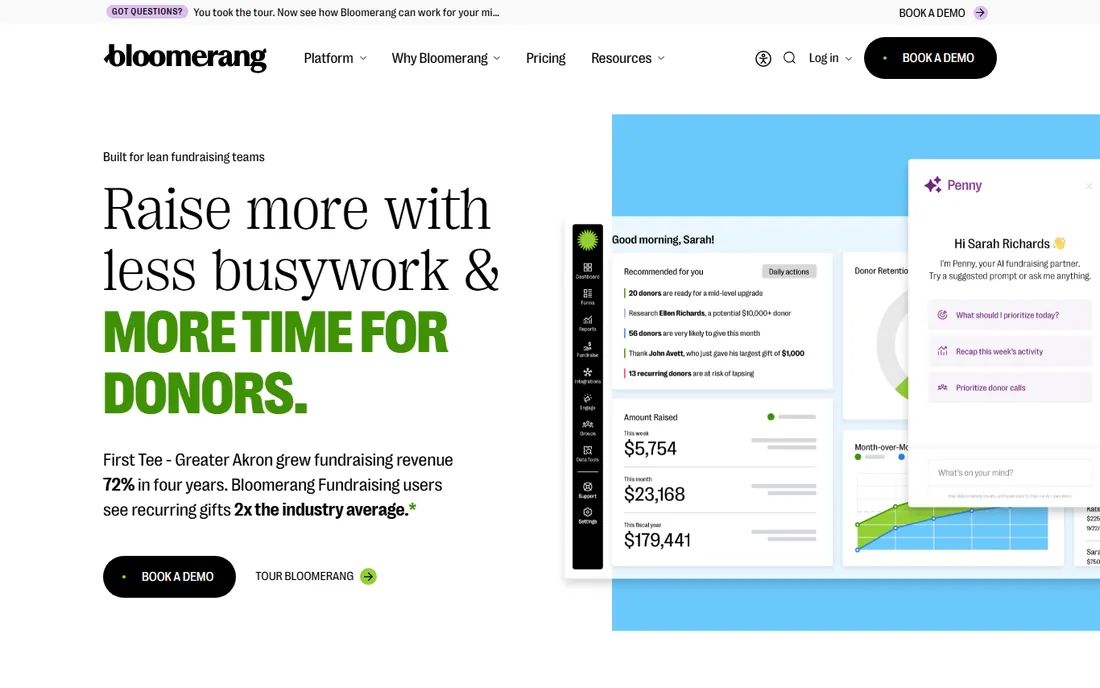
Bloomerang built its CRM around donor retention: engagement scoring, generosity indicators and dashboards that show which donors need attention. Small to mid-size nonprofits get fundraising tools their staff actually use, with support that gets consistently strong reviews.
Enterprise fundraising depth trails Blackbaud and Salesforce. Pricing scales with contacts. For nonprofits where keeping donors matters more than acquiring them, Bloomerang's retention focus is the right philosophy.
What we like- Donor retention analytics
- Easy to use
- Strong support
Watch out for- Less depth than Blackbaud
- Pricing by contact count
Starting priceSee website
Free planNo
Salesforce Nonprofit Cloud (the evolution of NPSP) brings the world's leading CRM to nonprofits: fundraising, programs, grants, marketing and analytics on one platform with an enormous partner ecosystem. Large nonprofits and foundations run their entire operations on it.
Complexity and cost are real; you need admin expertise or a partner. For enterprise nonprofits with the staff to wield it, no platform matches Salesforce's power and extensibility.
What we like- Most powerful platform
- Huge ecosystem
- Scales infinitely
Watch out for- Complex and expensive
- Needs admin expertise
Starting priceSee website
Free planNo
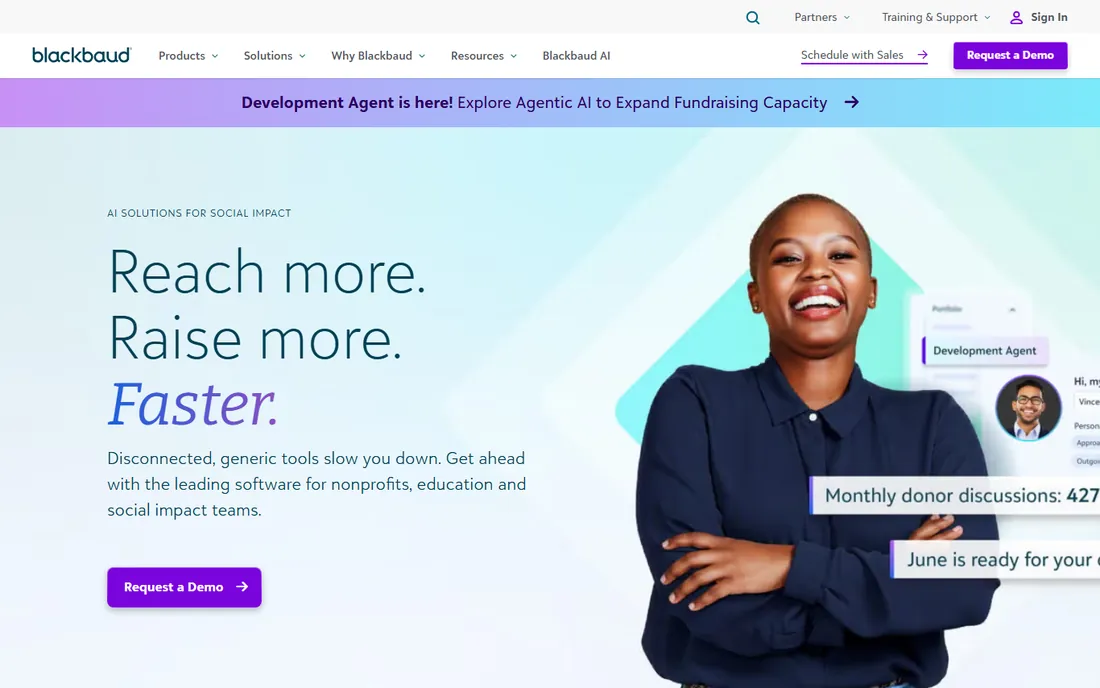
Raiser's Edge NXT is the fundraising CRM that defined the category: prospect management, major gifts, campaigns, events and analytics with depth no competitor matches. Established development shops with sophisticated fundraising run on it.
Pricing is premium and the interface shows its age. For nonprofits with professional fundraising operations and complex campaigns, Raiser's Edge remains the industry standard.
What we like- Deepest fundraising functionality
- Major gift tools
- Industry standard
Watch out for- Premium pricing
- Interface aging
Starting priceSee website
Free planFree trial
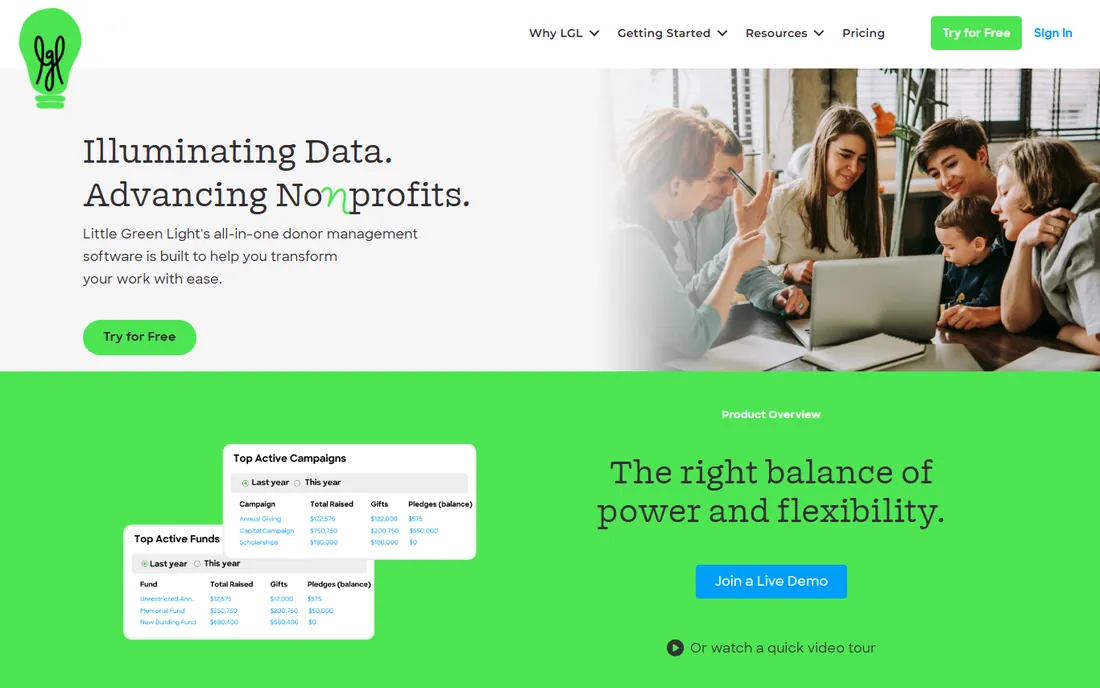
Little Green Light is the donor database for small nonprofits: affordable, straightforward, and focused on the essentials (donors, gifts, acknowledgments, reports). One-person development shops manage their entire donor base without enterprise software.
Advanced features (major gift pipelines, complex analytics) are thinner. For a small nonprofit that needs a real donor database without a real enterprise budget, Little Green Light is the honest value choice.
What we like- Very affordable
- Easy to use
- Great for small shops
Watch out for- Fewer advanced features
- Smaller vendor
Starting priceSee website
Free planNo
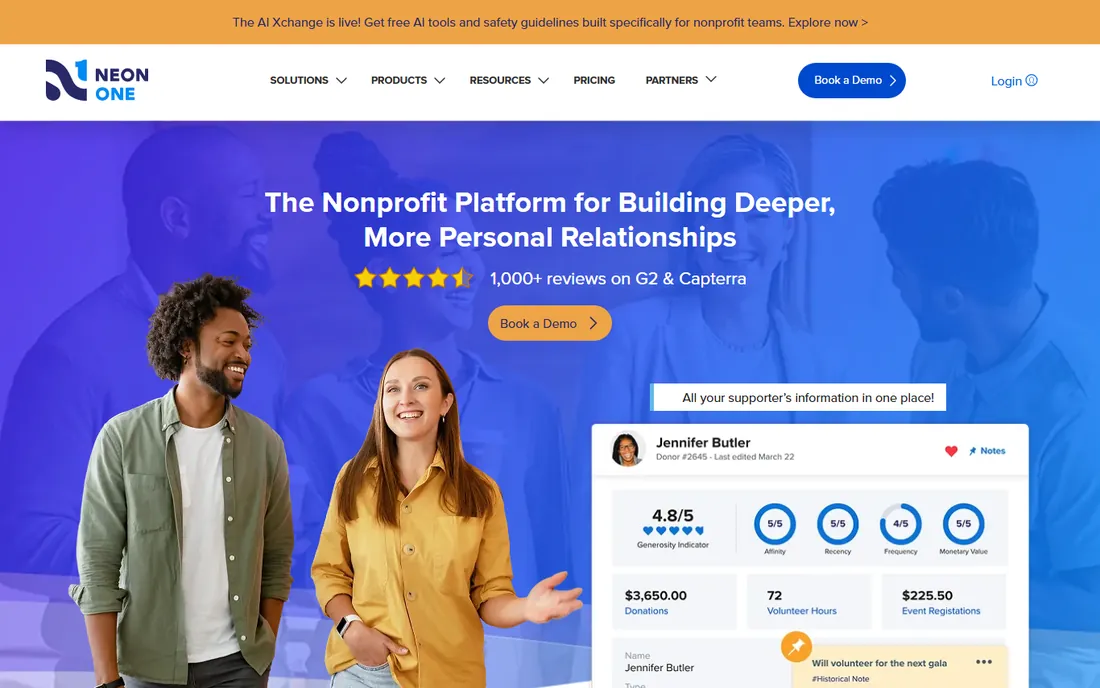
Neon CRM (part of Neon One) combines donor management with events, membership, fundraising pages and email: an all-in-one suite for nonprofits that want one vendor. Arts, associations and community nonprofits get breadth at reasonable pricing.
Depth in any single area trails specialists. For nonprofits that need CRM plus events plus membership without three subscriptions, Neon's suite value is compelling.
What we like- CRM plus events, membership, fundraising
- Good value
- Neon One ecosystem
Watch out for- Jack-of-all-trades depth
- Interface busy
Starting priceSee website
Free planNo
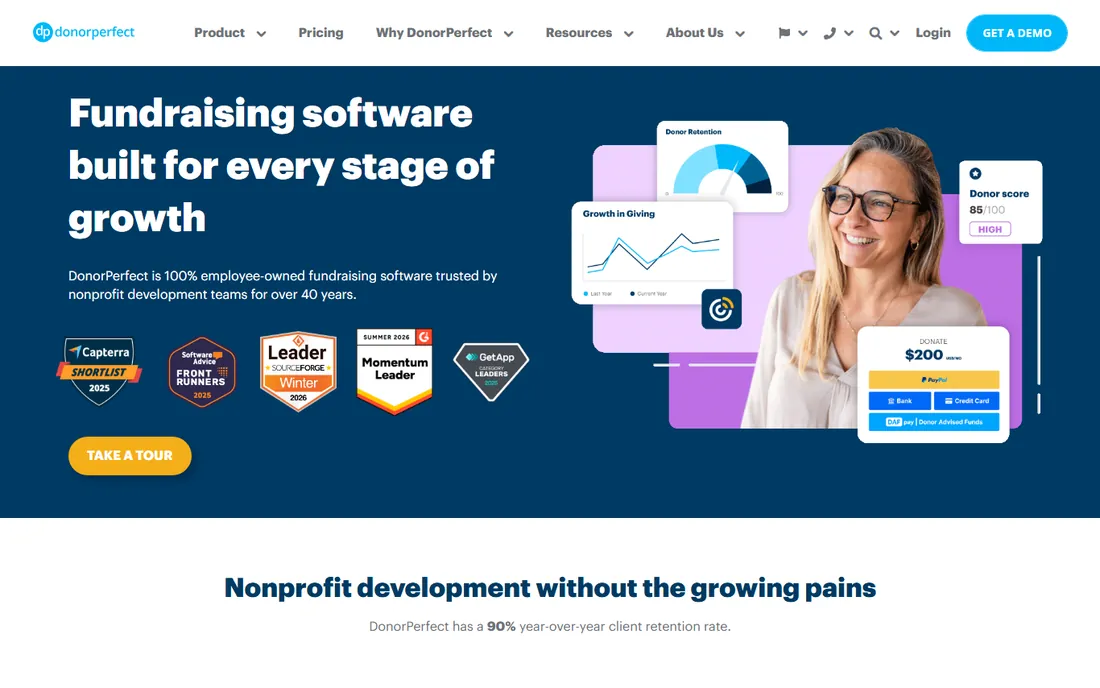
DonorPerfect has served fundraising nonprofits for decades: donor management, online giving, events, reports and the workflows development staff know. The focus stays on raising money, and the reporting supports board-ready fundraising analysis.
The interface reflects its history, and costs grow with add-ons. For nonprofits with active fundraising programs that want proven tools, DonorPerfect's longevity counts.
What we like- Fundraising-focused
- Good reporting
- Scales with growth
Watch out for- Interface dated in places
- Add-ons add cost
Starting priceSee website
Free planNo
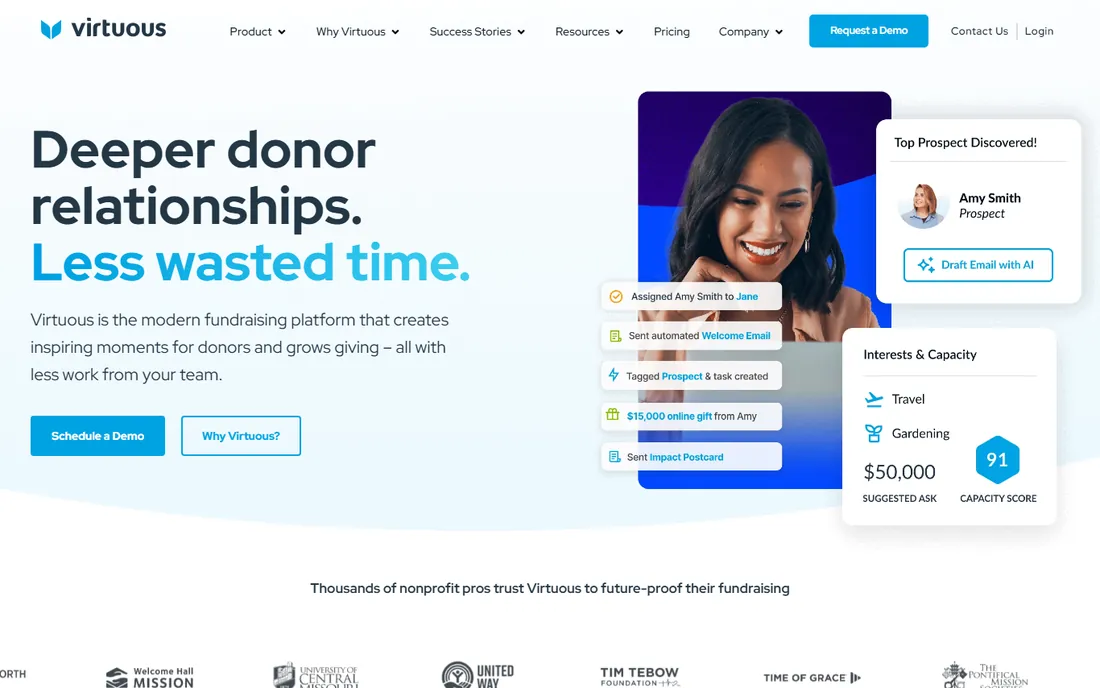
Virtuous built its CRM around "responsive fundraising": using donor signals to personalize outreach automatically. Marketing automation, donor journeys and a modern interface appeal to nonprofits that think like marketers.
Pricing requires a conversation, and the methodology is part of the package. For nonprofits ready to run personalized, signal-driven fundraising, Virtuous provides both the philosophy and the platform.
What we like- Responsive fundraising methodology
- Automation
- Modern interface
Watch out for- Quote-based
- Methodology commitment
Starting priceSee website
Free planNo
Bonterra (formed from Social Solutions, EveryAction, Network for Good and others) is the largest social good software company: fundraising, engagement, case management and corporate giving across a huge portfolio. Enterprise nonprofits and foundations find whatever they need somewhere in the suite.
The portfolio's breadth creates complexity in choosing and integrating. Pricing is enterprise. For large organizations wanting one social-good vendor, Bonterra's scale is unmatched.
What we like- Massive social good portfolio
- EveryAction heritage
- Enterprise scale
Watch out for- Enterprise pricing
- Portfolio complexity
Starting priceSee website
Free planFree trial
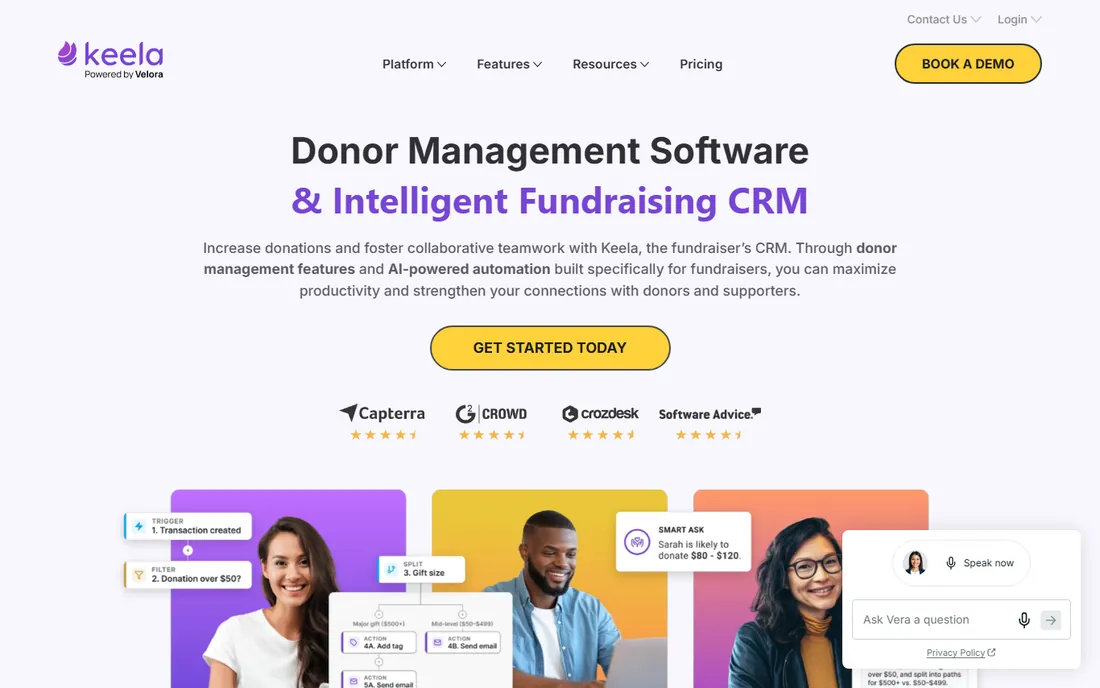
Keela gives small nonprofits a CRM with donations, email marketing, volunteer management and reporting at accessible pricing. The simplicity suits teams without dedicated database staff.
Large-organization depth is not here. For a small nonprofit that needs donor management plus email in one affordable tool, Keela covers the essentials well.
What we like- Affordable and simple
- Good for small teams
- Email built in
Watch out for- Less depth for large shops
- Smaller vendor
CRM vs donor database: what is the difference
Traditional donor databases (Little Green Light, DonorPerfect) track gifts and donors. Modern nonprofit CRMs (Bloomerang, Virtuous, Salesforce) manage relationships: engagement scoring, journeys, marketing automation and multi-channel touchpoints. The category is converging, but the philosophy differs. If your fundraising is relationship-driven, buy the CRM philosophy; if it is gift-tracking-driven, the database suffices.
Data migration: the hidden project
Moving donor history (gifts, notes, relationships, duplicates) is the hardest part of any CRM switch. Budget for data cleanup: deduplication, gift history mapping and staff training. Most vendors offer migration services; verify what actually transfers and test with a data sample before committing. A clean migration determines whether staff trust the new system.
Monthly giving programs: the revenue engine
Monthly donors are the most valuable supporters a nonprofit can have: they give more per year than one-time donors, they renew at dramatically higher rates, and they provide the predictable revenue that lets organizations plan. A donor giving $25 monthly contributes $300 annually, often more than their previous one-time gifts, and stays for years. Yet many nonprofits treat monthly giving as an afterthought, a checkbox on the donation form rather than a flagship program. The CRM should make monthly giving a first-class program with its own workflows, communications and metrics, because the organizations that invest here transform their financial stability.
The donation form is where monthly programs succeed or fail. Monthly giving must be the prominent, default-encouraged option, not a small toggle hidden below the one-time button. Pre-select monthly (with one-time easily chosen), show the annual impact of the monthly amount ("$25/month provides school supplies for a classroom all year"), and minimize the fields required. Every additional field costs conversions. The CRM's form builder should support this natively; if monthly giving requires custom development, the platform is behind. Also offer multiple payment methods for recurring gifts: cards expire and fail, while ACH bank transfers persist for years with lower fees. Donors who give via ACH have significantly higher lifetime value purely through reduced involuntary churn.
Failed payment recovery is the unglamorous work that saves enormous revenue. Cards expire, get replaced, hit limits. Without a dunning process, these donors silently lapse. The CRM should automate the recovery sequence: notify the donor before expiry when possible, retry failed charges on a smart schedule, and send update-payment links that take thirty seconds to complete. Each step recovers a meaningful percentage; together they preserve the majority of at-risk revenue. Track the involuntary churn rate monthly and treat it as a key metric. Organizations that manage this well keep monthly donor retention above 90 percent; those that ignore it bleed 20 to 30 percent annually without realizing.
Sustainer-specific communication builds the loyalty that retention requires. Monthly donors should hear from you differently: welcome series explaining their impact, regular updates showing what their ongoing support accomplishes, and exclusive touches (a yearly impact report, a thank-you call for anniversary milestones). Do not treat them like one-time donors who happen to repeat; they are your closest supporters and should feel it. But avoid the trap of asking sustainers for additional gifts constantly; nothing sours a monthly donor faster than feeling their commitment is never enough. One well-crafted upgrade appeal per year is plenty.
Measure the program with cohort metrics, not just totals. Track new sustainers acquired per month, 12-month retention by acquisition cohort, average monthly gift trends, and lifetime value versus one-time donors. These numbers guide investment: if social media acquires sustainers who retain at 80 percent while events acquire at 50 percent, shift the budget. Set a public goal for sustainer count; the whole organization rallies around "1,000 monthly donors" in a way it never does around "increase recurring revenue 15 percent." Monthly giving compounds quietly for years, then suddenly it is the foundation everything else stands on.
Create a simple sustainer welcome series that triggers automatically on the first recurring gift: an immediate thank-you explaining the impact, a 30-day update showing what monthly donors collectively accomplished, and a 90-day personal note from a program staff member. This three-touch sequence measurably lifts 12-month retention, because donors who understand their ongoing impact in the first 90 days stay for years. Automation handles the delivery; the content should feel personal, not programmatic.
Frequently asked questions
How much does nonprofit CRM software cost?
Little Green Light and Keela run tens of dollars monthly. Bloomerang, Neon and DonorPerfect run hundreds. Blackbaud, Salesforce and Bonterra run thousands to tens of thousands annually. Pricing usually scales with contacts or records.
Do nonprofits get discounts?
Yes. Salesforce offers nonprofit pricing through its Power of Us program. Many vendors have nonprofit tiers. Always ask; the listed price is often not the nonprofit price.
Can it handle online donations?
Yes, all these platforms process online gifts directly or integrate with giving tools. Confirm the processing fees and whether donors cover them. The donation page quality affects conversion.
How do we migrate from spreadsheets?
Start with data cleanup before choosing software: standardize names, deduplicate, define gift types. Then use the vendor's import tools or migration services. Most small nonprofits can migrate in weeks; large ones take months.
What about email marketing?
Bloomerang, Virtuous, Neon and Keela include email. Others integrate with Mailchimp or Constant Contact. If email is central to your fundraising, prefer built-in over integrated.
How long does implementation take?
Small nonprofits: 4 to 8 weeks. Mid-size: 2 to 4 months. Enterprise (Salesforce, Blackbaud): 6 to 12 months with partners. Data migration and staff training dominate the timeline.
How we chose
We compared the nonprofit CRMs organizations actually buy, from small-shop databases to enterprise platforms. Pricing is tier or quote-based across the category. We weighted donor management depth, fundraising tools, ease of use for nonprofit staff and honest fit for different organization sizes. No hands-on testing was performed; assessments rest on documentation and public reviews.
Sources we checked (9)
- https://bloomerang.com/
- https://www.salesforce.com/
- https://www.blackbaud.com/
- https://www.littlegreenlight.com/
- https://neonone.com/
- https://www.donorperfect.com/
- https://virtuous.org/
- https://www.bonterra.com/
- https://www.keela.co/
Is your product missing or out of date?
We review this list regularly. Vendors can request a listing, send updated pricing or ask about featured placement.

Shihab Mia · Founder, Rankite
Shihab has spent more than a decade helping SaaS and e-commerce brands grow through search. He writes Rankite's software buying guides from pricing pages, documentation and public user reviews. More about Shihab.
 Bloomerang
 Salesforce Nonprofit Cloud
 Blackbaud Raiser's Edge NXT
 Little Green Light
 Neon CRM
 DonorPerfect
 Virtuous
 Bonterra
 Keela
Keela