How we make this list: we compare pricing pages, product documentation and public user reviews. Ratings come from G2, Capterra or Trustpilot, with the date we checked them.
Key takeaways
- Insight Timer and Medito give you a real daily practice for free, while Headspace and Calm charge about $70 a year for a more guided path.
- Headspace is the clearest starting point for a complete beginner, thanks to its step-by-step Basics course.
- Calm stands out for sleep, with more than 500 Sleep Stories, soundscapes, and sleep meditations.
- Balance builds a personal plan from your answers each day, and Happier focuses on bringing mindfulness into ordinary moments.
- Meditation apps support a daily habit, but they are not a substitute for professional care. This is not medical advice, and anyone dealing with serious anxiety, depression, or trauma should talk to a clinician.
Quick comparison
| Tool | Best for | Starting price | Free plan |
|---|
 Headspace | Structured beginner courses | $12.99/month or $69.99/year | Free trial |
 Calm | Sleep stories and soundscapes | $14.99/month or $69.99/year | Free trial |
 Insight Timer | A huge free meditation library | $9.99/month or $59.99/year | Yes |
 Balance | A personal plan that adapts daily | $11.99/month or $69.99/year | Free trial |
 Waking Up | Depth, theory, and philosophy | See website | Free trial |
 Happier | Mindfulness in everyday life | $99.99/year | Yes |
 Medito | A fully free practice | Free | Yes |
 Breethe | Sleep, hypnosis, and relaxation | See website | Free trial |
 Smiling Mind | Free programs for families and schools | Free | Yes |
Is your product missing or out of date?
We review this list regularly. Vendors can request a listing, send updated pricing or ask about featured placement.
The best mindfulness meditation apps
#1Headspace
Best for: Structured beginner courses4.6/5 on
G2 (68 reviews, checked Oct 2026)
Visit headspace.com
Starting price$12.99/month or $69.99/year
Free planFree trial
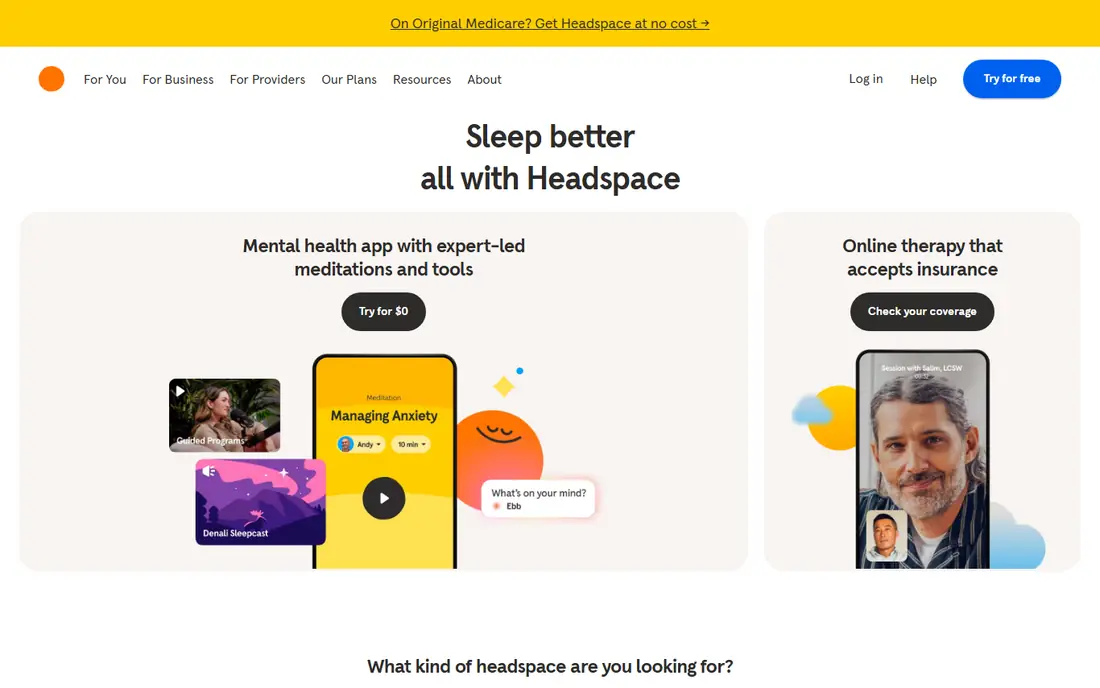
Headspace opens with a simple promise: tell it what you want help with, and it points you to a course. The Basics course teaches one skill at a time across short sessions, so a new meditator never has to guess what to do next. That structure is the main reason Headspace still leads for beginners, even with strong free rivals around.
Beyond the courses, Headspace covers sleep with sleepcasts and wind-downs, plus quick tools for stress in the middle of a workday. The app also offers movement sessions and focus music, which makes it useful beyond the cushion. Subscriptions auto-renew monthly or annually, and student, family, and gift plans are available.
The trade-off is price. Once the trial ends, most of the library sits behind the subscription, and at $69.99 a year it costs more than a free app that covers the same basics. If you already meditate daily and pick your own sessions, the guided structure may feel like more hand-holding than you need.
What we like- Clear Basics course for beginners
- Short sessions for busy days
- Sleepcasts and soundscapes included
Watch out for- Little content stays free after the trial
- The library can feel small next to Insight Timer
Starting price$14.99/month or $69.99/year
Free planFree trial
Calm is the app people reach for at night. Its Sleep Stories library, narrated by familiar voices, is the largest in this list, and it adds new stories every week. Soundscapes cover rain, ocean waves, and colored noise, and a sleep check-in feature tracks nightly sleep quality so patterns become visible over time.
For daytime practice, Calm starts with 7 Days of Calm, then 21 Days of Calm, before opening into themed collections on anxiety, stress, focus, and gratitude. The Breathe Bubble gives a 60-second breathing exercise for moments of acute stress, and Panic SOS offers in-the-moment help. Kids get their own Sleep Stories with familiar characters, which makes one subscription work for a household.
The weakness is focus. Calm packs meditation, sleep, music, and masterclasses into one app, and pure meditation practice can feel buried. The free tier covers only a handful of sessions, so most people will need the $69.99 annual plan to get real value.
What we like- More than 500 Sleep Stories
- A strong 7 Days of Calm starter program
- Breathing tools for acute stress
Watch out for- Meditation can get lost among sleep and music content
- The free tier is very limited
Starting price$9.99/month or $59.99/year
Free planYes
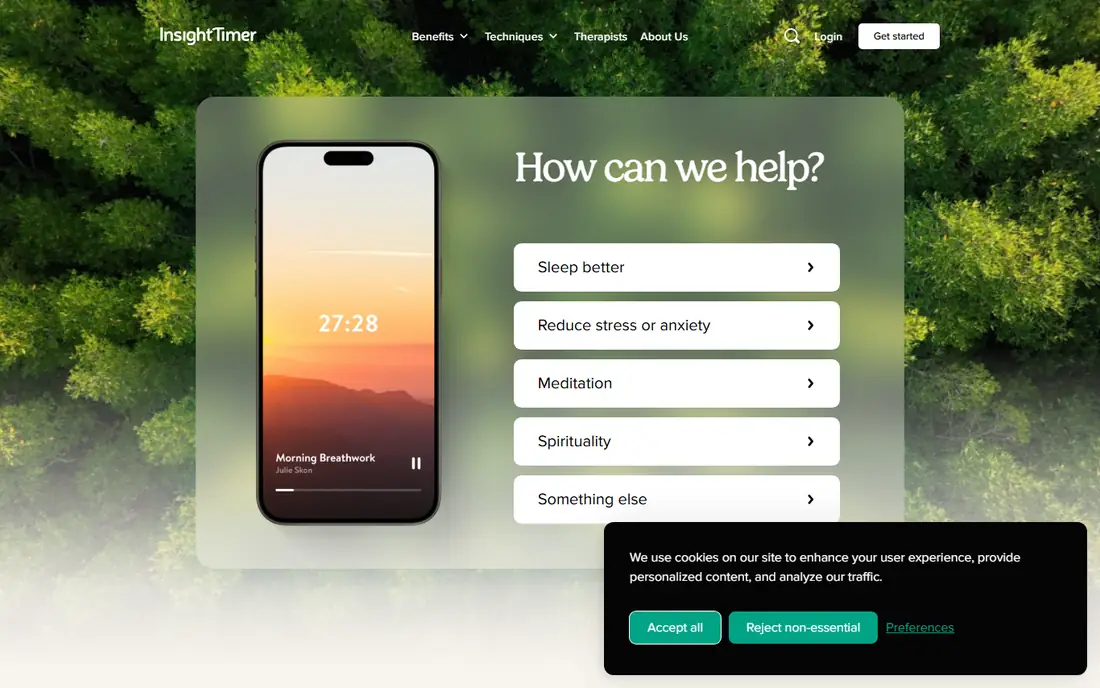
Insight Timer is the best free option in this list by a wide margin. Its homepage describes the largest library of free guided meditations anywhere, with tracks from psychologists, teachers, and spiritual leaders, plus live yoga streamed through the day. A customizable timer with ambient sounds covers unguided practice, and community features show other people meditating at the same time.
The free tier is genuinely usable for a daily habit, not a teaser. Member Plus, at $9.99 a month or $59.99 a year, adds offline listening, advanced courses, and an ad-free experience, but you can maintain a rich practice without paying. Breathwork, sleep content, journaling, and mood tracking round out the app.
Two honest drawbacks remain. Because many teachers can publish, quality varies, and finding a teacher you trust takes some trial and error. The library is so large that new users can spend more time browsing than meditating, so following a few teachers early helps.
What we like- Hundreds of thousands of free guided meditations
- Live yoga and events
- A customizable timer
Watch out for- Quality varies between teachers
- The sheer volume can feel overwhelming
Starting price$11.99/month or $69.99/year
Free planFree trial
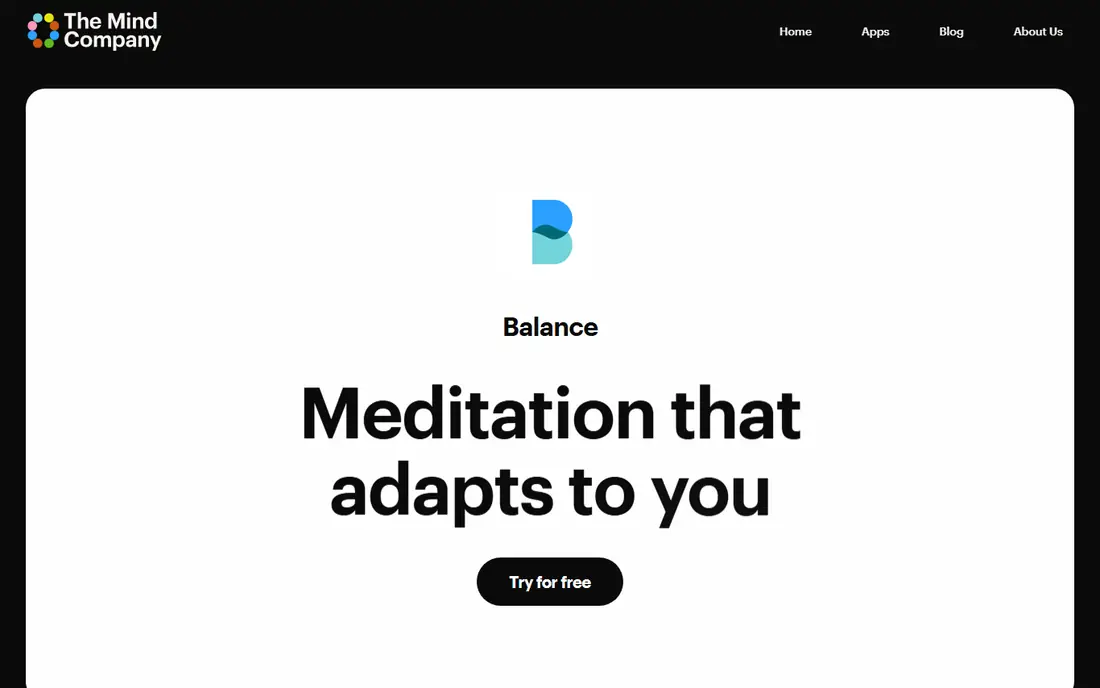
Balance takes a different approach from the rest of this list. Each day it asks about your goals, experience, stress, and obstacles, then assembles meditations from a library of thousands of audio files to match. The more you share over time, the better the plan fits, which suits people who want the app to decide for them.
Guidance comes from meditation experts, and the app covers stress, sleep, focus, and mood in one program. It also offers interactive features such as vibration-based immersive meditations and a Wind Down single for the end of the day. Balance was named Google Play's Best App of 2021, and its design stays clean and calm.
The catch is patience. The personal plan needs a few days of answers before it feels truly personal, and people who like to browse a giant library may find the guided path narrow. The subscription runs $11.99 a month or $69.99 a year after the trial.
What we like- A daily plan built from your answers
- Guidance from experienced teachers
- An award-winning design
Watch out for- Personalization takes a few days to settle in
- Less browsing freedom than Insight Timer
Starting priceSee website
Free planFree trial
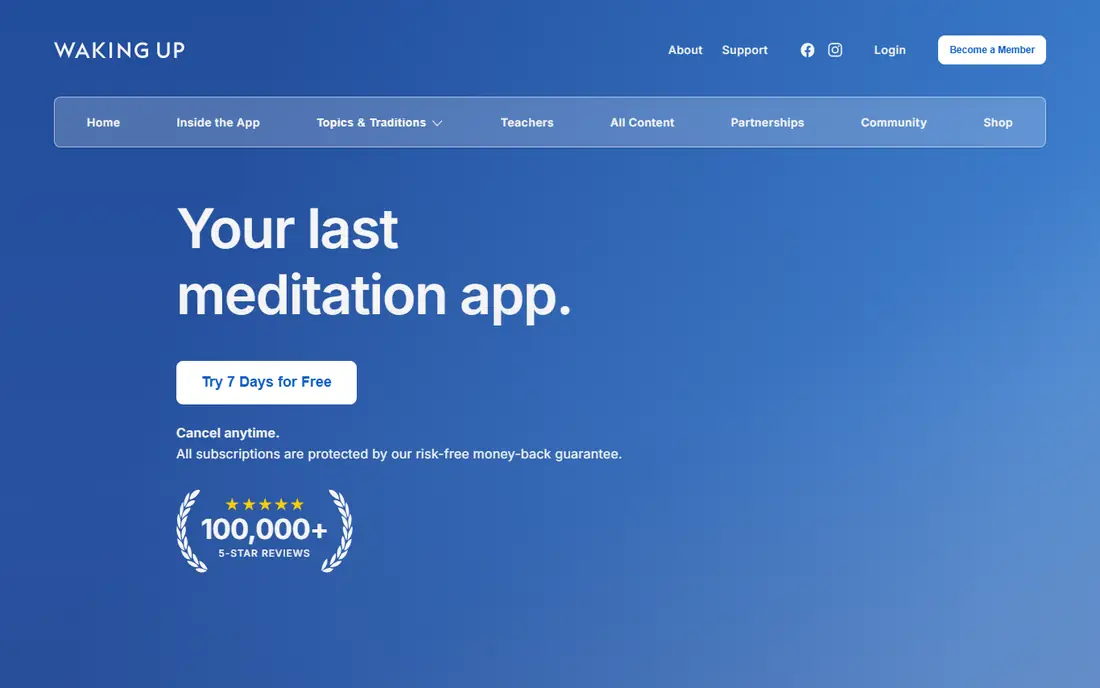
Waking Up, created by neuroscientist and author Sam Harris, treats meditation as a skill worth understanding, not just a habit to repeat. The introductory course pairs daily meditation with short lessons on the theory behind the practice, and the library adds conversations with more than 100 teachers, plus archival talks from figures such as Alan Watts and Joseph Goldstein.
The app takes a secular approach, so no beliefs or spiritual commitments are required. Daily meditations arrive fresh each morning, an unguided timer covers silent sits, and playlists let you build your own sequences. Members also get access to a private community forum with local meetups.
Waking Up is the most expensive-feeling pick here in tone, if not in price, because its lessons demand attention and patience. People who want a quick ten-minute wind-down may find the theory lessons heavy. Anyone who cannot afford the subscription can request a free scholarship membership, with no questions asked.
What we like- A thorough introductory course
- Lessons from neuroscience, philosophy, and psychology
- A scholarship for anyone who cannot afford it
Watch out for- Theory-heavy style is not for everyone
- Pricing is not shown plainly on the homepage
Starting price$99.99/year
Free planYes
Happier, formerly Ten Percent Happier, is built around a practical question: how does mindfulness help during an ordinary day? Its courses cover meditation basics, taming anxiety, focus, relationships, and mindful eating, and its guided meditations run from 5 minutes to 90 minutes. Teachers include long-practicing names from the Insight Meditation tradition, such as Sharon Salzberg and Joseph Goldstein.
The free tier is unusually generous for a paid app. A free account includes two courses, The Basics and The Dalai Lama's Guide to Happiness, plus more than 500 guided meditations. The subscription, at $99.99 a year, opens everything, including podcasts a week early and ad free, plus subscriber-only shows.
Happier works only on phones, tablets, and watches, with no desktop or web version, which matters if you meditate at a desk. The conversational, skeptic-friendly tone is the main draw, and it suits people who bounced off more mystical-sounding apps.
What we like- A free tier with 500 guided meditations
- Courses on anxiety, focus, and relationships
- Teacher-led, conversational style
Watch out for- No desktop or web app
- The full library needs the $99.99 annual subscription
Starting priceFree
Free planYes
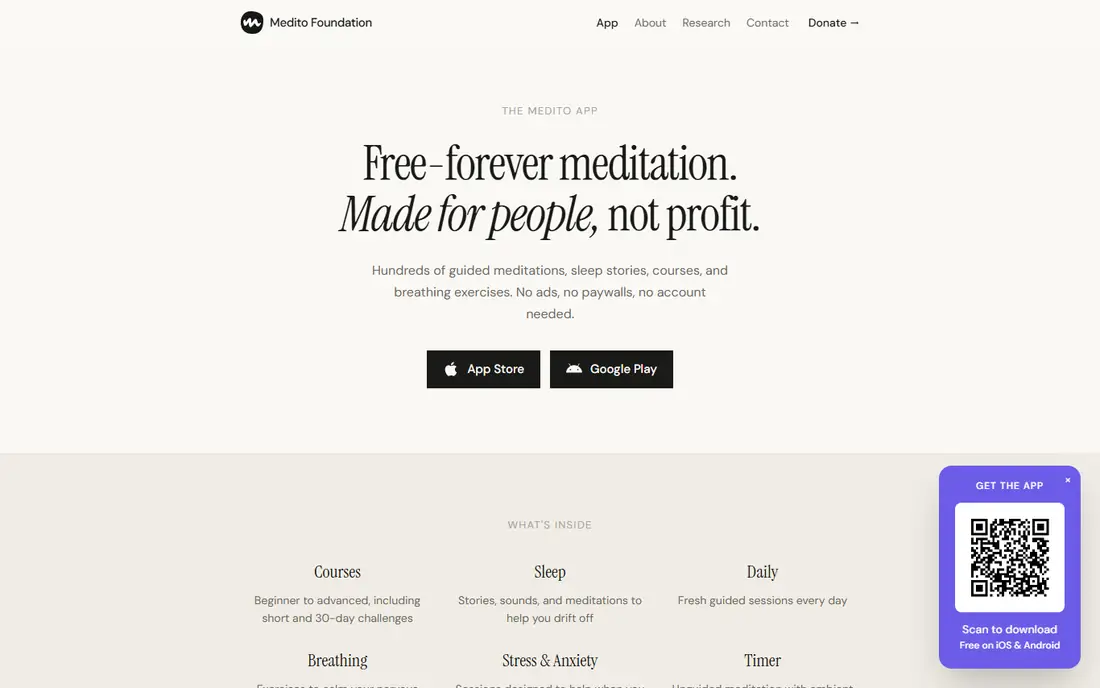
Medito is a registered charity, and its app shows it. Every meditation is free, forever, with no trial period, no premium tier, and no ads. You can download it and start meditating in under a minute, with no email or sign-up, and the code is open source.
Inside, you get beginner to advanced courses, including 30-day challenges, sleep stories and sounds, fresh daily sessions, breathing exercises, and an unguided timer with ambient sounds. Sessions for stress and anxiety are easy to find, and the app reports more than 4.1 million downloads with a 4.9-star app store rating.
The library is smaller than Insight Timer's, and content is English-focused, so variety is the main limit. For a new meditator on a budget, though, Medito removes every barrier at once: no cost, no account, no upsell waiting at the end of a trial.
What we like- Everything free, forever, with no ads or paywall
- No account needed
- Courses, sleep stories, and breathing exercises included
Watch out for- Smaller library than Insight Timer
- English-focused content
Starting priceSee website
Free planFree trial
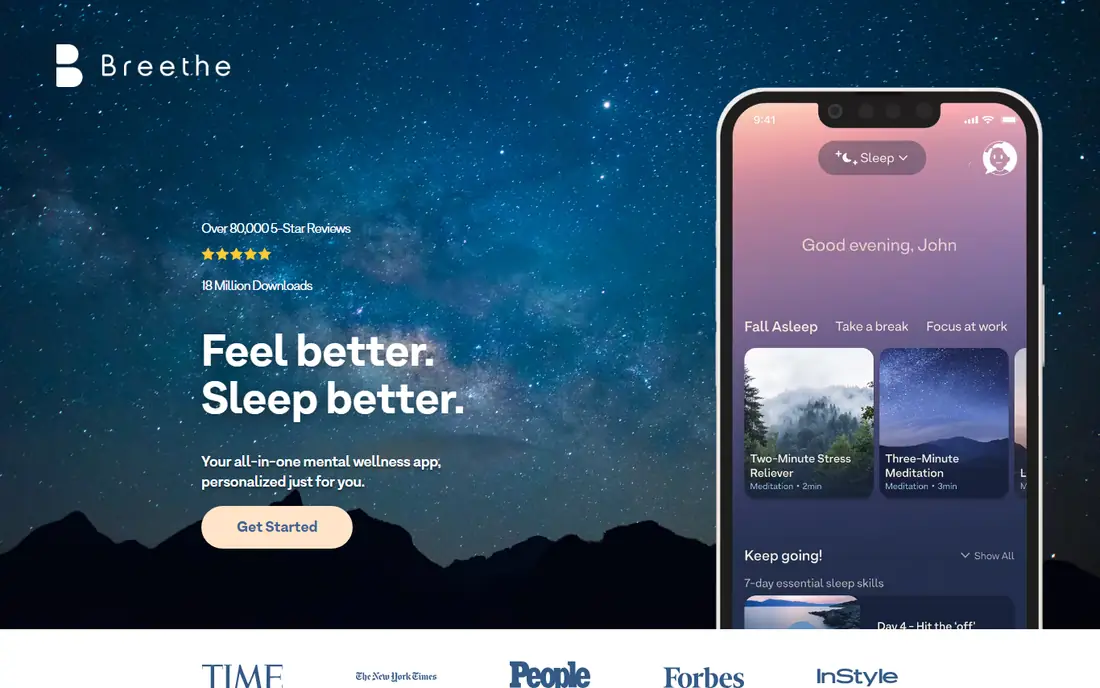
Breethe describes itself as the most personalized, all-in-one mental wellness app, and the library backs that up. Meditations sit next to hypnotherapy sessions, sleep stories, music, and nature sounds, and the app learns what helps you most so it can suggest content for the moment you are in, whether that is a 3 pm reset or a 3 am wind-down.
Content is developed by qualified professionals, and the app reports more than 18 million users. Sleep is a clear strength, with stories and hypnotherapy sessions aimed at people who struggle to fall asleep, plus music and sounds for focus and relaxation during the day.
The broad mix is also the drawback. If you want a focused meditation practice with courses and progression, Breethe's wellness buffet can feel scattered. Pricing is not displayed on its homepage, so check the app store listing or the subscription screen before committing.
What we like- Meditations, hypnotherapy, stories, music, and sounds in one app
- Personalized recommendations
- Content from qualified professionals
Watch out for- Pricing is not shown on the homepage
- The broad wellness mix can dilute pure meditation
Starting priceFree
Free planYes
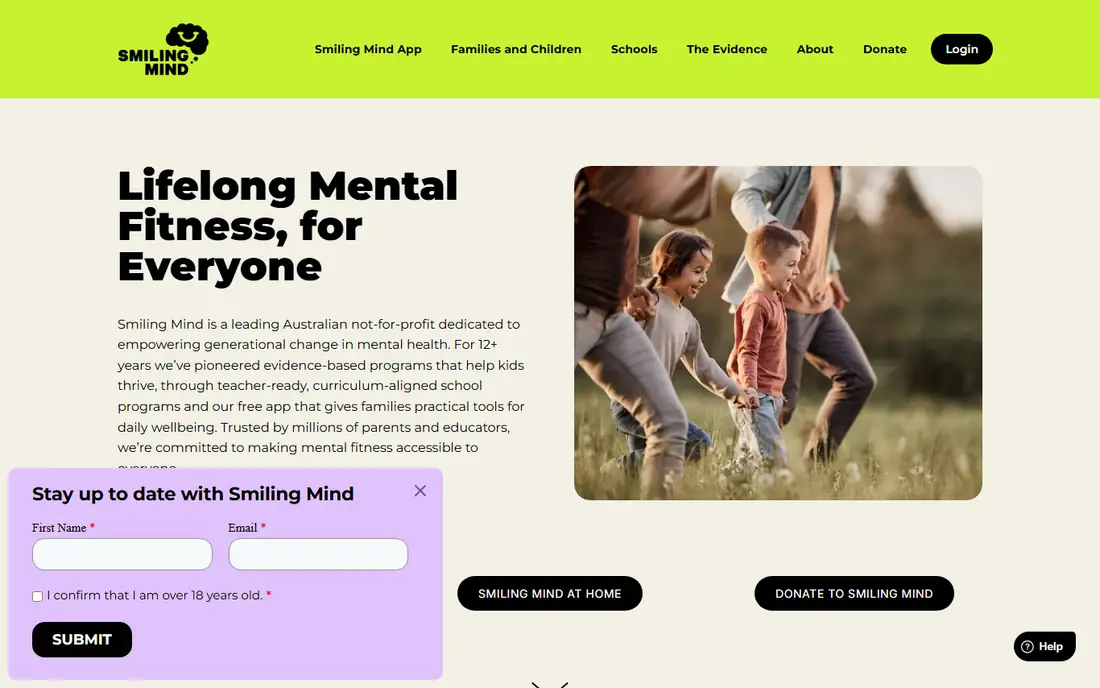
Smiling Mind is an Australian not-for-profit that has spent more than a decade building evidence-based mental health programs. Its refreshed app frames practice as mental fitness, with five skill sets that cover focus, emotions, relationships, and wellbeing, not just seated meditation. Everything in the app is free, and its school programs are curriculum-aligned and teacher-ready.
For families, Smiling Mind is the strongest free pick in this list. Kids get age-appropriate programs, parents get practical tools for daily wellbeing, and schools can embed lessons into the classroom. Content is developed with psychologists and mental health experts, and the organization puts its funding back into its mission rather than shareholders.
Advanced adult meditators may find the content gentler and less deep than Waking Up or Happier, and some references feel Australian. For a household that wants one free app for adults and kids alike, though, Smiling Mind is hard to beat.
What we like- Fully free app
- Evidence-led programs for kids, families, and schools
- A mental fitness model that covers more than meditation
Watch out for- Australian focus may feel less local elsewhere
- Less depth for advanced adult meditators
How we chose
We compared pricing pages, product documentation, and public reviews on G2, Capterra, and Reddit, and we opened each app's official homepage to confirm it is live and belongs to that product. We favored apps with a real free tier or trial, a clear path for beginners, and content that covers both meditation and sleep, since most readers want both. We left out apps that were discontinued, region-locked, or mostly a single feature dressed up as a meditation library.
What to check before you subscribe
Start with the free tier, not the annual plan
Most paid apps here offer a trial, and Insight Timer, Medito, Happier, and Smiling Mind give you a usable free tier with no card. Use one free option for two weeks first. If you meditate most days, an annual plan saves money over monthly billing. If you meditate twice and stop, you have lost nothing.
Match the app to your real goal
A beginner who needs structure should start with Headspace or Balance. A poor sleeper should start with Calm or Breethe. A curious reader who wants to understand why meditation works should try Waking Up or Happier. A tight budget points straight to Medito or Insight Timer.
Watch the renewal and the trial clock
Paid apps auto-renew, and trials convert automatically if you do not cancel. Set a reminder a day before the trial ends, and check whether a student, family, or scholarship option applies to you. Waking Up offers a free scholarship, and Headspace offers student and family plans.
Keep expectations honest
Meditation apps can support a daily habit and help you notice stress earlier, but they are not treatment. If anxiety, low mood, or sleep problems persist or get worse, talk to a doctor or mental health professional. A streak in an app is not a health outcome.
Frequently asked questions
Which meditation app is best for beginners?
Headspace is the safest first pick, because its Basics course teaches one skill at a time and tells you what to do next. Balance is a strong alternative if you want the app to build a daily plan for you. If you want to spend nothing, start with Medito, which gives you a full beginner course free.
What is the best free meditation app?
Insight Timer has the largest free library, with hundreds of thousands of guided meditations, plus live yoga and a timer. Medito is the best fully free option, since everything is free with no ads, no account, and no premium tier. Smiling Mind is the best free pick for families and schools.
Is Calm or Headspace better for sleep?
Calm wins for sleep, with more than 500 Sleep Stories, soundscapes, and sleep meditations added weekly. Headspace covers sleep well too, with sleepcasts and wind-downs, but its strength is structured meditation courses. If sleep is your main reason for subscribing, Calm is the better spend.
Do meditation apps actually help with stress?
Research on mindfulness programs shows modest benefits for stress and anxiety for many people, and regular short practice beats occasional long sessions. Apps help mainly by making practice easy to repeat: reminders, short sessions, and a visible streak. They are not a replacement for therapy or medical care when symptoms are serious.
How much should I pay for a meditation app?
Most paid apps cost $70 to $100 a year, or $12 to $15 a month. Start free with Insight Timer or Medito, and only pay if you use the app most days and want its courses, sleep content, or offline listening. Annual billing usually cuts the monthly cost by about 40 percent.
Can I use these apps with my kids?
Yes. Smiling Mind and Calm both offer kids content, and Smiling Mind's school programs are designed for classrooms. Medito and Insight Timer work for older kids too, but check content first, since their libraries are built mainly for adults. Keep sessions short for children, and treat the app as a shared activity rather than a babysitter.
Sources we checked (9)
- https://www.headspace.com
- https://www.calm.com
- https://insighttimer.com
- https://www.balanceapp.com
- https://www.wakingup.com
- https://www.happierapp.com
- https://medito.app
- https://www.breethe.com
- https://www.smilingmind.com.au
Is your product missing or out of date?
We review this list regularly. Vendors can request a listing, send updated pricing or ask about featured placement.

Shihab Mia · Founder, Rankite
Shihab has 5+ years in B2B and SaaS SEO. He writes Rankite's software buying guides from pricing pages, documentation and public user reviews. More about Shihab.