How we make this list: we compare pricing pages, product documentation and public user reviews. Ratings come from G2, Capterra or Trustpilot, with the date we checked them.
Key takeaways
- Komodo and Smartick are the structured programmes, with short daily sessions designed by educators to build number fluency a few minutes at a time.
- Khan Academy Kids and Moose Math are completely free, which makes them the sensible first try for children aged roughly four to eight.
- Matific teaches through games aligned to school curricula, and Todo Math is the pick for younger children and learners who need extra accessibility support.
- No app guarantees learning outcomes: what builds mental math is short, regular practice over months, so pick the app your child will actually open.
Quick comparison
| Tool | Best for | Starting price | Free plan |
|---|
 Komodo Math | A parent managed fluency programme at home | See website | No |
 Smartick | Adaptive daily sessions of 15 minutes | See website | No |
 Matific | Game based math aligned to school topics | See website | Yes |
 Khan Academy Kids | Free early learning for ages two to eight | Free | Yes |
 Todo Math | Early math with strong accessibility options | See website | Yes |
 Moose Math | Free playful practice for ages three to seven | Free | Yes |
 Endless Numbers | Number sense for the youngest learners | Free | Yes |
Is your product missing or out of date?
We review this list regularly. Vendors can request a listing, send updated pricing or ask about featured placement.
The best mental math apps for kids
Starting priceSee website
Free planNo
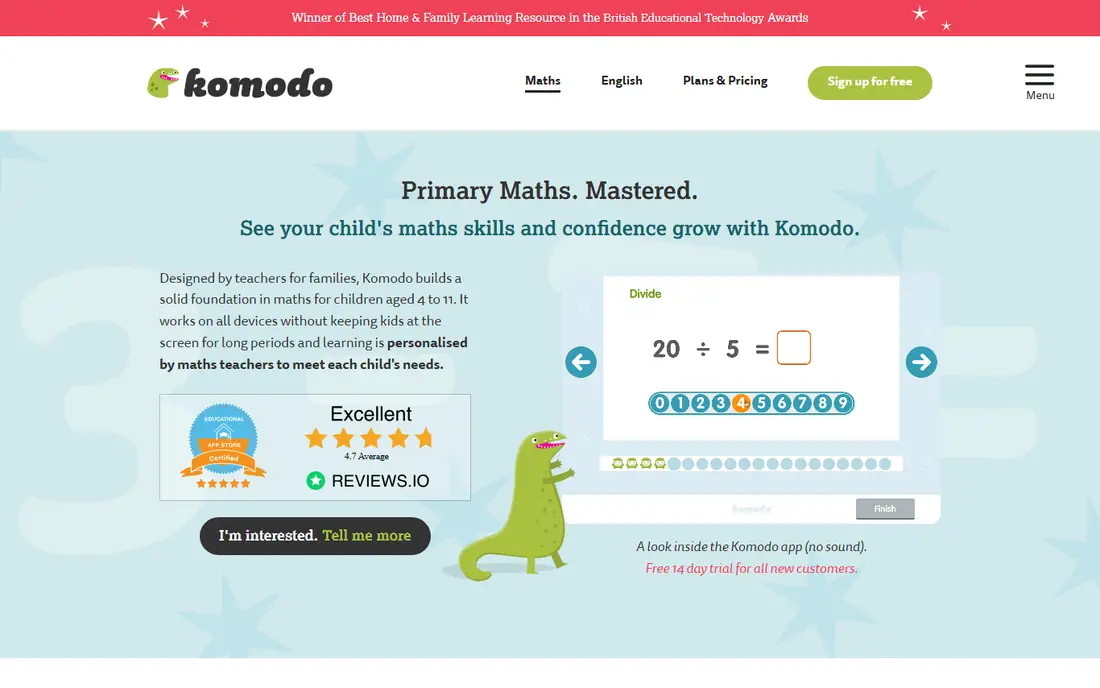
What we like- Komodo was designed by teachers and a family specifically for home use: a short diagnostic places the child at the right level, then a personalised plan of brief sessions, around five times a week, builds number facts and mental strategies step by step, with the parent receiving progress reports rather than the child chasing game rewards. The design is deliberately calm, no cartoon chaos and no advertising, which many parents of easily distracted children value. It covers roughly ages five to eleven, the primary years when mental math fluency is actually built, and a family plan covers siblings.
Watch out for- Calm is not every child's flavour: children motivated by games and characters may find Komodo plain beside Matific, and a programme only works if the sessions happen. There is no free plan, only subscription pricing published on its site. It is a fluency programme rather than a full curriculum, so school topic coverage is thinner than Smartick or Matific. Parent involvement is part of the design, which is a feature for engaged households and a barrier for stretched ones.
Starting priceSee website
Free planNo
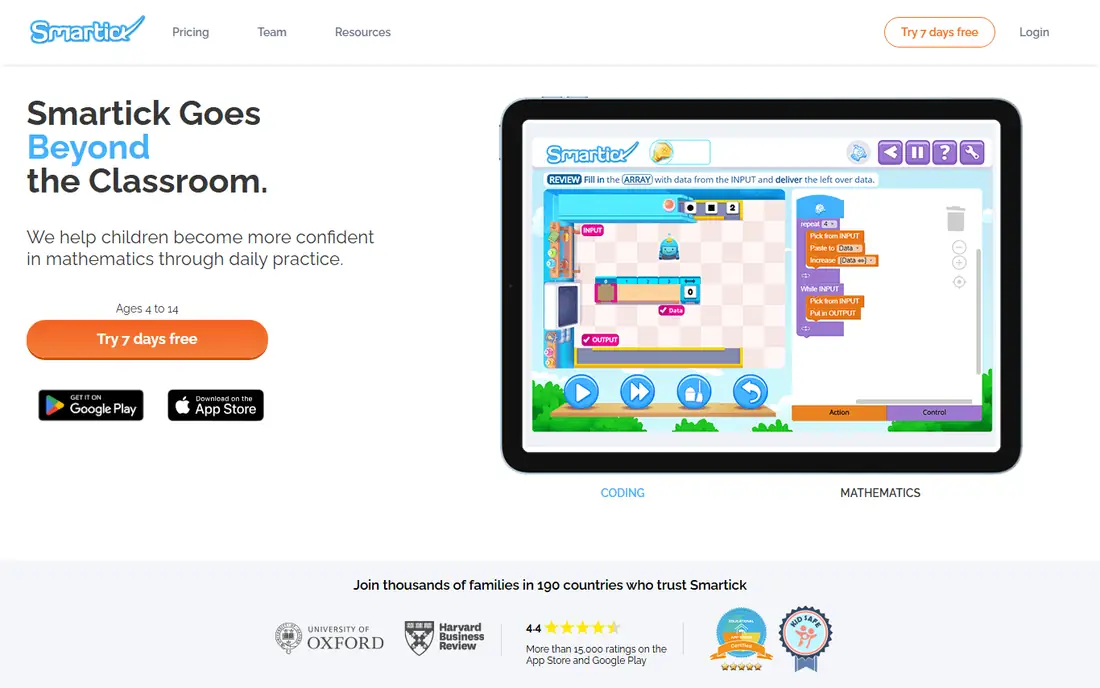
What we like- Smartick runs a single adaptive session per day, about fifteen minutes, adjusting difficulty in real time to the child's answers and covering mental calculation alongside the broader primary curriculum for ages four to fourteen. Parents get a detailed dashboard and tutorial support, and the method caps the day's work by design, which protects against both bingeing and battles. Its mental math strand is explicit, with speed and strategy exercises woven through the sessions rather than isolated as a drill mode. A free trial period lets families test the fit before paying the subscription.
Watch out for- One company decides the fifteen minutes, and children who want to keep going, or who miss days, meet a system built around its own rhythm. Pricing is among the higher in this list and varies by billing period and country, hence see website. The single daily session covers all math, so mental math gets minutes within it rather than the whole sitting
- Parents wanting pure fluency drilling may prefer Komodo. Screen based explanations do not suit every learner, and the dashboard's detail can tempt parents into pressure the method itself discourages.
Starting priceSee website
Free planYes
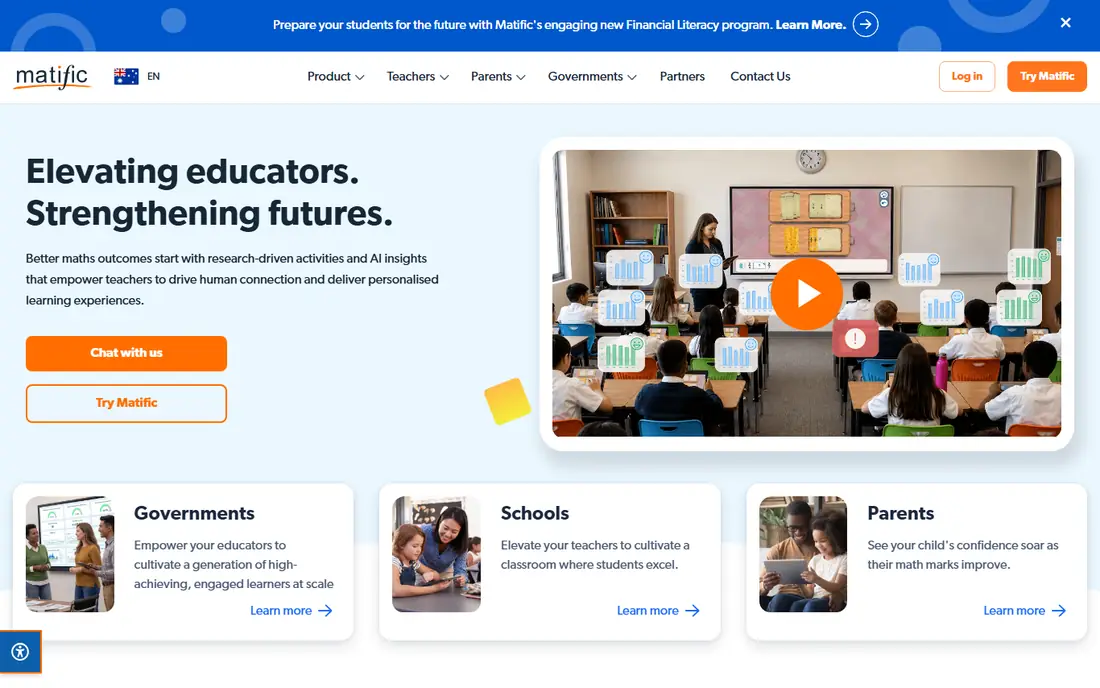
What we like- Matific builds hundreds of short game like activities and worksheets aligned to school curricula by country and grade, so practice matches what the class is doing this term, including arithmetic fluency activities for mental math inside a wider world of problems. Children experience it as games with characters and gentle humour
- Parents and teachers get reports by skill. It serves schools as well as homes, which keeps its content development deep for ages from reception to year six and beyond, and home plans are priced on its site with free access routes through schools in many regions.
Watch out for- Because it is a curriculum world, finding pure mental math drilling takes navigation: fluency is one strand among many. The game framing, while tasteful, still means some session time goes to story and rewards rather than sums. Home subscription pricing varies by market, hence see website. Children at the top of their class may exhaust the challenge in their grade band, and the app's alignment strength matters less to families who are not following a specific national curriculum.
Starting priceFree
Free planYes
What we like- Khan Academy Kids is entirely free, with no ads and no subscriptions, funded as a nonprofit project, and its early math covers counting, number recognition, simple addition and subtraction through stories, games and friendly characters for ages two to eight. For a parent who wants to test whether app based practice suits their child at all, this is the zero risk answer, and its privacy posture is among the cleanest in the category. Content beyond math, reading, social learning and creativity, is a genuine bonus for the youngest users, whose school readiness is broader than arithmetic.
Watch out for- Mental math as a discipline gets lighter treatment than the paid programmes: there is no structured fluency plan building speed over months, and children age out of its content by about eight. Parents get less reporting than Komodo or Smartick provide. The breadth that delights a four year old dilutes focus for a seven year old who specifically needs times tables. It is the best free starting point in this list, not a complete answer for the whole primary phase.
Starting priceSee website
Free planYes
What we like- Todo Math covers early childhood math, counting through early multiplication, in structured daily adventures and free play modes, and it stands out for accessibility: the app was designed with features supporting children with learning differences, including dyslexia friendly fonts, adjustable reading support and multiple ways to answer, which earned it a loyal following among special education teachers and parents. Missions give the practice a shape children return to, and the parent area shows progress by skill. A free tier covers a meaningful slice before the subscription, priced on its site and in the app stores.
Watch out for- The content tops out at early elementary level, roughly age eight, so its life in a family is a few years by design. Full access needs the subscription, and in app purchase prompts need a parent's hand on the settings. Its mental math work is foundational, number bonds and early operations, rather than speed building for older children. Families outside its early years sweet spot should start with Komodo, Smartick or Matific instead.
Starting priceFree
Free planYes
What we like- Moose Math, from Duck Duck Moose, now part of the Khan Academy family, is a free app of mini games for ages three to seven: counting, addition, subtraction, shapes and simple problem solving dressed as juice bars, pet shops and races. It has survived in app stores for years because the games are genuinely well made for small children, with spoken instructions that let pre readers play independently. A simple report card shows parents which skills a child has practised. For a first math app on a family tablet, free, gentle and competent is a hard combination to beat.
Watch out for- The app is older software: it teaches early skills well but has no adaptive programme, no fluency ladder and no content beyond about age seven. Mental math speed building is not its purpose. Updates are infrequent, and on the newest devices families should check the store listing still supports their tablet. Once a child can add two digit numbers, Moose Math becomes a fond memory rather than a tool, and the next step is one of the programme apps above.
Starting priceFree
Free planYes
What we like- Endless Numbers introduces children from about age three to five to numbers as ideas: counting, quantity, simple addition, with animated characters acting out each concept so a child sees what seven means before being asked to write it. From Originator, a studio known for careful early learning design, it avoids scores, timers and failure states entirely, which suits toddlers and preschoolers whose mental math journey is really number sense. The free download includes a starter set of numbers, with packs of more available to buy. As a first screen experience with numbers, it is close to ideal.
Watch out for- It is a beginning, not a programme: no drilling, no fluency practice, no content for school age children, and the free set is small enough that the purchase prompt arrives quickly. Parents should handle buying through the store's family settings, as with any app aimed at small children. There is no reporting and no adaptation. Families reading this guide for an eight year old's times tables need Komodo or Smartick
- Endless Numbers serves the sibling on the other end of childhood.
How we chose
We compared children's math apps that include real mental arithmetic practice, counting and number bonds up through multiplication fluency, and that are actively available on iOS or Android in October 2026. Every entry has a parent facing account or reporting model consistent with children's privacy law, and none uses advertising aimed at children as its business model on its paid or main experience; the free apps here are nonprofit or studio supported rather than ad funded. Prices vary by region and promotion across this category, so most are marked see website. We weighted structure for fluency, since mental math improves through planned repetition, and we say plainly where an app is a starting point rather than a programme.
How to choose the right mental math app
Match the app to the child's age and your household's appetite for structure. Under fives need number sense, not drills: Endless Numbers, Moose Math and Khan Academy Kids, all free, cover that stage between them. From five to eleven, choose between a programme you will supervise lightly, Komodo or Smartick, and a game world the child explores, Matific or Todo Math, knowing the programmes build fluency more reliably and the worlds sustain interest more easily. Children with learning differences deserve a look at Todo Math's accessibility design before anything else.
Whichever you pick, the practice pattern matters more than the brand: ten to fifteen minutes, most days, beats an hour on Sunday, and stopping while it is still fun protects tomorrow's session. Sit in on the first week to check the level is right, too easy bores and too hard discourages within days, then check the parent report monthly rather than hovering over scores. Finally, treat the app as one leg of the stool: number talk at the table, counting games in the car and real money at the shop build the same fluency in the wild, and no subscription replaces them.
Frequently asked questions
Can an app really improve my child's mental math?
Yes, within honest limits. Short daily practice with instant feedback is a proven way to build recall of number facts and confidence with strategies, and the structured apps here are built on that principle. What no app can do is guarantee grades, test results or a place in an advanced group, and parents should walk away from any product that promises them. Fluency also transfers best when children use numbers off screen too. Judge an app after a term of regular use by whether your child answers more confidently, not by its own in app scores alone.
Are these apps safe and private for children?
The apps in this list are designed for children and operate under children's privacy rules: in the US, COPPA restricts collecting personal information from under thirteens, so accounts are parent held, chat is absent and data collection is limited by design. Still read the privacy policy, use the parent account settings, disable optional data sharing where offered, and keep purchases behind the app store's family controls. Free apps deserve the same check as paid ones; the two fully free apps here are nonprofit backed, which is the strongest privacy signal in the category.
How much time should my child spend on a math app each day?
About ten to fifteen minutes is the working range used by the programme apps themselves, Smartick builds its whole method on fifteen, and it fits both attention spans and the spacing effect that makes practice stick. More is not better once frustration or fatigue appears. Most days matters more than long days, and stopping on a success leaves the child willing tomorrow. Screen time guidance for young children also argues for keeping app practice as one small part of a day that includes plenty of offline play.
Which app is best for times tables specifically?
Komodo and Smartick give multiplication fluency the most structured treatment, with planned progression and parent reporting, while Matific covers tables inside its curriculum games. Whichever you choose, tables respond to the same treatment everywhere: small daily sets, mixed order once the pattern is learned, and quick fire practice only after accuracy is solid, since speed pressure on shaky facts produces guessing habits. Many families pair an app with a printed chart and car ride chanting, an unfashionable method with an excellent record.
Should I pay when free apps exist?
Start free. Khan Academy Kids, Moose Math and Endless Numbers cover the early years at no cost, and a month with them tells you whether your child takes to app practice at all. Pay when you need what free does not provide: a structured fluency plan with placement and progression, parent reporting across the primary years, and content that keeps pace with an older child. That is a fair description of Komodo and Smartick's value. Paying earlier than that buys features a preschooler cannot use.
Sources we checked (0)
Is your product missing or out of date?
We review this list regularly. Vendors can request a listing, send updated pricing or ask about featured placement.

Shihab Mia · Founder, Rankite
Shihab has 5+ years in B2B and SaaS SEO. He writes Rankite's software buying guides from pricing pages, documentation and public user reviews. More about Shihab.