How we make this list: we compare pricing pages, product documentation and public user reviews. Ratings come from G2, Capterra or Trustpilot, with the date we checked them.
Key takeaways
- Per-technician pricing from Atera and Syncro suits endpoint-dense shops, while NinjaOne per-device pricing favors smaller fleets.
- All-in-one RMM plus PSA platforms save small MSPs from stitching two tools together, but larger shops often pair a standalone RMM with a dedicated PSA.
- The enterprise vendors here publish no prices, so get contract length, renewal terms and per-device rates in writing before comparing.
- AI agents for ticketing and triage are now standard claims, so test them on real tickets during the trial.
- Migration cost matters as much as license cost: agent deployment, policy rebuilds and PSA data migration all take weeks.
Quick comparison
| Tool | Best for | Starting price | Free plan |
|---|
 NinjaOne | Ease of use and automation at scale | $1.50 to $3.75 per device/month | Free trial |
 Atera | Small to mid-sized MSPs on per-technician pricing | $129 per technician/month (billed annually) | Free trial |
 Syncro | All-in-one RMM plus PSA for small MSPs | $129 per user/month (billed annually) | Free trial |
 SuperOps | Modern RMM plus PSA with AI-assisted workflows | $1.50 per endpoint/month | Free trial |
 N-able N-central | Large, complex MSP environments | See website | Free trial |
 Datto RMM | Security-first endpoint management with backup depth | See website | Free trial |
 ConnectWise Automate | Deep automation for large MSPs | See website | Free trial |
 HaloPSA | PSA-first shops that want deep customization | See website | Free trial |
Is your product missing or out of date?
We review this list regularly. Vendors can request a listing, send updated pricing or ask about featured placement.
The best managed service provider software
#1NinjaOne
Best for: Ease of use and automation at scale4.7/5 on
G2 (5,037 reviews, checked Oct 2026)
Visit ninjaone.com
Starting price$1.50 to $3.75 per device/month
Free planFree trial
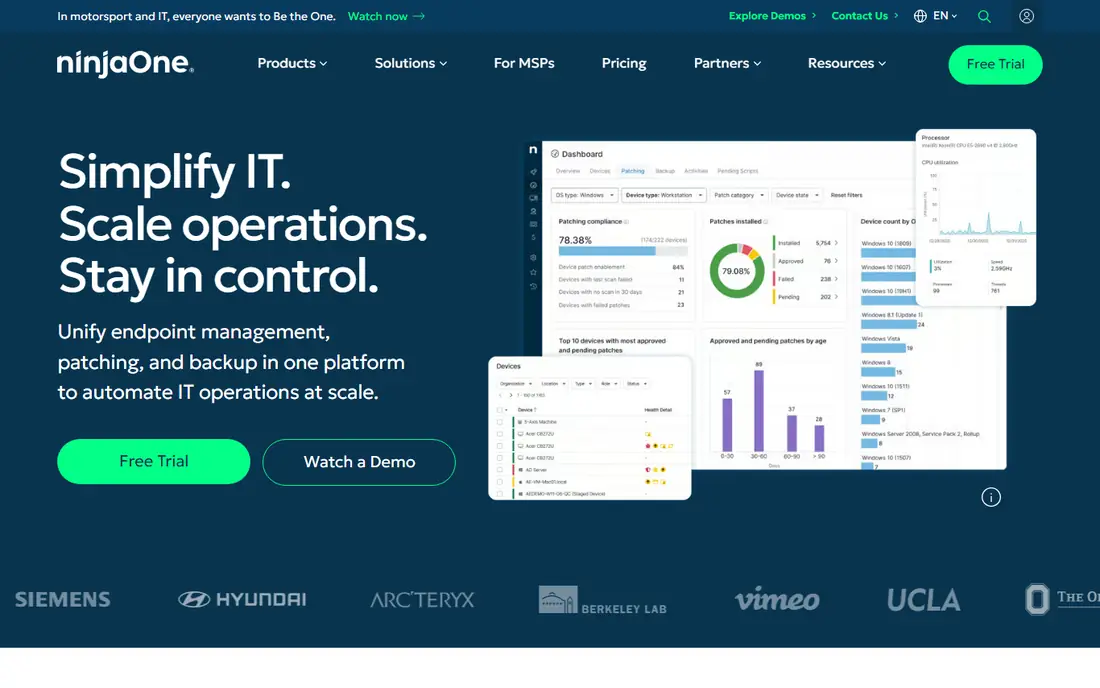
NinjaOne is the easiest RMM in this list to deploy and the one technicians complain about least. Endpoint management, patching, backup, mobile device management and remote control live in a single console, and policy-based automation handles the repetitive work that eats a small team's week. Patch cycles that once took days shrink to hours once policies and approvals are set.
Pricing runs per device and falls with volume, from around $3.75 per device per month for small fleets to around $1.50 at very large counts. That model rewards dense client estates and penalizes MSPs with many small clients. NinjaOne has no full native PSA, so shops that need contracts, quoting and billing will pair it with a dedicated PSA. For pure endpoint operations, though, few rivals match its combination of speed and polish.
What we like- Fast setup with a clean console
- Autonomous patching with AI-assisted checks
- Backup, MDM and remote control in one platform
Watch out for- No native full PSA, so pair it with a PSA for billing and contracts
- Remote access is a paid add-on in some bundles
- Per-device pricing climbs with large fleets
#2Atera
Best for: Small to mid-sized MSPs on per-technician pricing4.6/5 on
G2 (1,123 reviews, checked Oct 2026)
Visit atera.com
Starting price$129 per technician/month (billed annually)
Free planFree trial
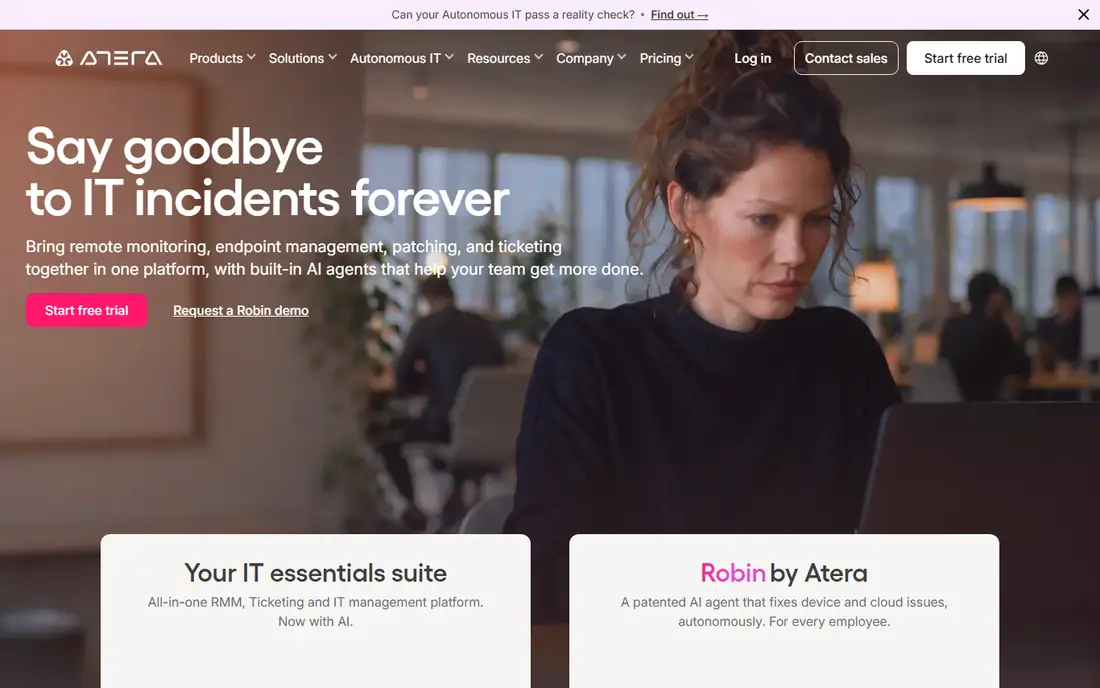
Atera's pricing model is its headline feature. At $129 per technician per month on annual billing, an MSP can add endpoints without adding license cost, which changes the math for shops with many devices per tech. The platform combines remote monitoring, patching, remote access, ticketing and billing, and its AI agents now resolve routine support requests without a technician touching them.
The trade shows up as the team scales. Once headcount grows, per-technician pricing can overtake per-device pricing, so run both models against your actual numbers. Atera's PSA and billing cover the basics well but lack some depth of dedicated PSA products. For lean teams of two to ten technicians, the simplicity of one platform and one predictable bill is hard to beat.
What we like- Per-technician pricing with unlimited endpoints
- RMM, ticketing and patching in one platform
- AI agents that resolve routine tickets
Watch out for- Per-technician model costs more once the team grows past endpoint counts
- Advanced PSA billing is lighter than dedicated PSAs
- Mac and Linux support sits on higher tiers
#3Syncro
Best for: All-in-one RMM plus PSA for small MSPs4.5/5 on
G2 (553 reviews, checked Oct 2026)
Visit syncromsp.com
Starting price$129 per user/month (billed annually)
Free planFree trial
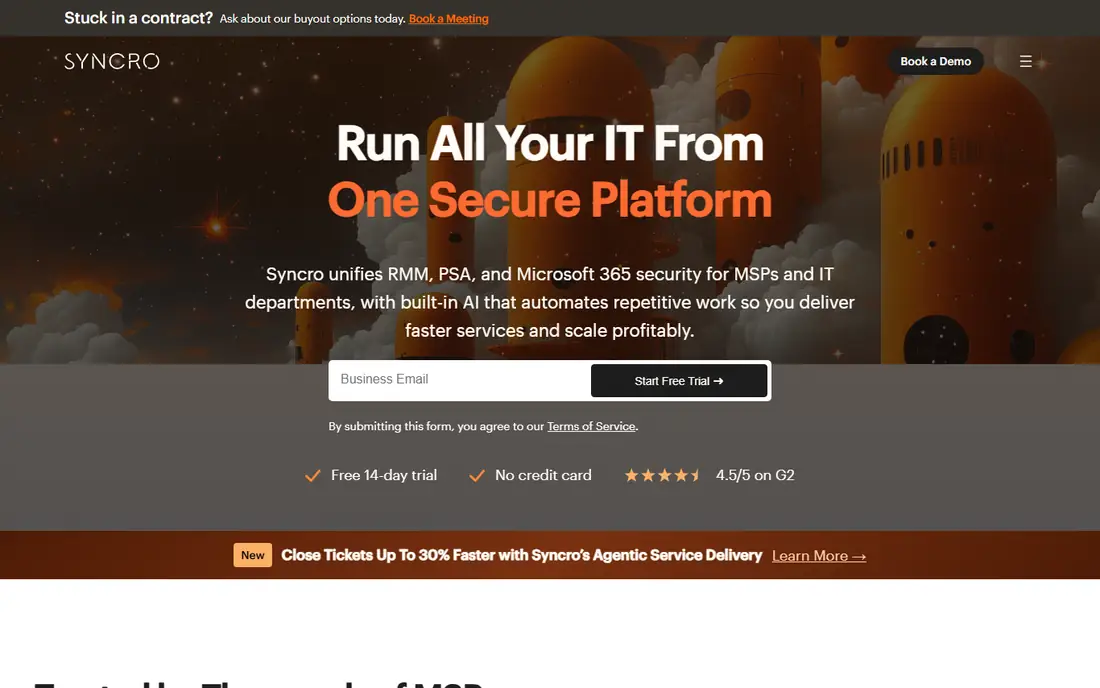
Syncro is built for the solo MSP and the small team that cannot afford five subscriptions. RMM, PSA ticketing, billing, remote access and Microsoft 365 security run in one platform priced per technician, starting at $129 per user per month on annual billing, with a Team tier at $179. That consolidation is the pitch: one login, one bill, and client onboarding that does not require a project plan.
The platform's agentic service delivery features aim to close tickets faster by automating repetitive steps, and the vendor reports meaningful reductions in ticket handling time. Syncro will not match ConnectWise Automate on deep scripting or enterprise reporting, and its documentation tools are basic. For MSPs under about fifteen technicians, though, the all-in-one value and published pricing make it the most transparent choice here.
What we like- True all-in-one RMM, PSA and Microsoft 365 management
- Per-technician pricing with unlimited endpoints
- Published pricing with a 14-day trial
Watch out for- Scripting and reporting depth trails enterprise RMMs
- Smaller integration library than ConnectWise
- Documentation features are basic
#4SuperOps
Best for: Modern RMM plus PSA with AI-assisted workflows4.4/5 on
G2 (205 reviews, checked Oct 2026)
Visit superops.com
Starting price$1.50 per endpoint/month
Free planFree trial
SuperOps is the newer entrant that MSPs switch to when legacy tools feel dated. Its pitch is a single work queue where tickets, alerts and patches land together and route to the right person or AI agent, with endpoint management, patching, ticketing and security sharing one platform. The interface is modern, onboarding is guided, and AI-assisted ticketing reduces the manual triage that fills a technician's morning.
Pricing starts at $1.50 per endpoint per month with a 100-endpoint minimum on one tier, while per-technician tiers run higher for shops that prefer that model. The platform is younger than NinjaOne or ConnectWise, so the community, script library and third-party integration depth are smaller. For a newer MSP building its stack from scratch, that freshness is a feature. For a large shop with deep automation libraries elsewhere, migration effort deserves a hard look.
What we like- Modern interface with a unified work queue
- RMM and PSA built together
- Per-endpoint pricing from $1.50 with a 100-endpoint minimum
Watch out for- Younger platform with a smaller community
- Advanced automation depth still maturing
- Per-technician tiers add complexity to pricing
#5N-able N-central
Best for: Large, complex MSP environments4.4/5 on
G2 (567 reviews, checked Oct 2026)
Visit n-able.com
Starting priceSee website
Free planFree trial
N-central is the workhorse for larger MSPs with complex environments. It monitors servers, networks, workstations and cloud resources, automates patching and maintenance, and integrates with N-able backup and security products for a fuller stack. Hybrid estates with on-premises infrastructure are a particular strength, where cloud-only tools sometimes struggle.
The buying experience is old-school: quote-based pricing, a sales conversation, and implementation help that larger deployments genuinely need. Smaller MSPs may find the platform more than they want to operate, and the interface shows its age next to newer rivals. For an MSP past fifty technicians or with demanding compliance clients, N-central's depth and maturity justify the effort.
What we like- Deep monitoring, patching and automation for hybrid estates
- Strong backup and security integrations in the N-able family
- Mature MSP feature set
Watch out for- Quote-based pricing with no public rates
- Setup and tuning take longer than cloud-native rivals
- Interface feels dated next to NinjaOne and SuperOps
#6Datto RMM
Best for: Security-first endpoint management with backup depth4.5/5 on
G2 (803 reviews, checked Oct 2026)
Visit datto.com
Starting priceSee website
Free planFree trial
Datto RMM is a security-first, cloud-based platform built to monitor and manage endpoints while cutting technician effort through policies, scripts and automation. Built-in ransomware detection and automated patching sit at the center, and its native Microsoft 365 management lets technicians handle users, licenses and devices from one console. Pairing it with Autotask PSA and Datto backup gives Kaseya-ecosystem shops a full stack from one vendor family.
Datto sells through partners, so pricing is quote-based and the total cost depends on which modules you add. That ecosystem lock-in cuts both ways: integration is smooth, but leaving means replacing several tools at once. For MSPs already committed to Datto backup or Autotask, RMM is the natural endpoint piece. For independent shops, compare the full stack price, not just the RMM quote.
What we like- Security-first RMM with built-in ransomware detection
- Native unified Microsoft 365 management
- Pairs with Autotask PSA and Datto backup
Watch out for- Quote-based pricing with no public rates
- Partner-only model means no direct purchase
- Backup and PSA upsells add to the total stack cost
#7ConnectWise Automate
Best for: Deep automation for large MSPs4.1/5 on
G2 (141 reviews, checked Oct 2026)
Visit connectwise.com
Starting priceSee website
Free planFree trial
ConnectWise Automate is the automation powerhouse of the MSP world. Its scripting engine, policy framework and integration with ConnectWise Manage PSA let large MSPs automate onboarding, maintenance and remediation at a depth no newer rival matches. The community script library alone saves weeks of work, and the platform scales to tens of thousands of endpoints.
That power comes with weight. Onboarding commonly takes months rather than weeks, the learning curve is steep, and pricing is quote-based with no public tiers. Small MSPs will find Automate more platform than they need, and newer tools will get them running faster. For mid-sized and large MSPs that already run ConnectWise Manage, Automate remains the automation standard everything else is measured against.
What we like- Deepest scripting and automation in this list
- Tight integration with ConnectWise Manage PSA
- Huge community script library
Watch out for- Quote-based pricing with no public rates
- Steep learning curve and long onboarding
- Interface and architecture show legacy roots
#8HaloPSA
Best for: PSA-first shops that want deep customization4.6/5 on
G2 (47 reviews, checked Oct 2026)
Visit halopsa.com
Starting priceSee website
Free planFree trial
HaloPSA approaches the MSP stack from the business side. It is a PSA first: ticketing, contracts, billing, projects and service level management with deep customization and ITIL-aligned workflows, plus integrations with RMM tools like NinjaOne for endpoint data. MSPs that live or die by contract profitability, agreement tracking and accurate billing tend to love it.
The flip side is that HaloPSA is not a full RMM replacement. Endpoint monitoring, patching and remote control come from a paired RMM, so buyers should budget for two tools. Customization depth also means configuration takes time and discipline. For a growing MSP whose PSA has become the bottleneck, HaloPSA is the strongest business-side upgrade in this list.
What we like- Deeply customizable PSA with ITIL-aligned workflows
- Strong billing, contracts and project features
- Integrates with NinjaOne and other RMMs
Watch out for- Quote-based pricing with no public rates
- RMM features are lighter than dedicated RMM tools
- Customization depth means longer configuration
How we chose
We compared vendor homepages, pricing pages and documentation against public comparisons and user reviews on G2 and Capterra. Every tool here had its official homepage opened and confirmed, and each one genuinely serves managed service providers rather than a neighboring category like general IT helpdesk software. Where the vendor does not publish a price, we recorded "See website" instead of repeating third-party estimates.
What to weigh before you buy
Start with your pricing model, not the feature list. Count your technicians and your endpoints, then run both per-technician and per-device pricing against those real numbers. A tool that looks cheap at ten endpoints can turn expensive at ten thousand, and the reverse is equally true. Then check the PSA question: if you need contracts, quoting and billing, an all-in-one or a dedicated PSA saves more than a standalone RMM with a spreadsheet on the side.
Trial on real endpoints, not a demo tenant. Deploy agents to a pilot client, run a patch cycle, test remote access from a technician's actual network, and time how long onboarding really takes. Ask about contract length, renewal pricing, data export and what happens to your agent deployment if you leave. The cheapest year-one quote can become the most expensive three-year commitment in this category.
Frequently asked questions
What is managed service provider software?
Managed service provider software is the toolkit MSPs use to monitor, manage and support client IT systems remotely. It typically combines remote monitoring and management for endpoints, a professional services automation tool for tickets and billing, and integrations for backup and security.
What is the difference between RMM and PSA software?
RMM software monitors and manages endpoints: patching, remote access, scripting and alerts. PSA software runs the business side: tickets, contracts, time tracking, billing and projects. All-in-one platforms combine both, while larger MSPs often pair a standalone RMM with a dedicated PSA.
Should a small MSP choose per-technician or per-device pricing?
Per-technician pricing usually wins when endpoints per technician are high, since adding devices costs nothing extra. Per-device pricing usually wins for small fleets or shops with many technicians relative to endpoints. Run both models on your actual counts before deciding.
How long does it take to switch MSP software?
Cloud-native tools like NinjaOne, Atera and Syncro can go live in one to three weeks for a small shop. Enterprise platforms like ConnectWise Automate or N-central commonly take one to three months including policy migration, script rebuilds and PSA data migration.
Do I need a PSA if I already have an RMM?
You need something for tickets, contracts and billing whether it is called a PSA or not. Small shops can start with the ticketing and billing inside an all-in-one platform, then move to a dedicated PSA like HaloPSA or Autotask as contract complexity grows.
Sources we checked (10)
- https://www.ninjaone.com
- https://www.atera.com
- https://www.syncromsp.com
- https://www.superops.com
- https://www.n-able.com
- https://www.datto.com
- https://www.connectwise.com
- https://www.halopsa.com
- https://rankite.com/blog/best-rmm-software-for-msp
- https://syncrosecure.com/blog/atera-alternatives/
Is your product missing or out of date?
We review this list regularly. Vendors can request a listing, send updated pricing or ask about featured placement.

Shihab Mia · Founder, Rankite
Shihab has 5+ years in B2B and SaaS SEO. He writes Rankite's software buying guides from pricing pages, documentation and public user reviews. More about Shihab.