How we make this list: we compare pricing pages, product documentation and public user reviews. Ratings come from G2, Capterra or Trustpilot, with the date we checked them.
Key takeaways
- TransPerfect is the largest language services company in the world, with 2025 revenue of about $1.32 billion on the Nimdzi 100 ranking.
- LanguageLine Solutions leads in interpreting, which makes it the default partner for healthcare and government programs.
- RWS brings the strongest technology and patent translation pedigree, built on the Trados software line.
- Lionbridge and Keywords Studios cover games and media work that generalist providers handle less well.
- Pricing in this industry is quoted per project or per word, so every entry reads See website. Judge providers on your content type, not on a rate card.
Quick comparison
| Tool | Best for | Starting price | Free plan |
|---|
 TransPerfect | Enterprise localization at global scale | See website | No |
 LanguageLine Solutions | Interpreting for healthcare and government | See website | No |
 RWS | Regulated content and patent translation | See website | No |
 Lionbridge | Technology, games, and AI content work | See website | No |
 Keywords Studios | Video game localization and testing | See website | No |
 Welo | Enterprise programs and AI data services | See website | No |
 Smartling | Software localization with a modern platform | See website | No |
 Acolad | European languages and regulated industries | See website | No |
Is your product missing or out of date?
We review this list regularly. Vendors can request a listing, send updated pricing or ask about featured placement.
The best localization companies
Starting priceSee website
Free planNo
TransPerfect has topped the industry rankings for years, and the 2026 Nimdzi 100 puts its 2025 revenue at about $1.32 billion, well ahead of the field. The company covers translation, localization, interpreting, and media work, and its GlobalLink technology connects client content systems to its linguist network so large websites and document sets update without manual file handling.
Its strongest ground is regulated work. Pharmaceutical, legal, and financial clients use TransPerfect because it can staff certified linguists and document quality processes across many countries at once. The cost of that scale is weight. Onboarding is a project, and small one off jobs are not its natural work. For an enterprise program, it is the safe first call.
What we like- Largest provider in the industry at about $1.32 billion revenue
- GlobalLink platform automates high volume workflows
- Deep life sciences and legal benches
- Offices in more than 100 cities
Watch out for- Scale brings project management overhead
- Smaller accounts can feel like a low priority
- Pricing is fully negotiated
- Process can feel heavy for quick jobs
Starting priceSee website
Free planNo
LanguageLine built its business on a moment of need: a nurse, a police officer, or a benefits caseworker who needs an interpreter in under a minute. Its phone and video services connect staff to interpreters in hundreds of languages, and the 2026 Nimdzi 100 ranks it second overall with about $1.1 billion in revenue, most of it from interpreting rather than translation.
That focus makes it the default choice for hospitals, insurers, and government agencies that must serve the public in many languages and document that they did. Written localization is available, but it is not why buyers pick LanguageLine. Pick it when spoken language access is the problem you must solve every day.
What we like- Largest interpreting provider, about $1.1 billion revenue
- Phone and video interpreting in hundreds of languages
- Deep healthcare and public sector compliance record
- Interpreters available on demand around the clock
Watch out for- Interpreting is the core, document localization is secondary
- Enterprise contracts with volume commitments
- Less of a technology platform story
- Marketing content is not its focus
#3
RWS
Best for: Regulated content and patent translation
Visit rws.com
Starting priceSee website
Free planNo
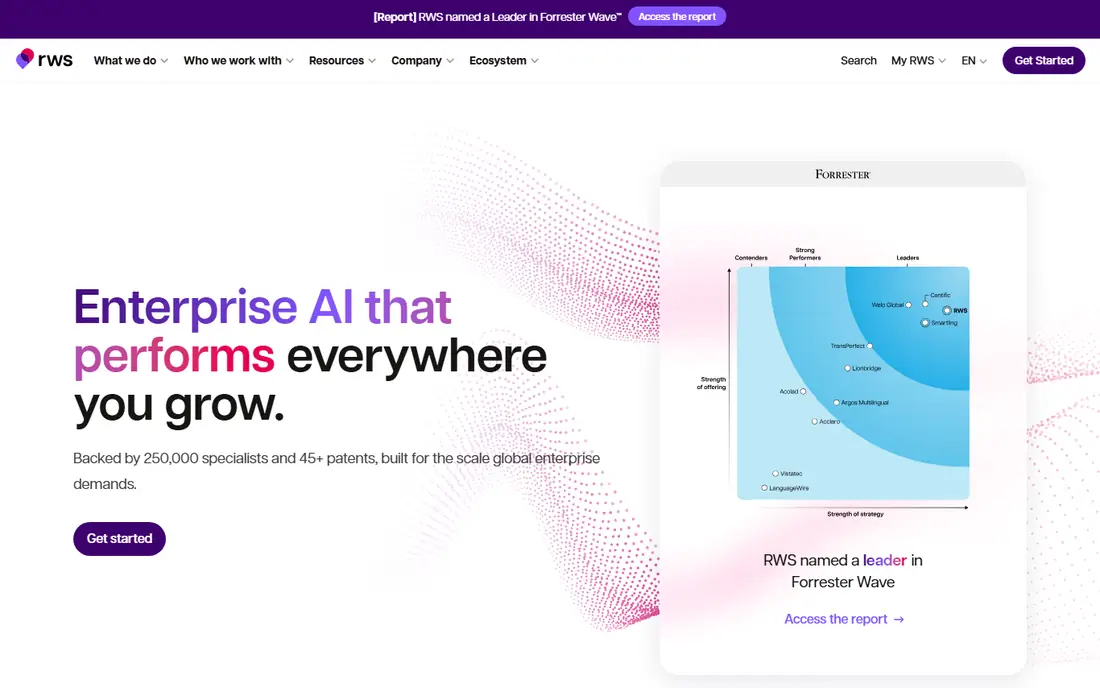
RWS is the technology elder of this list. The British group owns Trados, the translation management and computer assisted translation tools that much of the industry runs on, and it pairs that software with services for regulated industries. Its patent translation practice is a specialty few rivals match, serving law firms and corporate IP departments that file in dozens of jurisdictions.
Nimdzi puts RWS revenue at about $909 million, third among the providers here. Buyers choose RWS when content is technical, regulated, or legally sensitive, and when they want the vendor's own software in the workflow rather than a third party tool. Creative marketing adaptation is available, though it is not the headline.
What we like- Owner of the Trados translation software line
- Leading patent and legal translation practice
- About $909 million revenue
- Strong structured content and life sciences teams
Watch out for- Public company cost discipline shows in service levels at times
- Best value at enterprise volume
- Smaller creative and marketing bench
- Platform range can confuse first time buyers
Starting priceSee website
Free planNo
Lionbridge has served the technology industry since the early days of software localization, and it still anchors on tech, life sciences, and games. Its recent direction is AI content work: data for training models, evaluation of model output, and machine translation workflows with human review for content that does not need a full creative treatment.
Nimdzi's 2026 table lists Lionbridge at about $514 million in revenue, down the order from its historic top three spot, which tells an honest story of a company mid transition. The capability bench remains deep, especially for product UI, documentation, and games. Buyers who want a long established partner for technical content will still find Lionbridge on most shortlists.
What we like- Long record with major technology brands
- Large games and entertainment division
- Growing AI data and content services
- Global testing and QA capability
Watch out for- Revenue has been flat to down in recent rankings
- Ownership changes have unsettled some clients
- Rates sit at the enterprise end
- Creative work varies by studio
Starting priceSee website
Free planNo
Keywords Studios does one industry and does it at the largest scale. Game publishers hire it to translate and dub games, record voice lines, test builds, and produce art, across dozens of languages and platforms at once. Nimdzi ranks it fourth on this list with about $850 million in revenue, remarkable for a single industry focus.
If your product is a game, Keywords is usually the first name on the list, because it can take a title from first translation through launch testing in every market. If your product is not a game, it has little to sell you. That clarity is a strength for its buyers and a simple filter for everyone else.
What we like- The specialist in games services, about $850 million revenue
- Localization, audio, QA, and art under one roof
- Studios in the main game development hubs
- Works with nearly every major publisher
Watch out for- Games only, not a general business provider
- Project based pricing
- Capacity tightens around big release windows
- Less relevant outside entertainment
Starting priceSee website
Free planNo
The company most buyers still know as Welocalize now trades as Welo, or Welo Global in industry rankings, which credit it with about $325 million in revenue. It built its name running localization programs for large technology and professional services firms, managing the whole chain from content systems to in market review.
Welo has pushed into AI data work, supplying the labelled and evaluated content that model builders need, which gives it a second business beside classic translation. Buyers weighing Welo get an experienced enterprise operator without the sheer mass of TransPerfect. Ask about the rebrand only to confirm contracts and contacts, since the operating teams carried over.
What we like- Long enterprise record under the Welocalize name
- Strong technology and legal sector teams
- AI data services for model training
- About $325 million revenue
Watch out for- Rebrand from Welocalize to Welo is still settling
- Smaller than the top three
- Interpreting is not a focus
- Pricing is negotiated per program
#7Smartling
Best for: Software localization with a modern platform4.4/5 on
G2 (709 reviews, checked Oct 2026)
Visit smartling.com
Starting priceSee website
Free planNo
Smartling sells localization as software first. Its platform pulls strings from code repositories and content systems, shows translators the live page or app screen, and routes work between machine translation, its own linguist network, or your agency. Product and marketing teams that ship weekly releases tend to prefer this model over ticket based agency workflows.
The trade off is ownership. A platform puts your team in charge of quality settings, glossaries, and vendor choices, which is power and work at the same time. Smartling fits software companies and digital brands with steady content flow. It fits less well if you want to hand over a manual once a year and forget it.
What we like- Platform first approach with strong developer tooling
- Visual context shows translators the actual page or screen
- Connectors for common marketing and code stacks
- Translation supply options from machine to pro linguists
Watch out for- You buy a platform and manage more of the process
- Smaller services bench than the giants
- Per word and platform fees combine in ways that need care
- Enterprise sales process
Starting priceSee website
Free planNo
Acolad is the European anchor of this list. Built by combining several national providers, it covers the continent's languages with local teams and holds strong positions in legal, financial, life sciences, and government work, where buyers often prefer a provider inside the European regulatory area.
For a US company localizing into twenty European languages, Acolad offers one contract and local review in each market. Its global rank sits below the top five here, and its media and games benches are thinner. For Europe centred programs in regulated industries, it earns its place on the shortlist.
What we like- Largest provider headquartered in Europe
- Strong in legal, life sciences, and public sector work
- Wide European language coverage with local offices
- Growing US presence
Watch out for- Brand recognition in the US trails the American giants
- Smaller media and games offer
- Enterprise pricing
- Fewer published case studies in English
How we chose
We ranked providers using the industry scoreboards, the 2026 Nimdzi 100 and CSA Research provider data, which track revenue and verify company information, and we checked each company's service pages in October 2026. Scale was not the only test. We kept specialists that lead a clear niche, such as Keywords Studios in games and LanguageLine in interpreting, and a platform led option in Smartling for buyers who want software rather than an agency. We left out pure interpreting firms beyond LanguageLine, freelance marketplaces, and machine translation software vendors, because this list is about companies that run localization programs end to end.
What to look for in a localization company
Match the provider to your content type first. Regulated documents, game dialogue, marketing copy, and live interpreting are different trades, and the best name in one is ordinary in another. Ask each candidate for references in your content type and your language set, and run a paid test project with the same hard files you will send in production. Quality shows up in the test, not in the sales deck.
Then pin down the operating model. Per word rates hide real cost drivers: project management, engineering for file formats, review rounds, and minimum fees. Ask how machine translation is used, who reviews it, and how quality is measured and reported. For ongoing programs, the technology matters as much as the linguists. Connectors to your content systems and a shared translation memory will save more money over three years than a small rate discount. Finally, agree the escalation path. Localization problems surface at launch, and the provider you want is the one that answers at that hour.
Frequently asked questions
How much does localization cost per word?
Professional translation and localization commonly runs from about $0.10 to $0.30 per word for major languages, with rare languages, legal certification, and heavy review costing more, and machine translation with human review costing less. Providers quote per project because file engineering, project management, and minimum charges change the real price. Treat any single rate as a starting point, and compare total quotes on the same test files.
What is the difference between translation and localization?
Translation converts words from one language to another. Localization adapts the whole product: interface text that fits the screen, dates, currencies, images, examples, and legal terms that match the market. A translated website can still feel foreign. A localized one reads as if it was built there. Most enterprise providers sell localization as the full service, with translation as one step inside it.
Should we use machine translation?
For high volume, lower risk content, yes, with human review. The large providers now route content by risk: machine translation and light review for support articles and listings, full human translation for legal, medical, and brand content. The saving is real, often a third or more, but unreviewed machine output in regulated or public facing content is a false economy.
How long does a localization project take?
A single document can turn around in days. A product or website program takes weeks to set up, for glossaries, style guides, connectors, and translator teams, and then runs continuously. The setup feels slow, but it is what makes later releases fast. If a provider promises a large program with no setup phase, expect quality problems later.
Sources we checked (0)
Is your product missing or out of date?
We review this list regularly. Vendors can request a listing, send updated pricing or ask about featured placement.

Shihab Mia · Founder, Rankite
Shihab has 5+ years in B2B and SaaS SEO. He writes Rankite's software buying guides from pricing pages, documentation and public user reviews. More about Shihab.