How we make this list: we compare pricing pages, product documentation and public user reviews. Rankite is independent; if a vendor ever pays for a featured spot, that listing is clearly labeled Partner.
Key takeaways
- Best overall: Profound, ideal for enterprises that want a dedicated AI search analytics platform: built specifically for tracking brand visibility inside AI answers.
- On price transparency, OtterlyAI stands out at $29 per month, which makes budgeting straightforward.
- OtterlyAI suits small teams that want affordable AI search monitoring, while Peec AI fits marketers who want readable AI visibility reports.
- Shortlist two or three tools and trial each with real work before signing anything longer than monthly.
- ZipTie is worth a look as a specialist alternative if the mainstream picks do not fit your workflow.
Quick comparison
| Tool | Best for | Starting price | Free plan |
|---|
 Profound Profound | Enterprises that want a dedicated AI search analytics platform | See website | No |
 OtterlyAI OtterlyAI | Small teams that want affordable AI search monitoring | $29 per month | No |
 Peec AI Peec AI | Marketers who want readable AI visibility reports | See website | No |
 LLMrefs LLMrefs | Small brands that only need LLM mention tracking | $79 per month | No |
 Rankscale Rankscale | Teams that want simple AI visibility metrics | See website | No |
 Writesonic Writesonic | Content teams that want tracking next to writing tools | See website | No |
 AthenaHQ AthenaHQ | Teams evaluating newer dedicated AI trackers | See website | No |
 Cituna Cituna | Price-sensitive teams that need core AI metrics | $39 per month | No |
 ZipTie ZipTie | Teams that need occasional AI visibility checks | About $0.01 per check | No |
Is your product missing or out of date?
We review this list regularly. Vendors can request a listing, send updated pricing or ask about featured placement.
The Best LLM SEO Checking Software
#1
Profound
Best for: Enterprises that want a dedicated AI search analytics platform
Visit tryprofound.com
Starting priceSee website
Free planNo
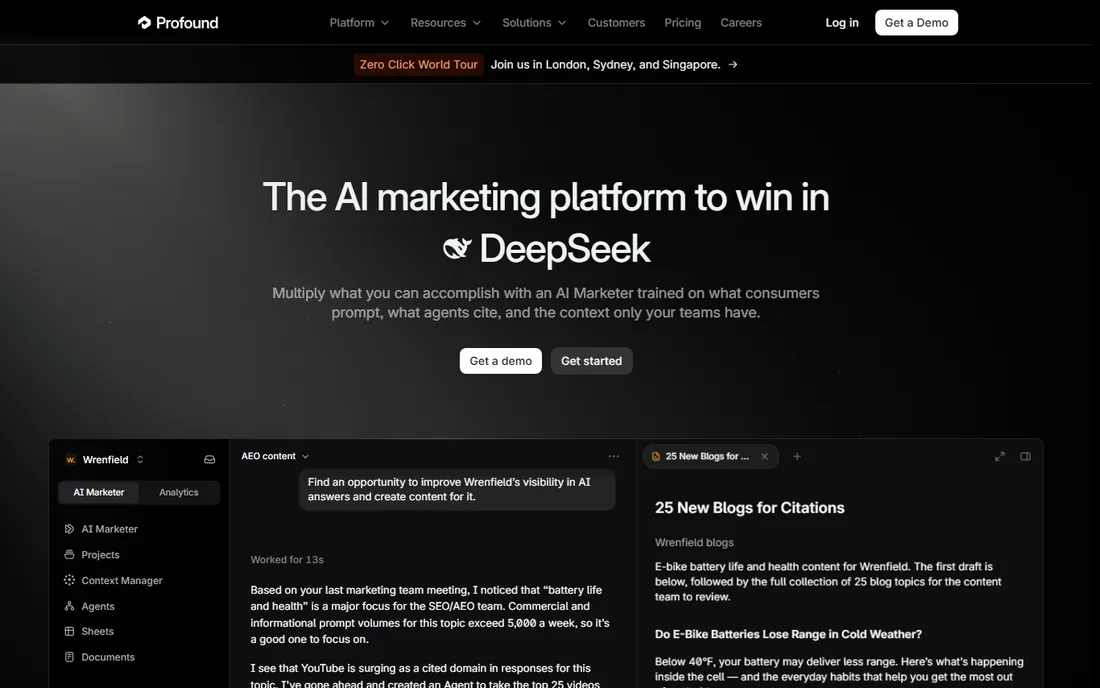
If your team already reports on share of voice in Google, Profound translates that habit into ChatGPT, Perplexity, Gemini and Copilot. You define the prompts that matter, the platform runs them, and you get trend lines showing how often your brand appears and in what context. It feels familiar to anyone who has worked with rank tracking.
What sets it apart is the depth of the answer analysis. Profound breaks down citations, sentiment and topic association, so a drop in visibility comes with a likely explanation. That saves the guessing that usually follows a ranking change.
Expect an enterprise sales process and enterprise pricing. There is no self-serve plan to start small with. For mid-size and larger brands that need defensible AI visibility data, though, it is one of the most complete options available.
What we like- Built specifically for tracking brand visibility inside AI answers
- Covers ChatGPT, Perplexity, Gemini and Copilot in one dashboard
- Sentiment and competitor comparison reports
Watch out for- Pricing is quote-based, which rules out smaller budgets
- Historical benchmarking is still thin in this new category
#2
OtterlyAI
Best for: Small teams that want affordable AI search monitoring
Visit otterly.ai
Starting price$29 per month
Free planNo
OtterlyAI earns its spot by covering Google AI Overviews alongside the chatbots, which many pure-play trackers skip. That dual coverage matches how buyers actually encounter AI-generated content, split between search results and conversational tools. The $29 entry price makes it an easy experiment.
The interface keeps things readable. You see mention frequency, trend direction and the engines where you appear, presented for marketers rather than data analysts. Weekly checks take minutes.
Larger teams will outgrow it. There is less here for multi-brand portfolios, custom research or deep competitive intelligence. But as an affordable way to start measuring AI visibility, OtterlyAI is hard to argue with.
What we like- Low entry price for the category
- Covers Google AI Overviews alongside chatbots
- Straightforward dashboards that need little training
Watch out for- Less analytical depth than enterprise platforms
- Smaller integration set for reporting pipelines
#3
Peec AI
Best for: Marketers who want readable AI visibility reports
Visit peec.ai
Starting priceSee website
Free planNo
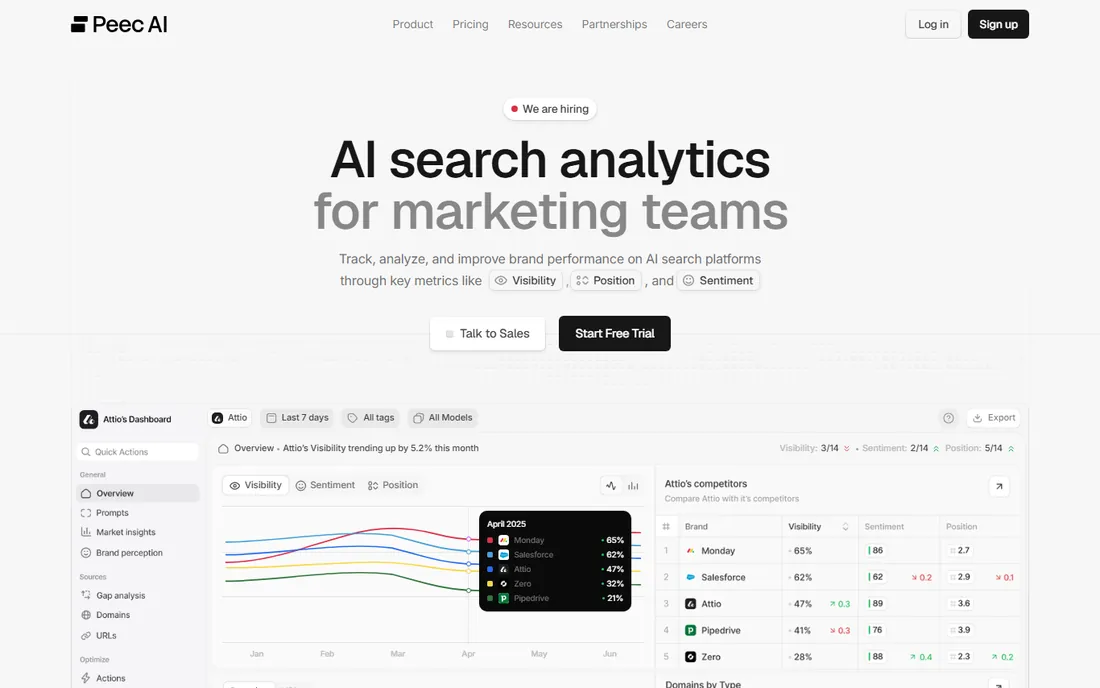
Peec AI focuses on one job: telling you how visible your brand is across the AI engines your customers actually use. The platform monitors mentions and presents them in reports that a marketing manager can read without an SEO dictionary. That clarity is its main selling point.
Onboarding is light. You define your brand and the topics you care about, and Peec starts building the visibility picture. The emphasis stays on trends and comparisons rather than raw prompt logs.
Pricing is not published, so you will need to talk to the team for a quote. And if you also need keyword rankings, backlinks and site audits, a full SEO suite will serve you better. For pure AI visibility with minimal fuss, Peec AI is a solid pick.
What we like- Multi-engine brand mention tracking
- Reports written for marketers, not analysts
- Quick setup with minimal configuration
Watch out for- Pricing is not published
- Fewer legacy SEO features than full suites
#4
LLMrefs
Best for: Small brands that only need LLM mention tracking
Visit llmrefs.com
Starting price$79 per month
Free planNo
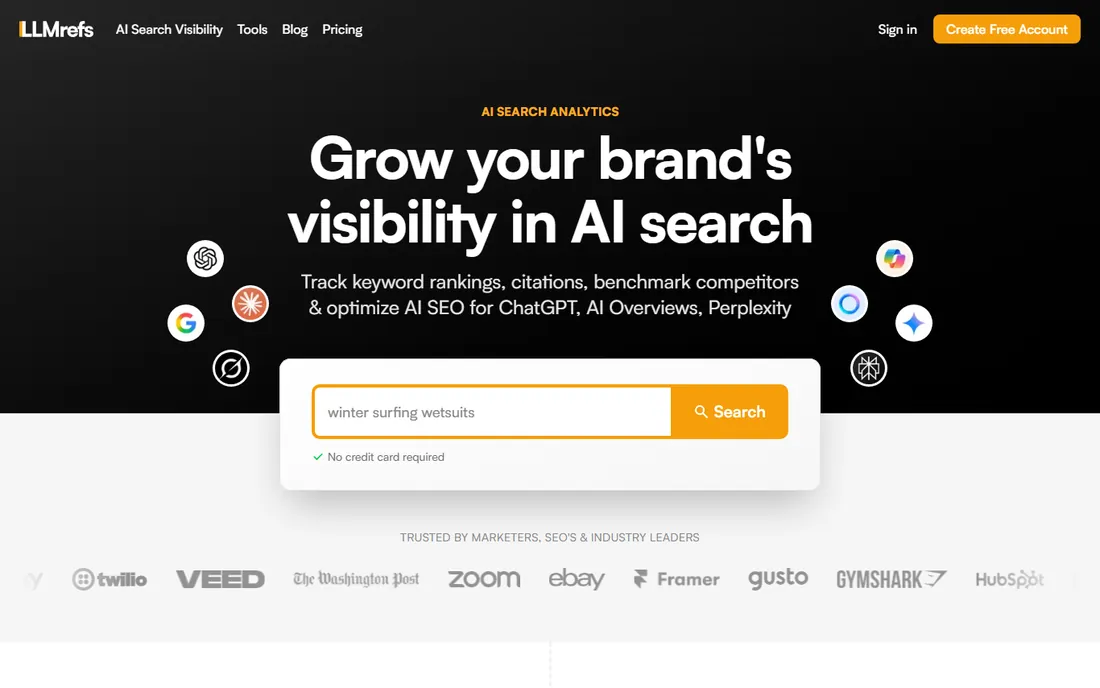
Small brands that only care about LLM mentions can skip the suites and use LLMrefs. The $79 flat monthly price buys dedicated mention tracking across language models, presented without the surrounding complexity of an SEO platform. It is a specialist tool at a generalist price point.
Simplicity drives the experience. You see where your brand gets referenced, how often, and whether the trend is moving your way. Reports stay readable for non-technical stakeholders.
Expect fewer integrations and less depth than bigger names. LLMrefs is early in its journey, so buyers should trial it against their specific needs. For the narrow job it does, though, it is priced to try.
What we like- Focused on LLM referral and mention tracking
- Simple setup with clear flat pricing
- No bloat from unrelated SEO features
Watch out for- Newer vendor with a smaller feature set
- Limited third-party integrations
Starting priceSee website
Free planNo
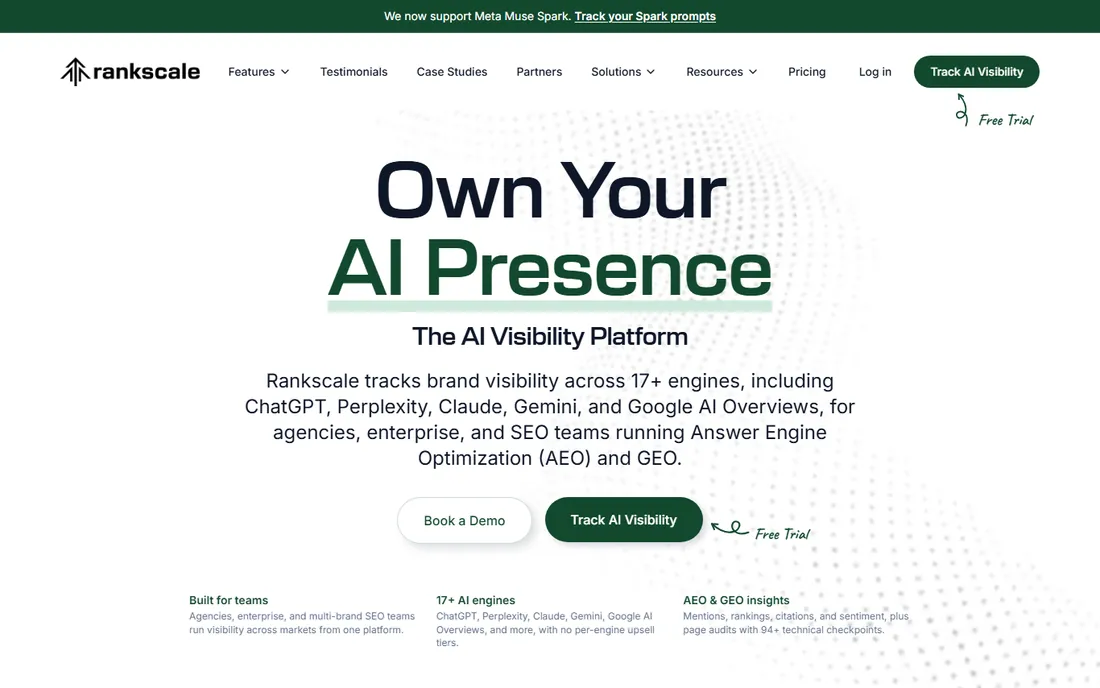
Rankscale covers the core job: monitor where your brand appears in AI answers and track the trend. The platform is purpose-built for AI visibility, so every screen serves that goal rather than splitting attention with legacy SEO features. Metrics stay plain and report-friendly.
Quick setup means you start accumulating trend data within days, not weeks. For teams under pressure to show AI search progress, that speed matters.
Pricing is not clearly published and the vendor is less proven than the big names. Those are fair cautions. But if you want a straightforward AI visibility tracker without enterprise complexity, Rankscale belongs in the evaluation.
What we like- Purpose-built for AI visibility measurement
- Metrics simple enough for monthly reporting
- Quick onboarding
Watch out for- Pricing information is limited
- Smaller review footprint than established tools
Starting priceSee website
Free planNo
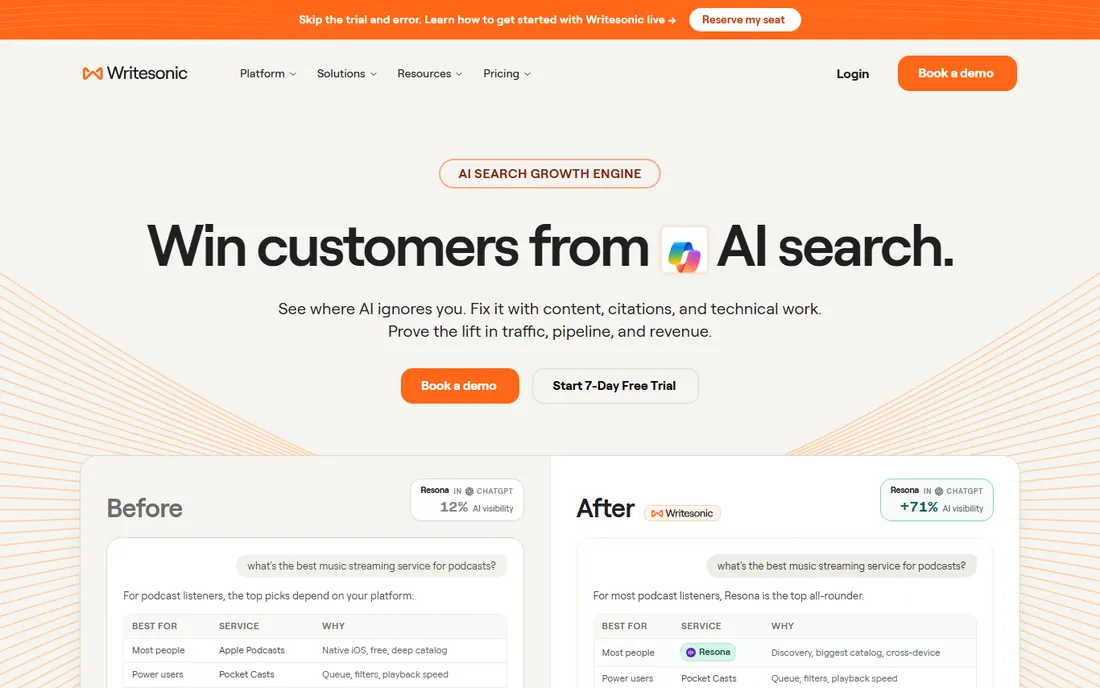
Writesonic approaches AI visibility from the content side, pairing tracking with the generation tools marketers already use. If your team writes with Writesonic, adding visibility data keeps measurement next to production. That proximity is convenient for content-led SEO.
The platform's AI marketing feature set is broad, covering writing, optimization and now visibility. Teams that centralize content work in one tool get a coherent workflow from draft to measurement.
Pure analytics platforms go deeper on tracking detail, and Writesonic's tiered pricing takes some study. But for content teams that want AI search data where the writing happens, it is a practical combination.
What we like- Pairs visibility tracking with AI content generation
- Familiar to content marketers
- Wide set of AI marketing features
Watch out for- Less analytical depth than pure tracking platforms
- Pricing tiers can be confusing
Starting priceSee website
Free planNo
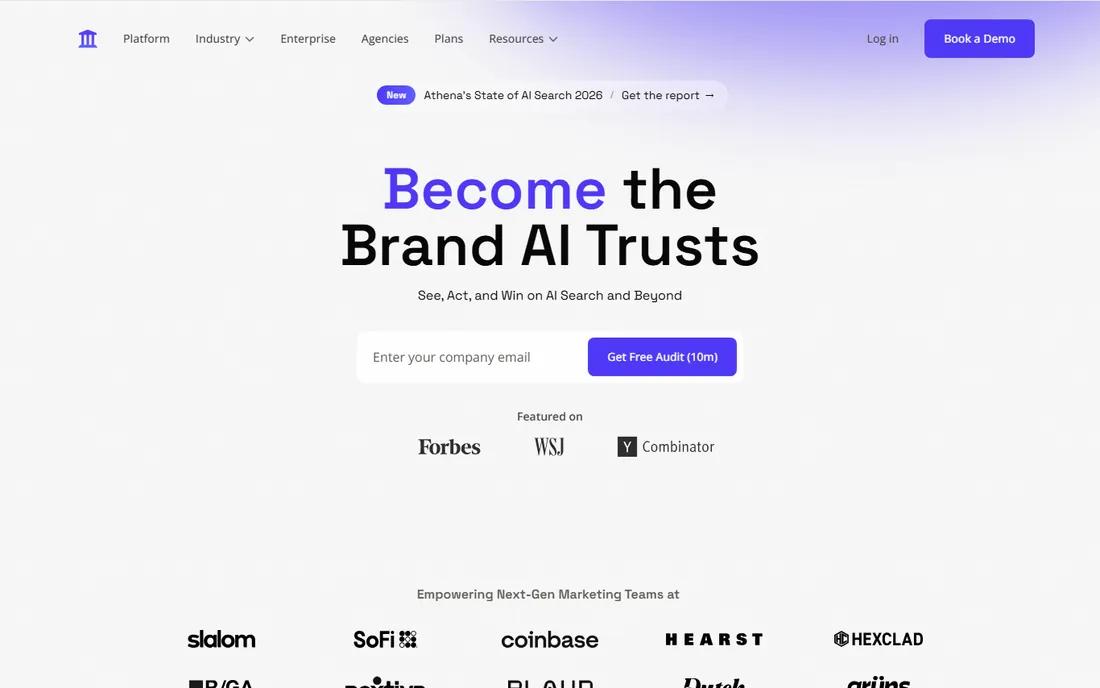
AthenaHQ keeps onboarding fast, which helps when you need AI visibility data before next month's report. The platform is built solely for tracking brand presence in AI answers, and that focus shows in a streamlined interface with little to configure.
For small marketing teams, the simplicity is the selling point. You get mention trends across engines without learning an analytics platform or hiring an SEO to interpret it.
The caution flags are youth and transparency. Limited reviews and unpublished pricing mean you evaluate on the trial alone. Within those bounds, AthenaHQ is one of the easier dedicated trackers to start with.
What we like- Dedicated AI search visibility tracking
- Clean, marketer-friendly dashboard
- Fast setup
Watch out for- Newer product with limited track record
- Few third-party reviews to validate claims
#8
Cituna
Best for: Price-sensitive teams that need core AI metrics
Visit cituna.com
Starting price$39 per month
Free planNo
Price-sensitive teams should look at Cituna before signing an enterprise contract elsewhere. The $39 monthly starting price and 3-day trial make it easy to test whether AI visibility data is worth paying for at all. Core mention tracking across engines is covered.
The product knows its audience. Dashboards are plain, setup is quick, and there is no feature bloat inflating the price. Small teams get in, get their numbers, and get on with their work.
Advanced users will notice the gaps: less coverage, lighter competitive analysis, minimal integrations. But Cituna never claims to be an enterprise platform. As affordable essentials go, it is well judged.
What we like- Low starting price for the category
- 3-day trial to evaluate
- Simple, readable dashboards
Watch out for- Smaller platform coverage than leaders
- Fewer advanced analytical features
#9
ZipTie
Best for: Teams that need occasional AI visibility checks
Visit ziptie.ai
Starting priceAbout $0.01 per check
Free planNo
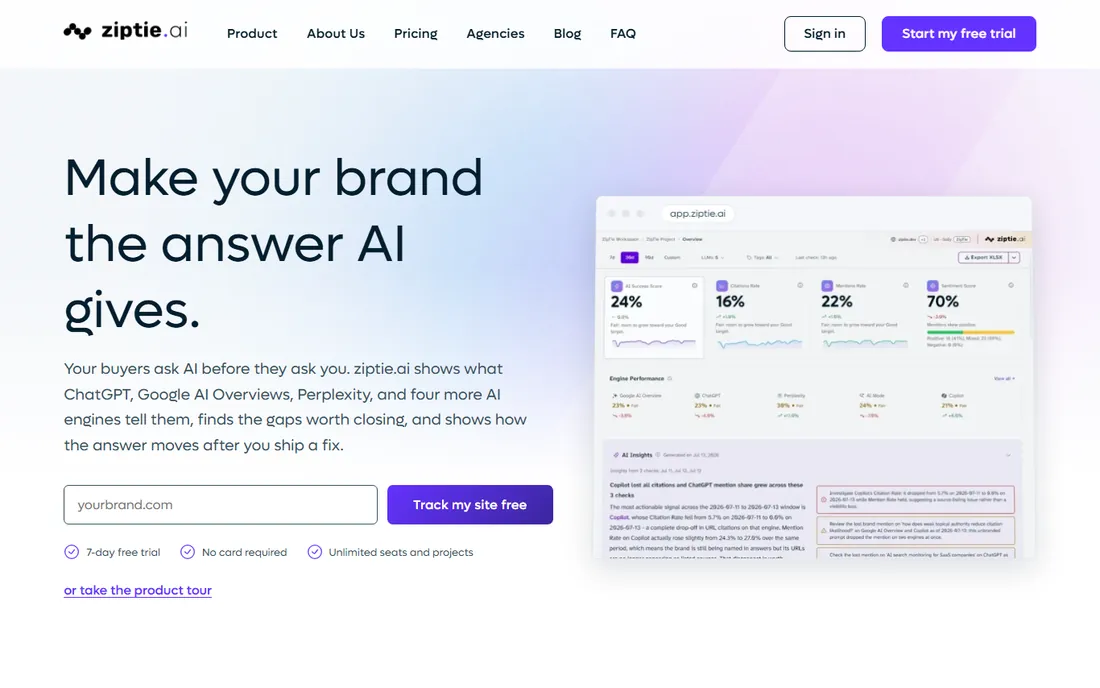
ZipTie charges per check, which makes it the cheapest way to spot-check AI visibility without a subscription. At about a cent per check with a 7-day trial, you can audit your brand's AI presence for pocket change. There is no monthly commitment.
That model fits specific workflows: quarterly audits, pre-campaign baselines, or checking a handful of key prompts after a site change. You pay for data when you need it and nothing when you do not.
It is not a monitoring suite. There are no continuous trend dashboards or alerting pipelines like subscription tools offer. But as a lightweight way to answer how visible are we right now, ZipTie is cleverly priced.
What we like- Pay-per-check model suits occasional use
- 7-day trial available
- Cheapest way to spot-check AI visibility
Watch out for- Not a full continuous monitoring suite
- Costs scale with check volume
How we chose
To build this comparison, we reviewed each vendor's pricing page, product documentation, and feature lists, then cross-checked against public reviews on G2, Capterra, and Reddit. We compared engine coverage, reporting depth, pricing transparency, and fit for different team sizes. No vendor paid for placement, and we did not claim hands-on testing we did not do.
Start with engine coverage. Your buyers use ChatGPT, Perplexity, Gemini, Copilot, and Google AI Overviews, and a tool that only watches two of those gives you a partial picture. Ask vendors exactly which engines they monitor and how often prompts run.
Next, check prompt methodology. The best tools let you define your own prompts based on real buyer questions, rather than forcing vendor defaults. Also confirm you get historical data, competitor comparison, and alerts when mentions change.
Finally, interrogate the pricing. Quote-based enterprise deals dominate this category, so get the number in writing before you fall in love with a demo. Trial the data quality on your own brand first: if the numbers look thin during the trial, they will not improve after you sign.
How AI visibility tracking actually works
The mechanics are straightforward. You define a set of prompts that mirror what buyers ask, such as best CRM for small business or safest family SUV. The platform runs those prompts against AI engines on a schedule, then parses the answers for brand mentions.
Parsing is the hard part. Answers are prose, not structured data, so the tool identifies brand names, measures sentiment, and notes which sources get cited. Over weeks, those observations become trend lines.
Good platforms add context: competitor mentions in the same answers, sentiment shifts, and the content or sources associated with visibility gains. That context turns raw monitoring into something you can act on.
Frequently asked questions
What is AI visibility software?
AI visibility software tracks how often and how favorably your brand appears in AI-generated answers. It runs prompts across engines like ChatGPT, Perplexity, Gemini, and Google AI Overviews, then reports mentions, sentiment, and trends over time. Think of it as rank tracking for the AI answer era.
How is AI visibility different from SEO rankings?
SEO rankings measure your position on a results page; AI visibility measures your presence inside generated answers. There are no positions to track, only mentions, citations, and sentiment. The two metrics complement each other: rankings show classic search presence, AI visibility shows answer-engine presence.
Which AI engines do these tools track?
Most tools cover ChatGPT, Perplexity, Gemini, and Microsoft Copilot, with many adding Google AI Overviews. Coverage varies, so check the specific list before buying. If your buyers use a particular engine heavily, confirm it is monitored.
How much does AI visibility software cost?
Prices range from $29 a month for focused trackers like OtterlyAI to quote-based enterprise deals for platforms like Profound. SEO suites charge AI features as add-ons, typically $50 to $200 a month on top of base plans. Expect to pay more for deeper analysis and competitor tracking.
Can I track AI visibility for free?
Free options are limited. Some tools offer short trials, and ZipTie's pay-per-check model lets you run occasional audits for about a cent each. For continuous monitoring, though, expect a paid subscription. The category is too new for mature free tiers.
Sources we checked (9)
- https://tryprofound.com/
- https://otterly.ai/
- https://peec.ai/
- https://llmrefs.com/
- https://rankscale.ai/
- https://writesonic.com/
- https://athenahq.ai/
- https://cituna.com/
- https://ziptie.ai/
Is your product missing or out of date?
We review this list regularly. Vendors can request a listing, send updated pricing or ask about featured placement.

Shihab Mia · Founder, Rankite
Shihab has spent more than a decade helping SaaS and e-commerce brands grow through search. He writes Rankite's software buying guides from pricing pages, documentation and public user reviews. More about Shihab.