How we make this list: we compare pricing pages, product documentation and public user reviews. Ratings come from G2, Capterra or Trustpilot, with the date we checked them.
What makes laboratory billing different from regular medical billing?
Laboratory billing starts with the requisition, not the visit. The lab must match each test to a diagnosis code, check medical necessity, and confirm that the payer covers that specific assay. Molecular and genetic tests face the strictest rules, with prior authorization and payer specific coverage policies that general billing software does not track. Toxicology labs face their own set of payer limits on drug testing frequency. A billing system built for labs handles CPT and ICD-10 coding for tests, screens orders for medical necessity, and flags missing documentation before the claim goes out. General practice billing tools miss these steps, which is why denials pile up.
Should a lab bill in house or outsource billing?
The answer depends on volume, staffing, and test complexity. A lab with steady volume and a trained billing team can keep billing in house with a system such as TELCOR or Quadax, keeping control of claims and patient billing. A lab with thin staffing or a complex molecular menu often recovers more by outsourcing to a service such as XiFin or APS Medical Billing, which brings coders and denial specialists the lab would have to hire. Outsourced billing usually costs a percentage of collections, so the fee rises and falls with revenue. In house billing costs a software license plus salaries, which can be cheaper at scale but leaves the lab exposed when a key biller leaves.
How much does laboratory billing software cost?
Almost every vendor in this comparison keeps pricing behind a sales conversation, so a public starting price is the exception rather than the rule. LigoLab publishes monthly investment ranges tied to annual case volume, starting under 2,000 dollars per month for labs under 10,000 cases a year. iSolve RCM publishes a starting rate of 2.99 percent of monthly collections. Third party directories report Coronis Health at 4 to 8 percent of collections, but Coronis does not publish that figure itself, so treat it as an unverified estimate and ask for a written quote. For the rest, budget for a quote based on test volume, payer mix, and whether you want software only or a managed service.
What should a lab check before signing a billing contract?
Ask who owns the data and how you get it back if you leave. Ask whether the price covers coding, claim scrubbing, denial appeals, and patient billing, or whether some of those are add on fees. Ask how the system connects to your LIS and your ordering providers, and how long implementation takes. Ask for the clean claim rate and the average days in accounts receivable for labs like yours, and ask for references from a lab with a similar test menu. Finally, read the contract term and the termination clause. Multi year contracts are common in this market, and a long term with no exit clause can trap a lab with a system that does not fit.
Quick comparison
| Tool | Best for | Starting price | Free plan |
|---|
 XiFin RPM | High volume molecular, genetic, and toxicology labs | Quote | No free plan |
 Quadax | Labs and pathology groups that want clearinghouse control | Quote | No free plan |
 TELCOR RCM | Outreach and independent labs that may bring billing in house later | Quote | No free plan |
 LigoLab | Pathology and clinical labs that want billing inside their LIS | From under $2,000 per month for labs under 10,000 cases a year, vendor published tier guide | No free plan |
 Orchard Harvest LIS | Physician office labs, clinics, and small hospitals | Quote | No free plan |
 APS Medical Billing | Pathology practices and outreach and reference labs | Quote | No free plan |
 Coronis Health | Multi specialty groups and health systems with a laboratory | Quote | No free plan |
 iSolve RCM | Physician office labs and small independent labs | From 2.99% of monthly collections, vendor published | No free plan |
Is your product missing or out of date?
We review this list regularly. Vendors can request a listing, send updated pricing or ask about featured placement.
The best laboratory billing software
| Tool | Model | Best for | Starting price |
| XiFin RPM | Software plus managed RCM | High volume molecular and genetic labs | Quote |
| Quadax | Software, clearinghouse, and outsourced billing | Labs and pathology groups wanting clearinghouse control | Quote |
| TELCOR RCM | Billing software plus billing service | Outreach and independent labs | Quote |
| LigoLab | LIS with integrated RCM module | Pathology and clinical labs wanting one system | From under $2,000 per month |
| Orchard Harvest LIS | LIS with billing support | Physician office labs and small hospitals | Quote |
| APS Medical Billing | Outsourced billing service | Pathology and reference labs | Quote |
| Coronis Health | Outsourced RCM service | Multi specialty groups with a lab | Quote |
| iSolve RCM | Outsourced billing service | Physician office labs and small independent labs | From 2.99% of collections |
#1
XiFin RPM
Best for: High volume molecular, genetic, and toxicology labs
Visit xifin.com
Starting priceQuote
Free planNo free plan
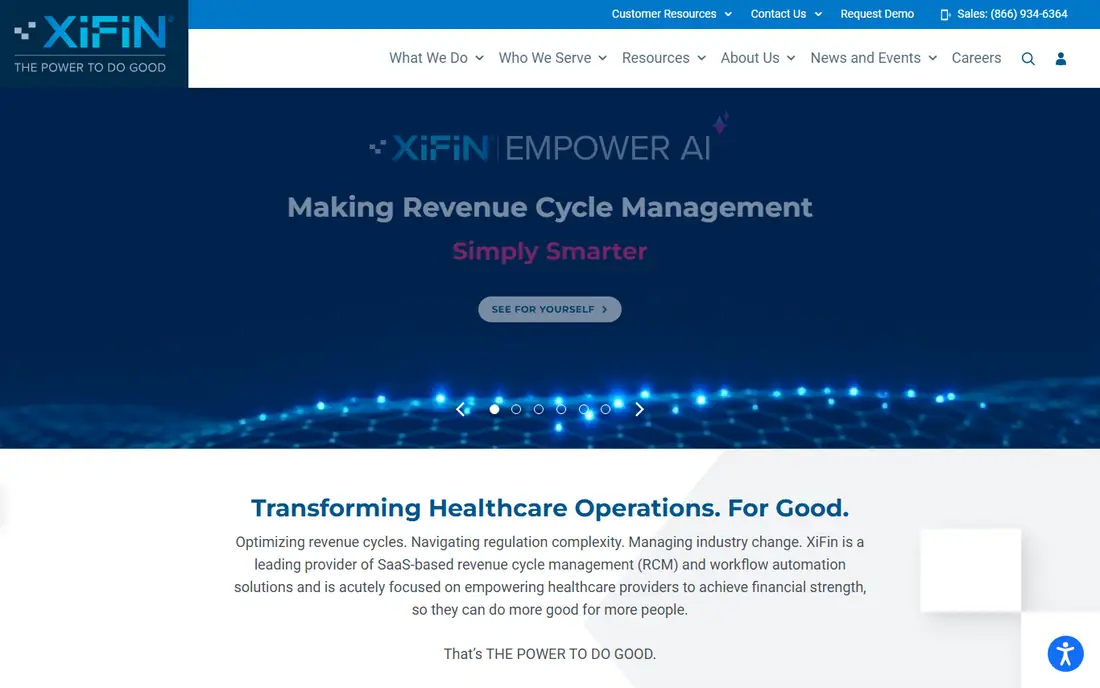
XiFin RPM is a cloud based revenue cycle platform built for diagnostic labs, with automation for coding, claim scrubbing, denial management, and payment posting. It is ranked first by Black Book for outpatient laboratory revenue cycle management, a position it has held for seven years in a row according to the research firm. The platform suits high volume molecular and genetic labs that need payer connectivity across many plans. XiFin also offers managed billing services, so a lab can pair the software with a XiFin team.
What we like- Lab specific revenue cycle platform, strong payer connectivity, analytics built for diagnostic labs
Watch out for- Pricing is not published, and the platform is built for larger labs, so small labs may find the onboarding and minimums heavy
#2
Quadax
Best for: Labs and pathology groups that want clearinghouse control
Visit quadax.com
Starting priceQuote
Free planNo free plan
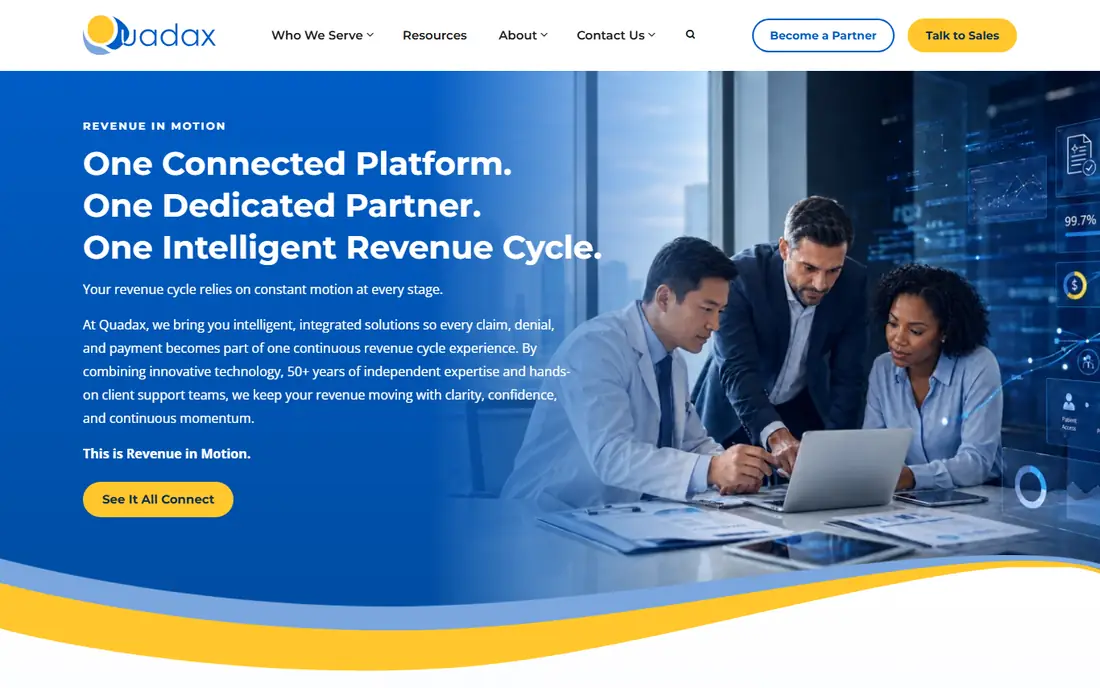
Quadax offers laboratory billing software, a clearinghouse, and outsourced billing services, so a lab can start with software and add services as volume grows. The company has worked in laboratory and pathology billing since 1973, giving it deep experience with payer rules for lab tests. Its clearinghouse gives labs direct control over claim routing and status checks. The hybrid model suits labs that want to keep some billing in house while outsourcing the hardest parts, such as denial appeals and aged accounts receivable follow up.
What we like- Combines software, clearinghouse, and outsourced billing in one vendor, long history in lab billing since 1973
Watch out for- Pricing is not published, and the hybrid model means buyers must check carefully which parts are software and which are staffed services
#3
TELCOR RCM
Best for: Outreach and independent labs that may bring billing in house later
Visit telcor.com
Starting priceQuote
Free planNo free plan
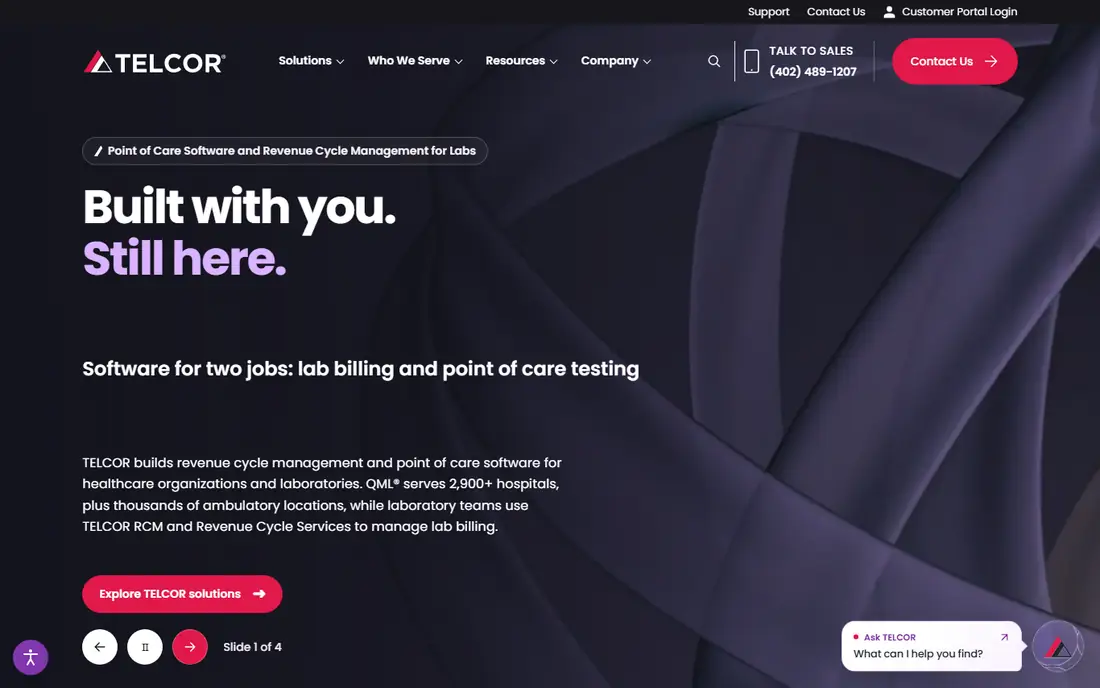
TELCOR is a standalone laboratory billing system designed for in house revenue cycle management, with workflow control and reporting built for lab claims. The company has sold lab billing software since 1995 and serves outreach and independent labs across the United States. Because TELCOR is software rather than a service, a lab keeps its own billing staff and processes, which suits labs that want full control of their revenue cycle. TELCOR also offers a billing service for labs that prefer to outsource while keeping the option to bring billing back in house.
What we like- Standalone lab billing system with workflow control, lab revenue cycle software since 1995
Watch out for- Pricing is not published, and the interface and reporting feel dated next to newer cloud platforms
#4
LigoLab
Best for: Pathology and clinical labs that want billing inside their LIS
Visit ligolab.com
Starting priceFrom under $2,000 per month for labs under 10,000 cases a year, vendor published tier guide
Free planNo free plan
LigoLab is an all in one laboratory information system with a fully integrated revenue cycle module, so orders, results, and billing live in one database with no interface between systems. The billing module covers real time demographic review, insurance eligibility and discovery, automatic CPT and ICD-10 coding, claim scrubbing, ABN generation, and patient and client billing. LigoLab prices in four tiers, Essential, Professional, Advanced, and Enterprise, with cost per test falling as volume rises. The vendor publishes monthly investment ranges tied to annual case volume.
What we like- LIS and billing share one database, volume based tiered pricing, real time eligibility and auto coding
Watch out for- Implementation costs are reported to run high, and billing is part of a larger LIS purchase rather than a standalone product
#5
Orchard Harvest LIS
Best for: Physician office labs, clinics, and small hospitals
Visit orchardsoft.com
Starting priceQuote
Free planNo free plan
Orchard Harvest LIS is a laboratory information system with billing support built into order entry, including medical necessity screening, diagnosis code checks, and payer specific bundling rules. The system screens whether a test is covered, whether the frequency is allowed under Medicare rules, and whether the diagnosis code matches the test. Orchard added automated insurance verification in 2024, which checks eligibility before testing and cuts denials caused by wrong or missing insurance details. Orchard serves more than 2,000 laboratories, including physician office labs, clinics, hospitals, and regional reference labs.
What we like- Rules based billing and coding checks at order entry, strong interfaces to billing systems and EMRs, used by more than 2,000 labs
Watch out for- Billing is a module inside an LIS, not a standalone billing product, and pricing is not published
#6
APS Medical Billing
Best for: Pathology practices and outreach and reference labs
Visit apsmedbill.com
Starting priceQuote
Free planNo free plan
APS Medical Billing is a revenue cycle service, not software, with a history in pathology billing dating back to 1960. It was one of the first firms to perform professional component clinical pathology billing and serves pathology practices, outreach labs, and reference labs across the United States. Its services include CPT and diagnosis driven pre billing edits by payer, denial management, payment validation, and customized reporting. Because APS works as an extension of the lab, it suits labs that want experienced lab billers without hiring and training their own team.
What we like- Billing pathology practices since 1960, deep lab coding expertise, payer specific pre billing edits
Watch out for- This is a billing service, not software you buy, and pricing is not published
Starting priceQuote
Free planNo free plan
Coronis Health is a global revenue cycle management company that lists laboratory and pathology among its specialties, alongside anesthesia, emergency medicine, radiology, and behavioral health. Its services run from patient access and coding through billing, collections, denial management, credentialing, and analytics. The company manages large collection volumes and works with practices, surgery centers, and hospitals. Labs inside a larger group benefit from one vendor covering the whole organization, but buyers should ask which team and systems will handle their lab accounts, since Coronis grew by acquiring regional billing firms.
What we like- End to end revenue cycle service across many specialties, large scale operations with lab and pathology billing
Watch out for- Primarily a service company rather than a software product, pricing is not published, and third party reports of 4 to 8 percent of collections are unverified
Starting priceFrom 2.99% of monthly collections, vendor published
Free planNo free plan
iSolve RCM is an outsourced medical billing and revenue cycle company based in Edison, New Jersey, that handles lab billing as part of a full revenue cycle service. Its work covers eligibility verification, coding, claim submission, denial management, accounts receivable follow up, and payer credentialing, which keeps a lab in network. The company publishes a starting rate of 2.99 percent of monthly collections, which is unusually transparent in this market. iSolve suits physician office labs and small independent labs that want one team for lab claims and professional claims.
What we like- Published starting price, full cycle service including credentialing, fast onboarding of about one to two weeks
Watch out for- This is an outsourced service, not software, so labs that want to bill in house will not find a product to buy here
We picked tools that sell billing built for laboratories, not general medical billing, and checked each vendor homepage on 22 Nov 2026. We favored vendors with a documented lab focus, such as molecular, pathology, toxicology, or outreach billing, and we kept a mix of software, integrated LIS billing, and outsourced services so labs with different operating models can compare. Prices were taken from vendor pages where published and marked as quote where hidden. We excluded vendors whose homepage did not load or whose lab billing offering could not be confirmed.
Cost worked example: what a lab collecting $200,000 a month would pay
A lab that collects 200,000 dollars a month would pay about 5,980 dollars a month at iSolve RCM starting rate of 2.99 percent of collections, or 71,760 dollars a year. At the third party reported Coronis Health range of 4 to 8 percent, the same lab would pay 8,000 to 16,000 dollars a month, or 96,000 to 192,000 dollars a year, though Coronis does not publish that range itself. A lab on LigoLab lowest published tier would pay under 2,000 dollars a month in software fees, but that figure excludes billing staff salaries and any implementation cost. The worked example shows why the fee model matters as much as the headline rate.
Frequently asked questions
How is laboratory billing software different from regular medical billing software?
Laboratory billing software is built around the requisition and the test, not the patient visit. It checks medical necessity, matches diagnosis codes to each assay, screens test frequency against payer rules, and handles payer specific coverage policies for molecular, genetic, and toxicology tests. Regular medical billing software is built around appointments and procedures, and it usually lacks these lab specific checks. Labs that use a general billing tool often see more denials and more manual rework, because the system does not catch lab coding errors before the claim goes out.
What is the average cost of laboratory billing software?
Most vendors do not publish prices, so there is no reliable market average for software licenses. LigoLab publishes monthly ranges starting under 2,000 dollars per month for labs under 10,000 cases a year, and that figure covers the LIS and billing module together. Outsourced billing is easier to compare, with iSolve RCM publishing a starting rate of 2.99 percent of monthly collections, while third party directories report 4 to 8 percent for larger firms. Ask every vendor for a written quote based on your test volume and payer mix.
Can a small lab use laboratory billing software, or should it outsource?
A small lab can do either, and the right choice depends on staffing. A physician office lab with low volume and no billing specialist usually does better outsourcing to a service such as iSolve RCM or APS Medical Billing, which supplies coders and denial follow up for a percentage of collections. A small lab with a trained biller can run software such as TELCOR or Orchard Harvest LIS in house and keep control of claims. Labs should compare the percentage fee against the cost of one billing salary before deciding.
What is the difference between an LIS with billing and standalone billing software?
An LIS with billing, such as LigoLab or Orchard Harvest, keeps orders, results, and billing in one system, so there is no interface to maintain between the lab bench and the billing office. Standalone billing software, such as TELCOR or XiFin RPM, connects to an existing LIS and focuses only on the revenue cycle. The integrated option cuts handoffs and duplicate entry, but it ties the lab to one vendor for both operations and finance. The standalone option gives more freedom to change the LIS later.
How long does it take to switch laboratory billing software?
Implementation time varies by vendor, lab size, and how many payer connections and LIS interfaces are needed. Small labs moving to an outsourced service can be live in about one to two weeks, based on iSolve RCM published onboarding time. Larger labs moving to an integrated LIS with billing should expect several months, because the project covers order entry, instruments, interfaces, coding rules, and staff training. Ask each vendor for a written implementation timeline and for references from a lab of similar size before signing.
Sources we checked (11)
- https://www.xifin.com
- https://www.quadax.com
- https://www.telcor.com
- https://www.ligolab.com/post/rip-off-the-bandage-ligolab-billing-solution
- https://www.ligolab.com/post/ligolabs-new-tiered-structure-for-its-lis-platform-delivers-a-tailored-fit-and-maximum-value
- https://www.reworked.co/the-wire/orchard-software-announces-new-billing-functionality-to-improve-reimbursements/
- https://apsmedbill.com/about
- https://coronishealth.com
- https://isolvercm.com/laboratory-billing-companies/
- https://isolvercm.com/medical-billing-outsourcing-cost/
- https://pathleaders.org/wp-content/uploads/2025/05/24-RPT-153-Black-Book-2024.pdf
Is your product missing or out of date?
We review this list regularly. Vendors can request a listing, send updated pricing or ask about featured placement.

Shihab Mia · Founder, Rankite
Shihab has 5+ years in B2B and SaaS SEO. He writes Rankite's software buying guides from pricing pages, documentation and public user reviews. More about Shihab.