How we make this list: we compare pricing pages, product documentation and public user reviews. Rankite is independent; if a vendor ever pays for a featured spot, that listing is clearly labeled Partner.
Key takeaways
- Procore and Autodesk Construction Cloud lead for large contractors needing full project lifecycle management.
- Buildertrend and Buildern serve residential builders and remodelers with client-facing tools.
- Fieldwire and Raken focus on the field: task management, daily logs, and photo documentation crews actually use.
- Assignar and HCSS specialize in workforce and heavy civil operations, from scheduling crews to equipment tracking.
- Adoption by field crews decides success, so prioritize mobile usability over back-office feature depth.
The jobsite runs on paper until it does not
Walk onto most jobsites and the information system is a trailer wall covered in marked-up drawings, a foreman's notebook, and a group text thread. It works until it does not: the drawing on the wall is three revisions old, the notebook stays in the truck, and the text thread buries the RFI that is now blocking the electricians. Jobsite management software exists to replace that fragile system with one source of truth that lives in everyone's pocket.
The category covers a lot of ground. Daily logs, photo documentation, punch lists, safety forms, time tracking, scheduling, and drawing management all fall under the umbrella. Some platforms try to do everything from preconstruction to closeout. Others focus on the field experience and integrate with the back office. The difference matters because the buyer is usually in the office while the users are in the dirt.
We compared eight platforms across that range, judging them on field usability first, since software the crew will not open is just an expense.
Quick comparison
| Tool | Best for | Starting price | Free plan |
|---|
 Procore Procore | Full project management for contractors | See website | No |
 Buildertrend Buildertrend | Residential builders and remodelers | See website | No |
 Autodesk Construction Cloud Autodesk Construction Cloud | Design-to-field BIM workflows | See website | Free trial |
 Fieldwire Fieldwire | Field task management | See website | Yes |
 Raken Raken | Daily logs and field reporting | See website | Free trial |
 Assignar Assignar | Workforce scheduling and allocation | See website | No |
 HCSS HCSS | Heavy civil operations | See website | No |
 Buildern Buildern | All-in-one for small builders | See website | Free trial |
Is your product missing or out of date?
We review this list regularly. Vendors can request a listing, send updated pricing or ask about featured placement.
The best jobsite management software in 2026
Starting priceSee website
Free planNo

Procore is the closest thing construction has to a standard platform, covering project management, financials, quality, safety, and field productivity in one system. Drawings, RFIs, submittals, daily logs, and budgets connect so that office and field work from the same information. On large commercial projects, that integration eliminates the version-control chaos that causes rework.
The pricing is enterprise and quoted by project volume, and implementations take real effort. Small contractors often find it heavy. But for general contractors running complex projects with many stakeholders, Procore's breadth means fewer systems to integrate and a single record of what happened. The marketplace of integrations extends it further into estimating, accounting, and BIM.
What we like- Broadest construction platform, Strong financial management, Huge integration marketplace, Proven on large projects
Watch out for- Enterprise pricing, Implementation is significant, Can overwhelm small teams
Starting priceSee website
Free planNo
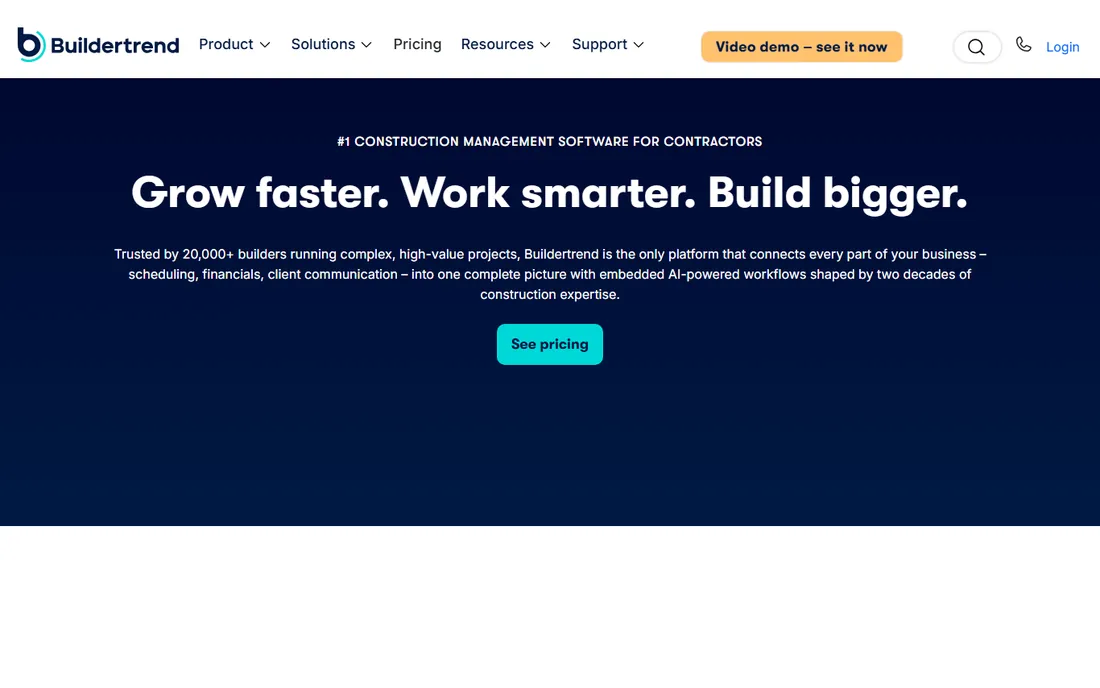
Buildertrend owns the residential builder and remodeler segment by designing for how those businesses actually work. Client communication is the standout: homeowners see schedules, selections, photos, and invoices through a portal that reduces the "what is happening with my project" calls. Scheduling, daily logs, and financial tracking cover the operational side.
Commercial contractors will find it limiting, and pricing scales with project volume. But for custom home builders and remodelers, the client-facing polish is a competitive advantage, not just a feature. Happy clients refer friends, and Buildertrend is built to produce happy clients.
What we like- Built for residential workflows, Great client communication tools, Good scheduling, Strong customer support
Watch out for- Less suited to commercial, Pricing per project, Some features feel residential-only
Starting priceSee website
Free planFree trial
Autodesk Construction Cloud connects the design world to the field, which matters enormously on projects where BIM models drive construction. Models, drawings, and documents flow from design tools into field apps without the translation losses that plague mixed-vendor stacks. For design-build firms and contractors working from models, that continuity is the product.
The platform is really a family of products, Assemble, Build, Docs, and others, and navigating the lineup takes effort. Pricing varies by module. But if your projects live in Revit and your field teams need model access on tablets, no other platform connects the two ends as natively.
What we like- Deep BIM and design integration, Strong document management, Good for design-build, Backed by Autodesk
Watch out for- Complex product family, Pricing varies by module, Learning curve
Starting priceSee website
Free planYes
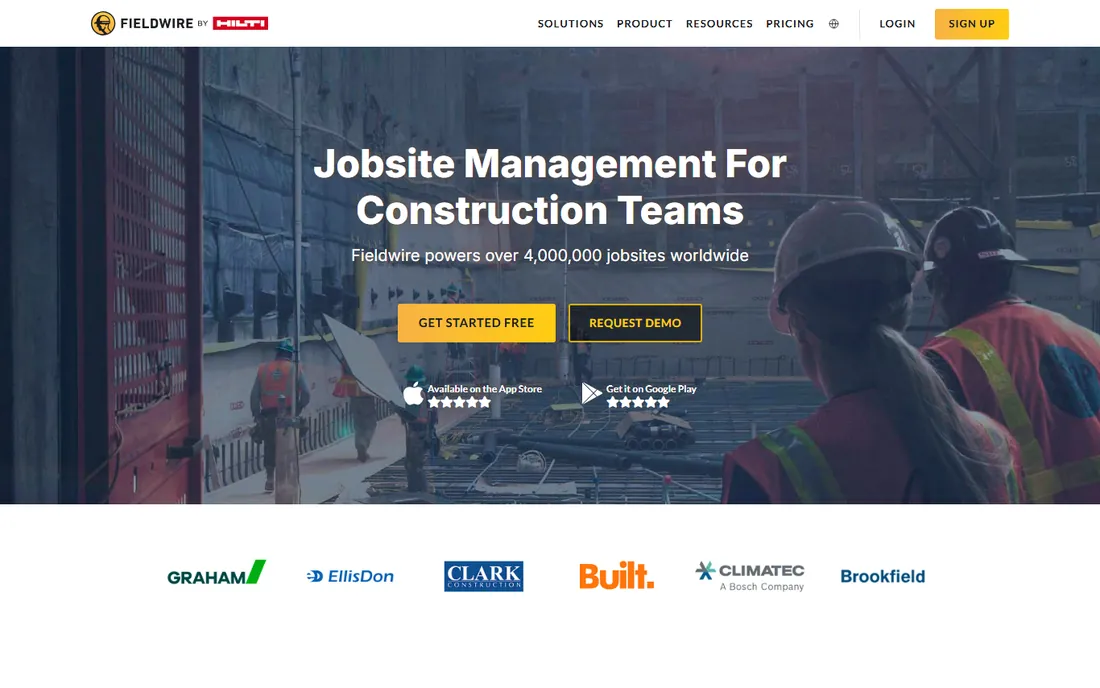
Fieldwire won jobsites by being the app foremen actually open. Tasks pin to locations on drawings, photos document progress, and the plan viewer is fast even on mediocre connections. The free tier is genuinely useful, which drove bottom-up adoption: crews started using it before management bought in.
The back-office side is thinner than Procore or Autodesk, and financials are not the focus. Hilti's acquisition adds some uncertainty about the long-term roadmap, though the product continues to develop. For contractors who need field execution nailed down without an enterprise platform, Fieldwire remains the crew favorite.
What we like- Excellent field task management, Generous free tier, Fast drawing viewing, Easy crew adoption
Watch out for- Less back-office depth, Limited financials, Acquired by Hilti, future uncertain
Starting priceSee website
Free planFree trial
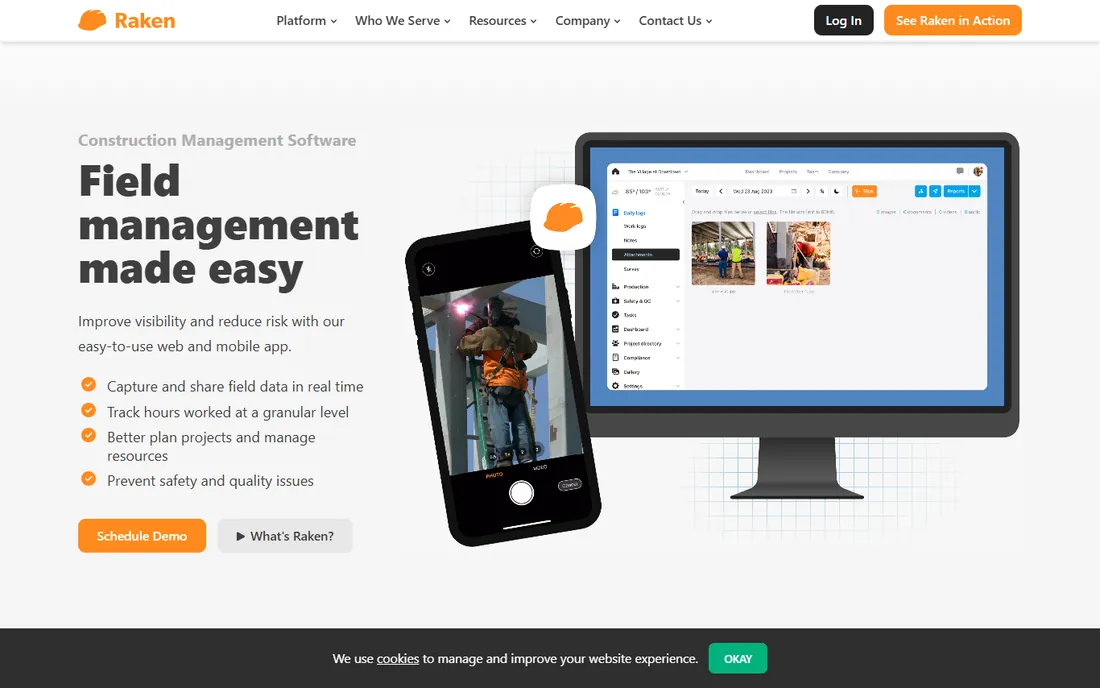
Raken does daily reporting better than anyone. Foremen complete daily logs in minutes with weather auto-filled, manpower tracked, and photos attached. Time cards flow from the same app. The result is documentation that actually gets done, which matters when a dispute arises two years later and the daily log is your evidence.
The scope is deliberately narrow: field reporting, not full project management. Companies that need scheduling, financials, and client management will pair Raken with other tools. But for the specific job of getting accurate daily records from the field, Raken's focus is its strength.
What we like- Best-in-class daily logs, Simple time tracking, Good photo documentation, Easy to deploy
Watch out for- Narrower scope, Less project management depth, Per-user pricing adds up
Starting priceSee website
Free planNo
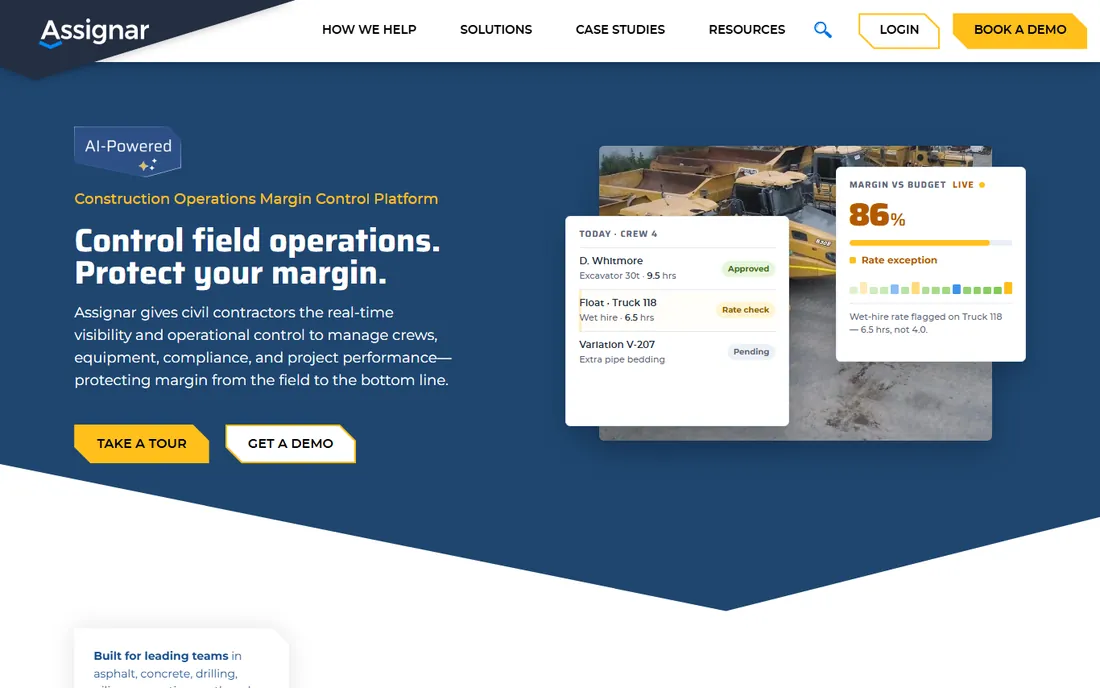
Assignar solves the puzzle of getting the right crews and equipment to the right jobs. Scheduling, allocation, timesheets, and compliance documentation connect so that operations managers see who is where and whether they are qualified to be there. For subcontractors juggling multiple sites, that visibility prevents the daily chaos of misallocated crews.
It is a workforce platform, not a project management suite, so expect to integrate with your accounting and project tools. The compliance tracking for certifications and inductions is a quiet strength in regulated markets. If crew scheduling is your bottleneck, Assignar addresses it directly.
What we like- Strong crew scheduling, Good resource allocation, Mobile-first for field, Useful compliance tracking
Watch out for- Narrow focus on workforce, Pricing not published, Needs integration for full picture
Starting priceSee website
Free planNo
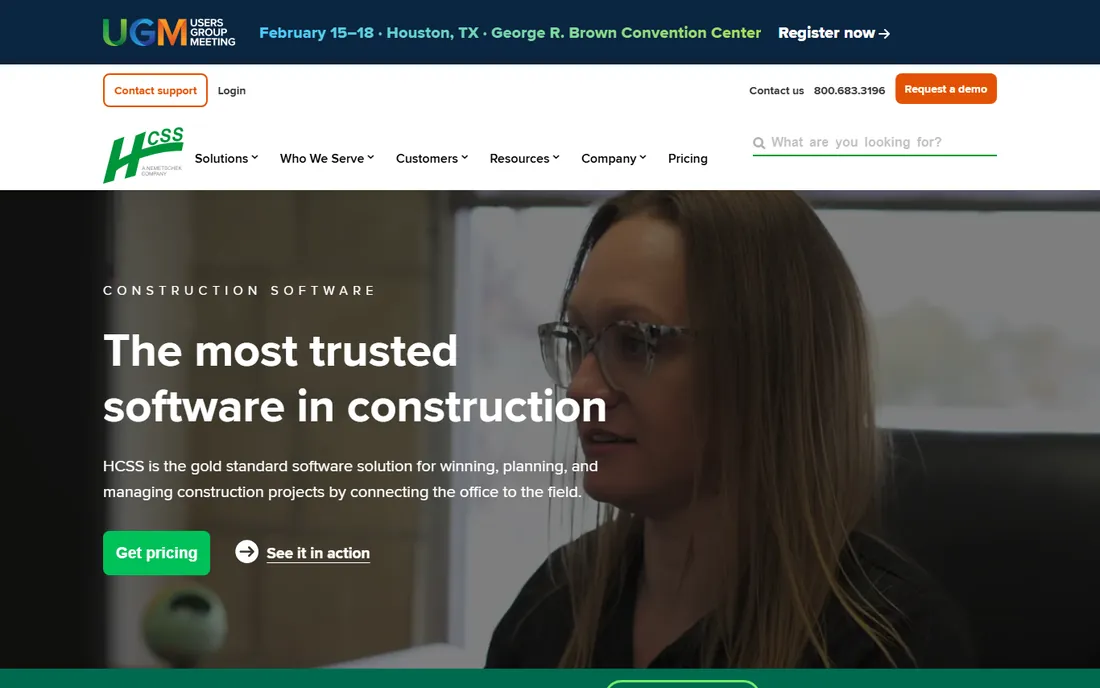
HCSS is the standard for heavy civil contractors: road builders, bridge builders, and infrastructure firms. HeavyJob tracks costs daily against estimates, equipment management follows utilization and maintenance, and the estimating tools connect bids to field performance. The company understands dirt work the way general platforms do not.
Building contractors will find it irrelevant, and that is fine. HCSS never pretended to serve them. For heavy civil firms, the combination of daily cost tracking and equipment management pays for itself in bid accuracy and margin protection. The annual users' conference alone tells you about the loyalty.
What we like- Built for heavy civil and infrastructure, Excellent equipment management, Strong estimating integration, Deep industry expertise
Watch out for- Niche focus, Enterprise pricing, Less relevant for building construction
Starting priceSee website
Free planFree trial
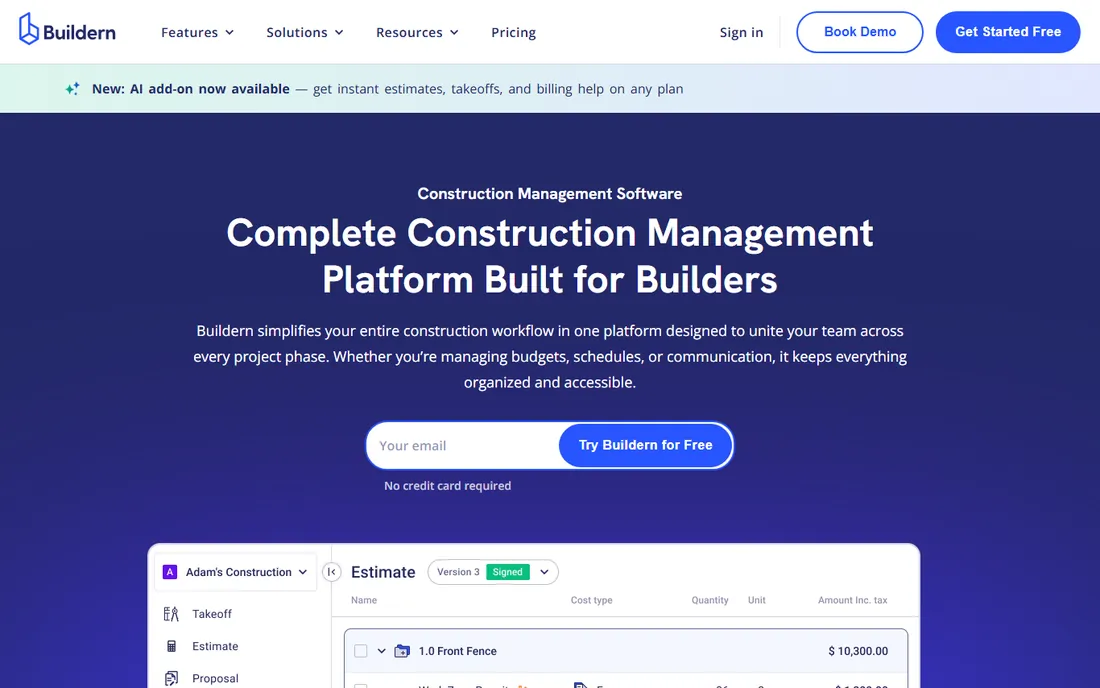
Buildern aims at the small builders who find Procore overwhelming and spreadsheets insufficient. Project management, scheduling, budgeting, and client communication come in one affordable package with onboarding that does not require consultants. The free trial lets small teams validate the fit quickly.
As a newer vendor, Buildern lacks the depth and ecosystem of the established players. Complex commercial work will outgrow it. But for small residential and light commercial builders, the all-in-one simplicity at a sensible price fills a real gap in the market.
What we like- Affordable all-in-one, Good for small teams, Covers projects to financials, Easy onboarding
Watch out for- Newer vendor, Less depth than leaders, Smaller ecosystem
How we chose
We prioritized field usability because jobsite software fails at the point of adoption. A platform with perfect back-office features that foremen will not open is a failed implementation. We looked for mobile-first design, offline capability, and evidence of real crew usage in reviews.
We covered the range from enterprise platforms to field-focused tools to residential specialists, because "contractor" describes everyone from a two-person remodeler to a multinational civil firm. Each product here leads in its segment rather than being a compromised middle.
Getting crews to actually use it
Involve foremen in the selection, not just the office. A half-hour of their feedback during evaluation prevents a failed rollout later. The tools that win jobsites are the ones that make a foreman's day easier, not the ones with the best executive dashboard.
Start with one pain point, not the whole platform. Daily logs or punch lists are the classic beachhead: visible value in week one builds the credibility for broader rollout. Trying to deploy everything at once is how implementations die.
And measure what matters to the field: time saved on paperwork, fewer trips back to the trailer, faster answers to RFIs. When the crew sees the benefit, adoption takes care of itself. When only management sees it, you have bought shelfware.
Before you decide, it is worth confirming current pricing on each vendor's site, since plans and limits change frequently. A short trial with your own data will tell you more than any feature list, so take advantage of the free plans or trial periods where they exist.
Frequently asked questions
What is jobsite management software?
Software that manages construction field operations: daily logs, task management, drawings, photos, safety forms, scheduling, and communication between the field and the office. It replaces paper-based and text-message workflows with a shared system of record.
Do I need Procore or is a simpler tool enough?
It depends on project complexity and company size. Large commercial contractors with complex projects justify Procore or Autodesk. Smaller builders and specialty contractors usually do better with focused tools like Fieldwire, Raken, or Buildertrend.
How important is offline capability?
Critical. Jobsites often have poor connectivity, especially in new construction and remote civil work. Any field tool must work offline and sync reliably, or crews will revert to paper the first time the connection drops.
Can jobsite software integrate with accounting?
Yes, through native integrations or connectors. Procore, Buildertrend, and others connect to common construction accounting systems. Verify the specific integration you need before buying, since depth varies.
How long does implementation take?
Field-focused tools like Fieldwire or Raken can be running in days. Enterprise platforms like Procore or Autodesk take weeks to months depending on scope. The bigger variable is usually change management, not technical setup.
Sources we checked (8)
- https://www.procore.com/
- https://buildertrend.com/
- https://www.autodesk.com/
- https://www.fieldwire.com/
- https://www.rakenapp.com/
- https://assignar.com/
- https://www.hcss.com/
- https://buildern.com/
Is your product missing or out of date?
We review this list regularly. Vendors can request a listing, send updated pricing or ask about featured placement.

Shihab Mia · Founder, Rankite
Shihab has spent more than a decade helping SaaS and e-commerce brands grow through search. He writes Rankite's software buying guides from pricing pages, documentation and public user reviews. More about Shihab.