How we make this list: we compare pricing pages, product documentation and public user reviews. Ratings come from G2, Capterra or Trustpilot, with the date we checked them.
Key takeaways
- AWS IoT Device Management and Azure IoT Hub are the cloud-native choices for fleets already running on those clouds.
- Balena is the best fit for Linux fleets with container-based updates, while Particle covers hardware, connectivity and cloud in one package.
- ThingsBoard and Datacake both offer free tiers, with ThingsBoard stronger on industrial dashboards and Datacake on LoRaWAN monitoring.
- Losant adds a low-code workflow engine for industrial IoT, and Cumulocity targets large industrial AI operations.
- Losant is joining SUSE, so buyers should confirm its roadmap and support plans before committing.
Quick comparison
| Tool | Best for | Starting price | Free plan |
|---|
 AWS IoT Device Management | AWS-based fleets at scale | See website | No |
 Azure IoT Hub | Azure-based fleets and edge AI | See website | No |
 Balena | Container-based Linux fleets | See website | Yes |
 Particle | Hardware plus connectivity plus cloud | See website | No |
 ThingsBoard | Open industrial dashboards and OTA | Free | Yes |
 Datacake | LoRaWAN sensor monitoring | Free | Yes |
 Losant | Low-code industrial workflows | See website | No |
 Cumulocity | Industrial AI operations at scale | See website | No |
Is your product missing or out of date?
We review this list regularly. Vendors can request a listing, send updated pricing or ask about featured placement.
Starting priceSee website
Free planNo
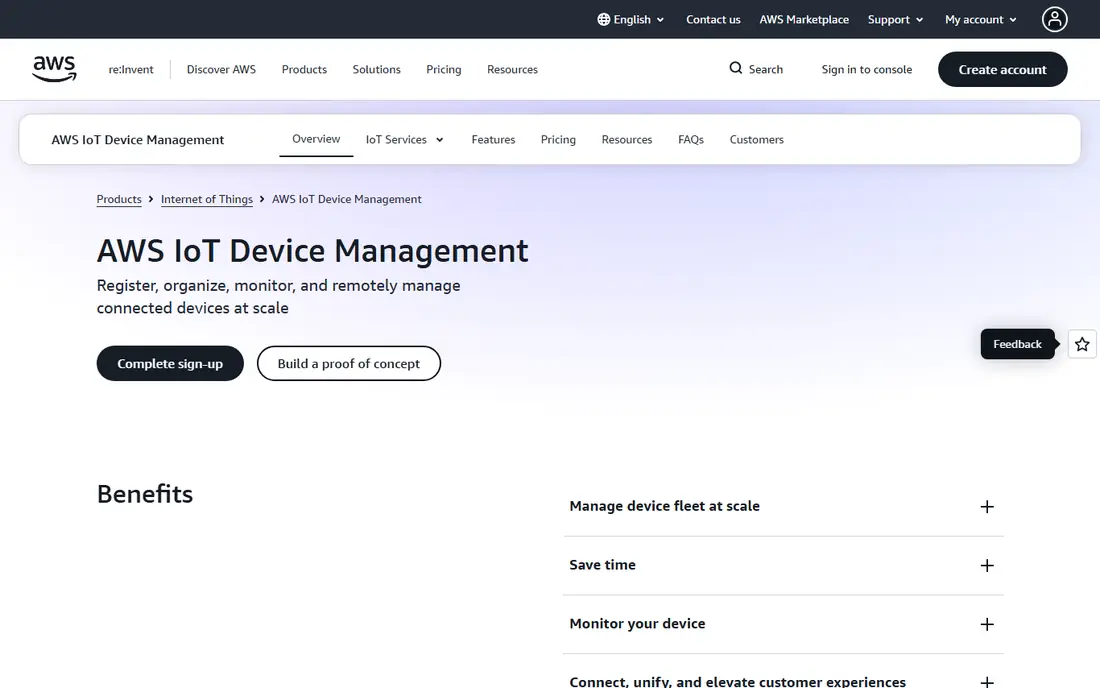
AWS IoT Device Management registers, organizes, monitors and remotely manages connected devices at scale. Teams can onboard devices into flexible hierarchies, filter device search by attributes, monitor fleet health, troubleshoot remotely and push firmware updates and reboots in bulk, with continuous jobs for automatic updates and logical device groups for targeting.
For fleets already on AWS, it is the natural choice: device data flows into the rest of AWS without new integration work. Teams outside AWS should weigh the learning curve and usage-based pricing, and confirm costs on the AWS pricing page before committing to a large fleet.
What we like- Onboard and organize devices into flexible hierarchies
- Bulk over-the-air updates with controlled deployment velocity
- Fleet health monitoring with policy alerts
- Integrates with ZigBee, Z-Wave and Wi-Fi devices
Watch out for- Pricing is usage-based and needs the AWS pricing page to scope
- AWS skills required to get full value
- Smaller standalone device management story outside AWS
Starting priceSee website
Free planNo
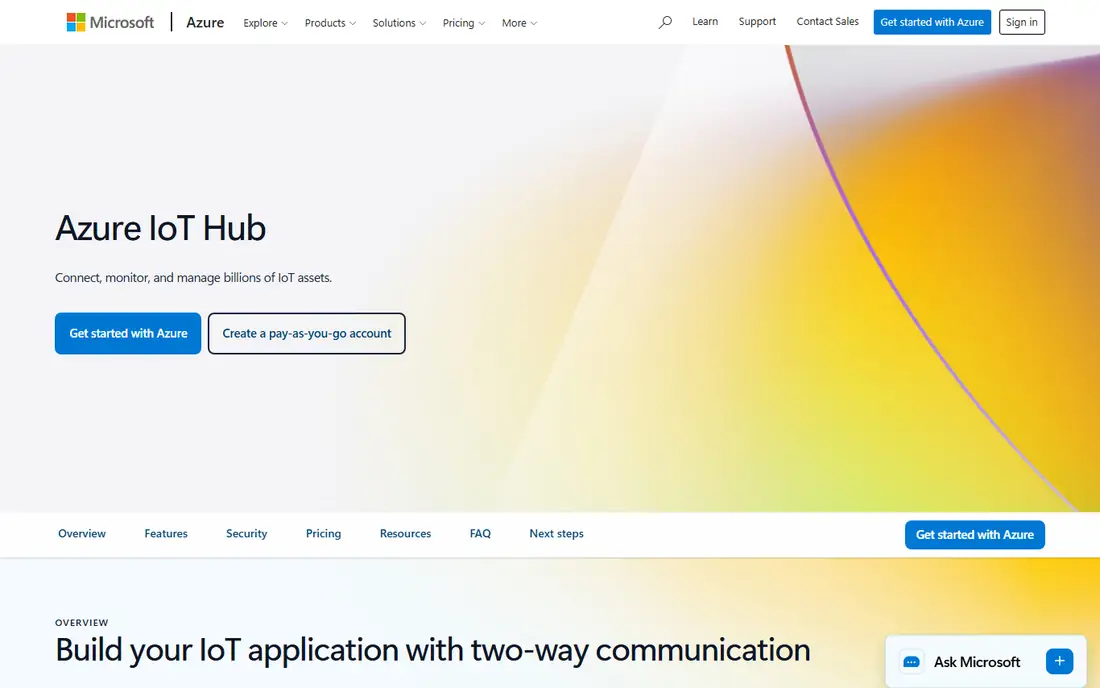
Azure IoT Hub provides a cloud-hosted back end to connect virtually any device, with highly secure and reliable two-way communication, built-in device management and scaled provisioning. Device-to-cloud telemetry routes to other Azure services without code, cloud-to-device messages carry commands with acknowledgement receipts, and Device Update for IoT Hub publishes, distributes and manages over-the-air updates for everything from tiny sensors to gateway-level devices.
For Microsoft shops, IoT Hub pairs naturally with Azure analytics, AI and edge computing. Teams should size their message tier carefully, since pricing scales with message volume and device count, and confirm the current tiers on the Azure pricing page.
What we like- Two-way communication with per-device authentication
- Device Update for IoT Hub handles over-the-air updates from sensors to gateways
- Zero-touch provisioning at scale
- IoT Edge modules distribute AI and analytics to devices
Watch out for- Pricing is tiered by message volume and needs scoping
- Azure skills required
- Device management is one part of a larger IoT service
Starting priceSee website
Free planYes
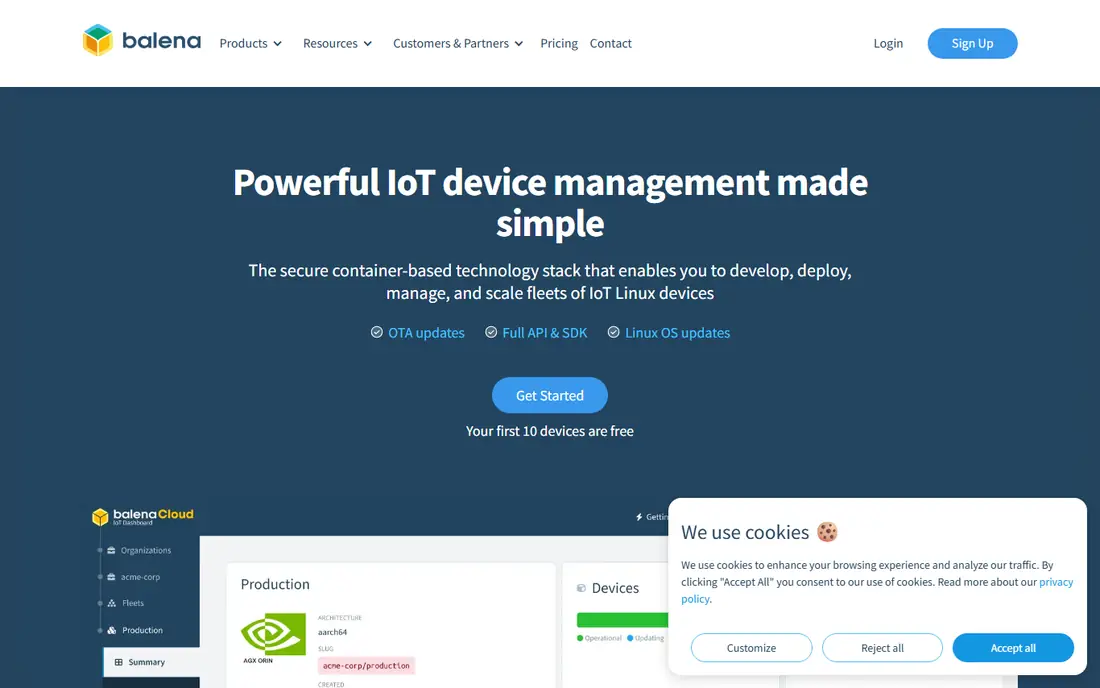
Balena is the secure container-based technology stack that lets teams develop, deploy, manage and scale fleets of IoT Linux devices. Applications run on a container-optimized OS, updates ship as deltas to minimize bandwidth, and the balenaCloud dashboard monitors fleet health, shows device logs, opens secure tunnels for troubleshooting and updates the OS remotely.
With 80 plus device types supported, from Raspberry Pi to x86 to Jetson Orin, and fleets proven into the hundreds of thousands, Balena is the strongest choice for Linux-based products that need fast, reliable remote updates. A free trial lets teams test with an example application before committing.
What we like- Container-based stack for developing, deploying and managing IoT Linux devices
- OTA updates with application deltas to cut bandwidth
- 80 plus device types supported
- Free trial of balenaCloud
Watch out for- Linux-focused, not a fit for microcontroller-only fleets
- Pricing scales with fleet size and needs a quote
- Container skills help
#4Particle
Best for: Hardware plus connectivity plus cloud4.5/5 on
G2 (195 reviews, checked Oct 2026)
Visit particle.io
Starting priceSee website
Free planNo
Particle is an integrated IoT platform as a service built to ship software to hardware, with developer productivity, observability and reliability as its stated goals. The console monitors and manages every device, every bit of software and every ounce of data through a single portal, with software releases, security and compliance controls and device vitals for fleet health.
For teams building connected products on Particle hardware, the integrated stack removes the work of stitching connectivity, cloud and updates together. Teams with existing non-Particle hardware should confirm compatibility in a demo, and pricing requires a conversation with Particle's team.
What we like- Integrated platform covering hardware, connectivity and cloud
- Console gives complete control of devices in the field
- Software releases and device vitals built in
- 60 billion messages and 12 million OTA updates per month
Watch out for- Works best with Particle hardware
- Pricing not published on the homepage
- Some console features marked as coming soon
#5ThingsBoard
Best for: Open industrial dashboards and OTA4.5/5 on
G2 (8 reviews, checked Oct 2026)
Visit thingsboard.io
Starting priceFree
Free planYes
ThingsBoard is an all-in-one IoT platform covering device management, data collection, processing and visualization, with AI assistants that build solutions from plain-language prompts. Teams connect devices directly, through gateways, from LoRaWAN or NB-IoT networks or via platform integrations, model assets and hierarchies as digital twins, and act on data with calculated fields, alarm rules and rule chains.
The platform ships 600 plus widgets for real-time dashboards, supports white-labeling and multi-tenancy, and runs either as managed ThingsBoard Cloud with a free start on shared infrastructure or self-hosted on your own infrastructure, including air-gapped deployments. For industrial teams that want dashboards, control and OTA in one open platform, ThingsBoard is the strongest free-start option.
What we like- All-in-one platform with device management, data collection, processing and visualization
- 600 plus dashboard widgets with SCADA support
- OTA updates by device profile
- Free cloud start or self-hosted on-premises
Watch out for- Breadth means a longer setup than a narrow monitoring tool
- Advanced features like Trendz analytics are add-ons
- Enterprise support needs a conversation
Starting priceFree
Free planYes
Datacake is the LoRaWAN monitoring platform that turns sensors into live dashboards, alerts and reports, covering cold-chain, air quality and environmental monitoring end to end. The free plan includes 5 devices forever, the full LoRaWAN Network Server with no per-gateway fees, dashboards, alerts and the device template library, and teams can migrate from The Things Stack, ChirpStack or Loriot without re-flashing hardware.
With 400 plus device templates from 124 plus manufacturers, including Milesight, Dragino and TEKTELIC, and an AI assistant that answers plain-language questions about sensor data, Datacake is the fastest start for LoRaWAN monitoring projects. Teams pay only when they scale beyond the free tier or turn on add-ons like white-label or advanced export.
What we like- Free plan with 5 devices forever and a free LoRaWAN Network Server
- 400 plus device templates with payload decoders
- AI assistant answers questions about sensor data
- White-label and multi-tenancy for integrators
Watch out for- LoRaWAN focus means less for Wi-Fi or cellular fleets
- AI assistant paid plan costs 20 euros per user per month
- White-label and advanced export are paid add-ons
#7Losant
Best for: Low-code industrial workflows4.5/5 on
G2 (5 reviews, checked Oct 2026)
Visit losant.com
Starting priceSee website
Free planNo
Losant is an enterprise IoT platform whose low-code workflow engine freely collects, centralizes and integrates data from all connected devices and systems, turning products into intelligent assets with custom branding, API integration and effortless multi-tenancy. Its edge agent integrates with PLCs, CRMs and Azure or AWS, with automatic provisioning and digital twin capabilities.
The platform handles millions of data points per second and includes a Connected Product Foundation template that reduces development time for connected products. Note that Losant's homepage announces it is joining SUSE to build an open process automation platform for industrial IoT, so buyers should confirm support, pricing and roadmap with the team before committing.
What we like- Low-code workflow engine collects, centralizes and integrates device data
- Edge agent integrates with PLCs, CRMs and Azure or AWS
- Multi-tenancy with custom branding
- Included in the 2024 Gartner Magic Quadrant for global industrial IoT platforms
Watch out for- Pricing not published on the homepage
- Losant is joining SUSE, so roadmap and support may change
- Enterprise focus means smaller teams should confirm fit
Starting priceSee website
Free planNo
Cumulocity is an industrial AIoT platform that gives industrial companies a path from connected equipment and fragmented operational data to governed, increasingly autonomous operations. Teams securely onboard, monitor, update and manage devices throughout their lifecycle, contextualize machine data with a semantic layer, and use condition monitoring, anomaly detection and predictive maintenance to catch failures early.
With deployment flexibility across cloud, edge, on-premises and air-gapped environments, and compliance-ready controls for EU CRA, NIS2 and the EU AI Act, Cumulocity suits large industrial operators building digital services and autonomous operations. Pricing is enterprise and quote-based.
What we like- Connect and manage equipment from first device to millions
- Semantic layer grounds AI in operational reality
- Deployment across cloud, edge, on-premises and air-gapped
- Proven at more than 5 billion messages a day for 1,000 plus enterprises
Watch out for- Enterprise pricing with no public rates
- Industrial focus may be more than smaller fleets need
- AI features need data maturity to pay off
How we chose
We compared vendor homepages against public comparisons and user reviews, focusing on platforms that manage real device fleets rather than data-only dashboards. Every tool here had its official homepage opened and confirmed, and each one supports onboarding, monitoring and remote updates at business scale. Where a vendor does not publish a price, we recorded "See website" instead of repeating third-party estimates. Note that Google Cloud IoT Core was excluded because Google discontinued it in 2023.
What to weigh before you buy
Start with your hardware and connectivity. LoRaWAN sensor projects fit Datacake best, Linux fleets fit Balena, Particle hardware fits Particle, and industrial equipment fits ThingsBoard, Losant or Cumulocity. Cloud-native fleets fit AWS IoT Device Management or Azure IoT Hub depending on which cloud you already run.
Then check the update story before you scale. Over-the-air updates, rollback behavior and bandwidth use matter more than dashboards once devices are in the field, and the platforms here differ sharply: Balena uses container deltas, Azure and ThingsBoard handle profile-based OTA, and Particle ties updates to its own hardware stack. Test updates on a small pilot fleet before committing to a large rollout.
Frequently asked questions
What is an IoT device management platform?
It is software that registers, organizes, monitors and remotely manages connected devices at scale, including onboarding, grouping, health monitoring, configuration and over-the-air updates, so teams can run large fleets without touching each device.
Which IoT platform is best for beginners?
Datacake is the easiest start for LoRaWAN sensor projects, with a free plan for 5 devices and 400 plus templates. ThingsBoard's free cloud start suits industrial dashboards, while Balena's free trial suits Linux fleets.
How much does IoT device management cost?
Free tiers exist at ThingsBoard, Datacake and Balena's trial, while AWS and Azure charge usage-based rates and Losant, Particle and Cumulocity price by program. Expect to scope costs by device count, message volume and update frequency.
Can I manage devices without the cloud?
Yes. ThingsBoard and Cumulocity support on-premises and air-gapped deployments, Balena supports self-hosted infrastructure, and edge agents from Losant and Azure IoT Hub run logic locally during connectivity outages.
What happens to Google Cloud IoT Core?
Google discontinued IoT Core in 2023, so it is not listed here. Teams migrating from it should look at AWS IoT Device Management, Azure IoT Hub or ThingsBoard, depending on their cloud and hardware.
Sources we checked (8)
- https://aws.amazon.com/iot-device-management/
- https://azure.microsoft.com/en-us/products/iot-hub/
- https://www.balena.io
- https://www.particle.io
- https://thingsboard.io
- https://datacake.co
- https://www.losant.com
- https://www.cumulocity.com
Is your product missing or out of date?
We review this list regularly. Vendors can request a listing, send updated pricing or ask about featured placement.

Shihab Mia · Founder, Rankite
Shihab has 5+ years in B2B and SaaS SEO. He writes Rankite's software buying guides from pricing pages, documentation and public user reviews. More about Shihab.