How we make this list: we compare pricing pages, product documentation and public user reviews. Ratings come from G2, Capterra or Trustpilot, with the date we checked them.
Key takeaways
- DTEX and Microsoft Purview represent the privacy first school: behavioural risk scoring from metadata, with identities pseudonymised until a threshold justifies a closer look.
- Proofpoint ITM and Teramind represent the evidence school: risk triggered or continuous session recording that can show investigators exactly what happened on screen.
- Code42 Incydr watches the data rather than the person, tracking file movement to catch intellectual property leaving, with no policy setup required to start.
- The software is the smaller decision: a published monitoring policy, works council or regional law compliance, and proportionality decide whether a programme is defensible or a liability.
Quick comparison
Is your product missing or out of date?
We review this list regularly. Vendors can request a listing, send updated pricing or ask about featured placement.
The best insider threat management software
Starting priceSee website
Free planNo
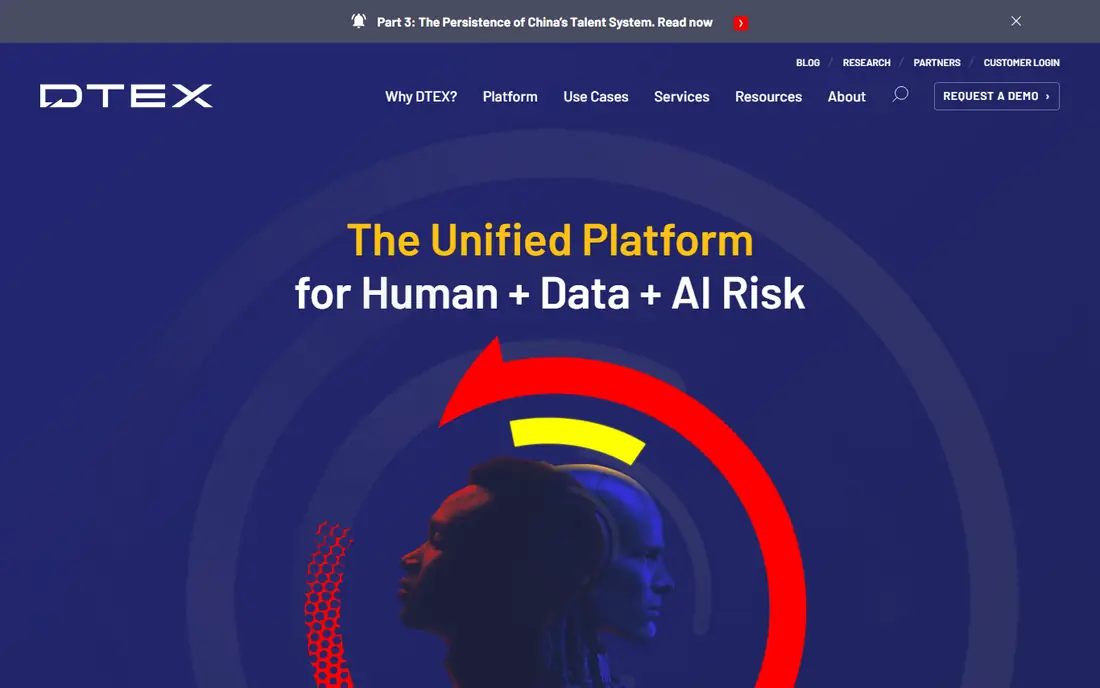
What we like- DTEX is the privacy first benchmark: it builds risk scores from more than 500 behavioural indicators using metadata rather than content inspection, with user identities pseudonymised by default and revealed only when risk justifies it. That design exists precisely so a programme can pass works council and GDPR scrutiny in Europe while still catching the resignation who suddenly downloads the design archive. Pricing is a custom quote scaled by monitored headcount.
Watch out for- Metadata discipline means DTEX deliberately cannot show you the screen or the document
- When an investigation needs evidence, teams pair it with other tooling. Its value depends on tuning indicators to your environment, which takes a security team's time. Small companies get little from it: this is enterprise risk machinery.

#2Proofpoint Insider Threat Management
Best for: Evidence grade investigation inside Proofpoint4.3/5 on
G2 (48 reviews, checked Oct 2026)
Visit proofpoint.com
Starting priceSee website
Free planNo

What we like- Proofpoint ITM, built on the ObserveIT lineage, takes the evidence approach with restraint: it scores human risk and records user sessions when risk triggers fire, producing video grade evidence tied into Proofpoint's email security and DLP estate. Data masking with threshold based unmasking keeps casual browsing of employee activity in check. For an organisation already running Proofpoint for email, the insider module completes a picture few rivals can assemble.
Watch out for- Pricing is custom and typically bundled into the wider Proofpoint relationship, so it rarely makes sense as a standalone purchase. Session recording, however triggered, is the most intrusive capability in this guide and needs the policy and governance scaffolding described above before it is switched on. Deployment and rule tuning are enterprise projects.

#3
Microsoft Purview Insider Risk Management
Best for: Microsoft 365 organisations
Visit microsoft.com
Starting price$5 per user per month
Free planNo
What we like- Purview Insider Risk Management is the no new agent option for Microsoft estates: more than 100 machine learning indicators built from native Microsoft 365 and Defender signals, pseudonymised by default, with policy templates for data theft, leaks, and code exfiltration scenarios. It is included in Microsoft 365 E5 and available as a 5 dollar per user per month add on at E3 level. For an E5 organisation, the marginal cost of a credible insider risk programme is close to zero, which changes the build or buy maths entirely.
Watch out for- Its visibility ends at the Microsoft estate's edge: activity outside M365 and managed endpoints is thin. The pseudonymised workflow, alerts triaged before identities are revealed, is principled and can feel slow to investigators used to direct monitoring. Licensing archaeology applies, as always with Microsoft bundles, so confirm exactly which SKUs your tenant needs.
Starting priceSee website
Free planNo
What we like- Incydr, now sold through Mimecast, watches the data instead of the person: it tracks file movement across endpoints, cloud drives, email, and personal accounts, scoring exfiltration risk from the file's value and destination, with no policy authoring required to start. Source code leaving to an unsanctioned repository and designs moving to a personal drive surface quickly. For intellectual property protection, this narrower lens produces fewer, better alerts than general surveillance.
Watch out for- Incydr answers one question, where is the data going, and does not attempt the wider behavioural picture of DTEX or the session evidence of Proofpoint. Watchlist based monitoring without pseudonymisation by default puts the privacy design work on your policy rather than the product. Pricing is via Mimecast's sales process following the acquisition.

#5Teramind
Best for: Deep monitoring and DLP in one console4.6/5 on
G2 (183 reviews, checked Oct 2026)
Visit teramind.co
Starting priceSee website
Free planNo
What we like- Teramind is the deepest monitoring platform here: continuous screen recording, keystroke logging, email and file transfer watching, behavioural rules that can alert, block, or lock out on a violation, and DLP in the same console, deployable in cloud, on premise, or private cloud. Reviewers rate it 4.6 out of 5 on G2 across about 183 reviews. Regulated firms that must be able to prove exactly what happened reach for it deliberately.
Watch out for- That depth is the risk as well as the feature: always on recording by default is the most culturally expensive setting in this guide, and employee pushback is a documented pattern once the capture scope becomes known. Pricing has moved to sales quotes from historic published levels around 28 to 32 dollars per user per month. Setup and rule tuning demand dedicated security administration, and no Linux support rules out some estates.
Starting priceSee website
Free planNo
What we like- Ekran System concentrates on the highest risk users: administrators, contractors, and third parties with privileged access. It records sessions on servers and endpoints, indexes them for search, manages privileged access with secondary authentication and approval workflows, and alerts on dangerous commands and unusual activity. For compliance regimes that specifically audit what admins and vendors did inside critical systems, this focus is the point. Perpetual and subscription licensing are both offered by quote.
Watch out for- Ekran is a privileged access and session tool, not a company wide behavioural analytics platform, so general insider risk across all staff needs a different product beside it. Its interface and reporting assume a security administrator audience. Pricing transparency is low, and evaluation requires a scoped pilot on your own server estate.
#7Veriato
Best for: Insider risk detection for mid size firms4.3/5 on
G2 (37 reviews, checked Oct 2026)
Visit veriato.com
Starting price$15 per user per month
Free planNo
What we like- Veriato is the veteran, founded as SpectorSoft in 1998, offering user activity monitoring at a published 15 dollars per user per month on annual billing, with one licence covering all of an employee's devices, desktop, laptop, and Android, which keeps multi device maths honest. Its IRM tier adds AI driven risk scoring with behavioural and language based signals for organisations that outgrow raw monitoring. Cloud and on premise deployment are both available.
Watch out for- The IRM tier is custom quoted with a 20 user minimum, and the base product has a 5 user minimum with only a 7 day trial to evaluate in. This is forensic tooling, rated 4.3 out of 5 on G2 from a modest review base, and reviewers echo the cultural warning: it is built for genuine threat detection in sectors such as finance, healthcare, and government, and it is overkill with real trust costs when used as a productivity substitute.

#8ActivTrak
Best for: Low intrusion workforce risk analytics4.3/5 on
G2 (340 reviews, checked Oct 2026)
Visit activtrak.com
Starting price$10 per user per month
Free planYes
What we like- ActivTrak sits at the light end of this market on purpose: it analyses work patterns, applications, and websites at team level, with dashboards aimed at trends rather than individual screens, a free plan for up to three users, and paid plans from 10 dollars per user per month on annual billing. Its insider risk value is spotting the precursor patterns, unusual hours, new unsanctioned tools, data handling changes, without recording keystrokes. For a company whose risk is carelessness more than malice, the proportionate tool is this one.
Watch out for- ActivTrak will not produce forensic evidence: screenshots and full URLs need an add on, and determined exfiltration through channels it does not watch will pass it by. Paid plans require at least five licences on annual terms. Positioned between productivity analytics and security, it can underserve a buyer who truly needs either end of the range.
How we chose
We covered the market's real spread: metadata based behavioural analytics, platform bundled insider risk, data centric exfiltration detection, forensic session recording, privileged session monitoring, and proportionate workforce analytics. Privacy posture was treated as a product feature and recorded per tool, pseudonymisation, masking, recording scope, because in this category it decides deployability by region. Prices are published per user figures where vendors print them, October 2026, with the quote based enterprise norm marked see website.
How to choose the right insider threat management software
Start with the threat model and the law, in that order. Write down the three insider scenarios you actually fear, data theft at resignation, contractor misuse of privileged access, compromised account behaviour, and the jurisdictions and consultation duties your workforce sits under. A European workforce with works councils points at DTEX or Purview's pseudonymised model. A regulated firm that must prove events points at Proofpoint or Teramind with governance built around them. A company whose crown jewels are files points at Incydr. Most organisations need one of those shapes, not all of them.
Then deploy proportionately and in the open: publish the monitoring policy before the agent, scope collection to work systems, set the unmasking process, who approves it, what threshold triggers it, how long data is kept, and review the alert quality monthly, because a tool that cries wolf weekly trains the security team to ignore the one alert that matters. Pilot on the security and IT teams themselves first; a programme the security team will not run on its own machines has no business running on everyone else's. Prices are October 2026 published and reported figures.
Frequently asked questions
What is the difference between insider threat software and employee monitoring?
Purpose and depth. Employee monitoring measures work: time, applications, productivity. Insider threat management hunts a narrow set of harmful acts, data theft, sabotage, fraud, account compromise, using behavioural risk scoring, file movement tracking, or session evidence. The overlap in sensors causes the confusion, and the governance should follow the security purpose: if your real need is productivity, buy the lighter tool and say so, rather than running forensic software under a softer label.
Is it legal to monitor employees this way?
It depends on jurisdiction and method, which is why the policy comes first. In much of the US, monitoring company systems is permitted with notice, and several states require that notice in writing. In Europe, GDPR requires a lawful basis and proportionality, employee monitoring is a high scrutiny processing activity, and in countries such as Germany and France works council or employee representative consultation is effectively mandatory before deployment. Covert monitoring is defensible only in narrow, documented investigation circumstances. Take employment law advice for your footprint before rollout; this guide is not legal advice.
What does pseudonymisation actually protect?
In DTEX and Microsoft Purview, analysts triage risk alerts attached to coded identities, and a named identity is revealed only when the risk score and a human review justify it under a defined process. That protects the ordinary employee from casual scrutiny of their work patterns, and it protects the company, by making the proportionality argument concrete. It does not make monitoring anonymous in an absolute sense, and employees should be told how the process works rather than promised what it is not.
Can this software stop data theft, or only record it?
Both, at different depths. Behavioural platforms mostly detect and alert, fast enough to intervene in a resignation scenario unfolding over days. Teramind and DLP equipped tools can block actions in real time, a transfer to a personal drive stopped mid act, and Incydr can surface and coach or block risky file moves. Blocking raises the stakes: a false block on a legitimate transfer is a business incident, so most programmes start in alert mode and earn their blocking rules.
How should we tell employees?
Before deployment, in writing, in plain language: what is collected, on which systems, during which hours, who can see it, when an identity behind an alert gets revealed, how long data is kept, and what the programme exists to prevent. Then repeat it in onboarding. Programmes that are announced survive works councils, regulators, and the internal rumour mill; programmes that are discovered become the story, and the security benefit is spent on the argument instead.
Sources we checked (0)
Is your product missing or out of date?
We review this list regularly. Vendors can request a listing, send updated pricing or ask about featured placement.

Shihab Mia · Founder, Rankite
Shihab has 5+ years in B2B and SaaS SEO. He writes Rankite's software buying guides from pricing pages, documentation and public user reviews. More about Shihab.
 DTEX InTERCEPT
 Code42 Incydr
 Ekran System