How we make this list: we compare pricing pages, product documentation and public user reviews. Rankite is independent; if a vendor ever pays for a featured spot, that listing is clearly labeled Partner.
Key takeaways
- Gusto and OnPay win on simplicity for small US teams that mainly need payroll plus light HR.
- Rippling and Deel are the strongest picks when your workforce spans countries or you want IT, payroll and HR in one system.
- BambooHR and HiBob suit mid-size companies that care about performance management and people analytics.
- Zoho People is the budget option with a genuine free trial, and it fits teams already in the Zoho ecosystem.
- Paychex and Justworks bundle HR software with employer-of-record or PEO services, which changes the compliance picture entirely.
Quick comparison
| Tool | Best for | Starting price | Free plan |
|---|
 Gusto Gusto | Small US businesses that need payroll first | $49/month + $6 per person (Simple plan) | No |
 BambooHR BambooHR | Mid-size teams building a performance culture | Custom quote (from about $10/employee/month) | Free trial |
 Rippling Rippling | Global teams that want IT, payroll and HR in one place | $8/user/month + $40 base fee | No (free demo) |
 Deel Deel | Hiring employees and contractors in other countries | $5/employee/month (HR Core) | No |
 Justworks Justworks | Startups that want a PEO to handle compliance | See website | No |
 HiBob HiBob | Mid-market companies that run on people data | See website | No (free demo) |
 OnPay OnPay | Simple payroll with genuinely human support | $49/month + $6 per worker | No |
 Zoho People Zoho People | Budget HR suites and Zoho shops | From $1.5/user/month | Free trial (30 days) |
 Paychex Paychex | Established companies that want full-service HR | See website | No |
Is your product missing or out of date?
We review this list regularly. Vendors can request a listing, send updated pricing or ask about featured placement.
The best HR software
#1
Gusto
Best for: Small US businesses that need payroll first
Visit gusto.com
Starting price$49/month + $6 per person (Simple plan)
Free planNo
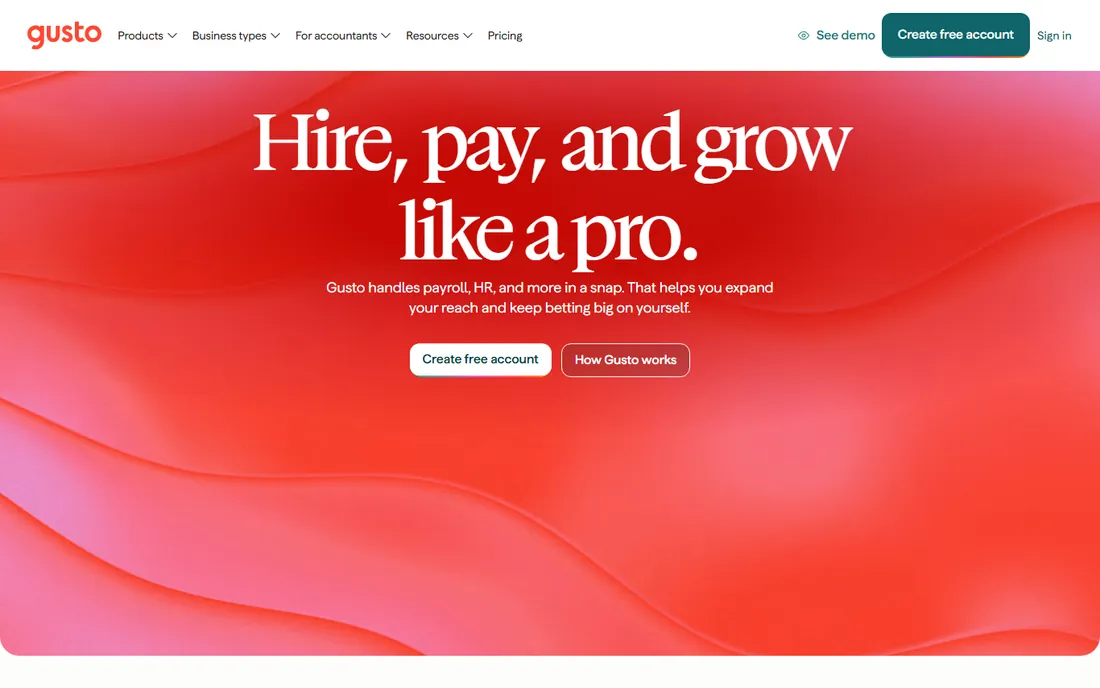
Gusto built its reputation on making payroll painless for small businesses, and it still does that better than almost anyone. The Simple plan covers full-service payroll with federal, state and local tax filings, employee self-service, offer letters and onboarding checklists, and you pay nothing until you run your first payroll. Adding health insurance, 401(k) plans and workers compensation keeps the growing company inside one system instead of juggling brokers.
The per-person pricing means a 50-person company pays noticeably more than a 10-person one, which is where buyers should run the math against flat-fee competitors. International support is limited, so distributed teams will need a companion tool. For a domestic small business whose core need is "pay everyone correctly and stay compliant," Gusto is the easiest yes on this list.
What we like- Full-service payroll with automatic tax filing
- Health benefits and 401(k) add-ons
- Clean interface owners actually learn
Watch out for- Pricing climbs per head as you grow
- Limited support for international contractors
- Advanced HR analytics are thin
Starting priceCustom quote (from about $10/employee/month)
Free planFree trial

BambooHR is the HRIS most mid-size companies reach for when spreadsheets stop working. The platform covers the employee lifecycle from applicant tracking through onboarding, time-off management, e-signatures and performance reviews, all in an interface that HR generalists pick up in days rather than weeks. The mobile app and employee self-service portal cut the routine "how much PTO do I have" questions down to almost nothing.
Pricing is quote-based and generally lands around ten dollars per employee per month, with payroll available as an integrated add-on. That puts BambooHR above the budget tier but well below enterprise suites, which matches its audience: companies of roughly 50 to 500 people that want real HR capability without an implementation project. Reporting will not satisfy a data-hungry people team, but for operational HR it is a dependable pick.
What we like- Intuitive core HR with strong onboarding
- Performance management and engagement surveys included
- Widely praised support
Watch out for- Pricing requires a quote and scales with headcount
- Payroll is a separate add-on in some plans
- Reporting can feel basic
#3
Rippling
Best for: Global teams that want IT, payroll and HR in one place
Visit rippling.com
Starting price$8/user/month + $40 base fee
Free planNo (free demo)
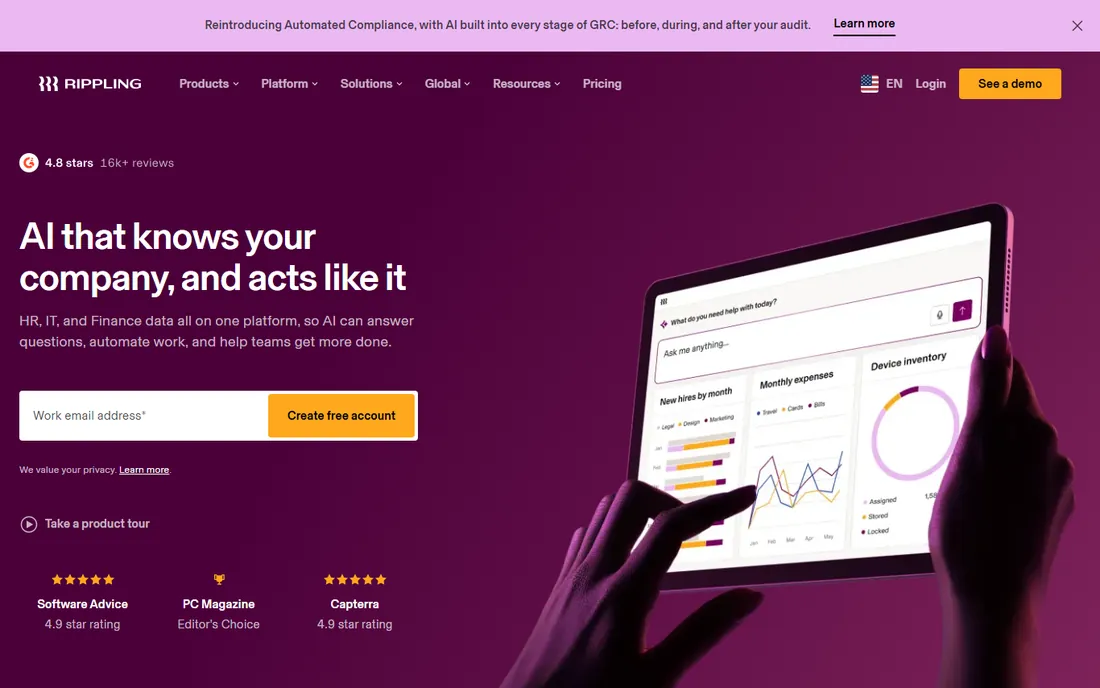
Rippling's pitch is that HR software should not stop at HR: the same platform provisions laptops, manages SaaS access, runs payroll in dozens of countries and handles corporate cards. When a new hire is added, Rippling can create their accounts, order their device, enroll them in benefits and start payroll in one workflow. That unified model is genuinely different from bolting HR and IT tools together with integrations.
The modular pricing starts around $8 per user per month plus a base fee, but the real number depends on how many modules you switch on, and buyers should budget for the full stack they intend to use. Reviews praise the automation while flagging that support can be inconsistent during complex implementations. For companies scaling fast with a global workforce, the consolidation argument is strong; for a 20-person domestic team, it is more platform than needed.
What we like- One system for HR, payroll, IT provisioning and spend
- 600+ integrations
- Strong automation with minimal manual entry
Watch out for- Costs add up across modules quickly
- Implementation can be complex
- Support quality varies by review
#4
Deel
Best for: Hiring employees and contractors in other countries
Visit deel.com
Starting price$5/employee/month (HR Core)
Free planNo
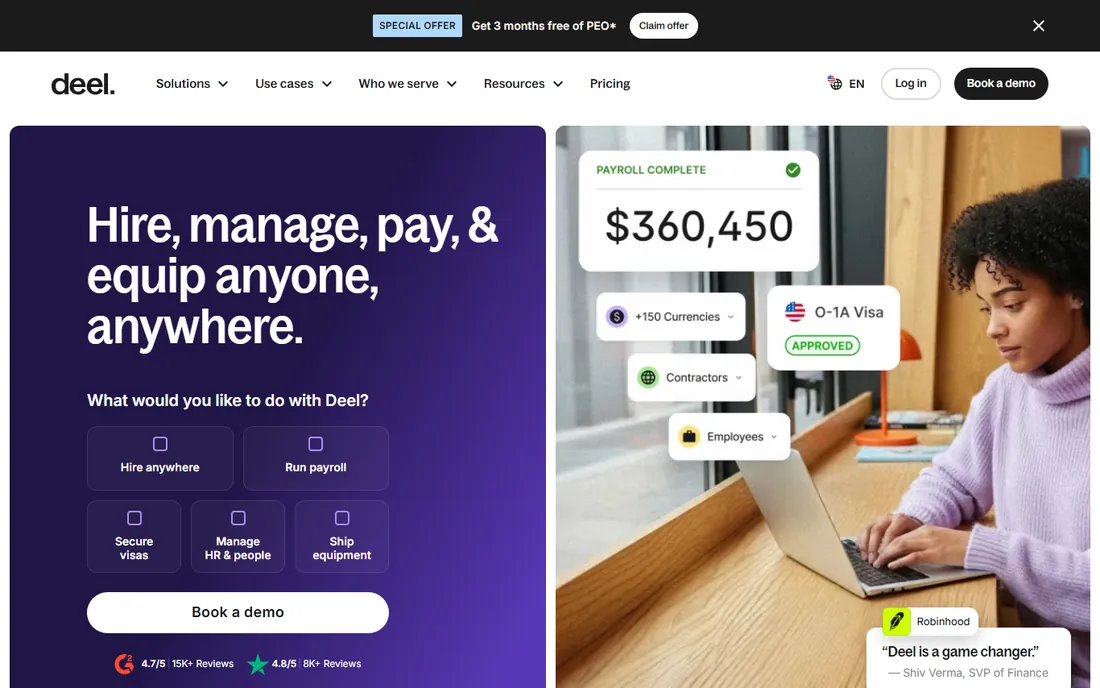
Deel solved the problem most HR software ignores: hiring legally in countries where you have no entity. Its employer-of-record service covers more than 150 countries, handling contracts, benefits, taxes and terminations under local law, while contractor management starts at $49 a month with built-in compliance checks. The HR Core plan at $5 per employee per month gives distributed teams a system of record for people data, time off and documents without the EOR premium.
The pricing ladder is steep: EOR runs from $599 a month per employee, and global payroll and immigration services add more. Deel makes sense when international hiring is the actual need; a company with everyone in one country gets little value from its differentiators. If your roadmap includes hiring across borders in the next year, it is the most mature option here.
What we like- Employer of record in 150+ countries
- Contractor management with local compliance
- HRIS core from $5/employee/month
Watch out for- EOR and contractor plans are much pricier than HR Core
- Service quality varies by country
- Not built for domestic-only teams
Starting priceSee website
Free planNo
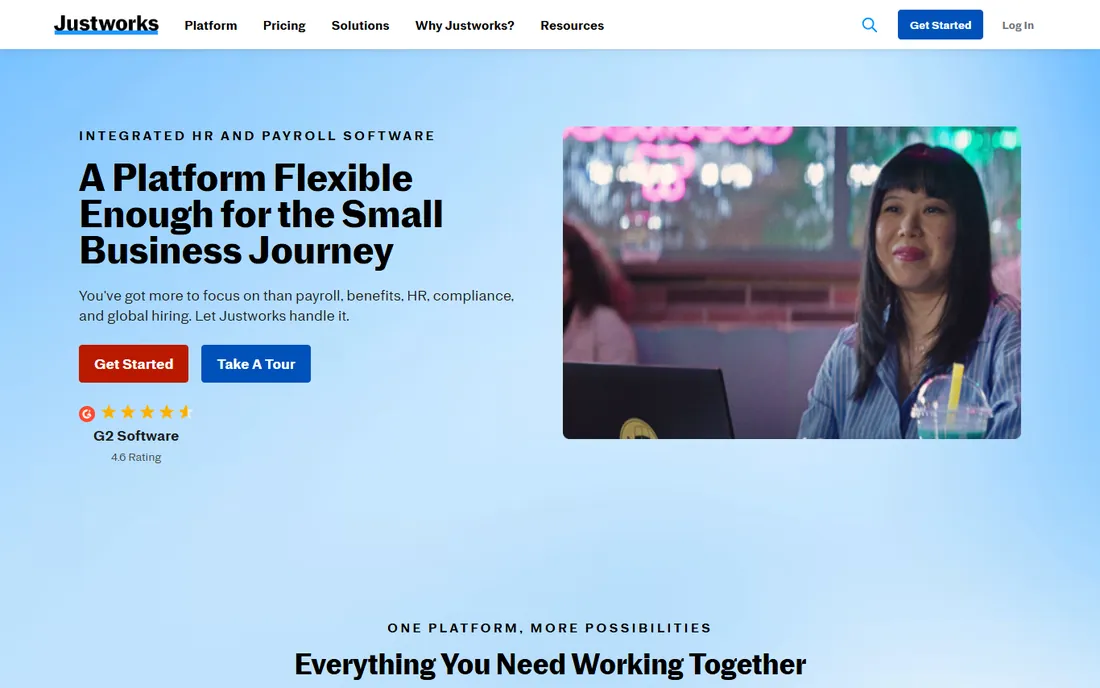
Justworks operates as a professional employer organization, which is a different deal from HR software: as your PEO, it becomes a co-employer, handles payroll taxes, workers compensation and benefits administration, and takes on much of the compliance burden. That model is attractive to startups that want big-company benefits and to stop worrying about multi-state tax registrations. Pricing is per employee per month with Basic and Plus tiers.
The tradeoff is control. Because Justworks is a co-employer, benefits plan choices and some HR policies run through its framework rather than yours. Published pricing figures conflict across sources, so get a current quote before comparing. For founders who would rather outsource HR compliance entirely than learn it, the PEO route deserves a look alongside pure software.
What we like- PEO model takes on HR compliance liability
- Access to large-group benefits
- Straightforward per-employee pricing
Watch out for- You share employer status with the PEO
- Less control over plan design
- Pricing figures vary by source, confirm directly
#6
HiBob
Best for: Mid-market companies that run on people data
Visit hibob.com
Starting priceSee website
Free planNo (free demo)
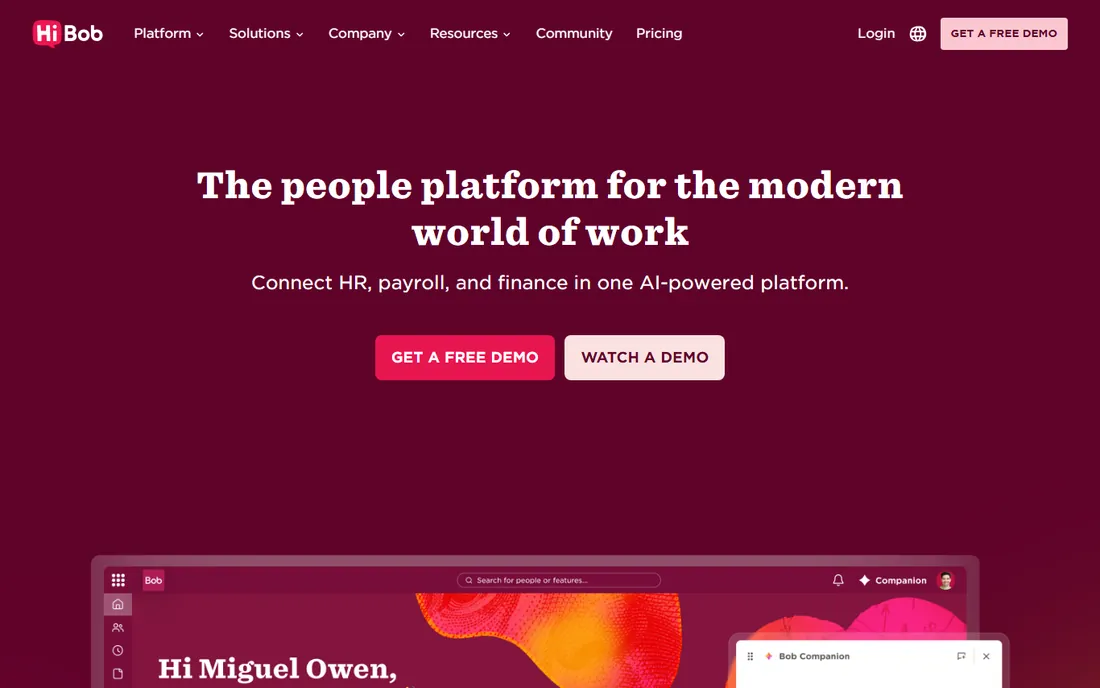
HiBob, whose product is called Bob, positions HR as a strategic function rather than an administrative one. The platform combines core HR with performance management, compensation cycles, engagement surveys and workforce planning, backed by analytics dashboards that finance and leadership teams actually open. Integrations with Slack, Teams, NetSuite and payroll providers keep it connected to the rest of the stack.
Pricing is entirely quote-based, which frustrates comparison shoppers, and payroll runs through integrations rather than natively. HiBob's sweet spot is companies past the startup stage, roughly 100 to several thousand employees, that want culture and analytics treated as first-class features. Smaller teams will find it oversized; mid-market people teams tend to rate it among the best they have used.
What we like- Strong people analytics and workforce planning
- Culture-focused features like engagement surveys
- Well reviewed for usability
Watch out for- Quote-based pricing with no public numbers
- Payroll is via integrations, not native
- Best fit is 100+ employees
#7
OnPay
Best for: Simple payroll with genuinely human support
Visit onpay.com
Starting price$49/month + $6 per worker
Free planNo
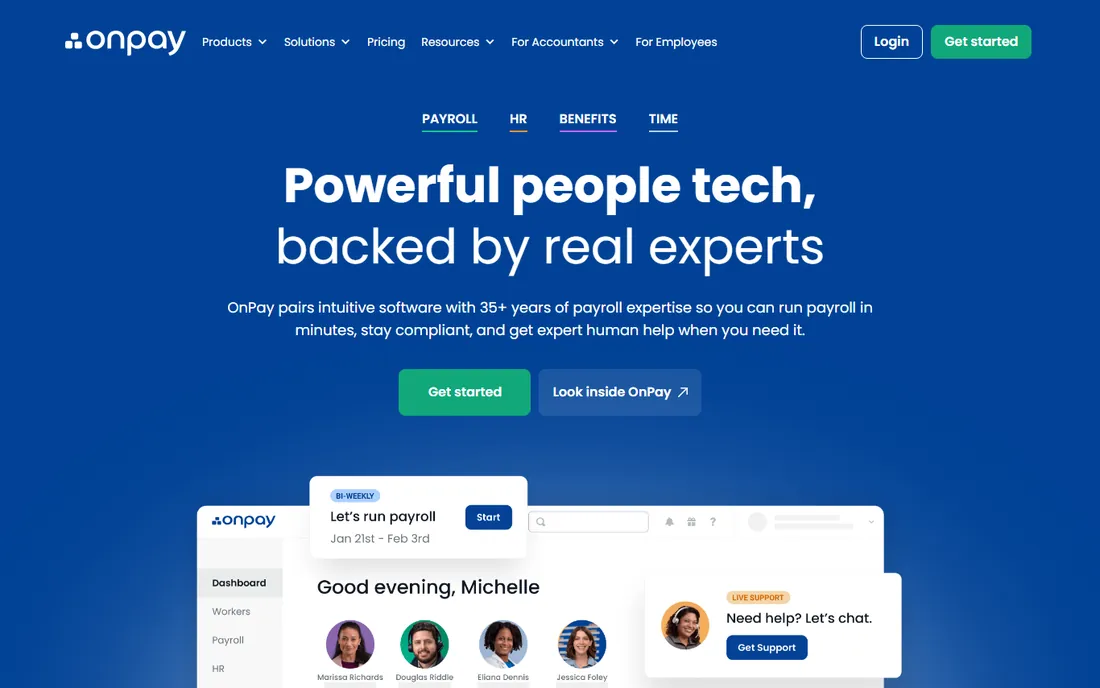
OnPay's differentiator is refreshingly old-fashioned: clear pricing on the homepage ($49 a month base plus $6 per worker) and a fully US-based support team that every client can reach by phone, chat or email with no support tiers. The product covers full-service payroll with automated tax filings, plus HR basics like onboarding, document storage and benefits administration, and the company migrates your prior wage data for free when you switch.
It is not trying to be Rippling or BambooHR. The HR toolkit is lighter, the integration catalog is shorter, and payroll is US-only. But for small businesses that want payroll done right by people who answer the phone, OnPay's reviews are consistently among the strongest in the industry, and the honest pricing makes budgeting trivial.
What we like- Transparent published pricing
- US-based support with no paywalls
- Free data migration when you switch
Watch out for- HR features are lighter than dedicated HRIS platforms
- Fewer integrations than larger competitors
- US-only payroll
#8
Zoho People
Best for: Budget HR suites and Zoho shops
Visit zoho.com
Starting priceFrom $1.5/user/month
Free planFree trial (30 days)
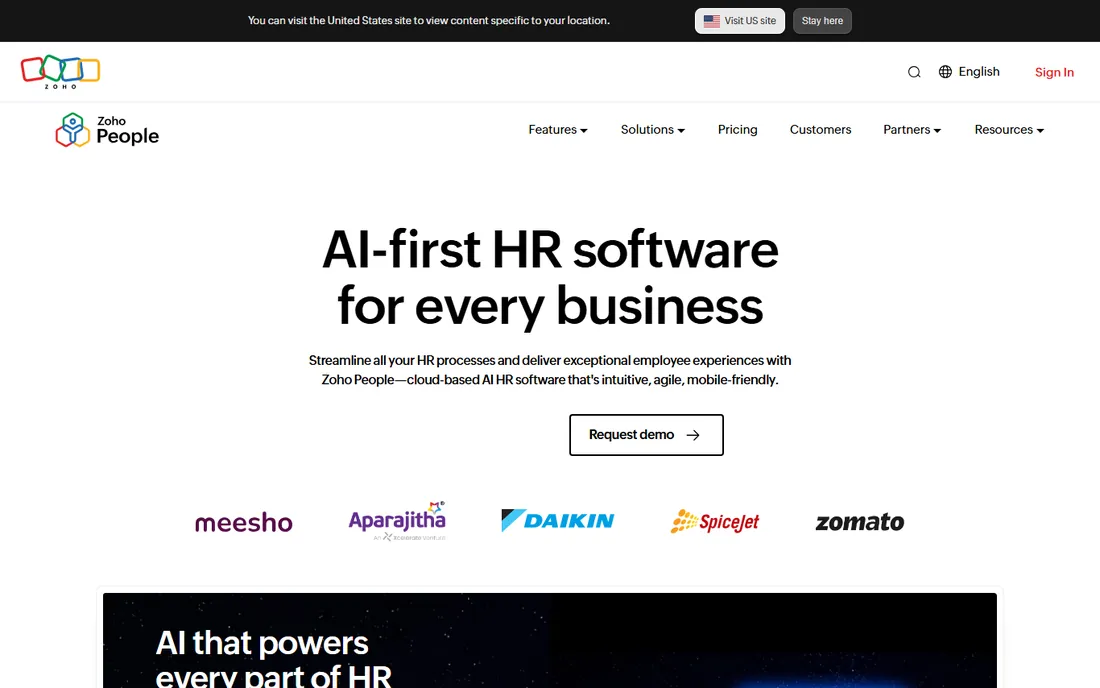
Zoho People brings the Zoho playbook to HR: a full HRMS covering core HR, time and attendance, performance, learning management and shift scheduling at a fraction of Western competitors' prices, starting around $1.5 per user per month. A 30-day free trial on all plans lets you evaluate properly, and integration with Zoho Payroll, Zoho Expense and Zoho Recruit makes it a natural fit for companies already in the ecosystem.
The compromises are the interface, which lags the polish of BambooHR or HiBob, and a tiered feature structure where the more useful modules sit on higher plans. For cost-sensitive teams, nonprofits and companies in regions where the big US vendors are overkill, Zoho People delivers working HR software at a price that is hard to argue with.
What we like- Very low per-user pricing
- 30-day trial on all plans
- Deep integration with the rest of the Zoho suite
Watch out for- Interface feels dated in places
- Advanced features cost extra across tiers
- Support is adequate rather than standout
#9
Paychex
Best for: Established companies that want full-service HR
Visit paychex.com
Starting priceSee website
Free planNo
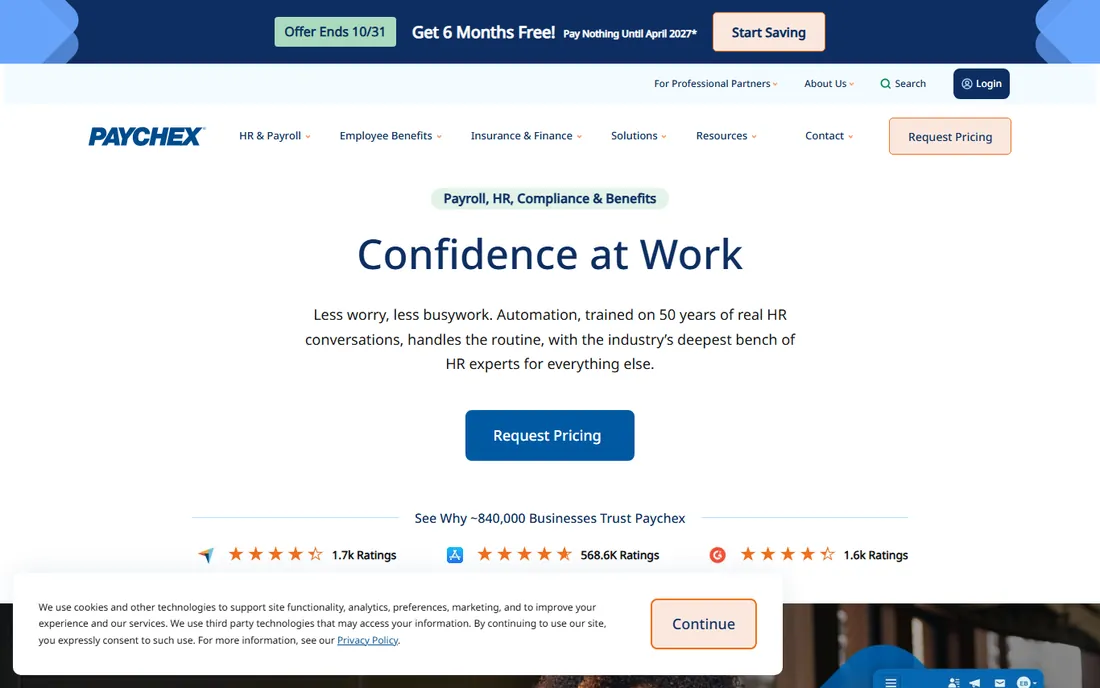
Paychex is one of the oldest names in payroll, and its Flex platform now bundles HR software with the services companies actually call about: payroll processing, benefits administration, retirement plans, workers compensation and access to HR consultants. For businesses that want a vendor to share the compliance burden rather than just software to manage it themselves, that services layer is the point.
Pricing is quote-based and varies widely by company size and services selected, so budget conversations start with a sales call. The software itself is competent rather than exciting, and reviewers note the upsell pressure toward add-on services. Companies with complex compliance needs, multiple locations or limited in-house HR expertise get the most from the Paychex model.
What we like- Decades of payroll and compliance expertise
- HR advisory services with real consultants
- Scales from small business to enterprise
Watch out for- Quote-based pricing with no public numbers
- The platform can feel corporate
- Upselling to add-on services is common
How we chose
We compared HR platforms that are actively sold and supported in 2026, using vendor pricing pages, product documentation, public reviews on G2, Capterra and TrustRadius, and buyer discussions on Reddit. The nine tools cover the main buying patterns: payroll-first software, core HRIS, global employment platforms, PEOs and full-service providers. We weighted pricing transparency, fit for small to mid-size teams, compliance coverage and reported support quality, and we treated vendor marketing claims as claims rather than facts. Prices shown are the best current public figures; quote-based vendors are marked as such. No hands-on testing was performed.
PEO vs HRIS vs HRMS: what the labels actually mean
The HR software market uses three labels that buyers constantly mix up, and the distinction decides what you are really buying. An HRIS (human resource information system) is the system of record for people data: profiles, time off, documents and reporting. Gusto, BambooHR and Zoho People are HRIS products at heart. An HRMS adds talent management on top: performance reviews, learning, succession planning, which is where BambooHR and HiBob stretch the definition.
A PEO is not software at all: it is a co-employment arrangement where a company like Justworks becomes the employer of record for tax and benefits purposes and takes on compliance liability. That is a legal and financial relationship, not a feature toggle, and it changes your obligations in ways software cannot. Employer-of-record services like Deel's sit between the two: they handle international employment without co-employing your domestic staff. Before comparing prices, decide which of these three relationships you actually want, because a cheap HRIS and a PEO are not competing products.
How to match the software to your headcount
Under 25 employees, the decision is usually between a payroll-first tool and a light HRIS. Gusto or OnPay handle payroll, taxes and basic HR for domestic teams at a predictable per-person price; add Zoho People if budget is the top constraint. Between 25 and 200, core HRIS value shows up: BambooHR for performance culture, HiBob for analytics-minded people teams, Rippling if IT provisioning and global payroll are part of the same headache. Past 200 employees, or with workers in multiple countries, the shortlist narrows to Rippling, Deel, HiBob and Paychex, and the evaluation should include implementation support, data migration and the compliance coverage of each country you operate in. Whatever the size, run payroll for one real cycle during the trial: that is where the painful surprises hide.
Frequently asked questions
Should a small business choose a PEO or HR software?
A PEO like Justworks takes on compliance liability and gives you access to large-group benefits, which suits founders who want HR handled rather than learned. Pure HR software like Gusto or OnPay keeps you in control and is usually cheaper at small headcounts. Choose the PEO when compliance risk keeps you up at night; choose software when you want control and lower per-head cost.
How much does HR software cost per employee?
Published pricing ranges from about $1.5 per user per month for Zoho People to $49 a month base plus per-worker fees for OnPay and Gusto, with Rippling around $8 per user plus a base fee and Deel's HR Core at $5 per employee. BambooHR, HiBob, Justworks and Paychex price by quote. Always model the total for your actual headcount, because per-head pricing compounds fast past 50 employees.
Can these tools handle international employees?
Deel is built for exactly that, with employer-of-record coverage in 150+ countries. Rippling runs payroll in dozens of countries. Gusto, OnPay and Justworks are primarily US-focused, while BambooHR, HiBob and Zoho People vary by region and rely on integrations for payroll abroad. If international hiring is on the roadmap, shortlist Deel and Rippling first.
Do I need HR software if I already have payroll?
Payroll pays people correctly; HR software manages the employment relationship: onboarding, time off, performance, documents and compliance records. Many companies run payroll through Gusto or OnPay and keep HR in spreadsheets until headcount or compliance complexity forces the upgrade, usually somewhere between 20 and 50 employees.
What is the difference between Deel and a PEO like Justworks?
Deel's employer-of-record service lets you hire in countries where you have no legal entity, handling local contracts, benefits and taxes. A PEO like Justworks co-employs your domestic workforce and takes on US compliance liability. They solve different problems: Deel for crossing borders, a PEO for outsourcing domestic HR compliance.
How long does implementation take?
Payroll-first tools like Gusto and OnPay can go live in days, with OnPay offering free data migration. Core HRIS platforms like BambooHR and HiBob typically take two to six weeks depending on data cleanup and workflow configuration. Global rollouts with Rippling or Deel run longer, especially where entity setup or benefits enrollment is involved. Ask for a written timeline before signing.
Sources we checked (9)
- https://www.gusto.com/
- https://www.bamboohr.com
- https://www.rippling.com
- https://www.deel.com
- https://www.hibob.com/
- https://onpay.com/
- https://www.zoho.com/people/
- https://www.justworks.com
- https://www.paychex.com
Is your product missing or out of date?
We review this list regularly. Vendors can request a listing, send updated pricing or ask about featured placement.

Shihab Mia · Founder, Rankite
Shihab has spent more than a decade helping SaaS and e-commerce brands grow through search. He writes Rankite's software buying guides from pricing pages, documentation and public user reviews. More about Shihab.