How we make this list: we compare pricing pages, product documentation and public user reviews. Ratings come from G2, Capterra or Trustpilot, with the date we checked them.
What is the best heavy civil construction software in 2026?
HCSS HeavyBid is the best heavy civil construction software for most contractors in 2026, because it was built for DOT bids, pay items, crews, equipment, and production rates rather than adapted from general building work. Pair it with HCSS HeavyJob for field tracking and job costing. B2W Estimate is the strongest alternative for contractors already working inside the Trimble system.
- Heavy civil work needs pay items, production rates, and DOT bid formats, not generic task lists.
- Estimating and field tracking should share the same cost codes, so actual production improves the next bid.
- Most heavy civil tools are sold by quote, so budget for licences, setup, training, and support together.
- Linear scheduling matters on roads, rail, pipelines, and tunnels, where work moves along a route.
- Job costing, equipment, payroll, and accounting must connect, or the same numbers get entered twice.
Heavy civil contractors build roads, bridges, dams, tunnels, pipelines, and utility networks. The work is linear, weather dependent, and equipment heavy, and it is often paid by unit price or pay item. A bid can run to hundreds of items, each tied to a crew, a production rate, and a set of machines. When the estimating tool and the field tool do not share cost codes, the office spends hours reconciling numbers that should already match.
How do I choose heavy civil construction software?
Start with the work you self-perform, then match the tool to the job it must do every day. A highway contractor that bids DOT work needs strong estimating, electronic bid support, and quote comparison. An earthwork contractor needs production tracking by cubic yard, truck counts, and equipment hours. A utilities contractor needs daily logs, materials tracking, and clear records for inspectors. Write down the three workflows that cause the most rework today, and test each shortlisted tool against those workflows in a demo using your own bid items and cost codes. Check the integrations before you sign anything. Ask how estimates move into the field, how field quantities move into job costing, and how job costs move into accounting and payroll. Ask whether the sync is automatic, how often it runs, and what happens when a cost code changes after work has started.
How much does heavy civil construction software cost?
Most heavy civil construction software is sold by quote, so there is no simple price list to compare. Vendors price by user count, modules, deployment, and company size, and implementation and training are often charged separately. That is why the starting prices in this guide are mostly listed as quote. The exception is InEight Estimate NOW, which publishes per seat pricing on its own page, and Trimble Tilos, where third party listings report a one time starting price. Treat any third party price as a guide only, and confirm the current figure with the vendor before you budget. Plan the total cost, not just the licence fee. Add setup and data migration, training for estimators and foremen, support after go live, and any hardware such as tablets or telematics units.
Do I need estimating, field tracking, or an ERP?
Most heavy civil contractors need more than one of these, but they do not need to buy them all at once. Estimating comes first for a company that loses bids or finds errors after award, because a better bid protects margin before work starts. Field tracking comes first for a company that cannot see job costs until the month ends, because daily quantities and hours show problems while there is still time to fix them. An ERP comes first for a company whose accounting, payroll, and job costing live in separate systems and need constant manual reconciliation. HCSS HeavyBid with HeavyJob is the clearest example of that pairing, and B2W Estimate with B2W Track follows the same pattern inside Trimble.
Best heavy civil construction software compared
| Tool | Best for | Starting price | Free plan |
| HCSS HeavyBid | DOT and heavy civil estimating | Quote | No |
| HCSS HeavyJob | Field tracking and job costing | Quote | No |
| B2W Estimate | Trimble based heavy civil estimating | Quote | No |
| InEight Estimate | Large capital project estimating and controls | 199 dollars per user per month billed annually for Estimate NOW | No |
| Trimble Tilos | Linear scheduling for roads, rail, and pipelines | 4,290 dollars one time, third party reported | No |
| Sage 300 CRE | Construction accounting and job costing | Quote | No |
| Vista by Viewpoint | Construction ERP for larger contractors | Quote | No |
| Procore | Multi company project management and documents | Quote based on annual construction volume | No |
Quick comparison
| Tool | Best for | Starting price | Free plan |
|---|
 HCSS HeavyBid | Self-performing heavy civil contractors bidding DOT, highway, bridge, and utilities work | quote | No free plan; demo available on request |
 HCSS HeavyJob | Foremen and project managers who need daily field data tied to job cost | quote | No free plan; demo available on request |
 B2W Estimate | Heavy civil contractors in the Trimble system who bid by pay item or work breakdown structure | quote | No free plan; demo available on request |
 InEight Estimate | Large infrastructure, energy, mining, and transportation programmes that need estimating tied to project controls | 199 dollars per user per month billed annually for InEight Estimate NOW, enterprise pricing by quote | No free plan; demo available on request |
 Trimble Tilos | Schedulers planning linear highway, rail, pipeline, tunnel, and transmission line work | 4,290 dollars one time, third party reported, vendor price not published | No free plan; free trial available according to third party listings |
 Sage 300 Construction and Real Estate | Mid sized to large contractors that need deep job costing, payroll, and financial control | quote | No free plan; demo and product information available on request |
 Vista by Viewpoint | Larger contractors that need one ERP for accounting, job costing, payroll, HR, and equipment | quote | No free plan; demo available on request |
 Procore | Owners, general contractors, and large project teams coordinating many companies on infrastructure work | quote based on annual construction volume | No free plan for the full platform; a limited free company account is available in the US and Canada |
Is your product missing or out of date?
We review this list regularly. Vendors can request a listing, send updated pricing or ask about featured placement.
#1HCSS HeavyBid
Best for: Self-performing heavy civil contractors bidding DOT, highway, bridge, and utilities work4.6/5 on
G2 (257 reviews, checked Oct 2026)
Visit hcss.com
Starting pricequote
Free planNo free plan; demo available on request

HCSS HeavyBid is the estimating standard for heavy civil work, and it earns that place because every part of it reflects how a DOT bid is actually built. Estimators work from bid items and activities, assign crews, equipment, and materials, and apply production rates to reach a price. Vendor and subcontractor quotes can be compared side by side, and last minute changes can be tested without rebuilding the whole estimate. Historical costs carry forward, so a crew rate or material price that proved right on the last job can be reused on the next one. Pricing is by quote, and HCSS does not publish a price list, so a small contractor must go through sales to get a number.
What we like- Built for heavy civil estimating, with pay items, crew based costing, quote comparison, and historical cost reuse
Watch out for- Training takes time, and the per user cost can add up for a large estimating team
#2
HCSS HeavyJob
Best for: Foremen and project managers who need daily field data tied to job cost
Visit hcss.com
Starting pricequote
Free planNo free plan; demo available on request
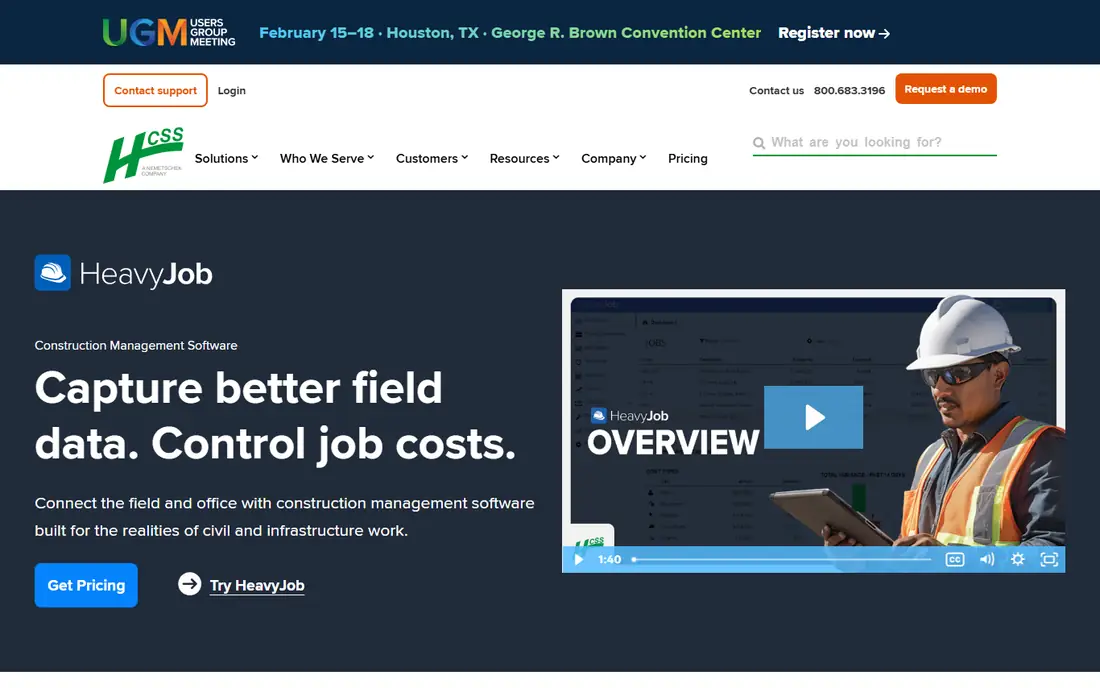
HCSS HeavyJob is the field half of the HCSS suite, and it is designed for self-performing civil, infrastructure, and utility contractors. Foremen enter time cards, installed quantities, materials, equipment hours, and daily logs from a mobile device, even without a connection, and the data syncs when service returns. Project managers see costs against budget by cost code, spot items running over budget, and forecast the outcome while work is still in progress. Pay item tracking helps the office bill faster and with better backup, because quantities and photos are captured at the source. HeavyJob also exports approved time cards to payroll and accounting, which cuts double entry.
What we like- Real time job costing, offline mobile entry, daily field reports, and pay item tracking
Watch out for- Full value needs the wider HCSS suite, so a standalone purchase can feel incomplete
#3B2W Estimate
Best for: Heavy civil contractors in the Trimble system who bid by pay item or work breakdown structure4.5/5 on
Capterra (201 reviews, checked Oct 2026)
Visit trimble.com
Starting pricequote
Free planNo free plan; demo available on request
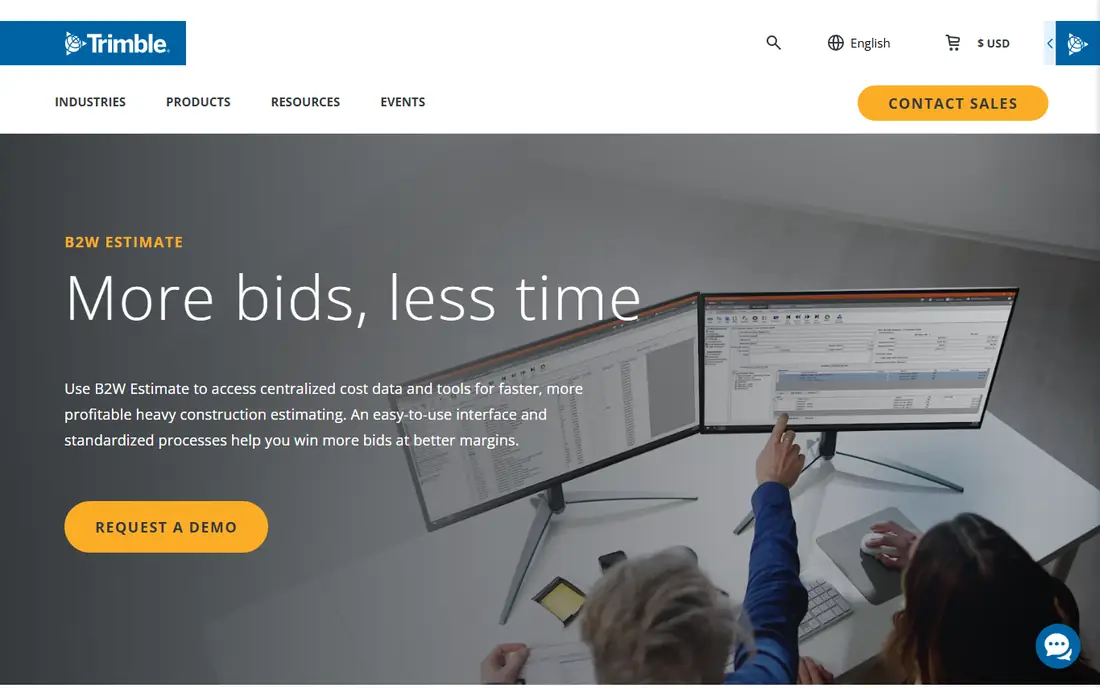
B2W Estimate, now part of Trimble, is a database driven estimating and bidding system for heavy civil and utility contractors. Rather than pricing from a simple unit cost book, it builds a bid from crews, equipment, materials, and production rates, so changing a crew or a daily output updates every affected item. Estimators can bid by pay item, by work breakdown structure, or by a hybrid of the two, and several estimators can work on one estimate at the same time. The shared resource database is the real strength, because B2W Track, Schedule, and Maintain draw on the same labour, equipment, and cost data. Pricing is by quote, and Trimble does not publish a price list for B2W Estimate.
What we like- Centralised cost database, pay item and work breakdown bidding, and a shared resource base with Track and Schedule
Watch out for- Setup takes real effort, because the cost database must be loaded with your own crews, equipment, and production rates before bids improve
#4
InEight Estimate
Best for: Large infrastructure, energy, mining, and transportation programmes that need estimating tied to project controls
Visit ineight.com
Starting price199 dollars per user per month billed annually for InEight Estimate NOW, enterprise pricing by quote
Free planNo free plan; demo available on request
InEight Estimate is built for complex capital projects, where an estimate must keep working through planning, controls, and execution rather than stopping at bid day. Estimators can build from assemblies, which are template based scope packages that adjust to project specs, and use parametric estimating to adapt quickly without rebuilding from scratch. The wider InEight platform links Estimate with Schedule, Control, Contract, and Document, so a cost overrun flagged in an estimate can create a risk alert in the schedule. That connection is the reason large owners and EPC contractors choose it. The published Estimate NOW path offers the full estimating tool online at 199 dollars per seat per month billed annually, or 260 dollars per seat per month billed monthly, with no complex contract.
What we like- Parametric and assembly based estimating, strong project controls links, and published per seat pricing through Estimate NOW
Watch out for- Depth demands skilled cost engineers and schedulers, and enterprise modules can move back into quote only territory
Starting price4,290 dollars one time, third party reported, vendor price not published
Free planNo free plan; free trial available according to third party listings
Trimble Tilos is a linear scheduling tool, and it solves a problem that a standard Gantt chart handles badly. On a road, railway, pipeline, or tunnel, work moves along a route, and crews, machines, and materials must not clash in the same place at the same time. Tilos draws that work as a time distance chart, so the whole project can be seen on one page instead of spread across many pages of bar chart. Planners can test what if scenarios, move activities, and see where production rates create a bottleneck or where two crews would meet. The starting price of 4,290 dollars one time comes from third party listings, because Trimble does not publish a Tilos price on its product page, so confirm the current figure with Trimble before you budget.
What we like- Time distance charts show a whole linear project on one page, with clear views of clashes and float
Watch out for- Narrow focus, so it must sit beside estimating, field, and accounting tools rather than replacing them
#6
Sage 300 Construction and Real Estate
Best for: Mid sized to large contractors that need deep job costing, payroll, and financial control
Visit sage.com
Starting pricequote
Free planNo free plan; demo and product information available on request
Sage 300 Construction and Real Estate, formerly Timberline, is an accounting first construction ERP. Its core strengths are job costing, general ledger, work in progress reporting, AIA billing, and payroll that can handle union rules, multiple pay types, and complex deductions. For a heavy civil contractor, the value is control over the money side of the job. Labour, subcontract, equipment, material, and retainage costs can be tracked by job and cost code, and a profit and loss view can be produced for each job at any time. Implementation often runs for months on a mid sized deployment, and the system needs a dedicated accounting team to run it well. Sage does not publish Sage 300 CRE pricing on its product page, so pricing is by quote.
What we like- Strong general ledger, work in progress schedules, AIA billing, and complex payroll including union payroll
Watch out for- Implementation can take months, and the interface feels dated next to newer cloud tools
#7
Vista by Viewpoint
Best for: Larger contractors that need one ERP for accounting, job costing, payroll, HR, and equipment
Visit viewpoint.com
Starting pricequote
Free planNo free plan; demo available on request
Vista by Viewpoint, now part of Trimble Construction One, is an enterprise construction ERP for larger contractors. Accounting, job costing, payroll, HR, service management, equipment management, and project tracking share one database, so a cost entered once flows through to the right reports without rekeying. The main drawbacks are scale and time. Trimble does not publish Vista pricing, and cost is quoted per deal based on users, modules, deployment, and implementation scope. Implementation and data migration can cost as much as the first year licence, so buyers should budget for the full project.
What we like- Single database for job cost, financials, payroll, HR, service, and equipment, with strong union payroll support
Watch out for- Long implementation and enterprise pricing make it too much system for a small contractor
#8Procore
Best for: Owners, general contractors, and large project teams coordinating many companies on infrastructure work4.6/5 on
G2 (4,357 reviews, checked Oct 2026)
Visit procore.com
Starting pricequote based on annual construction volume
Free planNo free plan for the full platform; a limited free company account is available in the US and Canada
Procore is a cloud construction management platform that acts as a single system of record across the companies on a project. Documents, drawings, RFIs, submittals, budgets, change orders, daily logs, and invoices live in one place, with an audit trail that owners and DOT agencies expect on infrastructure work. That cross company strength is the reason to choose it. A heavy civil contractor working as a subcontractor or joint venture partner can coordinate with the owner and the general contractor without passing files by email. Pricing is by quote, based on annual construction volume and the products chosen, with unlimited users on most products. Setup and training often take two to six months.
What we like- Strong document control, RFIs, budgets, change orders, and reporting across owners, contractors, and subcontractors
Watch out for- No published pricing, and the platform can be too complex and costly for a small self-performing crew
We picked tools that are sold for heavy civil or infrastructure work today, with a live vendor page checked on 12 Nov 2026. Each tool had to serve estimating, field tracking, linear scheduling, project controls, or construction accounting for roads, bridges, utilities, or similar work. We excluded generic small builder tools, residential tools, and tools with no working vendor site. Prices were taken from vendor pricing pages where published, and marked as quote where the vendor does not publish a price. Third party prices are flagged as third party reported. We did not run live trials, and we did not test DOT bid submission, payroll, or earned value on a live project.
Frequently asked questions
What software do heavy civil contractors use most?
HCSS HeavyBid and HeavyJob are the most common pairing for self-performing heavy civil contractors, because they cover estimating and field tracking with shared cost codes. B2W Estimate is the main rival, especially for Trimble users. Larger infrastructure programmes often add InEight for project controls, Trimble Tilos for linear scheduling, and an ERP such as Vista by Viewpoint or Sage 300 CRE for accounting and payroll.
Is HCSS HeavyBid better than B2W Estimate?
HeavyBid is usually better for complex DOT and highway bidding, with deep quote comparison and historical cost reuse. B2W Estimate is usually better for a contractor that wants a shared Trimble resource database and a faster learning curve. The right choice depends on your current system, because a contractor already using Trimble machine control or survey tools will get more from B2W, while a contractor that bids many DOT jobs will often prefer HeavyBid.
How much should a small heavy civil contractor budget for software?
A small contractor should budget for licences, setup, training, and support, not just the first year licence fee. Most heavy civil tools are quote only, so get at least two written quotes tied to your user count and modules. InEight Estimate NOW publishes 199 dollars per user per month billed annually, which gives a useful starting point for one estimating seat, but field, scheduling, and accounting tools will add to that total.
Does heavy civil software work offline in the field?
Most field tools in this guide work offline and sync when service returns, including HCSS HeavyJob, which is built for crews entering time cards and quantities from mobile devices. Always test offline entry on your own jobs before you buy, because coverage varies by site, and a tool that needs a constant connection will fail on remote road, pipeline, and utilities work where signal is weak or absent.
Can I use Procore instead of HCSS for heavy civil work?
Procore and HCSS solve different problems, so one does not replace the other for most contractors. Procore is strongest for documents, budgets, and coordination across owners, general contractors, and subcontractors. HCSS is strongest for estimating and field tracking for your own crews and equipment. Many large contractors use both, with HCSS for the bid and the field, and Procore for project management across the wider team.
Sources we checked (8)
- https://www.hcss.com/
- https://www.hcss.com/products/construction-project-management-software/
- https://www.trimble.com/en/products/b2w-software/estimate
- https://ineight.com/ineight-estimate-now/
- https://heavyindustry.trimble.com/en/products/tilos
- https://www.sage.com/en-us/products/sage-300-construction-and-real-estate/
- http://viewpoint.com/products/vista-by-viewpoint
- https://www.procore.com/
Is your product missing or out of date?
We review this list regularly. Vendors can request a listing, send updated pricing or ask about featured placement.

Shihab Mia · Founder, Rankite
Shihab has 5+ years in B2B and SaaS SEO. He writes Rankite's software buying guides from pricing pages, documentation and public user reviews. More about Shihab.