How we make this list: we compare pricing pages, product documentation and public user reviews. Ratings come from G2, Capterra or Trustpilot, with the date we checked them.
Key takeaways
- GRC means governance, risk, and compliance: one system for policies, risks, controls, and audits.
- Vanta and Drata suit startups and mid-size companies automating SOC 2, ISO 27001, and similar frameworks.
- AuditBoard and ServiceNow GRC suit larger companies with complex audit and risk programs.
- LogicGate and Hyperproof suit teams that want flexible workflows without enterprise complexity.
Quick comparison
| Tool | Best for | Starting price | Free plan |
|---|
 Vanta | Automated compliance | See website | Free trial |
 Drata | Automated compliance | See website | No |
 AuditBoard | Audit and risk management | See website | No |
 ServiceNow GRC | Enterprise GRC | See website | No |
 LogicGate | Flexible GRC workflows | See website | Free trial |
 MetricStream | Enterprise GRC suite | See website | No |
 OneTrust | Privacy and governance | See website | Free trial |
 Hyperproof | Compliance operations | See website | Free trial |
Is your product missing or out of date?
We review this list regularly. Vendors can request a listing, send updated pricing or ask about featured placement.
#1Vanta
Best for: Automated compliance4.5/5 on
G2 (2,742 reviews, checked Oct 2026)
Visit vanta.com
Starting priceSee website
Free planFree trial
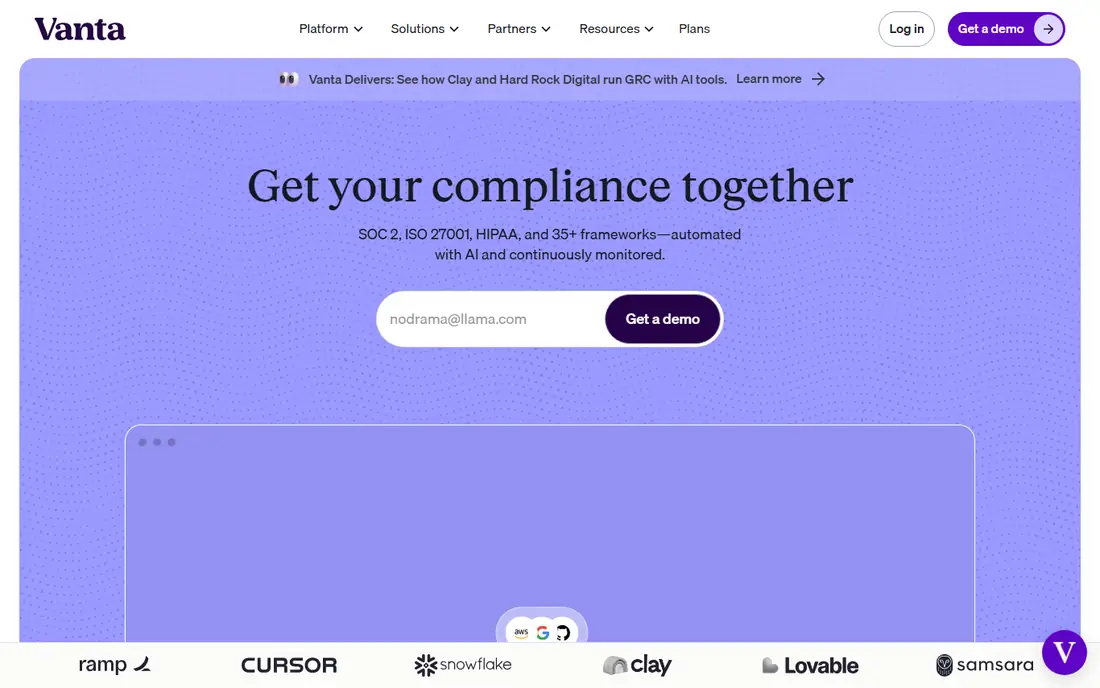
Vanta helps companies automate compliance by connecting to cloud services, code repositories, and HR systems, then collecting evidence continuously instead of once a year. It covers frameworks such as SOC 2, ISO 27001, HIPAA, and GDPR, with pre-built controls and tasks that guide teams through each requirement. That automation suits startups and mid-size companies that need a first audit quickly.
Pricing rises with frameworks, company size, and features, and Vanta is less suited to deep enterprise risk programs than AuditBoard or MetricStream. A free trial is available for testing. For a company whose main goal is passing a compliance audit efficiently, Vanta is the fastest path, with pre-built controls that shorten the journey from signup to audit-ready.
What we like- Automates evidence collection
- Covers SOC 2, ISO 27001, HIPAA, and more
- Good integrations
Watch out for- Pricing rises with frameworks and size
- Less suited to deep enterprise risk programs
#2Drata
Best for: Automated compliance4.7/5 on
G2 (1,392 reviews, checked Oct 2026)
Visit drata.com
Starting priceSee website
Free planNo
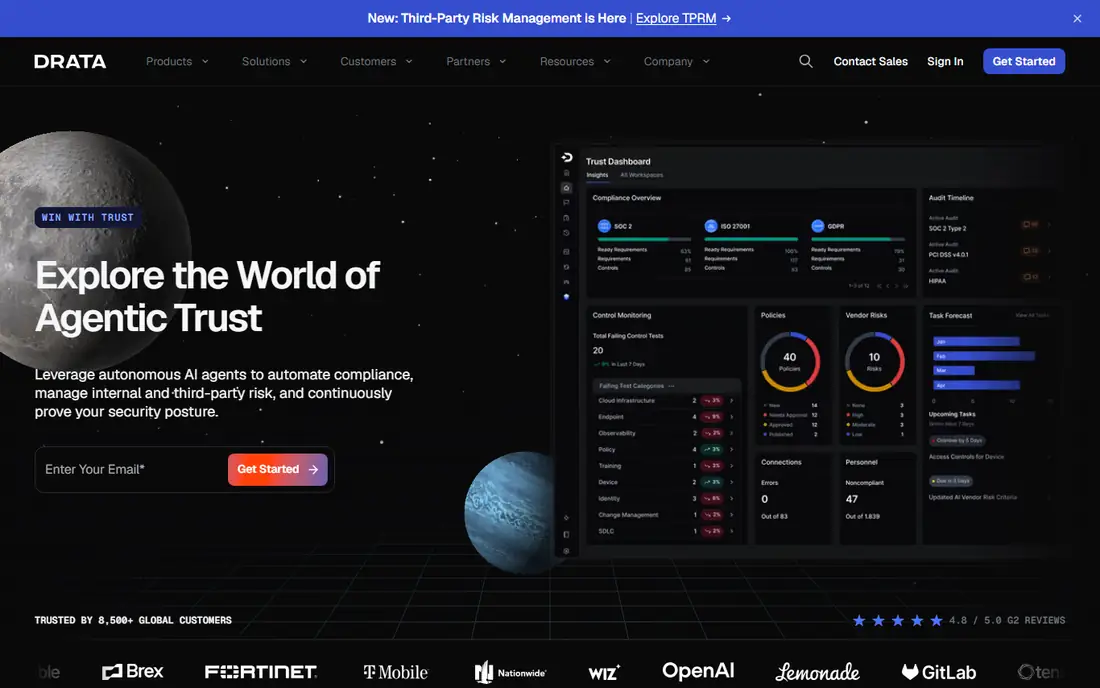
Drata is the close rival to Vanta, automating evidence collection and continuous control monitoring across frameworks such as SOC 2, ISO 27001, HIPAA, and PCI DSS. Its dashboards show control status in real time, so teams spot gaps before an audit rather than during it, and its framework library covers many standards out of the box.
There is no free tier, and enterprise risk management features are thinner than AuditBoard or ServiceNow. Pricing is quote-based and published on request. For a company that wants automated compliance with strong monitoring and support, Drata is a top contender, and a demo on your own stack is the best way to compare it with Vanta.
What we like- Continuous control monitoring
- Strong framework library
- Good customer support
Watch out for- No free tier
- Enterprise risk features are thinner than rivals
#3AuditBoard
Best for: Audit and risk management4.6/5 on
G2 (1,618 reviews, checked Oct 2026)
Visit auditboard.com
Starting priceSee website
Free planNo
AuditBoard suits larger companies with serious audit programs, covering internal audit, SOX compliance, risk management, and controls in one connected platform. Audit workflows, evidence requests, and issue tracking live together, which helps audit teams manage complex programs without spreadsheets. Cross-framework mapping reduces duplicate work when one control satisfies several requirements.
Pricing is enterprise-level, and implementation takes time, since large programs need configuration and training. For a large company where audit and risk are board-level concerns, AuditBoard gives the most complete audit-first platform on this list.
What we like- Strong audit management
- Risk and controls in one platform
- Good for large teams
Watch out for- Enterprise pricing
- Implementation takes time
Starting priceSee website
Free planNo
ServiceNow GRC brings governance, risk, and compliance into the wider ServiceNow platform, which many large companies already use for IT service management. Risk, policy, audit, and vendor risk workflows connect with IT tickets and assets, so a risk finding can become a tracked task automatically. That integration suits enterprises with mature ServiceNow estates.
Pricing and complexity are enterprise-level, and the platform needs ServiceNow expertise to configure well. For a large company already on ServiceNow, its GRC modules are the natural choice. For anyone else, a standalone GRC tool will deliver faster value.
What we like- Deep enterprise integration
- Strong workflows
- Scales to very large programs
Watch out for- Enterprise pricing and complexity
- Needs ServiceNow expertise
#5LogicGate
Best for: Flexible GRC workflows4.6/5 on
G2 (191 reviews, checked Oct 2026)
Visit logicgate.com
Starting priceSee website
Free planFree trial
LogicGate suits teams whose risk processes do not fit a standard template, thanks to no-code workflows that let risk managers build custom processes, forms, and approvals without developers. Reporting is strong, and the platform covers risk, compliance, and audit in a flexible model that adapts to unusual programs.
Out-of-the-box compliance automation is thinner than Vanta or Drata, so teams seeking SOC 2 automation will do more manual work. A free trial is available. For a team with unique risk workflows that needs flexibility over templates, LogicGate is the best fit.
What we like- Flexible no-code workflows
- Good for custom risk processes
- Strong reporting
Watch out for- Less out-of-the-box compliance automation than Vanta or Drata
Starting priceSee website
Free planNo
MetricStream offers the broadest enterprise GRC suite on this list, covering risk, compliance, audit, policy, and third-party risk for regulated industries such as banking, healthcare, and energy. Its risk analytics help large companies quantify and prioritize risks across business units, and its scale suits global programs.
Pricing and implementation are enterprise-level, and the platform is heavy for small teams. For a large regulated company that needs a complete GRC suite with deep analytics, MetricStream is a leading choice. For a mid-size company, a lighter tool will move faster.
What we like- Broadest enterprise GRC suite
- Strong for regulated industries
- Deep risk analytics
Watch out for- Enterprise pricing and implementation
- Heavy for small teams
#7OneTrust
Best for: Privacy and governance4.3/5 on
G2 (155 reviews, checked Oct 2026)
Visit onetrust.com
Starting priceSee website
Free planFree trial
OneTrust is best known for privacy management, helping companies handle consent, data subject requests, privacy assessments, and global privacy laws such as GDPR and US state laws. Its governance tools extend to ethics, ESG, and third-party risk, which suits companies whose main GRC pressure comes from privacy regulation.
The platform is broad and can feel complex, and pricing varies by module, so costs depend on which products you buy. A free trial covers some modules. For a company whose GRC program centers on privacy and data governance, OneTrust is the strongest specialist choice.
What we like- Strong privacy management
- Covers GDPR and global privacy laws
- Good for data governance
Watch out for- Broad platform can feel complex
- Pricing varies by module
Starting priceSee website
Free planFree trial
Hyperproof focuses on compliance operations, helping mid-size teams manage controls, evidence, and audits across frameworks without enterprise complexity. Workflows automate evidence collection and task tracking, and control status is clear at a glance, which helps small compliance teams stay audit-ready year-round.
Hyperproof is a smaller vendor than Vanta, Drata, or AuditBoard, and enterprise risk depth trails the leaders. A free trial is available. For a mid-size team that wants compliance operations without enterprise cost or complexity, Hyperproof is a practical choice today.
What we like- Compliance workflows with automation
- Good for mid-size teams
- Clear control tracking
Watch out for- Smaller vendor than leaders
- Enterprise risk depth trails AuditBoard
How we chose
We compared vendor pages, product documentation, and public user reviews, and we judged each platform on framework coverage, automation, risk management, audit workflows, reporting, ease of use, and price. Compliance automation tools were judged on audit speed, while enterprise suites were judged on depth and scale, since the two jobs differ. We did not claim hands-on testing. Where pricing was quote-based or module-based, we wrote See website rather than publish a figure that could mislead.
What to check before you pick
Start with your driver: a first SOC 2 audit, ongoing privacy compliance, internal audit efficiency, or enterprise risk management. Each driver points to a different tool, and buying an enterprise suite for a first SOC 2 audit wastes money just as surely as buying an automation tool for a global risk program wastes effort. Check framework coverage for the exact standards you need, since a tool that covers SOC 2 may not cover your industry framework.
Also check integrations with your cloud services, HR systems, and ticketing tools, because automation depends on those connections. Check evidence collection, since a tool that automates evidence saves weeks of manual work at audit time, while a tool that only tracks tasks leaves collection manual. Check auditor familiarity, since auditors work faster with tools they know, and ask your auditor which platforms they prefer before buying.
A further check matters for scaling: confirm how the tool handles multiple frameworks, business units, and subsidiaries, since a program that starts with one framework often grows to five, and a tool that cannot map controls across frameworks will duplicate work. Ask how control mapping, evidence reuse, and reporting work across frameworks in practice, not just on a feature list, and test with two frameworks during a trial. Teams that plan for growth avoid a painful migration when the second or third audit arrives.
Finally, run a trial or demo with your real controls and frameworks, and involve the compliance, security, and audit staff who will use the tool daily. A platform that looks clean in a demo can feel slow when a team manages hundreds of controls, and staff feedback during a trial predicts adoption better than any sales presentation. Measure evidence collection time and audit preparation time during the trial before committing. Also confirm support quality, since a GRC tool that stalls during audit season, when your team needs it most, can cost more in failed timelines than the subscription itself, so ask existing customers about response times under pressure.
Frequently asked questions
What does GRC software do?
GRC software manages governance, risk, and compliance in one system, covering policies, risks, controls, evidence, audits, and issues. It replaces spreadsheets and disconnected tools with a single source of truth for a company risk and compliance program.
Do startups need GRC software?
Startups that handle customer data, seek enterprise customers, or face SOC 2 or ISO 27001 requirements benefit from automation tools such as Vanta or Drata. Very early startups without compliance pressure can start with policies and spreadsheets, then adopt a tool when audit demands arrive.
What is the difference between Vanta and AuditBoard?
Vanta automates compliance evidence for frameworks such as SOC 2 and ISO 27001, targeting startups and mid-size companies. AuditBoard focuses on audit management, SOX, and enterprise risk, targeting larger companies with established audit programs.
How long does GRC implementation take?
Automation tools can show value within weeks for a single framework, while enterprise suites may take months to configure for complex programs. Implementation time depends on framework count, integrations, and how organized existing controls and evidence already are.
Can one tool cover privacy, risk, and audit?
Some suites such as MetricStream and ServiceNow cover all three broadly, while specialists such as OneTrust lead on privacy and AuditBoard leads on audit. Most large companies use one core platform plus specialists where depth matters.
Is GRC software worth the cost?
It is worth the cost when it saves audit preparation time, prevents compliance failures, or wins enterprise deals that require certifications. Compare the subscription cost with audit fees, staff time on manual evidence, and revenue at risk from missing certifications.
Sources we checked (8)
- https://www.vanta.com
- https://www.drata.com
- https://www.auditboard.com
- https://www.servicenow.com
- https://www.logicgate.com
- https://www.metricstream.com
- https://www.onetrust.com
- https://www.hyperproof.com
Is your product missing or out of date?
We review this list regularly. Vendors can request a listing, send updated pricing or ask about featured placement.

Shihab Mia · Founder, Rankite
Shihab has 5+ years in B2B and SaaS SEO. He writes Rankite's software buying guides from pricing pages, documentation and public user reviews. More about Shihab.