How we make this list: we compare pricing pages, product documentation and public user reviews. Ratings come from G2, Capterra or Trustpilot, with the date we checked them.
Key takeaways
- Anyscale is the best platform for teams building on Ray, covering training, fine-tuning, and serving.
- Together AI suits teams that want fast, affordable inference on open-weight models.
- Baseten fits developers deploying custom models with autoscaling endpoints.
- Modal is the pick for Python-native serverless GPU workloads with sub-second cold starts.
- CoreWeave serves enterprises and labs that need large-scale GPU capacity.
Quick comparison
| Tool | Best for | Starting price | Free plan |
|---|
 Anyscale Anyscale | Ray-based AI platform | See website | See website |
 Baseten Baseten | custom model deployment | See website | See website |
 Fireworks AI Fireworks AI | fast inference for compound AI | See website | See website |
 Modal Modal | serverless Python GPU workloads | See website | See website |
 RunPod RunPod | flexible GPU cloud | See website | See website |
 Together AI Together AI | open-model inference | See website | See website |
 Lambda Lambda | GPU cloud for AI teams | See website | See website |
 CoreWeave CoreWeave | large-scale GPU infrastructure | See website | See website |
Is your product missing or out of date?
We review this list regularly. Vendors can request a listing, send updated pricing or ask about featured placement.
The best generative AI infrastructure software
Starting priceSee website
Free planSee website
Anyscale, built by the creators of the Ray distributed computing framework, offers a managed platform for the full AI lifecycle: training, fine-tuning, batch inference, and online serving. Teams already using Ray get managed infrastructure with autoscaling, observability, and NVIDIA integrations. The platform handles the operational burden of running Ray at production scale.
Ray familiarity helps teams get the most from it. And pricing at scale needs careful modeling. But for organizations building serious AI applications on Ray, Anyscale removes the infrastructure management that would otherwise consume engineering time.
What we like- Built by the creators of Ray
- Unified training, fine-tuning, and serving
- Strong autoscaling
Watch out for- Ray knowledge helps
- Pricing complexity at scale
Starting priceSee website
Free planSee website
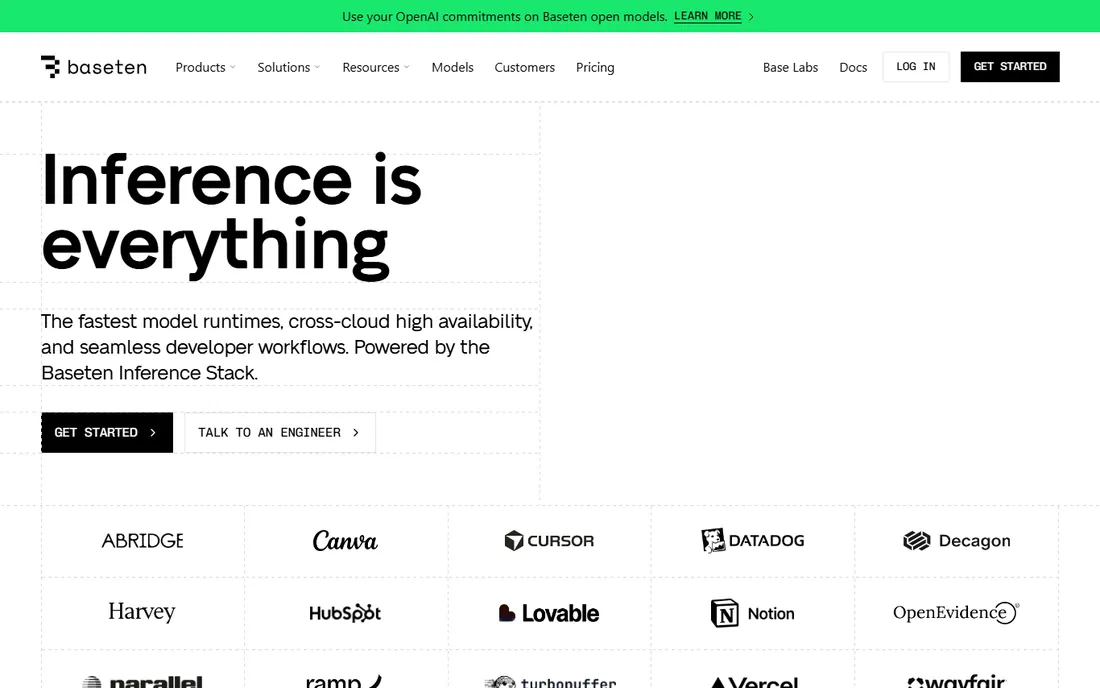
Baseten lets developers deploy custom models as autoscaling API endpoints with fast cold starts and per-second billing. The Truss framework standardizes model packaging, custom runtimes handle exotic dependencies, and the developer experience is polished. Teams shipping models to production get from checkpoint to endpoint quickly.
It focuses on inference and deployment rather than large-scale training. Teams needing massive training clusters look elsewhere. But for the common job of serving custom models reliably and affordably, Baseten's deployment experience is among the best.
What we like- Fast model deployment with autoscaling
- Custom runtimes and Truss framework
- Good developer experience
Watch out for- Inference-focused
- Less suited to large training runs
Starting priceSee website
Free planSee website
Fireworks AI provides high-performance inference optimized for compound AI systems: function calling, structured outputs, and JSON mode that agentic applications depend on. The platform serves open-weight models with low latency and competitive per-token pricing. Developers building agents and multi-step AI workflows find the optimizations meaningful.
It serves open models, not proprietary APIs like GPT or Claude. And it is newer than some competitors. But for teams building on open weights with demanding latency requirements, Fireworks' inference engineering shows in production performance.
What we like- Optimized for function calling and structured outputs
- Fast inference on open models
- Compound AI focus
Watch out for- Open-model focus excludes proprietary APIs
- Newer platform
Starting priceSee website
Free planSee website
Modal lets developers define GPU infrastructure in Python code with decorators, no YAML or containers to manage. Functions scale from zero to hundreds of GPUs with sub-second cold starts, and per-second billing means no idle costs. Inference, training, batch jobs, and sandboxes all run on the same platform. The developer experience is exceptional.
The Python-first design limits non-Python teams. And very long-running stateful workloads fit other platforms better. But for Python-based AI teams that want infrastructure to disappear, Modal is the most developer-friendly option available.
What we like- Python-native serverless with sub-second cold starts
- Pay-per-second pricing
- Scales to zero
Watch out for- Python-centric
- Less suited to non-Python stacks
Starting priceSee website
Free planSee website
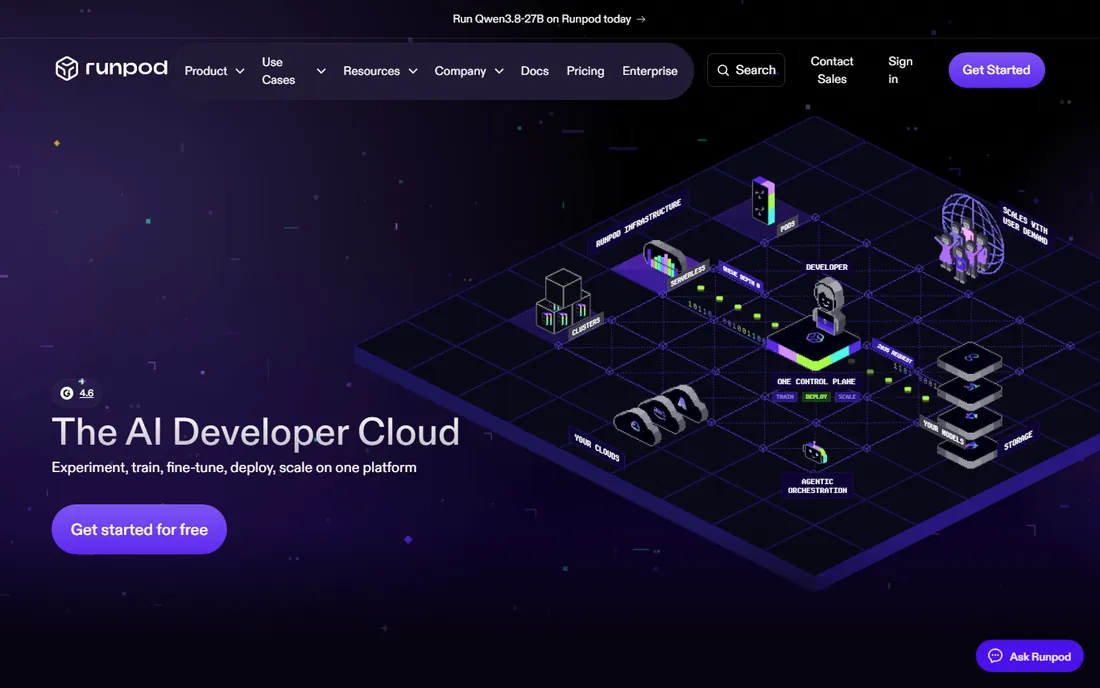
RunPod offers GPU pods and serverless endpoints with per-second billing across a wide range of GPUs, from budget cards to H100s. Developers get flexible, affordable compute for training, fine-tuning, and inference without long commitments. The platform suits experimentation and production alike.
Community marketplace GPUs vary in reliability; the Secure Cloud tier addresses this at higher cost. Support is not hyperscaler-grade. But for teams that want GPU flexibility and honest pricing, RunPod's combination of pods and serverless covers most needs.
What we like- Flexible pods and serverless endpoints
- Per-second billing
- Wide GPU selection
Watch out for- Marketplace GPU quality varies
- Support depth trails hyperscalers
Starting priceSee website
Free planSee website
Together AI provides fast, affordable inference across an extensive catalog of open-weight models, with fine-tuning pipelines and dedicated deployments for production workloads. Per-token pricing undercuts many competitors, and the model selection covers the popular open releases quickly. Research teams and startups building on open weights get production-grade inference without managing GPUs.
Proprietary models are not available here. And brand-new or obscure models may lag. But for the mainstream open models that power most applications, Together AI's price-performance is hard to beat.
What we like- Extensive open-model catalog
- Competitive per-token pricing
- Fine-tuning and dedicated deployments
Watch out for- Open models only
- Support for exotic models varies
Starting priceSee website
Free planSee website
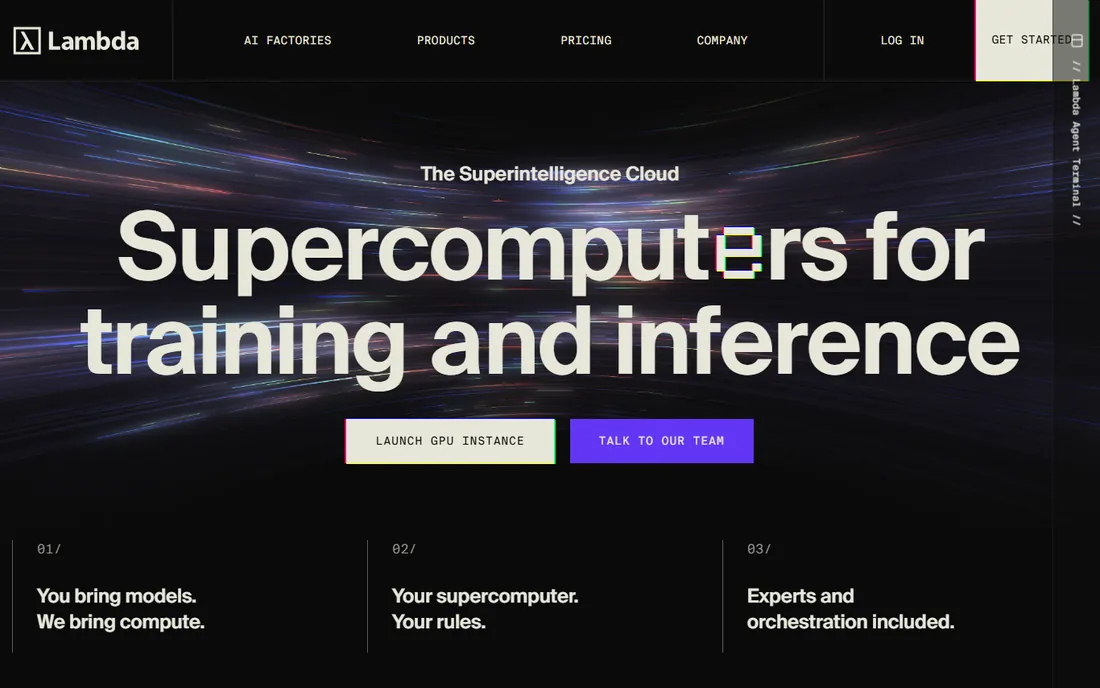
Lambda (formerly Lambda Labs) operates a GPU cloud purpose-built for AI workloads, offering on-demand instances from workstations to multi-GPU servers without minimum commitments. AI teams get straightforward access to NVIDIA hardware for training and inference, with pricing that undercuts hyperscalers. The focus on AI means the platform is tuned for ML workflows.
Scale and region coverage trail the hyperscalers. Availability of the newest GPUs varies. But for teams that want simple, affordable GPU access without enterprise contracts, Lambda's purpose-built cloud is a practical choice.
What we like- Purpose-built GPU cloud
- On-demand instances with no commitment
- Good for training and inference
Watch out for- Smaller scale than hyperscalers
- Availability varies by region
Starting priceSee website
Free planSee website
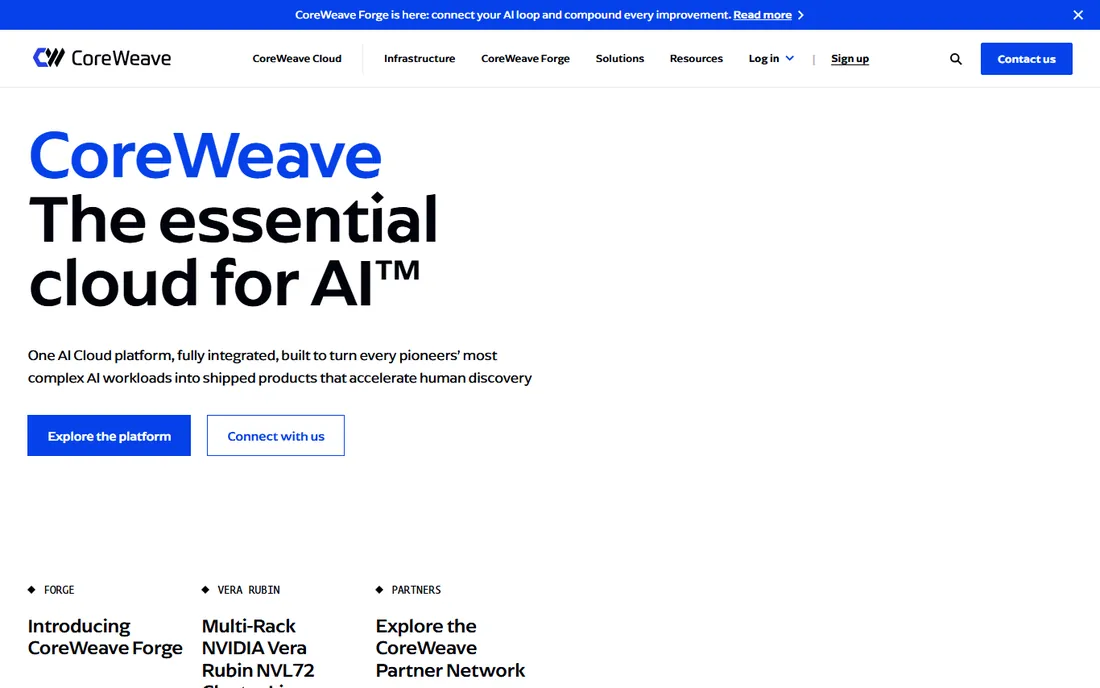
CoreWeave has grown into one of the largest GPU clouds, offering massive capacity of the latest NVIDIA hardware purpose-built for AI workloads. Enterprises and leading AI labs use it for large training runs and production inference at scale. Performance benchmarks and infrastructure engineering are top-tier.
This is enterprise infrastructure; small teams and individual developers will find the serverless platforms more practical. But for organizations whose AI ambitions require serious GPU capacity, CoreWeave is among the few providers that can deliver it.
What we like- Massive GPU capacity including latest NVIDIA hardware
- Purpose-built for AI at scale
- Strong performance benchmarks
Watch out for- Enterprise-oriented
- Overkill for small workloads
What to check before you buy
Start by separating inference from training. Inference platforms (Together AI, Fireworks, Baseten, Modal serverless) optimize for low latency and cost per token. Training clouds (Lambda, CoreWeave, RunPod pods, Anyscale) optimize for sustained GPU throughput and networking. Most teams need both, and the best vendors for each differ.
Then benchmark on your actual workload. Token pricing, cold start latency, and throughput vary by model and use case. Run your model with your traffic patterns on two or three candidates before committing. Published benchmarks use standard models; your fine-tuned model with its specific batching behavior is what matters. Include failure modes in the evaluation: what happens when traffic spikes 10x, when a region has issues, or when you need to roll back a deployment?
Finally, plan for portability. The AI infrastructure market moves fast, with pricing and capabilities shifting quarterly. Prefer platforms with standard APIs (OpenAI-compatible endpoints are common) so you can move workloads if a better option emerges. Avoid deep proprietary lock-in unless the performance advantage justifies it. Keep your evaluation harness reusable so re-benchmarking vendors every year is cheap.
Serverless vs dedicated: the cost crossover
Serverless inference (per-token or per-second billing) wins for variable workloads and development. Dedicated deployments (reserved GPUs) win for steady, high-volume production traffic. The crossover point depends on utilization: roughly speaking, sustained usage above 40-50% utilization favors dedicated capacity. Measure your actual traffic patterns rather than guessing, and revisit the math as you scale.
Do not forget the hidden costs on both sides. Serverless bills per token but may include data transfer and request fees. Dedicated capacity looks cheaper per hour but wastes money on idle time and requires engineering effort to manage. The honest comparison includes total cost of ownership: infrastructure spend plus the engineering time to run it. For many teams, the engineering time dominates, which is why managed platforms win even when raw GPU pricing looks higher.
Frequently asked questions
What is generative AI infrastructure software?
It is the compute platform layer for building generative AI applications: GPU clouds for training, inference platforms for serving models, and deployment tools that turn models into production APIs. It sits between raw cloud providers and the AI applications themselves.
Should we use open models or proprietary APIs?
Open models on infrastructure like Together AI or Fireworks cost less at scale, offer data privacy, and allow fine-tuning. Proprietary APIs are simpler to start with and often more capable. Many teams prototype on proprietary APIs, then move high-volume workloads to open models on dedicated infrastructure.
What does inference cost?
Per-token pricing for open models typically ranges from cents to dollars per million tokens depending on model size. Self-hosting on reserved GPUs can be cheaper at high volume. Always benchmark your specific model and traffic rather than relying on published price lists.
Do we need GPUs or will CPUs work?
LLM inference and training require GPUs for practical performance. Small models can run on CPUs for development, but production workloads need GPU acceleration. The GPU type matters: inference favors cost-efficient cards, training favors high-memory cards with fast interconnects.
What is the difference between serverless and dedicated GPU deployments?
Serverless deployments scale automatically and bill per use, ideal for variable traffic. Dedicated deployments reserve GPU capacity, ideal for steady high-volume workloads. Serverless costs more per unit but eliminates idle waste; dedicated costs less per unit but requires utilization to pay off.
How do we avoid vendor lock-in?
Use platforms with OpenAI-compatible APIs, containerize custom deployments, and keep model artifacts portable. Multi-cloud strategies work but add complexity. For most teams, API compatibility plus periodic market review provides enough flexibility without overengineering.
How we chose
We selected generative AI infrastructure providers that appear consistently in MLOps discussions, practitioner guides, and AI infrastructure comparisons, covering inference platforms, serverless GPU clouds, and large-scale GPU providers. Each vendor's site was checked to confirm the product is current in 2026. Pricing details come from vendor pages where published; usage-based models are noted as such. No hands-on GPU benchmarking was conducted for this guide.
Sources we checked (12)
- https://www.anyscale.com
- https://www.baseten.co
- https://www.fireworks.ai
- https://www.modal.com
- https://www.runpod.io
- https://www.together.ai
- https://www.lambda.ai
- https://www.coreweave.com
- https://github.com/ishandutta2007/awesome-foundation-model-platform
- https://cryptobriefing.com/modal-fireworks-baseten-kimi-k3-cost-advantage/
- http://gpusmith.com/articles/en/pdfs/choose-gpu-cloud-provider-ai-training.pdf
- https://slashdot.org/software/comparison/Anyscale-vs-cloud-init/
Is your product missing or out of date?
We review this list regularly. Vendors can request a listing, send updated pricing or ask about featured placement.

Shihab Mia · Founder, Rankite
Shihab has 5+ years in B2B and SaaS SEO. He writes Rankite's software buying guides from pricing pages, documentation and public user reviews. More about Shihab.