How we make this list: we compare pricing pages, product documentation and public user reviews. Rankite is independent; if a vendor ever pays for a featured spot, that listing is clearly labeled Partner.
Key takeaways
- ClearSale publishes the lowest entry price on this list: Growth plans with a chargeback guarantee start at $250/month, per its own site.
- Signifyd's Standard pricing is $1,500/month plus 0.8% of approved order value, with a 14-day free trial, per its own BigCommerce listing.
- SEON publishes self-serve pricing at $699/month for the Starter tier (2,500 fraud API checks), with a 14-day free trial, per its pricing page.
- Forter states on its own site that it does not publish list pricing, and Riskified, Sift, Kount, Sardine, and Fraud.net are all quote-based, so budget for a sales cycle.
Quick comparison
| Tool | Best for | Starting price | Free plan |
|---|
 Sift Sift | Marketplaces and digital businesses that want one platform covering the whole user journey, from signup to chargeback | See website | See website |
 Forter Forter | Large digital-first retailers that want fully automated approve/decline decisions with the fraud liability transferred to the vendor | See website | Free trial (sandbox) |
 Riskified Riskified | Mid-market to enterprise ecommerce brands, especially those selling internationally | See website | See website |
 Signifyd Signifyd | Ecommerce merchants selling physical goods who want to shift fraud liability to the vendor | $1,500/month + 0.8% of approved order value | Free trial (14 days) |
 Kount, an Equifax company Kount, an Equifax company | Businesses already running on Equifax identity data that want one vendor for identity and payment risk | See website | See website |
 SEON SEON | SMB to mid-market teams that want transparent pricing and digital-footprint screening without an enterprise sales process | $699/month | Free trial (14 days) |
 Wyllo Wyllo | Shopify and small ecommerce stores that want free fraud screening with an optional paid guarantee | Free to install; $250/month with $500 chargeback guarantee | Yes (screening-only plan) |
 ClearSale ClearSale | Established ecommerce stores, especially high-ticket sellers, with lean teams that want humans reviewing borderline orders | $250/month | No |
 Sardine Sardine | Fintechs, crypto platforms, and marketplaces that need fraud prevention, KYC, and AML in one stack | See website | See website |
 Fraud.net Fraud.net | Fraud, risk, and compliance teams that want an orchestration layer across many data feeds and models | See website | See website |
Is your product missing or out of date?
We review this list regularly. Vendors can request a listing, send updated pricing or ask about featured placement.
The best fraud protection software
Signifyd says retailers decline about 10% of orders out of fraud fear, even though less than 1% of orders are actually fraudulent. That gap is the whole market for fraud protection software: every wrongly declined order is revenue you never see, and every missed fraudster is a chargeback that lands weeks later. Which camp you need depends on whether you have a fraud team, or just want the problem gone.
#1
Sift
Best for: Marketplaces and digital businesses that want one platform covering the whole user journey, from signup to chargeback
Visit sift.com
Starting priceSee website
Free planSee website
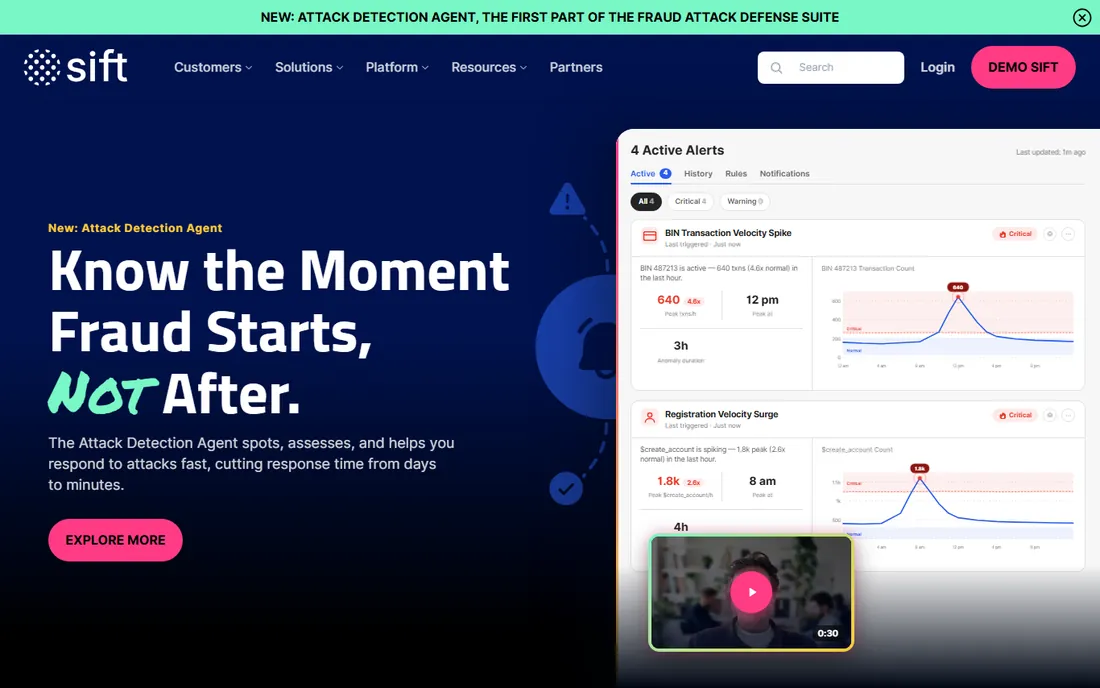
Sift is the broadest platform on this list. Most competitors focus on the checkout moment, but Sift scores events across account creation, login, payment, and post-transaction activity, which matters if your fraud problem is fake accounts and promo abuse rather than stolen cards.
The trade-off is that Sift sells you an engine, not an outcome. There is no financial guarantee against chargebacks, so your team still owns the approve/decline decision and the losses. Pricing is custom and based on event volume plus the modules you license. It is a strong fit for companies with a fraud or risk team that can tune models. If you want someone else to absorb the risk, look at Forter, Riskified, or Signifyd instead.
What we like- Data network scoring 1 trillion events per year, per Sift
- Covers payment fraud, account takeover, fake accounts, promo abuse, and content abuse
- More than 700 customers including DoorDash and Yelp, per Sift
Watch out for- No chargeback guarantee, you keep the fraud liability
- Quote-only pricing with a sales-led onboarding process
#2
Forter
Best for: Large digital-first retailers that want fully automated approve/decline decisions with the fraud liability transferred to the vendor
Visit forter.com
Starting priceSee website
Free planFree trial (sandbox)
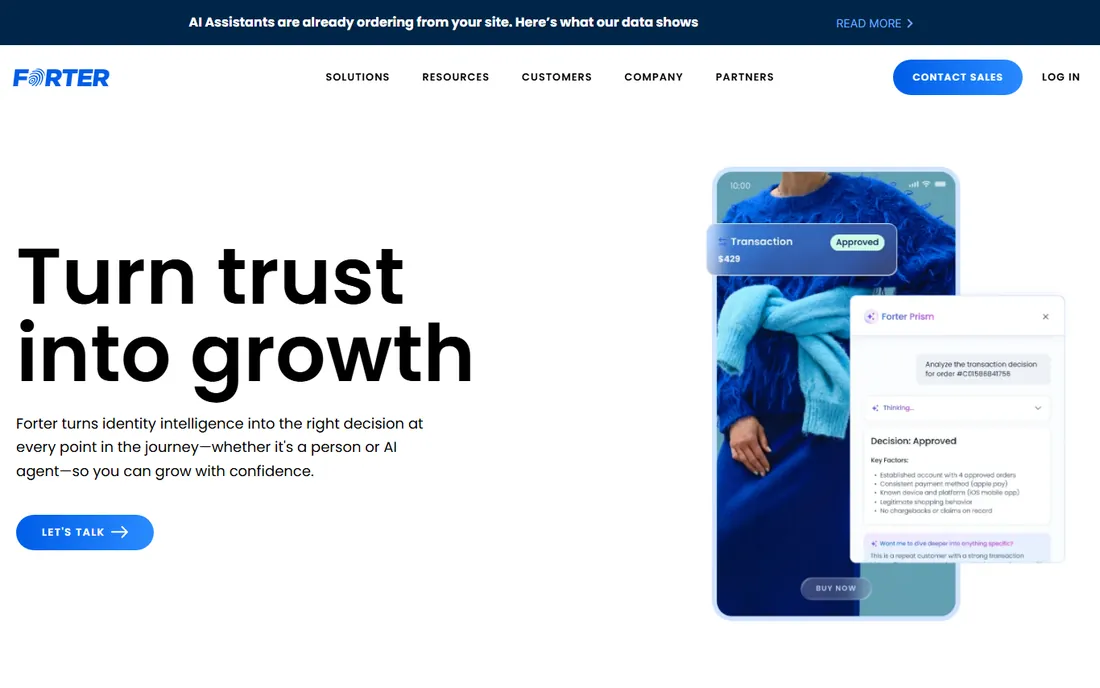
Forter positions itself as the opposite of Sift: pay more, transfer more risk. Its platform makes the approve/decline call on every transaction and backs approved orders with a full fraud chargeback guarantee, so the merchant never touches a fraud review. Forter also says its guarantee covers approval rates, committing to not wrongly decline good customers.
Production access needs a signed agreement, though Forter offers self-serve sandbox access so your developers can test the API before committing. Third-party procurement data puts mid-market Forter contracts in the $60,000 to $180,000 per year range, though Forter does not confirm those figures.
What we like- 100% chargeback guarantee on transactions Forter approves, per its own materials
- Fully automated decisions with no manual review queues
- Decisions returned in about 100ms at p95, per Forter
Watch out for- No published pricing, Forter says pricing is volume-tiered and negotiated per contract
- Percentage-of-revenue pricing scales with your sales, not your fraud
#3
Riskified
Best for: Mid-market to enterprise ecommerce brands, especially those selling internationally
Visit riskified.com
Starting priceSee website
Free planSee website
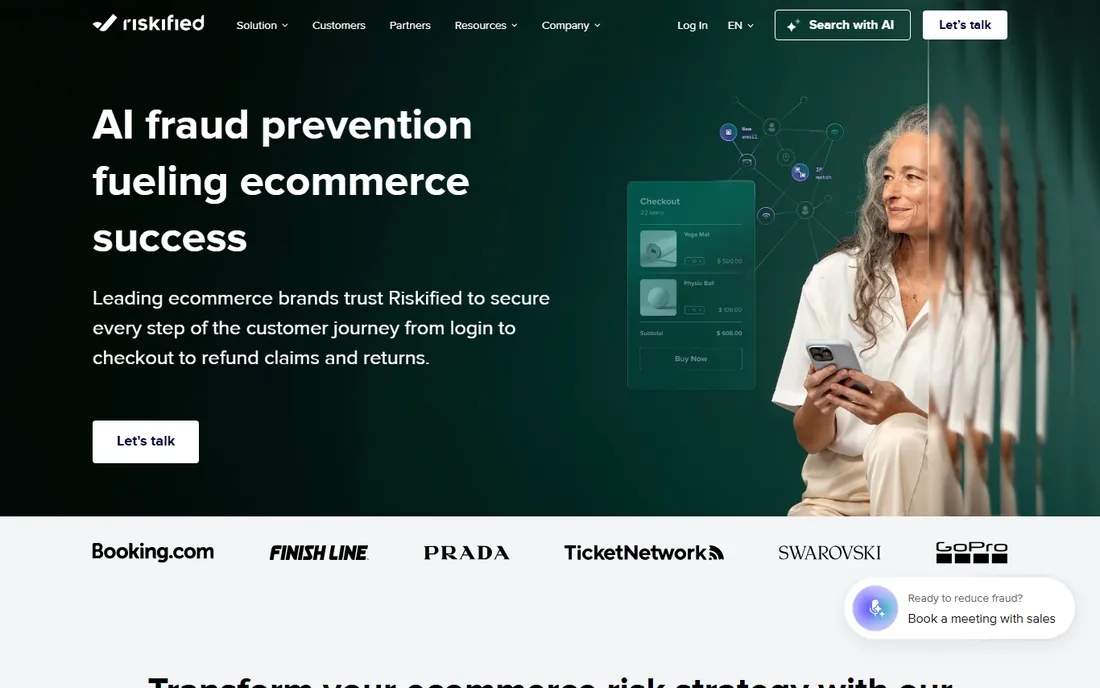
Riskified is the only publicly listed company in this lineup, and that matters for due diligence. You can read its financials before signing a multi-year deal, which is not possible with its private competitors. The platform approves or declines orders in real time and reimburses merchants when an approved order turns out to be fraudulent, aligning its incentives with yours: it cannot improve its own margins by declining aggressively.
The pricing model is a percentage of approved order value plus an annual minimum, and you will negotiate it through sales. Note the guarantee carve-outs. Fraud-related chargebacks are covered, but friendly-fraud categories like item-not-received or item-not-as-described fall outside the standard guarantee, which matters more for physical-goods sellers than for digital.
What we like- Full chargeback guarantee on approved orders, per Riskified
- Publicly traded company (NYSE: RSKD), which adds financial transparency competitors lack
- Covers policy abuse and account takeover beyond checkout fraud
Watch out for- Quote-based pricing with an annual minimum
- The guarantee covers unauthorized-card chargebacks but excludes disputes like item-not-received, per third-party analysis
#4
Signifyd
Best for: Ecommerce merchants selling physical goods who want to shift fraud liability to the vendor
Visit signifyd.com
Starting price$1,500/month + 0.8% of approved order value
Free planFree trial (14 days)
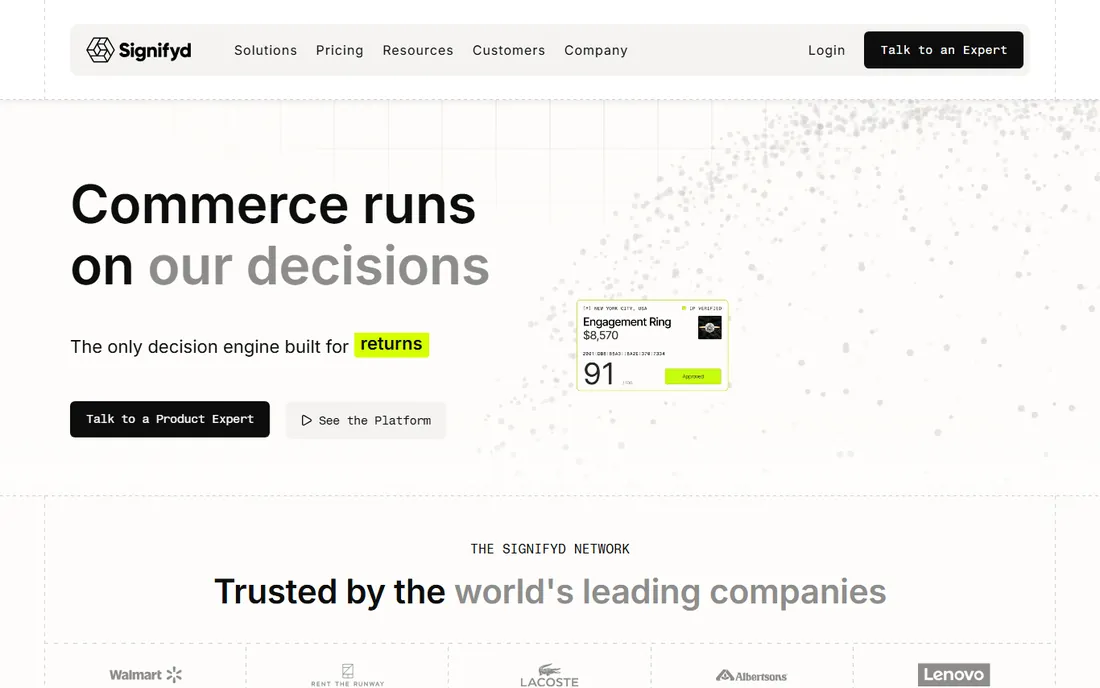
Signifyd is the most transparent of the guarantee vendors about how it charges. Its own BigCommerce listing puts Standard pricing at $1,500 per month with 0.8% charged on approved order value, and declined orders cost nothing. That structure means Signifyd only earns when it approves and guarantees an order, which keeps its incentives pointed at your revenue, not just your risk.
The guarantee is the product here. When Signifyd approves an order, it tells you to ship it, and if a fraud chargeback arrives, Signifyd reimburses you within 48 hours, per its listing. Its Complete Chargeback Protection tier goes further than most competitors by covering eligible non-fraud categories too. At 0.8%, the percentage adds up fast on high-ticket stores, so run the numbers first.
What we like- 100% financial guarantee against fraud chargebacks on approved orders, per Signifyd
- Complete Chargeback Protection extends coverage to some non-fraud dispute categories, per Signifyd
- Automated fulfillment decisions with analyst re-review on edge cases
Watch out for- Standard plan is $1,500/month plus 0.8% of approved order value, which adds up on high-ticket stores
- Merchants in EMEA or LATAM need custom pricing
#5
Kount, an Equifax company
Best for: Businesses already running on Equifax identity data that want one vendor for identity and payment risk
Visit kount.com
Starting priceSee website
Free planSee website
Kount's pitch changed the day Equifax bought it. Before, it was a device-fingerprinting fraud vendor. Now it is Equifax's payment-screening engine, and adopting Kount means tapping into Equifax's consumer credit and identity data as part of the risk decision. For businesses already using Equifax elsewhere, that consolidation is the main selling point.
The Kount 360 platform, launched under Equifax, added capabilities like address manipulation detection and passwordless authentication, aimed at newer attack vectors like card testing. Pricing is quote-only and depends on transaction volume and risk goals, so expect a full sales cycle. Kount fits companies with meaningful volume and an existing Equifax relationship; smaller merchants will find the process heavy.
What we like- Backed by Equifax's consumer identity data since its $640 million acquisition in 2021
- Identity Trust Global Network analyzes 32 billion annual interactions, per Kount
- Kount 360 adds passwordless authentication and reusable identities
Watch out for- Custom-quote pricing with no public rate card
- The Equifax ownership means your data relationship is with a credit bureau, which some buyers dislike
#6
SEON
Best for: SMB to mid-market teams that want transparent pricing and digital-footprint screening without an enterprise sales process
Visit seon.io
Starting price$699/month
Free planFree trial (14 days)
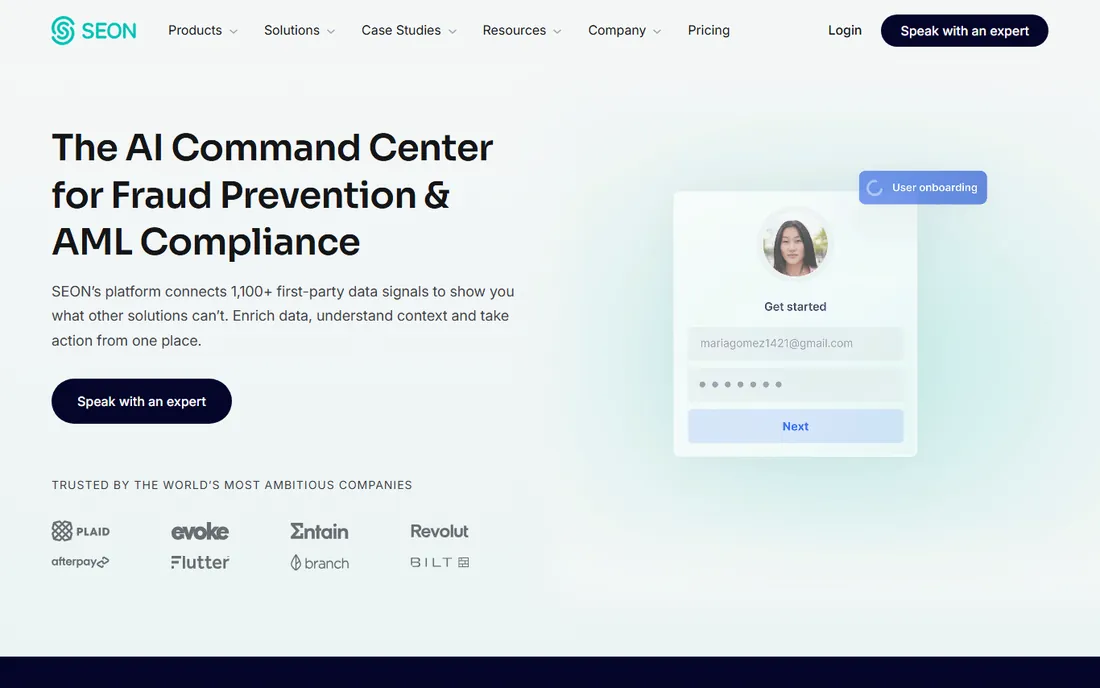
SEON is the self-serve answer to the quote-only enterprise tools above. Its angle is the digital footprint: it enriches an email address, phone number, or IP with hundreds of social and device signals to judge whether the person behind the signup looks real, before you spend money on full identity verification. That makes it especially useful at account creation and login, not just at checkout.
The published pricing is the differentiator. The Starter tier runs $699 per month with 2,500 fraud API checks and 10 team seats, and the 14-day free trial includes up to 2,000 free API queries, per its pricing page. Implementation averages 14 days through one API, and pre-built rules let non-engineers adjust logic. Watch the overage economics: if your check volume grows past the tier, per-check costs can stack up fast.
What we like- Published pricing starting at $699/month for the Starter tier with 2,500 fraud API checks, per its pricing page
- 1,100+ first-party fraud signals including email, phone, IP, and device data
- Average implementation of 14 days via a single API, per SEON
Watch out for- Check-based tiers can get expensive if you exceed the included volume
- Less hand-holding than managed services with human analyst teams
#7
Wyllo
Best for: Shopify and small ecommerce stores that want free fraud screening with an optional paid guarantee
Visit wyllo.ai
Starting priceFree to install; $250/month with $500 chargeback guarantee
Free planYes (screening-only plan)
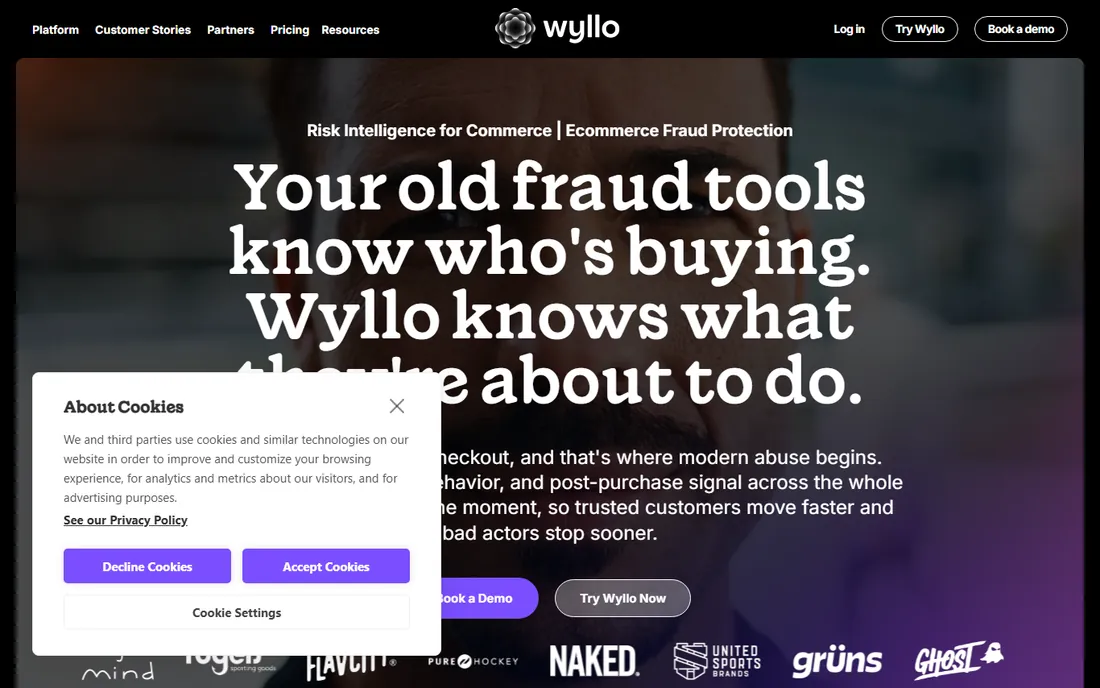
Wyllo is the new name for NoFraud, rebranded in March 2026 after acquiring the post-purchase risk platform Yofi. The pitch is now risk intelligence across the whole customer journey, from checkout screening to returns, refunds, and support interactions. For a small store, the core offer is simple: install the app, get every order screened by AI plus human analysts, and pay nothing until you want the guarantee.
The guarantee tiers are refreshingly concrete. Per its official Shopify app listing, the Screening Only plan is free, and guarantee plans run $250/month for $500 of coverage, $350/month for $1,000, and $450/month for $2,000. High-risk orders get escalated to analysts. The trade-off is coverage caps and a platform that still thinks in ecommerce terms; it is not built for fintech or marketplace seller risk.
What we like- Screening-only plan is free to install, per its official app listing
- Installs in minutes on major ecommerce platforms
- Human fraud analysts review high-risk orders and can contact cardholders directly
Watch out for- Paid guarantee tiers cap coverage at $500, $1,000, or $2,000, so large orders need custom terms
- Rebranded from NoFraud in March 2026, so reviews and documentation are split across two names
#8
ClearSale
Best for: Established ecommerce stores, especially high-ticket sellers, with lean teams that want humans reviewing borderline orders
Visit clear.sale
Starting price$250/month
Free planNo
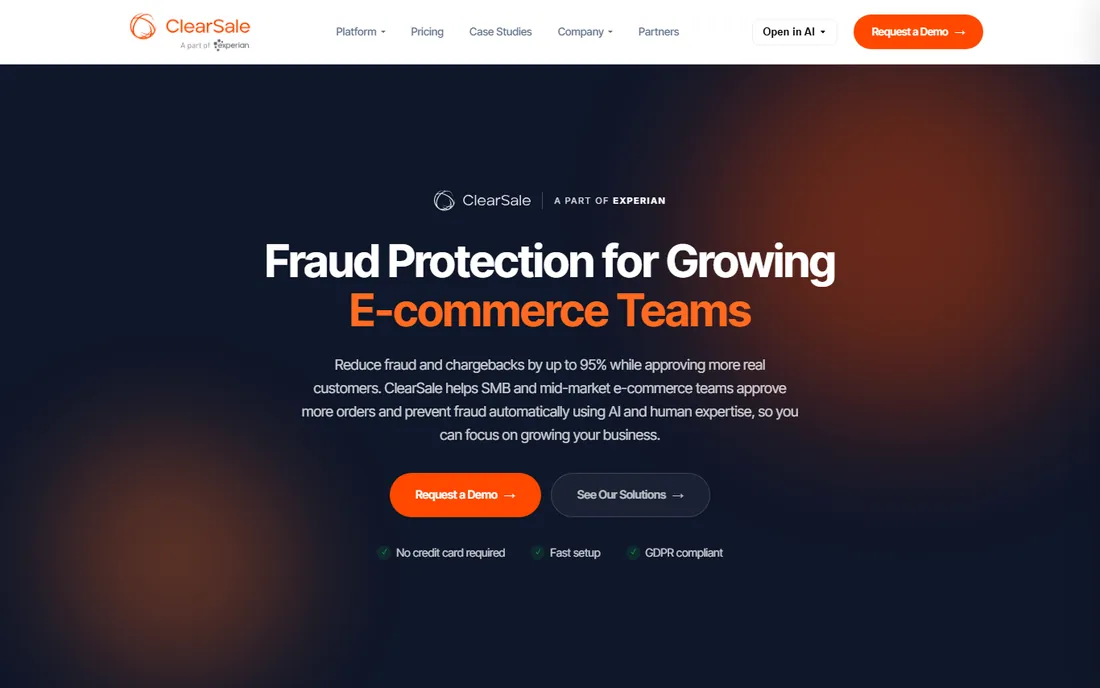
ClearSale's signature is the hybrid model. AI screens every order, and the ones that look borderline go to human fraud analysts instead of being auto-declined, which is how the company keeps approval rates high on expensive orders where a false decline costs real money. It was the first company to offer chargeback guarantees in this category, and the guarantee is now bundled into its Growth plans.
At $250 per month to start with the guarantee included, ClearSale is the cheapest entry point among the guarantee vendors here. There are no long-term contracts. The honest catch is the fee structure: under the performance model you pay on approved orders, and not every approved order is covered by the guarantee, so read the coverage terms against your actual dispute mix.
What we like- Growth plans with a chargeback guarantee start at $250/month, per ClearSale's own site
- Hybrid model pairs AI screening with human analyst review of flagged orders
- No long-term contracts, per third-party buyer reports
Watch out for- No free trial or free plan
- The performance model charges on approved orders, so fees apply even to transactions outside the guarantee, per buyer reports
#9
Sardine
Best for: Fintechs, crypto platforms, and marketplaces that need fraud prevention, KYC, and AML in one stack
Visit sardine.ai
Starting priceSee website
Free planSee website
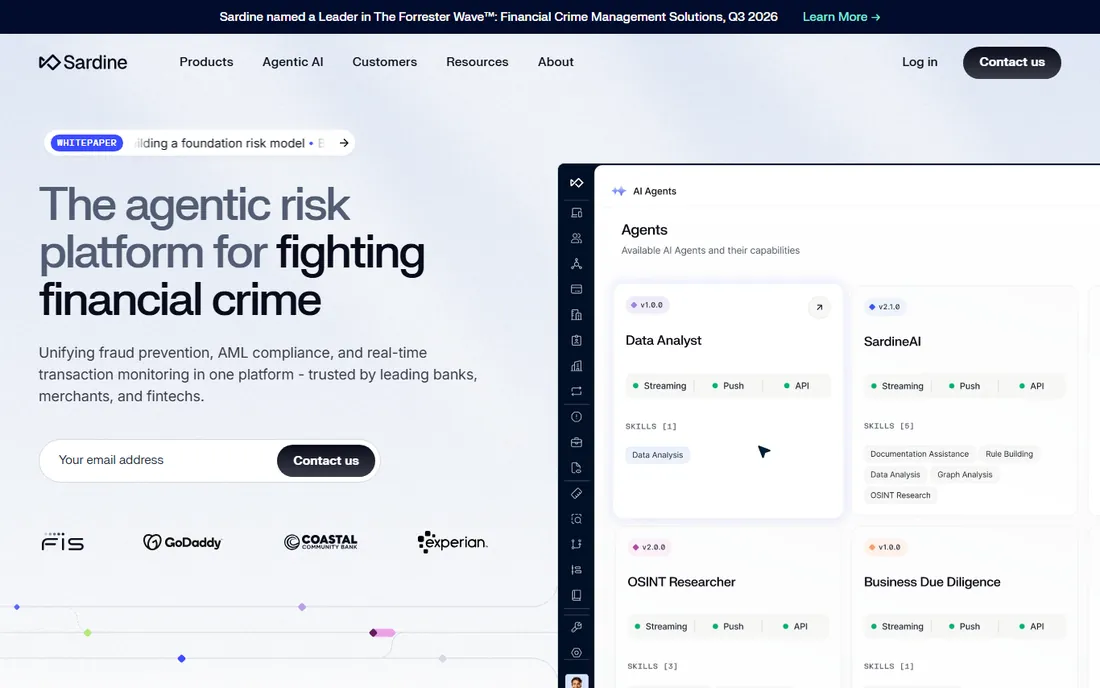
Sardine is the youngest company on this list and the most fintech-shaped. Where Sift and Forter think in terms of ecommerce checkout, Sardine thinks in terms of the full customer lifecycle for money-movement businesses: verify the identity at onboarding, watch the device and behavior, screen the payment, and monitor for money laundering, all in one platform. That combination of fraud and AML compliance in a single stack is rare and valuable for neobanks, crypto exchanges, and lending platforms.
The pricing page is contact-sales only, which puts it in the enterprise buying process despite the modern product. There is no published trial or self-serve tier. For a straight ecommerce store, Sardine is probably the wrong shape; for a fintech that would otherwise buy a KYC vendor, a fraud vendor, and an AML tool separately, the consolidation argument is strong.
What we like- Unifies onboarding (KYC, KYB, document and bank verification), device intelligence, and AML transaction monitoring
- Built for fintech risk teams with modern API-first architecture
- Founded in 2020 with a fintech-native product
Watch out for- Pricing is contact-sales only, per its own pricing page
- The fintech focus may be overkill if you only need checkout fraud screening
#10
Fraud.net
Best for: Fraud, risk, and compliance teams that want an orchestration layer across many data feeds and models
Visit fraud.net
Starting priceSee website
Free planSee website
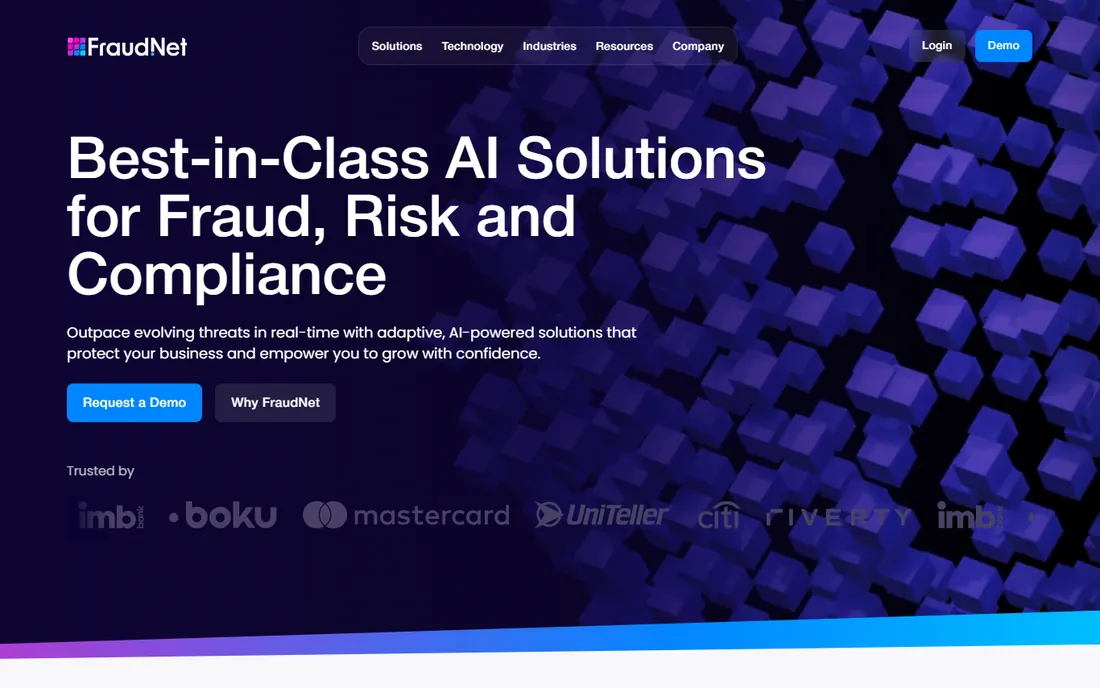
Fraud.net takes the platform-of-platforms approach. Instead of one black-box model, it gives your risk team an orchestration layer: connect your data feeds, apply AI rules and graph-based network scoring, and build the decisioning workflow your business needs. That flexibility is the appeal for payments companies and banks that already have fraud analysts and want tooling, not a managed service.
The flip side is that flexibility is work. Fraud.net is not a set-and-forget chargeback guarantee; it is infrastructure your team configures and tunes. Fraud.net does not publish pricing, so get a quote directly. It fits organizations with real risk teams and complex data environments. If you want someone to simply approve or decline your orders and absorb the losses, the guarantee vendors above are the shorter path.
What we like- App-store style platform that plugs in enterprise data feeds, AI rules, and graph network scoring
- Built for payments companies, banks, and fintechs with in-house risk teams
- API-first with broad integration options
Watch out for- Pricing is not published by the vendor
- It assumes you have analysts who can operate an orchestration platform, unlike managed services
What to compare before you sign a fraud contract
Start with the economic model, because it determines everything else. Guarantee vendors like Signifyd, Forter, Riskified, ClearSale, and Wyllo charge as a percentage of approved order value, so your bill scales with revenue. Score-only platforms like Sift, SEON, Kount, and Sardine charge by event or check volume, which scales with traffic. A store with high average order values can find the percentage model punishing: at 0.8% of approved volume, Signifyd's rate on $1 million in monthly sales is $8,000 before the $1,500 base. Model both structures against your actual fraud losses and chargeback fees before you sign.
Then check the fine print that actually bites: contract length, guarantee exclusions, and who does the manual review. ClearSale offers no long-term contracts, while enterprise tools like Forter require a signed agreement for production access. Read which dispute categories the guarantee excludes, since friendly-fraud chargebacks like item-not-received are often carved out. Ask about implementation time too: SEON reports an average of 14 days through a single API, while enterprise platforms can take months of integration and tuning. And confirm data export and rule portability, because switching fraud vendors later means rebuilding your risk logic.
The chargeback guarantee, explained without the fine print
A chargeback guarantee means the vendor reimburses you when an order it approved turns out to be fraudulent. In practice, the vendor is selling you insurance priced as a percentage of your sales, and it can offer that insurance because its models approve accurately enough to keep losses below the fees. That is why guarantee vendors only charge on approved orders: every approval is a bet they are willing to back with their own money.
The guarantee is not blanket coverage. It typically covers unauthorized-card and stolen-payment fraud on approved orders, while friendly fraud, item-not-received claims, and processing errors are often excluded or require a higher tier like Signifyd's Complete Chargeback Protection. Before you buy, sort your last six months of chargebacks by reason code and check which categories the guarantee covers. The tool that covers your real dispute mix is worth more than the one with the lowest headline rate.
How we chose
We researched this category through vendor pricing pages, product documentation, official press releases, and app-store listings published by the vendors themselves. We cross-checked feature claims and pricing against public buyer reviews on G2, TrustRadius, SourceForge, and Slashdot. We favored tools with verifiable pricing and clear guarantee terms, and we included both enterprise platforms and self-serve options so stores of different sizes can find a fit. Prices shown come only from the vendor's own published pages; where a vendor does not publish pricing, we say so instead of guessing.
Frequently asked questions
What is the difference between fraud protection software and a chargeback guarantee?
Fraud protection software scores transactions and tells you which ones look risky. A chargeback guarantee goes further: the vendor makes the decision and reimburses you if an approved order results in a fraud chargeback. Score-only tools like Sift and SEON leave the liability with you. Guarantee vendors like Signifyd, Forter, Riskified, ClearSale, and Wyllo take the liability onto themselves and charge for it, usually as a percentage of approved order value.
How much does fraud protection software cost?
It ranges from free to six figures a year. Wyllo offers free order screening, ClearSale's Growth plans with a guarantee start at $250/month, SEON's Starter tier is $699/month, and Signifyd's Standard plan is $1,500/month plus 0.8% of approved order value. Enterprise platforms like Forter, Riskified, Sift, Kount, and Sardine are quote-based, and third-party procurement data puts mid-market contracts in the tens of thousands per year.
Do small stores need dedicated fraud protection software?
Most small stores are fine starting with the built-in fraud analysis in Shopify, WooCommerce, or their payment processor, plus basic rules like velocity limits. Consider a dedicated tool when chargebacks start costing real money, when false declines are visibly hurting conversion, or when you are expanding into higher-risk international markets. Wyllo's free screening plan is a reasonable first step before any enterprise contract.
How long does it take to implement fraud protection software?
It depends on the tool. SEON reports an average implementation of 14 days through a single API, and Shopify apps like Wyllo and ClearSale install in minutes on supported platforms. Enterprise platforms are slower: Forter requires a signed agreement before production access, and tools like Sift, Kount, and Riskified need integration work plus a tuning period before the models perform well on your traffic.
What is friendly fraud, and do these tools stop it?
Friendly fraud is when a legitimate cardholder disputes a charge they actually made, claiming it was unauthorized or never received. Standard chargeback guarantees usually exclude friendly-fraud categories like item-not-received. Signifyd's Complete Chargeback Protection tier covers some of these categories, and Wyllo's post-purchase risk tools address return and refund abuse. Ask every vendor which dispute reason codes are covered before you sign.
Can I switch fraud protection vendors later?
Yes, but it takes work. Your risk rules, allow and block lists, and tuned thresholds live inside the vendor's platform, and you will need to rebuild them. Before signing any annual contract, confirm how you export your historical decision data and whether there are termination fees.
Sources we checked (10)
- https://sift.com/
- https://www.forter.com/
- https://www.riskified.com/
- https://www.signifyd.com/
- https://www.kount.com/
- https://seon.io/
- https://wyllo.ai/
- https://www.clear.sale/
- https://www.sardine.ai/
- https://www.fraud.net/
Is your product missing or out of date?
We review this list regularly. Vendors can request a listing, send updated pricing or ask about featured placement.

Shihab Mia · Founder, Rankite
Shihab has spent more than a decade helping SaaS and e-commerce brands grow through search. He writes Rankite's software buying guides from pricing pages, documentation and public user reviews. More about Shihab.