How we make this list: we compare pricing pages, product documentation and public user reviews. Ratings come from G2, Capterra or Trustpilot, with the date we checked them.

Key takeaways
- Mercury is the default for most LLCs and startups, with a free base plan, up to $5 million in FDIC sweep coverage, and a clean interface.
- Bluevine suits businesses sitting on operating cash they want to earn yield on, with up to 3.0 percent APY on Premier balances.
- Relay suits businesses running on the Profit First method, with up to 20 checking accounts on Starter and Grow plans.
- Novo is the strongest free pick for solo LLCs and e-commerce sellers, while Brex suits venture-backed teams managing spend.
- Fintech versus bank partner note: most fintech startup banks are not themselves chartered banks. They are software platforms partnered with chartered banks, so your deposits sit at the partner bank and are FDIC-insured at the partner level through pass-through coverage, while the fintech provides the interface, integrations, and cash management features. Always check the named partner bank and the sweep program terms before depositing large balances.
- Money note: APYs are variable and change with rates, so treat them as a snapshot, not a promise, and note that treasury and investment products are not FDIC-insured.
Quick comparison
| Tool | Best for | Starting price | Free plan |
|---|
 Mercury | Startups and digital-first businesses | Free | Yes |
 Bluevine | Yield on operating cash | Free | Yes |
 Relay | Profit First multi-account budgeting | Free | Yes |
 Novo | Solopreneurs and online sellers | Free | Yes |
 Brex | Venture-backed spend management | Free | Yes |
 Rho | Mid-market and funded startups | Free | Yes |
 Lili | Freelancers with bookkeeping | Free | Yes |
 Found | Self-employed banking plus tax tools | Free | Yes |
Is your product missing or out of date?
We review this list regularly. Vendors can request a listing, send updated pricing or ask about featured placement.
The best fintech companies for business banking
Starting priceFree
Free planYes
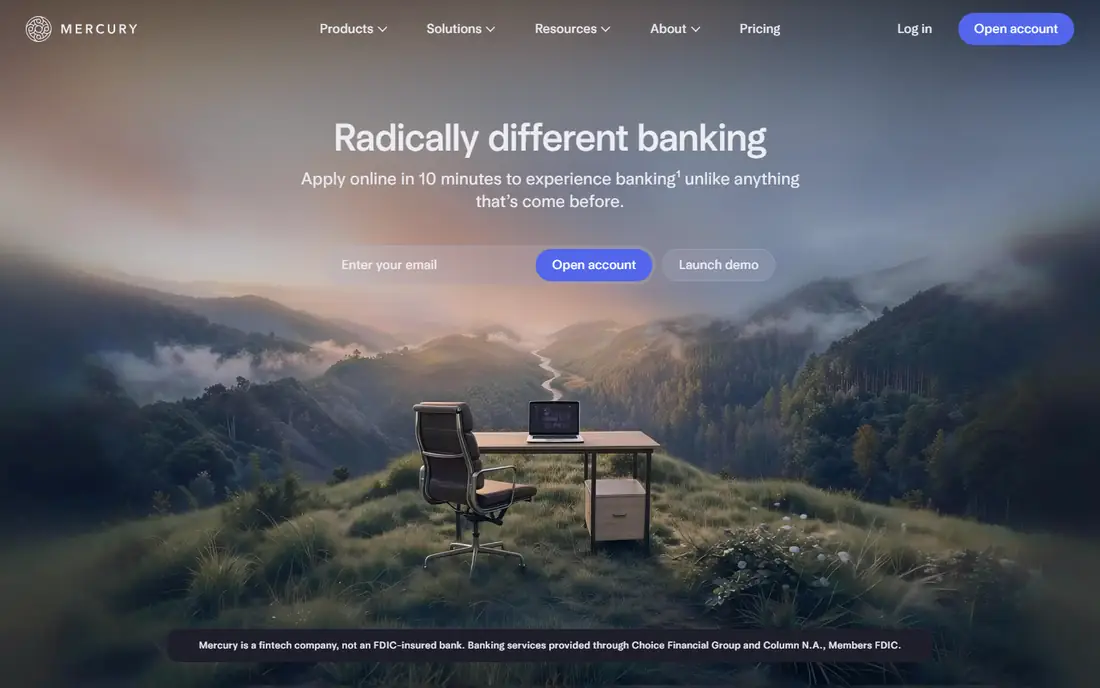
Mercury is the default pick for most LLCs and tech startups, with a free base plan, up to $5 million in FDIC coverage via an IntraFi sweep across partner banks Choice Financial Group and Column N.A., and a clean interface for digital-first businesses. Its Plus plan costs $29.90 per month and Pro $299 per month, while its Treasury product offers yield up to about 3.61 percent on idle cash but requires about $250,000 and is an investment product, not FDIC-insured.
The trade off is digital ease against cash handling. Mercury excels for online businesses, but it takes no cash deposits and its checking pays no APY. Mercury fits startups and digital-first businesses that operate online and hold larger balances.
What we like- Free base plan
- Up to $5 million FDIC coverage via partner-bank sweep
- No-fee accounts
- Integrated payments
- Accounting and payroll syncs
- Multiple checking and savings accounts under one login
Watch out for- No cash deposits
- No APY on checking, Treasury access needs about $250,000 balance
- Treasury is an investment product, not FDIC-insured
- Plus $29.90 and Pro $299 per month for advanced tiers
- Filed for its own US bank charter in late 2025, so structure may change
Starting priceFree
Free planYes
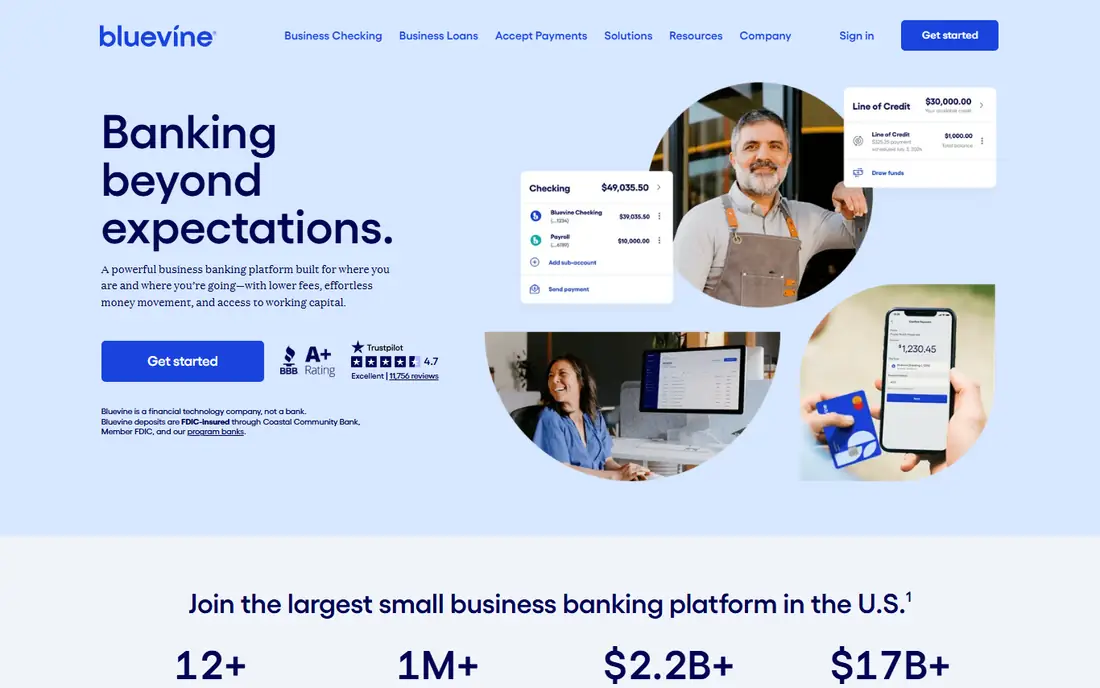
Bluevine is the yield pick for businesses sitting on operating cash, with Standard free, Plus at $30 per month or free, and Premier at $95 per month or free, plus APYs of 1.3 percent on Standard, 1.75 percent on Plus, and up to 3.0 percent on Premier for eligible balances. Its deposits sit at Coastal Community Bank, Member FDIC, with up to $3 million in coverage via an Insured Cash Sweep program, and it offers sub-accounts for smarter budgeting, integrated bill pay, and built-in ways to get paid.
The trade off is yield against tier complexity. Bluevine pays the best yield here on operating cash, but its best rates need higher tiers and eligibility, and cash deposits are limited with fees. Bluevine suits businesses with operating cash they want to earn yield on.
What we like- All-in-one small business banking
- Standard free
- 1.3 percent APY on Standard up to $250,000
- Up to 3.0 percent on Premier
- Up to $3 million FDIC coverage via Coastal Community Bank sweep
- Sub-accounts for budgeting
- Integrated bill pay
- Fast access to working capital
Watch out for- Plus $30 and Premier $95 per month, though waivable
- Cash deposits limited with fees
- APYs variable and eligibility applies
- 5 checking sub-accounts on Standard, 10 on Plus, 50 on Premier
Starting priceFree
Free planYes

Relay is the Profit First pick, built for multi-account cash management with multiple checking accounts, built-in expense controls, and automated transfers that allocate project income and tax reserves across accounts. Starter is free, Grow costs $30 per month, and Scale $120 per month, with up to 20 checking accounts for LLCs and corporations on Starter and Grow and up to 50 on Scale, plus up to 2 savings accounts on every plan. Its deposits sit at Thread Bank, Member FDIC, with up to $3 million via sweep, and pass-through insurance is subject to conditions.
The trade off is account structure against yield. Relay organizes money across accounts better than any tool here, but its savings APY trails Bluevine Premier. Relay fits businesses running Profit First or multi-account budgeting.
What we like- Multiple checking accounts, up to 20 for LLCs and corporations on Starter and Grow, up to 50 on Scale
- Built-in expense controls
- Automated percentage or dollar transfers
- Cash deposits at partner retailers
- Up to $3 million FDIC coverage via Thread Bank sweep
Watch out for- Starter savings APY lower than Bluevine Premier
- Grow $30 and Scale $120 per month
- Up to 10 checking accounts for sole proprietors on every plan
- Savings APY reports vary at 1.19 to 3.21 percent by tier
Starting priceFree
Free planYes
Novo is the solopreneur pick, offering no monthly fees, unlimited transactions, and Novo Reserves buckets for setting money aside, with integrated tools for online sellers. Its deposits sit at Middlesex Federal Savings, F.A., Member FDIC, with standard $250,000 coverage and no multi-bank sweep, and its checking pays no APY in most listings, with about 1.10 percent on select tiers.
The trade off is free simplicity against coverage and yield. Novo is free and simple, but its FDIC coverage is standard $250,000 without a sweep, and its yield is minimal. Novo fits solo founders and online sellers who want free, simple checking.
What we like- No monthly fees
- Unlimited transactions
- Novo Reserves buckets, up to 20
- Integrated tools
- Single checking account
- Good for solo founders and online sellers
Watch out for- Standard $250,000 FDIC coverage via Middlesex Federal Savings, with no multi-bank sweep
- No APY on checking in most listings, about 1.10 percent on select tiers
- Cash deposits limited at retail partners
- Single checking account, not multi-account like Relay
#5Brex
Best for: Venture-backed spend management4.8/5 on
G2 (1,643 reviews, checked Oct 2026)
Visit brex.com
Starting priceFree
Free planYes
Brex is the venture-backed pick, offering an all-in-one financial platform with business checking, treasury accounts, multi-currency support, and spend controls for teams. Essentials is free, Premium costs $12 per user per month, and Enterprise is custom, with up to $6 million in FDIC coverage via Vault sweep, though sub-checking accounts share a single $250,000 limit, and Treasury yield of up to about 3.74 percent on invested cash is not FDIC-insured. It suits VC-backed teams managing spend across a team.
The trade off is spend power against eligibility. Brex manages team spend better than rivals, but its eligibility is restricted to venture-backed companies, so non-VC businesses should look elsewhere. Brex fits venture-backed teams with spending teams.
What we like- All-in-one financial platform
- Business checking and treasury accounts
- Multi-currency support
- Up to $6 million FDIC coverage via Vault sweep
- Up to 512 sub-checking accounts under one EIN
- Spend controls and cards for teams
Watch out for- Eligibility restricted, avoid unless venture-backed
- No cash deposits
- Sub-checking accounts share a single $250,000 limit
- Treasury yield is not FDIC-insured
- Premium $12 per user per month
- Enterprise and Smart Card custom pricing
Starting priceFree
Free planYes
Rho is the mid-market pick, offering banking, corporate cards, expense management, and Bill Pay with no monthly, per-user, or minimum-balance fees, plus high-limit FDIC coverage, $0 ACH and bill pay automation, and cash management and yield tools. It is increasingly common at Series A plus startups, including AI startups with high cash burn from compute spend and large investor tranches.
The trade off is integrated finance against solo fit. Rho covers banking, cards, and expenses in one platform, but it suits funded teams better than solo founders. Rho fits mid-market and funded startups that want integrated finance.
What we like- No monthly, per-user, or minimum-balance fees across banking, corporate cards, expense management, and Bill Pay
- High-limit FDIC coverage
- $0 ACH and bill pay automation
- Cash management and yield tools
- Increasingly common at Series A plus AI startups
Watch out for- Partner bank details need checking on current disclosures
- Yield terms vary
- Less suited to solo founders than Novo
- Newer than Mercury and Brex
Starting priceFree
Free planYes
Lili is the freelancer pick, combining business banking with built-in bookkeeping, tax tools, and business credit building in one mobile platform, which suits freelancer and consulting LLCs that also need tax help. Basic is free, Pro costs $15 per month, Smart $35, and Premium $55, and it is a fintech partnered with a chartered bank, so deposits are FDIC-insured at the partner level through pass-through coverage.
The trade off is integrated tax help against team scale. Lili helps freelancers manage banking, bookkeeping, and taxes in one app, but it suits solo owners better than multi-person teams. Lili fits freelancers and solo owners who want banking plus tax tools.
What we like- All-in-one business banking plus bookkeeping and tax tools
- Integrated business credit building
- Mobile-first platform
- Basic free
- Good for freelancer and consulting LLCs
Watch out for- Pro $15, Smart $35, and Premium $55 per month
- Partner bank and FDIC sweep details need checking on current disclosures
- Less suited to multi-person teams than Mercury or Brex
- Bookkeeping tools are basic next to dedicated accounting software
#8Found
Best for: Self-employed banking plus tax tools4.4/5 on
G2 (7 reviews, checked Oct 2026)
Visit found.com
Starting priceFree
Free planYes
Found is the self-employed pick, offering banking, bookkeeping, and tax tools in one app, with virtual cards, Pockets for cash management, and integrated bookkeeping and tax tools. Basic is free, Plus costs $19.99 per month, and Pro $80 per month, and it is a fintech partnered with a chartered bank, so deposits are FDIC-insured at the partner level.
The trade off is self-employed simplicity against startup scale. Found covers banking plus taxes for the self-employed in one app, but it suits solo workers better than funded startups. Found fits self-employed users who want banking, bookkeeping, and tax tools together.
What we like- Banking, bookkeeping, and tax tools in one app
- Virtual cards
- Pockets for cash management
- Integrated bookkeeping and tax tools
- Good for self-employed users
Watch out for- Basic free, Plus $19.99 and Pro $80 per month
- Partner bank and FDIC details need checking on current disclosures
- Less suited to funded startups than Mercury or Brex
- Bookkeeping tools basic next to dedicated software
How we chose
We compared published fee schedules, APYs, and FDIC disclosures from 2026, favoring tools with distinct strengths: the best startup default, the best yield, the best multi-account budgeting, the best free solo checking, the best venture spend management, the best integrated mid-market finance, the best freelancer tax help, and the best self-employed bundle. We recorded fees and APYs as reported and flagged where APYs vary by tier and eligibility. We favored tools with a current offering and an active business user base, and we stressed partner bank checks, since most fintechs are not chartered banks themselves.
How to choose a fintech company for business banking
Start with your business type: tech startups point to Mercury, yield seekers point to Bluevine, Profit First users point to Relay, solo founders point to Novo, venture-backed teams point to Brex, mid-market teams point to Rho, and freelancers point to Lili or Found. Next, check the partner bank: confirm the named partner bank, whether coverage is standard $250,000 or extended via sweep, and whether treasury products are FDIC-insured or investment products. Then check cash needs: cash-heavy businesses need a traditional bank like Chase Business Complete with branch deposits, since most fintechs take no cash deposits. Finally, set up extended FDIC coverage before the next funding tranche lands, not after, especially for AI startups with large investor tranches above $5 million.
Frequently asked questions
What is the best fintech company for business banking?
Mercury is the default for most LLCs and startups, Bluevine is best for yield on operating cash, Relay is best for Profit First budgeting, Novo is best for free solo checking, and Brex is best for venture-backed spend management.
Are fintech banks FDIC-insured?
Most fintechs are not chartered banks themselves, so deposits sit at a partner bank and are FDIC-insured at the partner level through pass-through coverage. Check the named partner bank and sweep terms, and note that treasury and investment products are not FDIC-insured.
How much FDIC coverage do fintech business accounts offer?
It varies: Mercury offers up to $5 million via sweep, Brex Vault up to $6 million, Bluevine and Relay up to $3 million via sweep, and Novo offers standard $250,000 through its partner bank.
Can I deposit cash into a fintech business account?
Most fintechs take no cash deposits, or only limited deposits at retail partners with fees. Cash-heavy businesses should use a traditional bank with branch access, like Chase Business Complete.
Do fintech business accounts pay interest?
Some do, but APYs are variable and change with rates. Bluevine pays up to 3.0 percent on Premier, Relay pays up to 3.21 percent on Scale savings, and Mercury Treasury yields up to about 3.61 percent but is an investment product, not FDIC-insured.
Should a startup use Mercury or Brex?
Mercury suits most startups with a free base plan and $5 million sweep coverage, while Brex suits venture-backed teams managing spend, since its eligibility is restricted to funded companies.
Sources we checked (0)
Is your product missing or out of date?
We review this list regularly. Vendors can request a listing, send updated pricing or ask about featured placement.

Shihab Mia · Founder, Rankite
Shihab has 5+ years in B2B and SaaS SEO. He writes Rankite's software buying guides from pricing pages, documentation and public user reviews. More about Shihab.