How we make this list: we compare pricing pages, product documentation and public user reviews. Ratings come from G2, Capterra or Trustpilot, with the date we checked them.
Key takeaways
- Statsig is the top pick for teams that want flags, experiments and analytics in one place, with a free Developer plan and a 150 dollars per month Pro plan.
- GrowthBook is the best open source option, with a free self-hosted build that puts no cap on users, flags or experiments.
- Eppo, now Datadog Experiments, is the strongest choice for data teams that already live in a warehouse, but it is priced per launched experiment.
- Optimizely and VWO are quote only, so budget them through a sales conversation and confirm the traffic allowance in writing.
An experimentation platform is software that lets a product team release a feature behind a flag, split users into test and control groups, measure the result against real product metrics, and then roll the change out or roll it back with confidence. The difference from a simple flagging tool is the statistics layer: sample size planning, sequential testing, CUPED variance reduction, and checks for sample ratio mismatch.
Prices run from free to six figures a year, and the meter matters more than the headline number. Statsig charges 150 dollars per month for its Pro plan with 5 million events included, then 5 cents per 1,000 extra events. LaunchDarkly has no seat fee and instead charges 10 dollars per service connection per month plus 8.33 dollars per 1,000 client-side monthly active users on annual billing. Eppo, sold as Datadog Experiments, charges 450 dollars per launched experiment per month on annual billing, so a team running ten concurrent experiments pays far more than a team running two.
How do I choose between warehouse-native and hosted experimentation?
Warehouse-native platforms analyse experiments on data stored in your own warehouse, such as Snowflake, BigQuery or Databricks. Eppo and GrowthBook both work this way, and it suits teams with a mature data stack, strict data residency rules, or a single source of truth they refuse to duplicate. Hosted platforms such as Statsig and Amplitude Experiment ingest events into their own systems and return results faster for teams without a warehouse, but they add a second copy of your data and a meter you must watch. Pick warehouse-native when your analysts write SQL daily, and hosted when your team needs a first test this week.
What should product teams check before buying?
Start with the statistics engine, because a weak one produces false wins. Ask whether the platform supports sequential testing, CUPED, and sample ratio mismatch alerts, and whether it handles ratio metrics such as revenue per user without manual work. Next, check the flagging depth: targeting rules, dependencies between flags, approval workflows, and audit logs matter once more than one team ships behind flags. Pricing deserves a worked example: model your real event volume, seat count or experiment count and ask for the bill in writing.
Quick comparison
| Tool | Best for | Starting price | Free plan |
|---|
 Statsig | Product teams that want flags, experiments, analytics and session replay on one platform | $150 per month (Pro plan, checked 20 Nov 2026; Developer free with 2M events per month, then $0.05 per 1,000 events above 5M on Pro) | Developer free, 2M events per month, unlimited seats and flag checks, 50,000 session replays per month, no credit card required |
 Eppo | Data teams that run experiments on warehouse data and want rigorous statistics | $450 per launched experiment per month billed annually ($575 on demand, checked 20 Nov 2026) | None, 14-day Datadog trial only |
 Split | Engineering teams that want strong impact analysis tied to feature flags | Quote only (Teams reported at $33 per seat per month; Harness publishes no dollar figure, checked 20 Nov 2026) | Free plan with up to 10 seats, 50 feature flags, basic targeting and 2 environments |
 LaunchDarkly | Engineering teams that need release control, approvals and guardrails at scale | $10 per service connection per month billed annually, plus $8.33 per 1,000 client-side monthly active users (Foundation, pay as you go, checked 20 Nov 2026) | Developer free, unlimited seats and flags, 5 service connections, 1,000 client-side MAU, 100,000 experimentation MAU, 1 project, 3 environments |
 Amplitude Experiment | Product teams that already use Amplitude analytics and want experiments in the same place | $0 per month (Plus starts at $0 with the first 2M events free, then scales with event volume; checked 20 Nov 2026) | Free plan, 2M events per month, 10,000 session replays, unlimited feature flags, 1 active experiment, unlimited seats, no credit card required |
 Optimizely | Large enterprises that want experimentation inside a full digital experience platform | Quote only (vendor publishes no list price; third-party reports put paid plans from around $36,000 per year, checked 20 Nov 2026) | Rollouts free plan, unlimited feature flags, one A/B test, one project, up to 50,000 monthly active users |
 GrowthBook | Teams that want an open source core, warehouse-native analysis and no per-seat tax on the free build | $40 per seat per month (Pro cloud plan, checked 20 Nov 2026; self-hosted open source build free) | Open source self-hosted build free with unlimited users, flags, experiments and traffic; Cloud Starter free for up to 3 users and 1 project |
 VWO | Teams that want web testing, insights and personalization from one vendor | Quote only (vendor page lists no prices; Testing Growth reported from $314 per month billed annually, checked 20 Nov 2026) | Starter free tier being phased out for new accounts; new sign-ups receive a 30-day free trial instead |
Is your product missing or out of date?
We review this list regularly. Vendors can request a listing, send updated pricing or ask about featured placement.
These eight tools cover the full range of product experimentation, from free open source builds to enterprise suites. Each entry gives the starting price checked on 20 November 2026, the free plan, and one real drawback.
#1Statsig
Best for: Product teams that want flags, experiments, analytics and session replay on one platform4.7/5 on
G2 (348 reviews, checked Oct 2026)
Visit statsig.com
Starting price$150 per month (Pro plan, checked 20 Nov 2026; Developer free with 2M events per month, then $0.05 per 1,000 events above 5M on Pro)
Free planDeveloper free, 2M events per month, unlimited seats and flag checks, 50,000 session replays per month, no credit card required
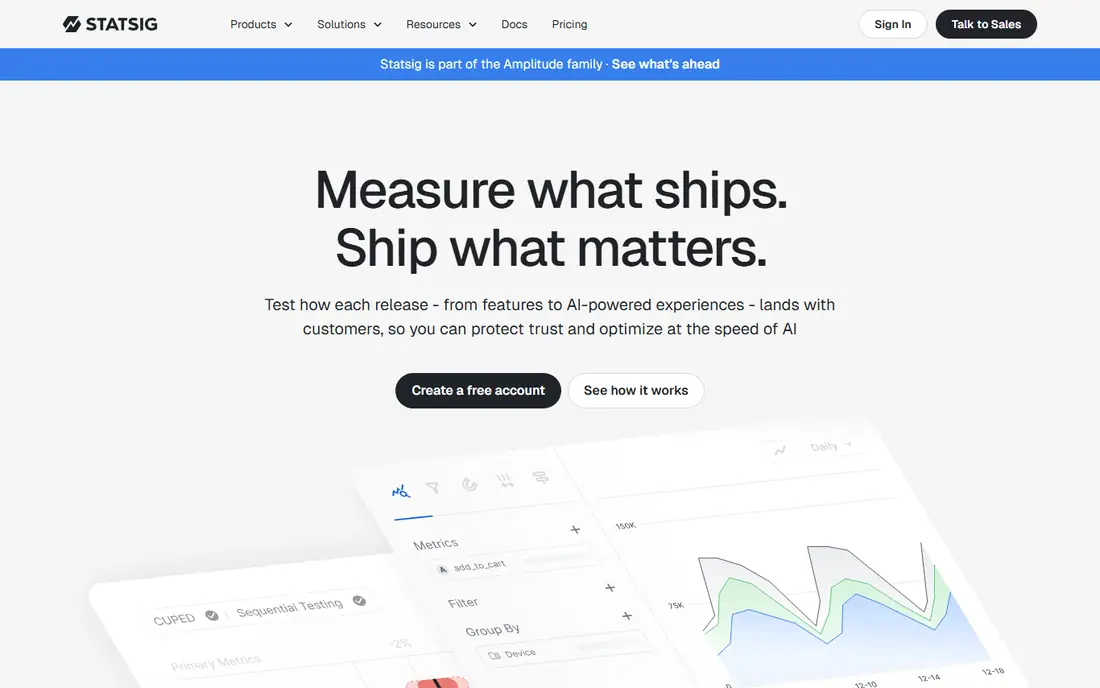
Statsig bundles feature flags, experiments, dynamic configs, product analytics and session replay under one account and one event meter. Flag and config checks are unlimited on every plan, so a team that only gates features can stay on the free Developer plan for a long time. The Pro plan at 150 dollars a month adds advanced experimentation, change reviews and approvals, and unlimited retention. Ownership needs checking: OpenAI announced a Statsig acquisition in September 2025, while 2026 sources describe it as run by Amplitude, so confirm the owner before signing.
What we like- Published flat pricing with no seat fees, unlimited flag and config checks on every plan, advanced statistics and session replay included
Watch out for- Event metering makes bills hard to forecast at scale, and the free plan stops metric lift calculations once the 2M event allowance is passed
#2
Eppo
Best for: Data teams that run experiments on warehouse data and want rigorous statistics
Visit datadoghq.com
Starting price$450 per launched experiment per month billed annually ($575 on demand, checked 20 Nov 2026)
Free planNone, 14-day Datadog trial only
Eppo is now Datadog Experiments. Datadog announced the acquisition of Eppo in May 2025 and relaunched the product as Datadog Experiments in April 2026. An experiment becomes billable only after 500 subjects and three days of data, and each one includes unlimited seats, users and metrics plus 1 million monthly flag configuration requests. One conflict: a third-party read puts the month-to-month rate at 530 dollars per launched experiment, against 575 dollars on demand from the vendor page, so confirm the rate in writing.
What we like- Warehouse-native analysis with sequential testing, CUPED and sample ratio mismatch checks built in, unlimited seats and metrics per experiment
Watch out for- Per-experiment pricing adds up fast for teams running many concurrent tests, and there is no free plan and no visual editor
#3
Split
Best for: Engineering teams that want strong impact analysis tied to feature flags
Visit split.io
Starting priceQuote only (Teams reported at $33 per seat per month; Harness publishes no dollar figure, checked 20 Nov 2026)
Free planFree plan with up to 10 seats, 50 feature flags, basic targeting and 2 environments
Split was acquired by Harness and is now sold as Harness Feature Management and Experimentation, often shortened to Harness FME. The platform pairs feature flags with experiment analysis, including impact analysis that ties a flag change to business metrics. Third-party comparisons consistently report a Teams plan at 33 dollars per seat per month and a custom Enterprise plan. A separate November 2026 pricing read states that Split publishes no dollar figure at all, which conflicts with the 33 dollars figure, so treat the Teams price as reported and get a written quote.
What we like- Strong impact analysis with frequentist and Bayesian inference, local evaluation mode in SDKs for low-latency flag checks, broad analytics integrations
Watch out for- The free tier caps at 50 flags and 10 seats, which is restrictive for larger teams, and paid pricing is not published by the vendor
#4LaunchDarkly
Best for: Engineering teams that need release control, approvals and guardrails at scale4.5/5 on
G2 (882 reviews, checked Oct 2026)
Visit launchdarkly.com
Starting price$10 per service connection per month billed annually, plus $8.33 per 1,000 client-side monthly active users (Foundation, pay as you go, checked 20 Nov 2026)
Free planDeveloper free, unlimited seats and flags, 5 service connections, 1,000 client-side MAU, 100,000 experimentation MAU, 1 project, 3 environments
LaunchDarkly is a runtime control plane for feature management, experiments and AI agent configuration. Foundation is pay as you go with no seat fees: the first 5 service connections are included, then each extra connection costs 10 dollars a month on annual billing, and client-side monthly active users cost 8.33 dollars per 1,000 on annual billing. One conflict to flag is the MAU rate: the vendor page shows 8.33 dollars per 1,000 on annual billing and 10 dollars per 1,000 in the monthly billing table, so confirm which rate your contract uses.
What we like- No seat or platform fees, sub-second flag updates through streaming, broad SDK coverage with more than 30 SDKs
Watch out for- The bill follows your architecture, so every replica, worker and environment adds a service connection, and the vendor page itself lists two different MAU rates
#5
Amplitude Experiment
Best for: Product teams that already use Amplitude analytics and want experiments in the same place
Visit amplitude.com
Starting price$0 per month (Plus starts at $0 with the first 2M events free, then scales with event volume; checked 20 Nov 2026)
Free planFree plan, 2M events per month, 10,000 session replays, unlimited feature flags, 1 active experiment, unlimited seats, no credit card required
The Free plan includes 2 million events a month, unlimited feature flags, web experimentation and one active experiment. The Plus plan starts at 0 dollars with the first 2 million events free, then scales with volume; third-party reads put it at 75 dollars a month billed annually at 3 million events, 225 dollars at 5 million and 576 dollars at 10 million. One conflict to note is the Plus entry price: an archived Amplitude pricing page showed Plus from 49 dollars a month, while the current page says it starts at 0 dollars, so the price moved during 2026 and the current page governs.
What we like- Experiments sit next to product analytics, session replay and activation in one platform, with unlimited seats on every plan
Watch out for- Full feature experimentation is an add-on on Growth and Enterprise, and the free plan allows only one active experiment
#6
Optimizely
Best for: Large enterprises that want experimentation inside a full digital experience platform
Visit optimizely.com
Starting priceQuote only (vendor publishes no list price; third-party reports put paid plans from around $36,000 per year, checked 20 Nov 2026)
Free planRollouts free plan, unlimited feature flags, one A/B test, one project, up to 50,000 monthly active users
Optimizely is the long-standing enterprise experimentation platform, now sold as part of a digital experience platform that also includes an agentic CMS, commerce, personalization and a customer data platform. Experimentation splits into Web Experimentation, the client-side product with a visual editor, and Feature Experimentation, the server-side SDK-based product for product teams. Third-party buyer reports put standalone Web Experimentation from around 36,000 to 80,000 dollars a year, with a Vendr median of 81,447 dollars a year across 126 purchases. Implementation, training and staffing often add 35 to 50 percent to the first-year license cost.
What we like- Mature experimentation engine with web and feature experimentation, plus CMS, commerce and personalization on the same platform
Watch out for- Pricing is fully opaque with no public price list, and each product is sold separately, so the total contract grows with every module added
#7GrowthBook
Best for: Teams that want an open source core, warehouse-native analysis and no per-seat tax on the free build4.6/5 on
G2 (26 reviews, checked Oct 2026)
Visit growthbook.io
Starting price$40 per seat per month (Pro cloud plan, checked 20 Nov 2026; self-hosted open source build free)
Free planOpen source self-hosted build free with unlimited users, flags, experiments and traffic; Cloud Starter free for up to 3 users and 1 project
GrowthBook is an open source feature flagging and experimentation platform that analyses results against data already in your warehouse, including BigQuery, Snowflake and Postgres. The cloud Starter plan is free for up to 3 users and 1 project with unlimited flags and experiments. Pro costs 40 dollars per seat per month and adds the AI visual editor, multi-armed bandits, safe rollouts, customisable dashboards and premium support. One conflict: the vendor page lists Pro at up to 30 users in one read, while a third-party summary lists up to 50, so confirm the cap before buying.
What we like- Open source core under the MIT licence, warehouse-native analysis on your own data, unlimited flags, experiments and traffic on every plan
Watch out for- Advanced features such as the visual editor, multi-armed bandits, safe rollouts and approval workflows sit behind paid plans even when you self-host
#8VWO
Best for: Teams that want web testing, insights and personalization from one vendor4.4/5 on
G2 (929 reviews, checked Oct 2026)
Visit vwo.com
Starting priceQuote only (vendor page lists no prices; Testing Growth reported from $314 per month billed annually, checked 20 Nov 2026)
Free planStarter free tier being phased out for new accounts; new sign-ups receive a 30-day free trial instead
VWO, short for Visual Website Optimizer, is a digital experience optimization platform that covers A/B testing, split URL tests, multivariate testing, personalization and insights. Its visual editor suits teams testing pages, while the FullStack module adds server-side testing for engineering teams. Third-party reports put Testing Growth from 314 dollars a month billed annually at 10,000 tracked users and 665 dollars at 100,000, with Pro at 972 dollars at 100,000, but those figures were captured in-app, not published on the public pricing page. VWO merged with AB Tasty in January 2026, and the combined company launched as Wingify in September 2026, with vwo.com/pricing now redirecting to wingify.com/pricing, which lists plans without prices.
What we like- Visual editor and multivariate testing with heatmaps, recordings and surveys available in the same platform, plus server-side testing through the FullStack module
Watch out for- Modules are billed separately, so heatmaps, personalization and feature flags each add to the bill, and the free Starter tier is being discontinued
Use this table for a quick scan, then read the full entries above.
| Tool |
Starting price |
Free plan |
Best for |
| Statsig |
$150 per month (Pro) |
Developer free, 2M events |
Flags, experiments and analytics in one place |
| Eppo |
$450 per launched experiment, annual billing |
None, 14-day trial |
Warehouse-native statistics for data teams |
| Split |
Quote only, Teams reported at $33 per seat |
Free, up to 10 seats, 50 flags |
Impact analysis tied to feature flags |
| LaunchDarkly |
$10 per service connection, plus $8.33 per 1,000 MAU |
Developer free |
Release control and guardrails at scale |
| Amplitude Experiment |
$0 per month, Plus starts at $0 |
Free, 2M events, 1 experiment |
Experiments inside Amplitude analytics |
| Optimizely |
Quote only, reported from $36,000 per year |
Rollouts free, 1 A/B test |
Enterprise experimentation in a DXP |
| GrowthBook |
$40 per seat (Pro cloud), self-hosted free |
Open source self-hosted free |
Open source warehouse-native testing |
| VWO |
Quote only, Growth reported from $314 per month |
Starter free tier being phased out |
Web testing with insights and personalization |
Frequently asked questions
What is the difference between feature flags and experimentation?
Feature flags control who sees a feature, while experimentation measures whether that feature changes a metric. A flag can roll a feature out to 10 percent of users with no measurement at all, which is useful for a safe release but tells you nothing about impact. An experiment adds random assignment, a control group, a statistics engine and guardrail metrics, so the team can say whether the change caused the result.
Do I need a data warehouse to run experiments?
No, but it helps at scale. Hosted platforms such as Statsig and Amplitude Experiment ingest events into their own systems, so a team without a warehouse can launch a first test quickly. Warehouse-native platforms such as Eppo and GrowthBook analyse data already in your warehouse, which suits teams with a mature data stack and strict residency rules.
How many experiments should a product team run at once?
The honest answer depends on traffic, not ambition. Each experiment needs enough users to reach a reliable result, so a low-traffic product may only support one or two tests at a time, while a high-traffic product can run dozens. Per-experiment pricing makes this a budget question too: on Eppo, ten concurrent experiments cost ten times one, while on Statsig or GrowthBook the experiment count does not drive the bill directly.
Can a small team use an enterprise experimentation platform?
Yes, but the price and the setup effort often argue against it. Optimizely and VWO are built for large organisations, with quote-only pricing and sales-led onboarding, so a small team usually pays for capacity it never uses. Statsig, GrowthBook and LaunchDarkly all offer free plans that a small team can run for months, and GrowthBook self-hosted costs nothing for the software itself.
What is the biggest mistake teams make when buying an experimentation platform?
The biggest mistake is comparing starting prices without comparing meters. A 150 dollar per month plan that meters events, a 40 dollar per seat plan, and a 450 dollar per experiment plan produce very different bills at the same company, and the cheapest headline often becomes the most expensive contract. Model your real event volume, seat count, service connections and concurrent experiment count, then ask each vendor for the bill in writing.
How we picked
We picked these eight tools because they cover the main ways product teams run experiments: hosted platforms, warehouse-native platforms, open source builds, and enterprise suites. We checked starting prices against vendor pricing pages and current third-party reads on 20 November 2026, and we flagged every conflict we found in the entries above. Prices are search-verified; homepages were not individually opened, so confirm the price before you buy.
Last verified: 20 November 2026
Sources we checked (8)
- https://www.statsig.com/pricing
- https://www.datadoghq.com/about/latest-news/press-releases/datadog-experiments-launches/
- https://www.split.io
- https://launchdarkly.com/pricing
- https://amplitude.com/pricing?siteLocation=nav
- https://www.optimizely.com/plans
- https://www.growthbook.io/pricing?ref=blog.growthbook.io
- https://www.wingify.com/pricing
Is your product missing or out of date?
We review this list regularly. Vendors can request a listing, send updated pricing or ask about featured placement.

Shihab Mia · Founder, Rankite
Shihab has 5+ years in B2B and SaaS SEO. He writes Rankite's software buying guides from pricing pages, documentation and public user reviews. More about Shihab.