How we make this list: we compare pricing pages, product documentation and public user reviews. Ratings come from G2, Capterra or Trustpilot, with the date we checked them.
Key takeaways
- Airalo is the default: the widest catalogue at 200 plus countries, fixed data packages from about 4.50 dollars per GB, and an app that makes a first eSIM painless.
- Holafly sells simplicity instead: unlimited data by the day in most destinations, priced per day, with fair use limits in the fine print.
- Nomad and Maya Mobile compete on price per trip, while Saily adds security extras from the team behind NordVPN.
- Two checks before any purchase: your phone must support eSIM, and it must not be carrier locked, because a locked phone cannot use a travel eSIM at all.
Quick comparison
| Tool | Best for | Starting price | Free plan |
|---|
 Airalo | Widest coverage, simple first eSIM | See website | No |
 Holafly | Unlimited data by the day | See website | No |
 Nomad | Budget per GB rates and sales | See website | No |
 Saily | Security extras and a clean app | See website | No |
 Ubigi | Japan, the US and long stays | See website | No |
 Maya Mobile | Cheap unlimited plans | See website | No |
 aloSIM | Credit that never expires quickly | See website | No |
 GigSky | Cruises, crews and offshore coverage | See website | No |
Is your product missing or out of date?
We review this list regularly. Vendors can request a listing, send updated pricing or ask about featured placement.
The best eSIM apps for international travel
Starting priceSee website
Free planNo
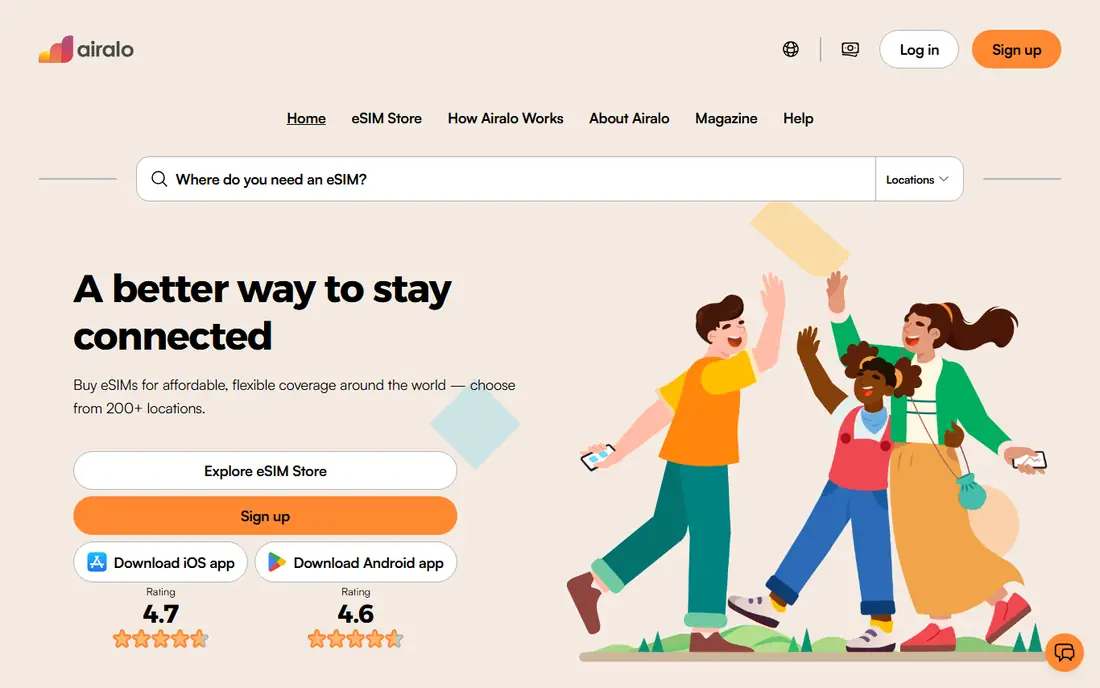
Airalo is where most travellers should start. The catalogue depth means one app covers a lifetime of varied trips, and the regional bundles solve the classic multi country problem, one eSIM for a whole European or Asian loop.
Its pricing is mid market rather than cheapest, which is the honest trade for the catalogue and the app quality. Price the same trip on Nomad before a long stay; buy Airalo for breadth and simplicity.
What we like- Airalo is the biggest travel eSIM store: local packages for more than 200 countries, regional bundles for trips crossing borders, and global packages, mostly fixed data from 1 GB up, with entry prices around 4.50 dollars per GB in cheaper destinations. The app handles purchase, install and top up in one flow, tracks your remaining data, and warns before you run dry. Its loyalty scheme returns a little credit on each purchase. For a first time eSIM buyer, the process is the most polished here, and support runs in several languages.
Watch out for- Fixed packages expire whether or not you used the data, and popular destinations cost more per GB than budget rivals. Some local packages are data only with hotspot restrictions that vary by partner. Speeds depend on the local partner network, which Airalo does not control. Refunds on an installed eSIM are limited, so check your phone's compatibility before paying, not after.
Starting priceSee website
Free planNo
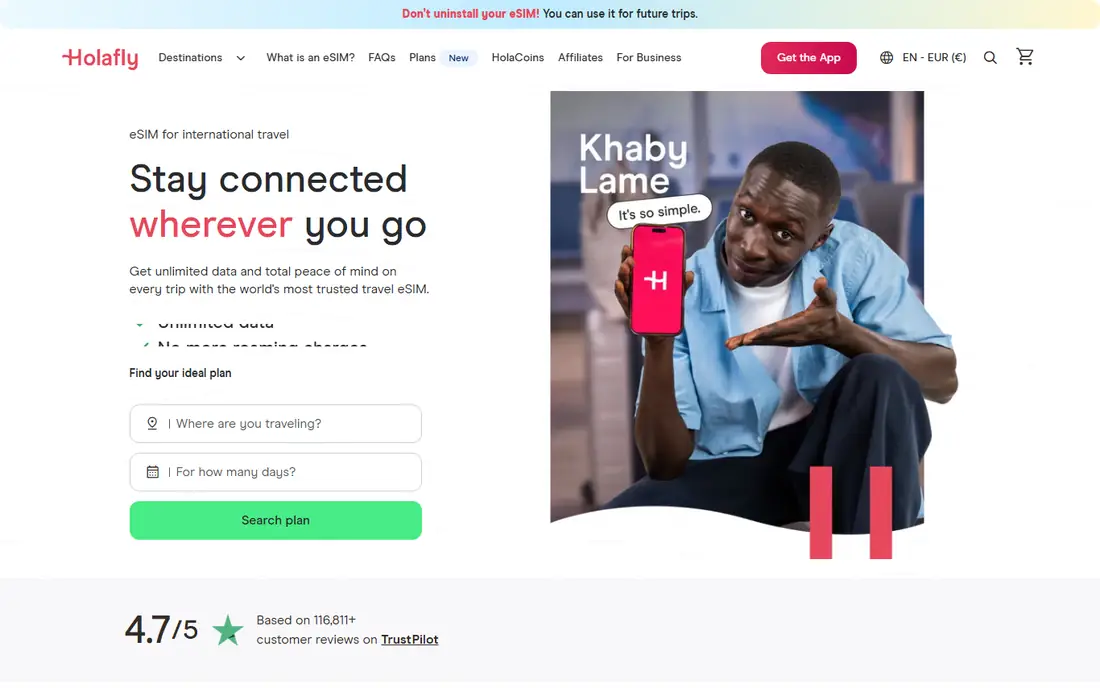
Holafly is the peace of mind purchase. If your travel style is maps all day, uploads all evening and no interest in data meters, paying by the day is rational, and its support reputation is the strongest here.
If you are a light user on a long trip, the same money buys months of fixed data elsewhere. Match the pricing shape to your usage shape, not to the headline word unlimited.
What we like- Holafly sells the opposite shape: unlimited data priced by the day, from a few dollars a day in many destinations, across more than 170 countries, so a heavy user never counts gigabytes. Setup is app led, support runs around the clock in several languages, and the company leans into traveller service with extras such as a monthly always on backup plan on some products. For streamers, remote workers on holiday and families sharing a hotspot where allowed, the flat daily shape removes data anxiety entirely.
Watch out for- Unlimited has an asterisk everywhere in this market: fair use policies can slow heavy users, and Holafly's terms allow speed management even where a daily allowance is not published, so very heavy daily use is not truly uncapped. Hotspot and tethering are restricted on many plans, which matters if a laptop depends on your phone. Per day pricing makes a long, light trip expensive compared with a fixed package. No phone number is included.
Starting priceSee website
Free planNo
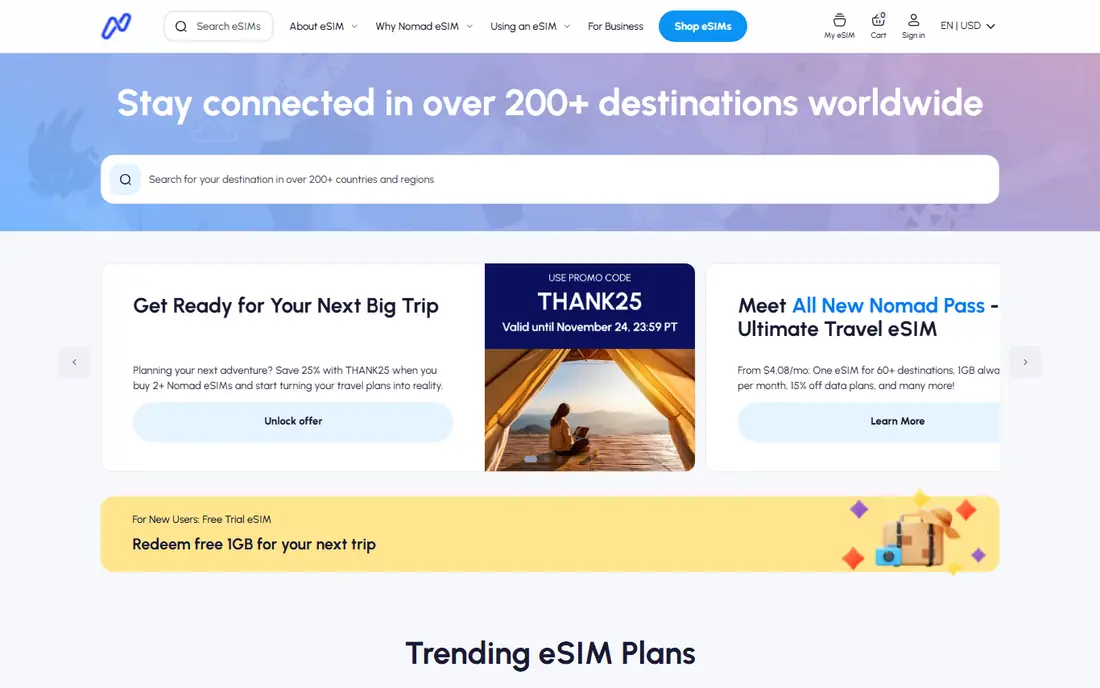
Nomad is the value hunter's Airalo: most of the same experience, sharpened prices, slightly thinner catalogue. On long stays in Asia it regularly wins the comparison by real money.
Buy it during its frequent sales for trips you have already booked. At full price on a common route, compare both apps in the same ten minutes; this market reprices constantly.
What we like- Nomad competes on per GB value, often the lowest of the big names in Asia and on sale routes, with local plans across more than 100 destinations and global plans that reach further in two tiers, a standard global and a wider Global EX with longer validity. The app is clean, installation is straightforward, and its regular promotions reward travellers who buy a few weeks ahead. Daily full speed allowances on its unlimited plans are published rather than hidden, which is the honest way to sell them.
Watch out for- Coverage depth trails Airalo in less visited countries, and the global plan split takes a minute to understand. Customer support is chat and ticket based and can lag at peak times. As with all fixed plans, unused data expires. Prices outside sale periods narrow the gap with Airalo considerably.
Starting priceSee website
Free planNo
Saily fits the traveller who already lives in the Nord world or who likes one app watching both data and basic security on public networks. The eSIM itself is competitive; the bundle is the differentiator.
If you need neither VPN nor extras, Nomad and Airalo compete purely on data price and coverage, and Saily's case weakens to its app's polish, which is real but not decisive.
What we like- Saily comes from Nord Security, the team behind NordVPN, and it shows in the extras: built in security features such as virtual location and ad and tracker blocking options sit inside the eSIM app, and an Ultra plan bundles wider Nord services for heavy travellers. Coverage passes 150 countries with fixed plans and unlimited options in many markets, priced from around 3.99 dollars per GB in comparison listings. The app is among the cleanest here, and installation is a tap rather than a QR hunt.
Watch out for- The security extras are nice rather than necessary, and the Ultra bundle only pays if you use the wider suite. Coverage trails Airalo. Unlimited plans have daily full speed allowances like everyone else's. As a younger brand its long haul track record is shorter than the pioneers', and prices in some destinations run higher than Nomad's.
Starting priceSee website
Free planNo
Ubigi is the connoisseur's pick for its strongholds. Japan travellers in particular will find its local network access and pricing hard to beat, and frequent US visitors can hold a recurring plan instead of rebuying each trip.
For a one off holiday elsewhere, the bigger stores are simpler. Judge Ubigi destination by destination, which is how its pricing is built anyway.
What we like- Ubigi, run by Transatel, part of NTT, is an infrastructure player rather than a reseller startup, and it shows in network quality in its strong regions: it is a favourite for Japan, where it connects to a top tier local network, and for the US, with plans that include Hawaii and Puerto Rico. Its range includes monthly and annual style plans for frequent travellers and expats, not only one trip packages, and it powers connected car services for several car brands, which says something about its carrier relationships. The app and account model suit repeat use.
Watch out for- The catalogue is narrower than Airalo's and the shopping experience less playful
- Comparing its plan types takes more reading. Some regions price above the budget names. Alaska is excluded from its USA plans, a detail road trippers should note. Support and community content are thinner than Holafly's traveller machine.
Starting priceSee website
Free planNo
Maya is the price check that keeps the famous names honest. Before paying Holafly for an unlimited month, price the same trip on Maya; in the US market the difference has recently been tens of dollars.
What you give up is catalogue breadth and the big brands' support machinery. On a mainstream route, that trade is often worth it.
What we like- Maya Mobile has built a following by undercutting the famous names on unlimited plans: in current US comparisons its unlimited weekly and monthly prices undercut Airalo, Ubigi and Holafly, and it sells fixed plans alongside for light users. Coverage spans the main travel destinations, the app is simple, and its plans are sold plainly by days and data rather than through bundles and credits. For a heavy data trip to a covered country, the savings against Holafly can be substantial.
Watch out for- The brand and support operation are smaller, and coverage depth beyond the main destinations is thinner than Airalo's. Unlimited plans carry fair use limits like all rivals. Traveller review volume is lower, so there is less community evidence on odd routes. It lacks the regional bundle breadth of the biggest stores.
Starting priceSee website
Free planNo
aloSIM suits the repeat short trip traveller who wants a balance waiting in the app and clear usage data. Its fixed packages are the sensible buy; treat its unlimited tiers with the most care on this list.
As with every provider, the destination matters more than the logo. Price your exact country and dates before the brand debate starts.
What we like- AloSIM runs on a credit model: top up a balance and buy packages from it, with the app showing live data usage clearly, local and regional packages across a wide country list, and occasional bundled phone number options through its sister services. It publishes its unlimited fair use terms unusually plainly in comparison coverage, including where a plan slows after a daily allowance. Prices on fixed packages are competitive, and the app suits travellers who make several shorter trips a year and prefer one wallet.
Watch out for- That plain speaking exposes a hard case: at least one of its unlimited plans throttles to a near stop after the daily allowance, so read the specific plan's terms before buying unlimited here. Coverage and partner quality vary by country as everywhere. The credit model adds a step compared with buying a package outright. Support is a smaller operation than Holafly's.
Starting priceSee website
Free planNo
GigSky is the specialist for the edges of the map. If your travel includes ships, rigs or crew rosters, it may be the only entry here that follows you.
Everyone else should buy it the normal way, by pricing their destination against Airalo and Nomad and letting the numbers speak.
What we like- GigSky has operated since the early eSIM era and covers the places others do not: maritime and cruise coverage, offshore and airline crew plans, and land packages across a broad country list, sold through its app with pay as you go and subscription options. It has a long history with enterprise and aviation customers, and its cruise ship data, while never cheap, solves a problem the other seven barely touch. Land pricing is competitive on many routes.
Watch out for- Cruise and maritime data is expensive across the industry and GigSky is no exception
- Per megabyte thinking applies at sea. The consumer app and marketing are quieter than rivals, so community guidance is thinner. Fixed land plans face the same expiry rules as everyone. For an ordinary city holiday, the big stores offer a smoother first experience.
How we chose
We picked eSIM providers a traveller can buy from in October 2026 that sell through an app, cover at least the main travel destinations, and publish their plan terms, including fair use rules where unlimited is claimed. We weighted network partnerships and pricing shape, fixed versus daily unlimited, because those decide real trip cost more than headline per GB figures. Per country prices change constantly, so entries say see website. No provider was hands on tested for this guide; judgements rest on vendor plan pages and current comparison reporting, including published fair use comparisons.
How to buy the right eSIM for a trip
Check the phone first. You need an eSIM capable handset, and it must not be carrier locked; a phone still tied to a carrier contract usually cannot install a travel eSIM, and no app purchase fixes that. Confirm in your settings or with your carrier before you pay anyone.
Then estimate your real usage. Maps, messaging and browsing use roughly 1 to 3 GB a week. Video calls and uploads multiply that fast. Light users should buy fixed packages from Airalo, Nomad or Maya; heavy users should compare daily unlimited from Holafly and Maya and read the fair use line, because the daily full speed allowance is the real product.
Buy and install on home wifi the day before you fly, activate on landing, and keep your home SIM active for bank texts and calls. That order avoids the airport wifi scramble that gives eSIMs a bad name they do not deserve.
Frequently asked questions
Will a travel eSIM work in my phone?
If your phone supports eSIM, iPhone XS and later, most Samsung Galaxy S20 and later models, and Google Pixel 3 and later, and it is not carrier locked, yes. The carrier lock is the catch that stops people most often: a phone bought on a carrier plan may refuse other networks' eSIMs until the carrier releases it. Every app here has a compatibility checker; run it before paying.
Can I keep my phone number with an eSIM?
Yes, in the way that matters. Travel eSIMs are usually data only, and your home SIM stays active alongside for calls and texts on your normal number, including bank verification codes. Set the eSIM as the data line and the home SIM as the voice line in your settings. Watch home carrier charges for any calls you actually make or receive abroad.
Is unlimited eSIM data really unlimited?
Not at full speed. Every unlimited plan here operates a fair use policy, typically a daily allowance of full speed data, often a few gigabytes, after which speeds drop until the next day. Some providers publish the allowance plainly, as Airalo, Nomad and Saily do in current comparisons; others keep it vaguer. Heavy users should compare the daily allowance, not the word unlimited.
When should I install the eSIM?
Buy and install it on wifi before you travel, usually the day before, and switch it on when you land. Most plans start their validity clock on first connection to a network abroad, but a few start at installation, so read your plan's activation line. Installing early turns landing into a two tap job instead of an airport project.
Is an eSIM cheaper than roaming or a local SIM?
Against home carrier roaming, almost always, often by a factor of ten. Against a local physical SIM bought in country, prices are now close in many destinations, and the eSIM wins on time and on keeping your home number reachable. In the cheapest data countries a local SIM can still win on price for a long stay; for a one or two week trip, the apps here are the sensible default.
Sources we checked (0)
Is your product missing or out of date?
We review this list regularly. Vendors can request a listing, send updated pricing or ask about featured placement.

Shihab Mia · Founder, Rankite
Shihab has 5+ years in B2B and SaaS SEO. He writes Rankite's software buying guides from pricing pages, documentation and public user reviews. More about Shihab.