How we make this list: we compare pricing pages, product documentation and public user reviews. Rankite is independent; if a vendor ever pays for a featured spot, that listing is clearly labeled Partner.
Key takeaways
- Substack is free to start but takes 10% of paid revenue, which gets expensive fast once you grow.
- beehiiv and Kit are the two serious picks for creators who want growth tools and monetization built in.
- Ghost is the only option here that lets you fully own the platform, with self-hosting free and managed hosting from $18 a month.
- If your list is small and your budget is zero, EmailOctopus and MailerLite have the most generous free tiers.
Quick comparison
| Tool | Best for | Starting price | Free plan |
|---|
 Substack Substack | Writers who want a built-in reader network | Free (10% of paid subscription revenue, plus payment processing) | Yes |
 beehiiv beehiiv | Newsletter-first publishers focused on growth | $49 per month (Lite plan) | Yes |
 Kit Kit | Creators selling products through email | $33 per month (Creator plan, billed annually) | Yes |
 Ghost Ghost | Publishers who want full ownership | $18 per month (Starter plan, billed annually) | No |
 MailerLite MailerLite | Budget senders who want clean design | $12 per month | Yes |
 Buttondown Buttondown | Minimalist newsletters and technical writers | $9 per month | Yes |
 Mailchimp Mailchimp | Small businesses already in its ecosystem | $13 per month | Yes |
 Flodesk Flodesk | Design-led creators who hate per-subscriber math | $25 per month (Lite plan, up to 1,000 subscribers) | No |
 EmailOctopus EmailOctopus | The cheapest way to send to a real list | $9 per month (Pro plan, billed annually) | Yes |
Is your product missing or out of date?
We review this list regularly. Vendors can request a listing, send updated pricing or ask about featured placement.
Starting priceFree (10% of paid subscription revenue, plus payment processing)
Free planYes
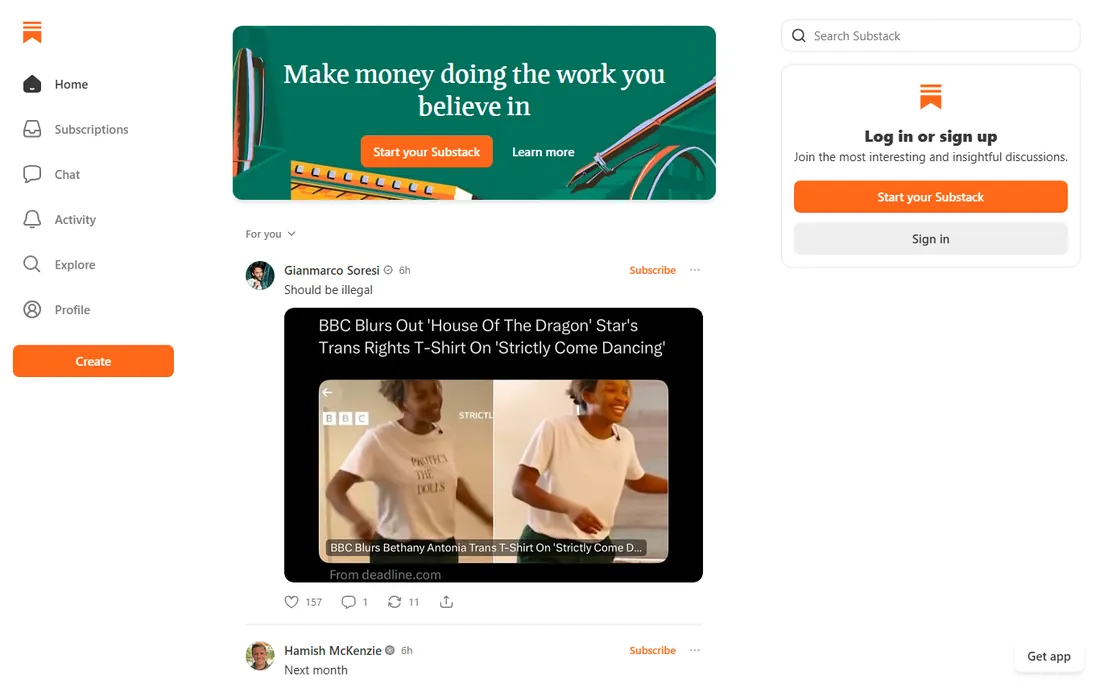
Picture a columnist who wants to write, charge $8 a month, and never think about software. That person should be on Substack. Publishing is genuinely free, paid subscriptions take minutes to enable, and the network effect is real: readers discover your publication through recommendations inside the Substack app and other writers' newsletters. For a solo writer, no other platform gets you from idea to paying subscribers this fast.
The price of that simplicity arrives later. Substack takes 10% of your paid subscription revenue on top of Stripe's processing fees, so a newsletter earning $5,000 a month hands over $500 plus fees. Design options are deliberately narrow, and the platform owns the reader relationship in ways that make leaving hard. Substack is the right call when your priority is writing and discovery today, not ownership and margins tomorrow.
What we like- Free to start with no subscriber limits
- Built-in discovery through the Substack network and recommendations
- Simplest path from zero to paid subscriptions
Watch out for- The 10% revenue cut is steep once you earn real money
- Limited design and branding control
- Migrating your audience away later is painful by design
Starting price$49 per month (Lite plan)
Free planYes
beehiiv was built by newsletter people for newsletter people, and every part of the product shows it. The free plan is unusually generous at 2,500 subscribers with unlimited sends. When you are ready to monetize, the ad network, paid recommendations and referral program are native rather than bolted on, and beehiiv takes 0% of your paid subscription revenue. That single number is the pitch against Substack: keep everything you earn.
The catch is the entry price once you outgrow free. Lite starts at $49 a month, and costs climb with your list, so a mid-size publication pays real money. It is also a specialist: if you need landing pages, SMS, a CRM and webinars in one account, look at Kit or GetResponse instead. For a publication whose product is the newsletter itself, beehiiv is the most complete growth machine here.
What we like- Free tier covers up to 2,500 subscribers with unlimited sends
- Built-in ad network, paid recommendations and referral program
- 0% platform fee on paid subscriptions
Watch out for- The Lite plan starts at $49 a month, which stings for small lists
- Fewer general marketing features than Mailchimp
- The platform is newsletter-only, not a full marketing suite
#3
Kit
Best for: Creators selling products through email
Visit kit.com
Starting price$33 per month (Creator plan, billed annually)
Free planYes
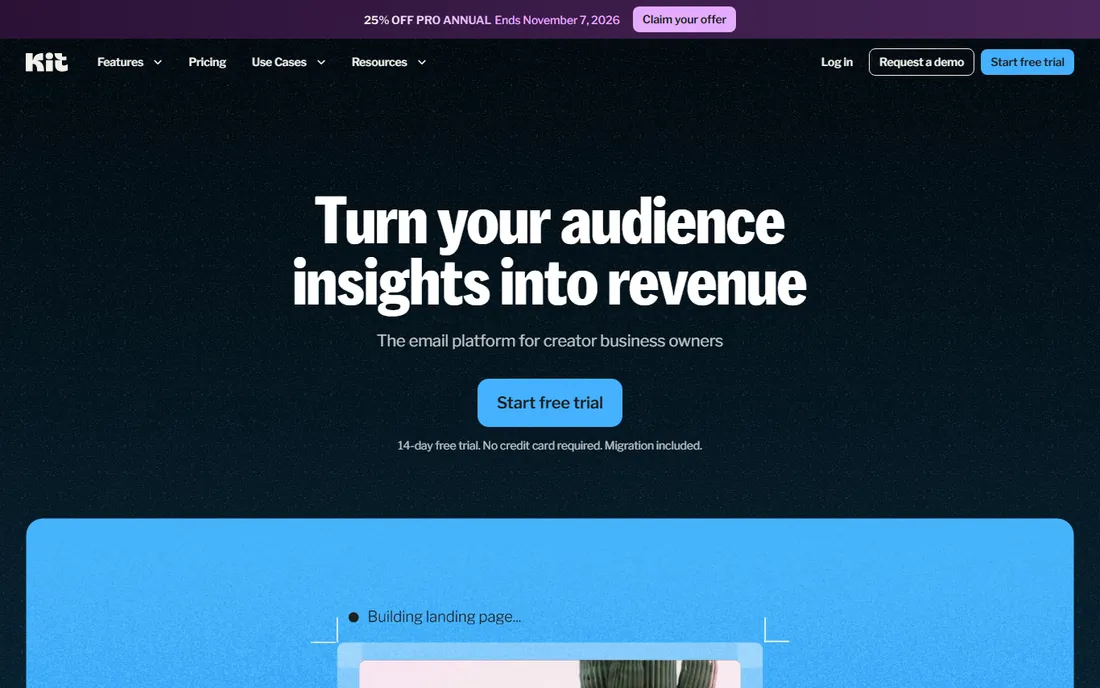
Kit, formerly ConvertKit, treats the newsletter as the top of a sales funnel rather than the product. The visual automation builder, unlimited sequences and subscriber tagging are built for a creator who sells courses, coaching or digital products to the list. Commerce is native, so you can sell without bolting on a separate checkout, and the free plan covers up to 10,000 subscribers, which is generous for testing the waters.
That funnel power costs more than a plain newsletter tool. The Creator plan starts at $33 a month billed annually for 1,000 subscribers, and Pro runs $50 a month billed annually, with prices rising as the list grows. Kit also charges transaction fees on commerce sales, which adds up. Choose Kit when the newsletter feeds something you sell. Choose beehiiv when the newsletter is what you sell.
What we like- Strong visual automations and email sequences for selling
- Free plan covers up to 10,000 subscribers
- Built-in commerce for digital products and paid newsletters
Watch out for- Paid plans start higher than simpler newsletter tools
- The 2025 price increase pushed costs up
- Advanced analytics and some features sit on higher tiers
Starting price$18 per month (Starter plan, billed annually)
Free planNo
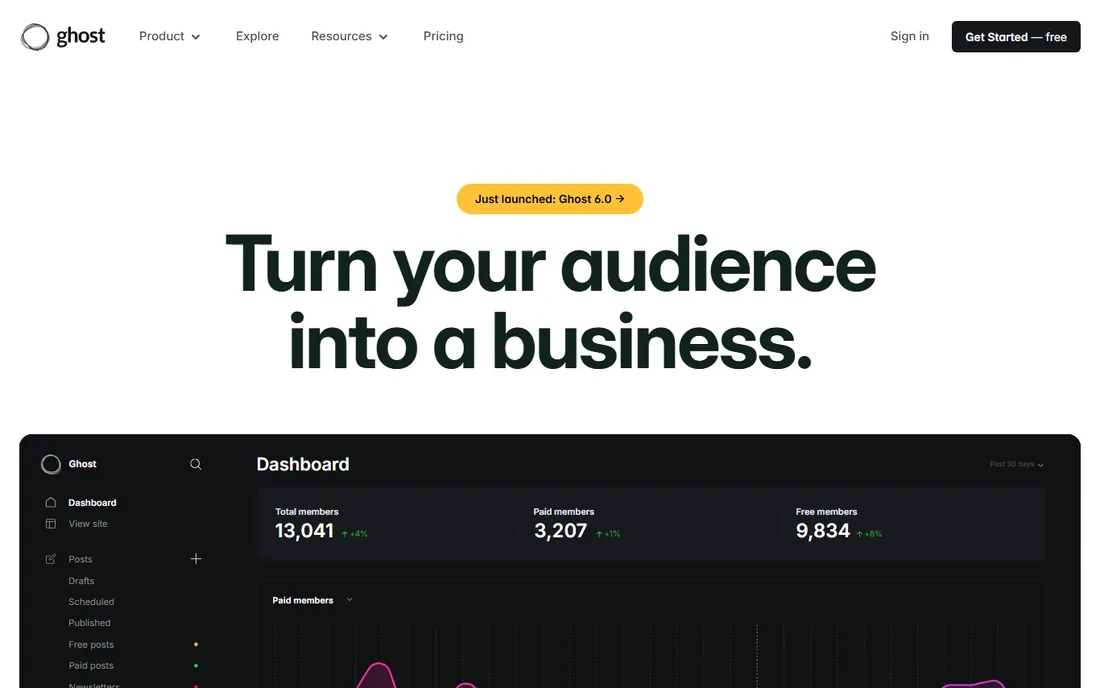
Ghost is the contrarian pick and the only one here that answers to nobody. The software is open source: self-host it and your only cost is a server, with zero platform fees on memberships forever. If you would rather not touch a server, Ghost(Pro) managed hosting starts at $18 a month billed annually for the Starter plan, and the company takes no cut of your payments on any plan.
The trade-off is that Ghost will not grow your list for you. There is no ad network, no paid recommendations engine, no viral referral machine. It is a publishing platform with newsletters and memberships, excellent at that job and uninterested in the rest. Pick Ghost when ownership, clean design and long-term cost control matter more than built-in growth hacks.
What we like- Open source, so you can self-host for free and own everything
- Managed hosting starts at $18 a month with no payment fees
- Clean, fast publishing with memberships and newsletters built in
Watch out for- No free hosted tier, only self-hosting
- Fewer growth and monetization gimmicks than beehiiv
- You manage the technical side if you self-host
Starting price$12 per month
Free planYes
MailerLite is the value menu of email marketing, and it is better than the price suggests. Paid plans start at $12 a month, the editor is genuinely pleasant, and you get automation, landing pages and popups that competitors reserve for higher tiers. For a small business or creator sending a straightforward newsletter with some automation, it covers the job at a fraction of the cost.
The limits are real but fair. The free plan covers only 250 subscribers, so growing lists move to paid quickly, and MailerLite is known for strict account reviews to protect deliverability, which can delay your first send. Segmentation and reporting are good, not great. If your needs are simple and your budget is tight, MailerLite is the rational choice.
What we like- One of the cheapest paid plans in email marketing
- Clean drag-and-drop editor that beginners learn fast
- Solid automation for the price
Watch out for- Free plan caps at 250 subscribers
- Account approvals can be strict for new senders
- Advanced segmentation lags Mailchimp and Kit
Starting price$9 per month
Free planYes
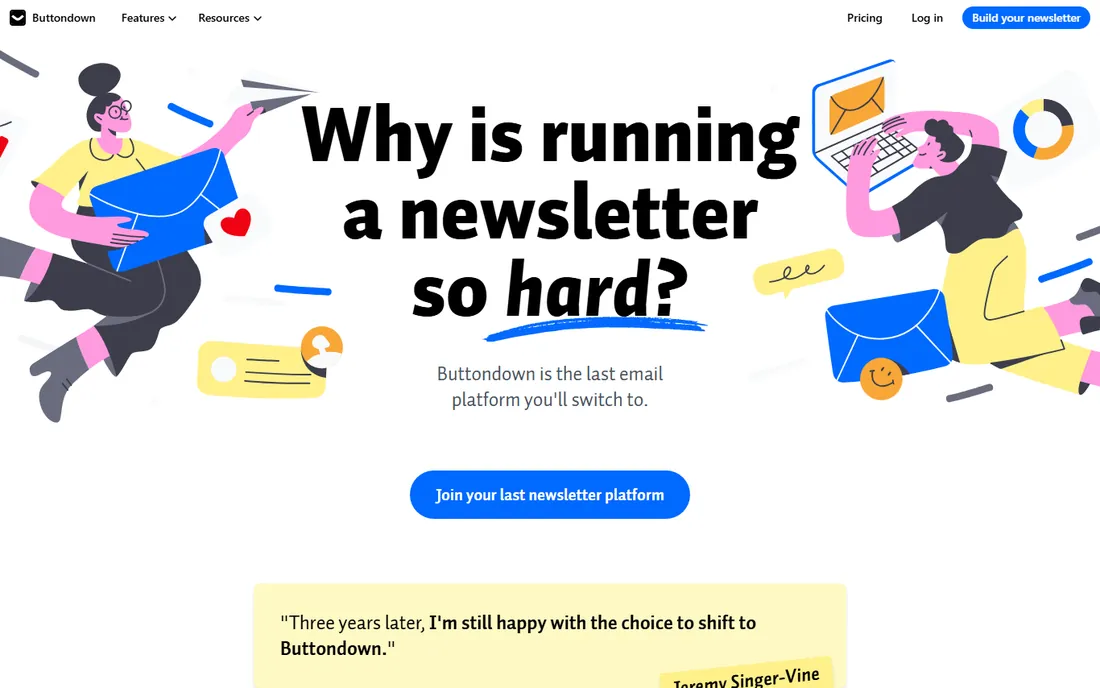
Buttondown is for the writer who finds every other platform too much. The interface is essentially a clean text editor with an API, Markdown support and sensible defaults. Technical writers love it because it stays out of the way: write in Markdown, hit send, and the email looks good without touching a template. Paid plans start at $9 a month, and the free tier covers your first 100 subscribers.
Minimalism is the whole point, which means the feature list is short. There are no fancy templates, no ad network, no recommendation engine, and the analytics tell you opens and clicks without much more. If you want growth tooling, go to beehiiv. If you want to write a great newsletter with zero fuss, Buttondown is quietly excellent.
What we like- Delightfully simple writing-first interface
- Markdown support and an API developers actually enjoy
- Cheap paid plans starting at $9 a month
Watch out for- Minimal design and template options
- No built-in discovery or monetization network
- Analytics are basic compared to bigger platforms
Starting price$13 per month
Free planYes
Mailchimp is the default recommendation for a reason and the wrong choice for just as many. As an all-round small business marketing platform it is genuinely capable: hundreds of templates, deep integrations, SMS add-ons, landing pages and automation that goes beyond newsletters. If your business already runs on Mailchimp or your freelancer knows it cold, that familiarity has real value.
For a pure newsletter, though, you pay for machinery you will not use. Pricing is per contact and rises fast: the entry Essentials plan starts at $13 a month for 500 contacts, and a 10,000-contact list costs over $100 a month. The product has also grown cluttered as features piled up. Pick Mailchimp when you need the whole marketing suite. Pick a newsletter specialist when you do not.
What we like- Huge template library and 300-plus integrations
- Familiar to freelancers and agencies, so help is easy to find
- Solid automation and segmentation on paid plans
Watch out for- Pricing climbs steeply as contacts grow
- The interface has grown cluttered over the years
- Cheaper and simpler options exist for pure newsletters
#8
Flodesk
Best for: Design-led creators who hate per-subscriber math
Visit flodesk.com
Starting price$25 per month (Lite plan, up to 1,000 subscribers)
Free planNo
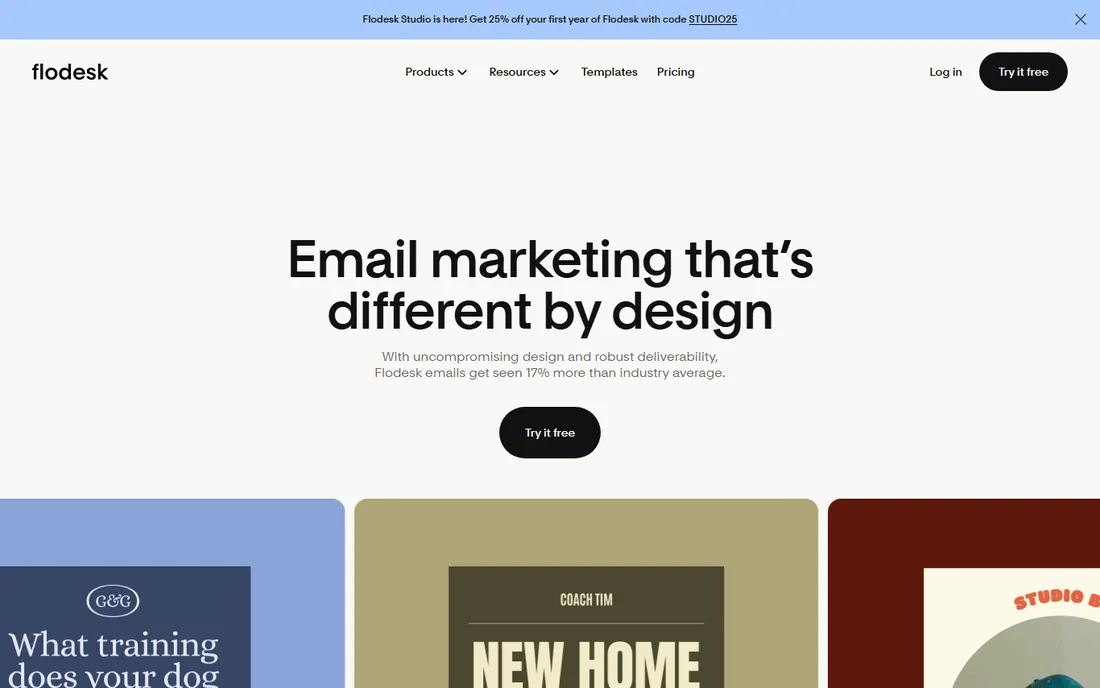
Flodesk sells on looks, and the looks are genuinely good. The templates are the prettiest in this category, which matters for creators in lifestyle, wellness, food and design niches where the email itself is part of the brand. Every paid plan includes unlimited sends, so a daily sender pays the same as a monthly one, and pricing is refreshingly simple: Lite starts at $25 a month for up to 1,000 subscribers, with Pro at $28 and an Everything plan at $54.
The honest catch is depth. Automation and segmentation are fine but not in Kit's league, and there is no free sending tier, so you pay from the first email. Flodesk also retired its famous flat-rate unlimited plan for new members in late 2025, so pricing now scales with your list like everyone else. It remains the best pick for the creator whose first question is "will my emails look gorgeous."
What we like- Beautiful templates that make every email look designed
- Unlimited email sends on every paid plan
- Simple pricing that scales with subscribers, not sends
Watch out for- No free sending tier, only free list building
- Fewer advanced automations than Kit or ActiveCampaign
- The original flat-rate unlimited plan was retired for new members
Starting price$9 per month (Pro plan, billed annually)
Free planYes
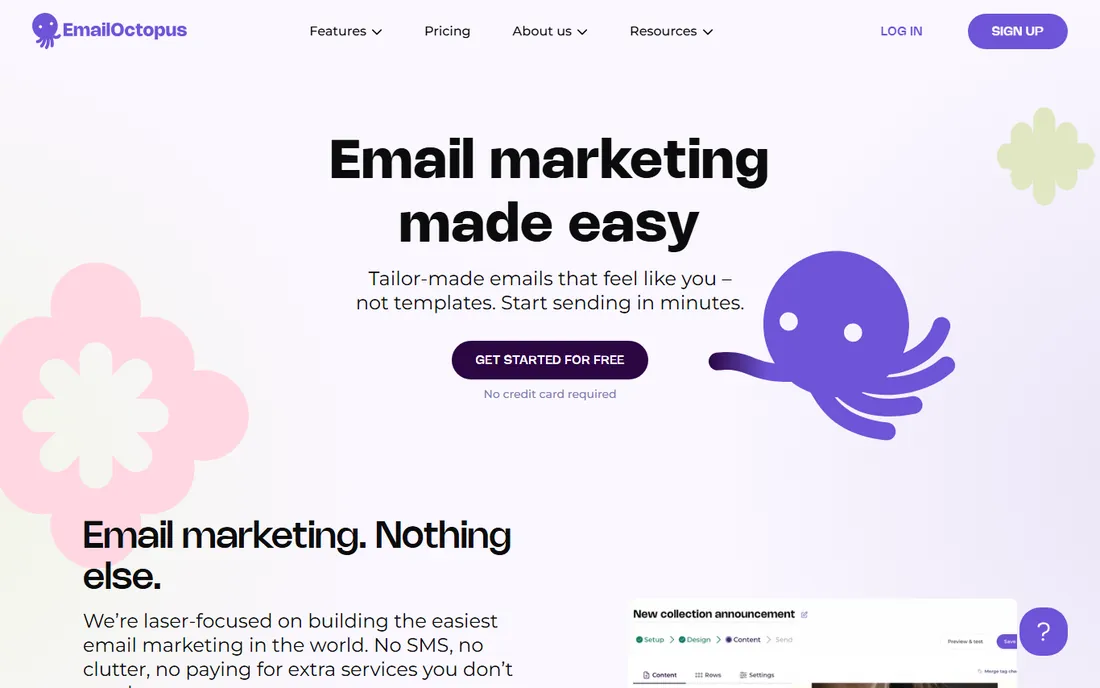
EmailOctopus wins the spreadsheet comparison and does not pretend to win anything else. The free tier is remarkable: 2,500 subscribers and 10,000 emails a month with landing pages and forms included. Paid plans start at $9 a month billed annually, undercutting nearly everything here. It sends emails reliably, the interface stays out of your way, and that is the entire pitch.
What you do not get is everything the specialists offer: no ad network, no beautiful template gallery, no advanced automation, no commerce. For a small organization, a community group or a side project that needs dependable sending at minimum cost, that trade is perfect. For a creator building a media business, the growth tools elsewhere justify their price.
What we like- Free plan covers 2,500 subscribers and 10,000 emails a month
- Paid plans start at $9 a month billed annually
- Simple, no-nonsense interface
Watch out for- Fewer templates and design options than prettier rivals
- Automation is basic
- No built-in monetization or discovery features
How we chose
We pulled the current pricing pages of every vendor in October 2026 and used only those numbers, falling back to "See website" nowhere in this category because all nine publish their rates. Tool selection started from what newsletter creators actually discuss on Reddit, in creator communities and in current comparison guides, then we filtered for products that exist today and serve newsletters as a core job. Free tier details come from the vendors' own pricing pages. We weighted the real economics, revenue shares and per-subscriber scaling, over feature checklists, because the bill is what surprises newsletter owners most.
The math that actually decides
Newsletter pricing looks simple and behaves badly, so run your own numbers before committing. First, project your list size in twelve months, not today, because per-subscriber pricing means the bill grows with your success. Second, price the revenue share: Substack's 10% looks like nothing at $200 a month and like a second rent payment at $8,000 a month, while beehiiv's 0% and Ghost's 0% keep that money.
Third, count what "free" excludes. Free tiers cap subscribers, monthly sends, automation or branding removal, and the upgrade that removes the cap is the real price. Fourth, check the billing cycle math: annual billing typically saves around 15 to 20%, which is meaningful on a $50-a-month plan. A platform that looks cheapest at 500 subscribers is rarely cheapest at 10,000, so compare at the list size you plan to have, not the one you have.
Mistakes that cost newsletter owners real money
The most expensive mistake is choosing on features and ignoring the revenue model. A writer who picks Substack for its lovely editor and later builds a $10,000-a-month publication has bought a very expensive editor. The second mistake is underestimating migration: moving an engaged list means re-warming deliverability, rebuilding automations and retraining yourself, so the switching cost a year from now dwarfs today's price difference.
Third, do not pay for marketing-suite features you will never open. If you send one essay a week, Mailchimp's automation library is dead weight at $100 a month. Fourth, check who owns the subscriber relationship: platforms with built-in discovery keep some of that relationship, which is fine until you want to leave. Export your list regularly wherever you land. Your subscribers are the asset; the platform is rented.
Frequently asked questions
Which newsletter platform is cheapest for a beginner?
EmailOctopus and MailerLite have the most generous free tiers for small lists, and Buttondown starts paid plans at $9 a month. Substack is free to start with no subscriber cap but takes 10% once you charge. For a hobby list under a few hundred subscribers, any of the free tiers works.
Should I use Substack or beehiiv?
Use Substack if you want the simplest start and value the built-in reader network, and you are comfortable with the 10% revenue share. Use beehiiv if the newsletter is a business: you keep 100% of paid revenue, and the growth tools like the ad network and referrals are built for scaling.
Can I sell digital products through my newsletter platform?
Kit has the strongest native commerce for creators selling courses and digital products. beehiiv supports paid subscriptions and digital products with 0% platform fees. Substack handles paid subscriptions but not much beyond that. Ghost with Stripe handles memberships with no platform cut.
Do I need a custom domain for my newsletter?
Not on day one, but it matters as you grow. A custom domain protects your brand if you ever switch platforms and looks more professional to sponsors. Ghost, beehiiv, Kit and Buttondown all support custom domains on paid plans.
How hard is it to switch newsletter platforms later?
The email list itself moves easily by CSV export and import. The pain is everything around it: rebuilding automations and sequences, redesigning templates, re-warming your sending reputation, and redirecting signup forms and archives. Expect a few weeks of fiddly work, which is why choosing with your twelve-month list size in mind pays off.
Is email deliverability different between platforms?
The big platforms all maintain decent deliverability, and your own practices matter more: consistent sending, list hygiene, authentication records and engaged subscribers. Strict approval processes, like MailerLite's, exist precisely to protect shared deliverability. No platform magically fixes a stale purchased list.
Sources we checked (9)
- https://www.beehiiv.com/pricing
- https://kit.com/pricing
- https://ghost.org/pricing
- https://www.mailerlite.com/pricing
- https://buttondown.com/pricing
- https://mailchimp.com/pricing
- https://flodesk.com/pricing
- https://emailoctopus.com/pricing
- https://substack.com/
Is your product missing or out of date?
We review this list regularly. Vendors can request a listing, send updated pricing or ask about featured placement.

Shihab Mia · Founder, Rankite
Shihab has spent more than a decade helping SaaS and e-commerce brands grow through search. He writes Rankite's software buying guides from pricing pages, documentation and public user reviews. More about Shihab.