How we make this list: we compare pricing pages, product documentation and public user reviews. Ratings come from G2, Capterra or Trustpilot, with the date we checked them.
What is dependency management software
Dependency management software keeps the third-party libraries in your code current, patched and license-clean. Most applications are built largely from open source packages, and each package pulls in its own dependencies, so a single project can depend on hundreds of libraries your team never wrote. When one of those libraries has a known vulnerability or a conflicting license, the risk sits in your shipped product until someone finds it. These tools find outdated and vulnerable dependencies, open pull requests with safe updates, and flag license problems before release. This guide covers tools that manage direct and transitive dependencies. It does not cover package managers such as npm, Yarn or pnpm, which install packages but do not manage their risk, or standalone SBOM file generators.
The buyer question is simple: which tool keeps dependencies current, secure and compliant without flooding developers with pull requests they ignore. The answer depends on where your code lives, how many repositories you run, and whether license compliance or vulnerability patching matters more. A small team on GitHub can start free with Dependabot and add Snyk for deeper scanning, while a large team with monorepos needs Renovate, Sonatype Lifecycle or Black Duck.
Choose a dependency management tool by matching it to your ecosystems, your repository count, and the policy you must enforce. Start with ecosystem coverage: a tool that does not support your package managers cannot see your real dependency tree. Then check how it handles updates: grouped pull requests and risk scoring matter far more than raw scan speed past a dozen repositories. Next, check the vulnerability data and whether it covers transitive dependencies, since most risk hides two or three levels deep. Fourth, check license policy: sellers to enterprise customers and regulated teams need license detection, conflict rules and audit reports, not just CVE alerts. Finally, check the pricing model: per developer, per project and quote only pricing produce very different bills.
The tool should also run inside your pull request workflow and CI pipeline, so developers see findings where they already work. Trial it against your largest repository before you buy, and count the pull requests it opens in the first week.
The best dependency management tool for most small teams is Snyk, because it pairs a free tier with a clear Team price and covers code, containers and open source in one place. The best free starting point is GitHub Dependabot, which costs nothing for teams already on GitHub. For large multi-platform teams, Mend Renovate groups updates across monorepos and supports more than 90 ecosystems. The best tool for license compliance on a budget is FOSSA. For regulated enterprises, Sonatype Lifecycle and Black Duck trade transparent pricing for deep policy and audit depth. The best free self-hosted option is OWASP Dependency-Track.
| Tool |
Best for |
Starting price |
Free plan |
| Snyk |
Small to mid-size teams wanting developer friendly scanning and fixes |
$25 per contributing developer per month |
Yes, $0 plan with limited tests |
| Mend Renovate |
Large teams with monorepos and many repositories |
Up to $250 per contributing developer per year |
Renovate open source bot is free |
| GitHub Dependabot |
Teams already on GitHub wanting free updates |
Free ($0) |
Yes, free on every GitHub plan |
| JFrog Xray |
Teams already running JFrog Artifactory |
$950 per month (SaaS Enterprise X) |
No, trial only |
| Sonatype Lifecycle |
Regulated teams needing policy enforcement |
quote |
No free plan, trial available |
| FOSSA |
License compliance and SBOM requests |
$20 per project per month, billed annually |
Yes, free forever for 5 projects |
| Black Duck (Synopsys) |
Enterprises needing deep component identification |
quote |
No |
| OWASP Dependency-Track |
Free self-hosted SBOM and vulnerability tracking |
Free ($0) |
Yes, fully free and open source |
Prices checked 21 Nov 2026.
Quick comparison
| Tool | Best for | Starting price | Free plan |
|---|
 Snyk | Small to mid-size teams that want developer friendly scanning plus automated fixes across open source, code and containers | $25 per contributing developer per month (Team plan, minimum 5 developers, maximum 10; checked 21 Nov 2026) | Free plan at $0 with limited monthly tests across 5 projects |
 Mend Renovate | Large engineering teams with monorepos that need grouped, policy driven updates across several source platforms | Up to $250 per contributing developer per year (Mend comparison page, checked 21 Nov 2026; final price by quote) | The Renovate open source bot is free to self-host; there is no free tier of the Enterprise edition |
 GitHub Dependabot | Teams that already host code on GitHub and want free automated dependency updates with no new vendor | Free ($0, included with GitHub on every plan, checked 21 Nov 2026) | Free for public and private repositories on GitHub Free, Team and Enterprise |
 JFrog Xray | Teams already running JFrog Artifactory that want scanning where binaries are stored | $950 per month (SaaS Enterprise X, the first cloud tier that includes Xray; self-managed Pro X from $27,000 per year; checked 21 Nov 2026) | No free plan; a free trial is available |
 Sonatype Lifecycle | Regulated organizations needing policy enforcement and component governance across the development life cycle | quote (vendor pricing page lists no price; consumption based pricing by quote, checked 21 Nov 2026) | No free plan for Lifecycle; a free trial is available |
 FOSSA | Teams whose main risk is open source license compliance and customer SBOM requests | $20 per project per month, billed annually (Business plan, checked 21 Nov 2026) | Free forever plan for 5 projects and 10 contributing developers |
 Black Duck (Synopsys) | Large enterprises needing deep component identification, including binary and snippet matching, for legal and audit teams | quote (vendor publishes no price, checked 21 Nov 2026) | No free plan |
 OWASP Dependency-Track | Teams with hosting skills wanting a free, self-hosted store for SBOMs and vulnerability tracking | Free ($0, open source under Apache 2.0, checked 21 Nov 2026) | Free and open source; the whole product is free |
Is your product missing or out of date?
We review this list regularly. Vendors can request a listing, send updated pricing or ask about featured placement.
These eight tools cover the full range of dependency management, from free GitHub native updates to enterprise governance platforms. Each entry lists the starting price checked on 21 Nov 2026, the free plan terms, and one real drawback.
#1
Snyk
Best for: Small to mid-size teams that want developer friendly scanning plus automated fixes across open source, code and containers
Visit snyk.io
Starting price$25 per contributing developer per month (Team plan, minimum 5 developers, maximum 10; checked 21 Nov 2026)
Free planFree plan at $0 with limited monthly tests across 5 projects
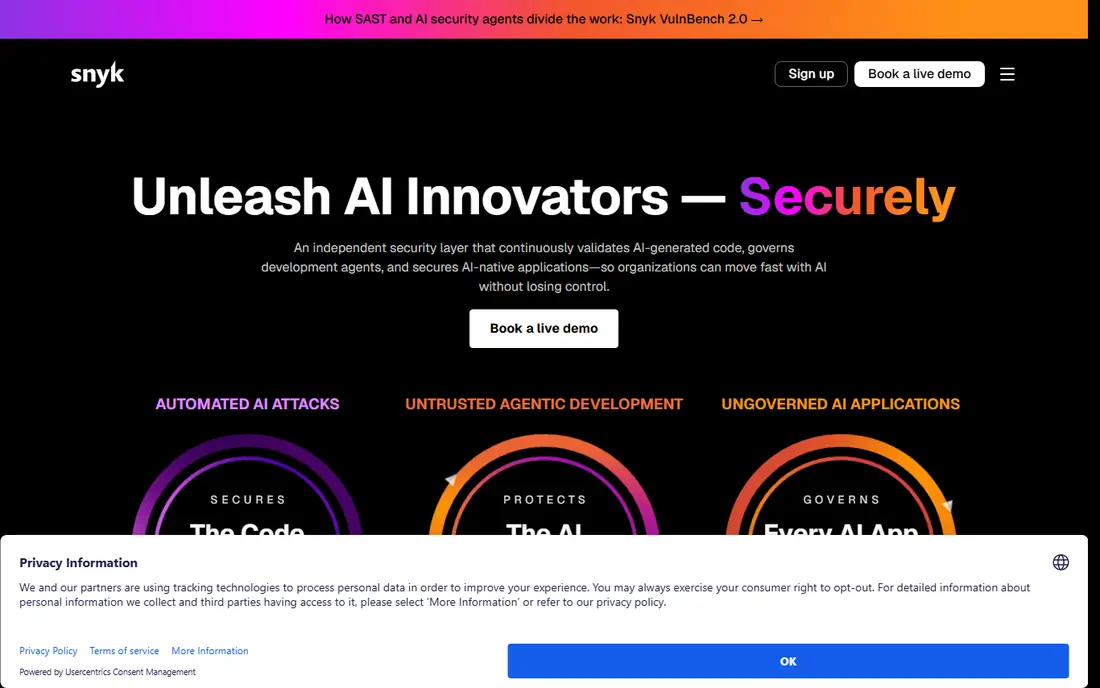
Snyk scans manifest files and lockfiles for known vulnerabilities, then opens fix pull requests that upgrade the package to a safe version. Snyk Open Source is part of a wider platform that also covers code, containers and infrastructure as code. The Team plan page lists $25 per contributing developer per month with a 5 developer minimum, shown as $1,375 a year. Enterprise pricing moved to prepaid credits in 2026, with 1 credit equal to $1, and each of Snyk Code and Snyk Open Source drawing 1 credit per active contributor per day. That model is flexible but harder to predict, so ask for a written estimate at your headcount first.
What we like- Broad ecosystem coverage
- Fix pull requests with suggested upgrades
- IDE and CI integrations
- Clear per developer pricing for small teams
Watch out for- Team caps at 10 contributing developers, so growing teams must move to credit based Enterprise pricing that is harder to forecast
#2
Mend Renovate
Best for: Large engineering teams with monorepos that need grouped, policy driven updates across several source platforms
Visit mend.io
Starting priceUp to $250 per contributing developer per year (Mend comparison page, checked 21 Nov 2026; final price by quote)
Free planThe Renovate open source bot is free to self-host; there is no free tier of the Enterprise edition
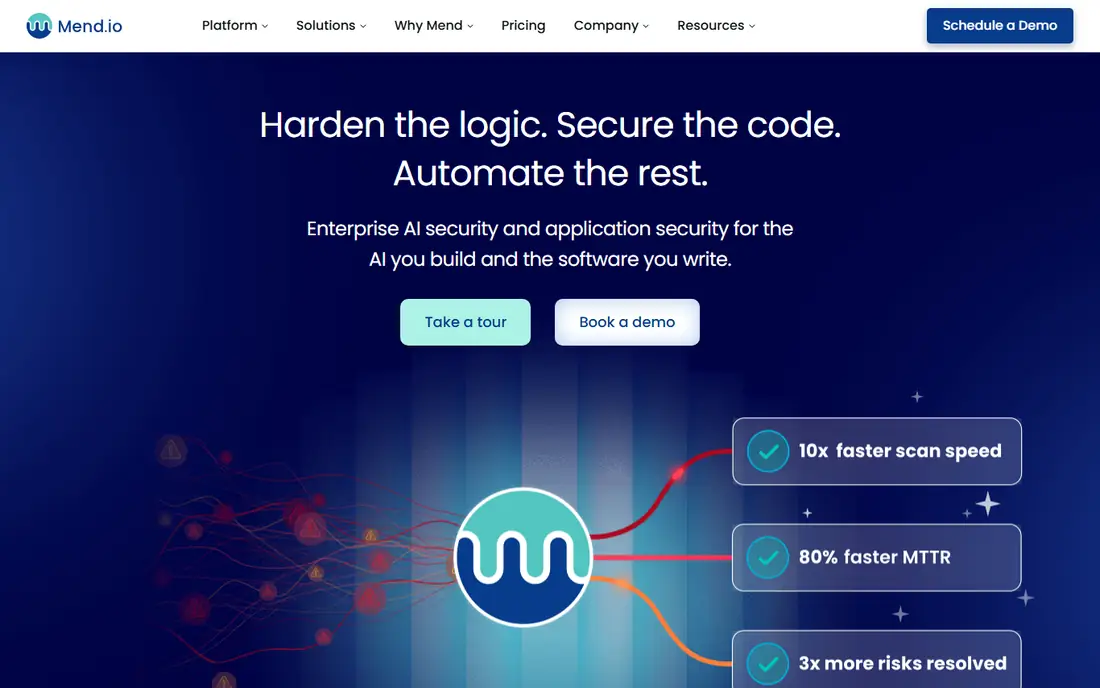
Mend Renovate grew out of the open source Renovate bot. The Enterprise edition adds the controls large teams need: grouped pull requests that combine related updates into one reviewable change, Merge Confidence ratings that predict whether an update will merge cleanly, and support across thousands of repositories. Mend states on its own comparison page that Renovate Enterprise is available standalone for up to $250 per developer per year, or inside Mend AppSec for up to $1,000 per developer per year. Treat the $250 figure as a ceiling, not a floor, because the final price is quoted.
What we like- Supports more than 90 package managers and ecosystems
- Strong grouping and monorepo support
- Merge Confidence scoring
- Works on GitHub, GitLab, Bitbucket and Azure DevOps
Watch out for- Enterprise pricing is quoted per deal, so small teams cannot see the real cost without a sales conversation, and the open source edition needs self-hosting and tuning
#3
GitHub Dependabot
Best for: Teams that already host code on GitHub and want free automated dependency updates with no new vendor
Visit github.com
Starting priceFree ($0, included with GitHub on every plan, checked 21 Nov 2026)
Free planFree for public and private repositories on GitHub Free, Team and Enterprise
Dependabot is built into GitHub, so there is nothing to install and no separate bill. Dependabot alerts watch your manifest and lockfiles against the GitHub Advisory Database, security updates open pull requests that patch vulnerable dependencies, and version updates keep packages current. GitHub documents Dependabot as free on every GitHub plan, including private repositories. The trade-off is scope: Dependabot only works on GitHub, and its grouping controls and risk signals are thinner than Renovate. Many teams run it alongside Snyk for deeper coverage.
What we like- No extra cost
- Native GitHub integration
- Alerts, security updates and version updates in one place
- Setup is a single configuration file
Watch out for- GitHub only, so code on other platforms needs a second tool, and grouped updates and risk scoring are more limited than Renovate or Snyk
#4
JFrog Xray
Best for: Teams already running JFrog Artifactory that want scanning where binaries are stored
Visit jfrog.com
Starting price$950 per month (SaaS Enterprise X, the first cloud tier that includes Xray; self-managed Pro X from $27,000 per year; checked 21 Nov 2026)
Free planNo free plan; a free trial is available
JFrog Xray scans the artifacts stored in Artifactory rather than only the source code, which catches vulnerable components in the binaries, builds and container images a team ships. It flags license violations and can block downloads that break policy at the registry. Xray is not a standalone product: it ships inside Pro X, Enterprise X and Enterprise Plus, and Artifactory is required. The first SaaS tier with Xray is Enterprise X from $950 a month, while self-managed Pro X starts at $27,000 a year for one server. One pricing conflict to note: some third-party pages list $10 a month for a product called Xray, but that figure belongs to a different product, a Jira test management app also called Xray, and does not apply to JFrog Xray.
What we like- Scans binaries, builds and container images stored in Artifactory
- Blocks policy breaking artifacts at download
- License compliance and SBOM export
Watch out for- Xray is not sold alone and Artifactory is required, so teams without Artifactory pay for a platform, not just a scanner
#5
Sonatype Lifecycle
Best for: Regulated organizations needing policy enforcement and component governance across the development life cycle
Visit sonatype.com
Starting pricequote (vendor pricing page lists no price; consumption based pricing by quote, checked 21 Nov 2026)
Free planNo free plan for Lifecycle; a free trial is available
Sonatype Lifecycle controls open source risk by scanning components, enforcing policy rules at each stage, and giving security and legal teams one view of what is in the software. Its policy engine supports the waiver and exception workflow regulated teams need. Sonatype moved to consumption based pricing, and its pricing page publishes no list price, directing buyers to contact sales for a quote. Third-party directories conflict: TrustRadius lists $690 per user per year, while SoftwareAdvice and GetApp list $775 per year. Neither figure comes from the vendor, so this guide records the price as quote. All Lifecycle capabilities are now included in Sonatype Guide, which new customers must buy.
What we like- Deep policy engine with component intelligence
- IDE and CI integrations
- Strong audit reporting
- Long track record in regulated sectors
Watch out for- Quote only pricing makes budgeting slow, and new customers must buy the broader Sonatype Guide bundle, not Lifecycle alone
#6
FOSSA
Best for: Teams whose main risk is open source license compliance and customer SBOM requests
Visit fossa.com
Starting price$20 per project per month, billed annually (Business plan, checked 21 Nov 2026)
Free planFree forever plan for 5 projects and 10 contributing developers
FOSSA focuses on the question that worries teams after a security scan: which licenses govern the code you ship, and can you prove it to a customer. It scans dependencies at any depth, flags license conflicts against your policy, and produces attribution notices and SBOM files in standard formats. The vendor pricing page lists three plans: Free at $0 forever for 5 projects and 10 contributing developers, Business at $20 per project per month billed annually, and Enterprise at a custom price. Business adds unlimited scan depth, the full quality checks, automated license and vulnerability scanning, and multi-project reporting. The price to watch is per project, not per developer. A team with 3 repositories pays about $60 a month, while 20 services cost about $400 a month, so count projects before comparing with per developer tools.
What we like- Strong license policy engine
- Automatic attribution notices
- SBOM export in SPDX and CycloneDX
- The free plan is usable, not a timed trial
Watch out for- Business pricing is per project, so many small repositories push the bill up with each new project, and remediation depth is thinner than Snyk
#7
Black Duck (Synopsys)
Best for: Large enterprises needing deep component identification, including binary and snippet matching, for legal and audit teams
Visit blackduck.com
Starting pricequote (vendor publishes no price, checked 21 Nov 2026)
Free planNo free plan
Black Duck is the long running software composition analysis platform that many large organizations use as their open source governance standard. Its knowledge base tracks components, vulnerabilities and licenses across many ecosystems, and it scans source code and binaries to find components a manifest scan would miss, including code fragments. Its license analysis identifies obligations, flags conflicts, and produces the compliance reports legal teams need. Black Duck publishes no price: its product pages offer a pricing request and a sales contact only. Third-party estimates conflict widely, from about $525 per team member to $50,000 to $250,000 per year, and none is verified by the vendor, so this guide records the price as quote. Black Duck was formerly Synopsys Black Duck and now operates as independent Black Duck Software after Clearlake Capital completed its acquisition of the Synopsys application security business in 2025.
What we like- Very large component knowledge base
- Binary and snippet scanning finds components manifest scans miss
- Deep license analysis and compliance reporting
Watch out for- Quote only enterprise pricing, a long sales cycle, and dedicated staffing to run well
#8
OWASP Dependency-Track
Best for: Teams with hosting skills wanting a free, self-hosted store for SBOMs and vulnerability tracking
Visit dependencytrack.org
Starting priceFree ($0, open source under Apache 2.0, checked 21 Nov 2026)
Free planFree and open source; the whole product is free
OWASP Dependency-Track is a free open source platform that stores SBOMs and tracks vulnerabilities against them over time. It takes CycloneDX SBOMs from your build pipeline and continuously checks each component against sources including the National Vulnerability Database, the Sonatype OSS Index, GitHub Advisories and OSV. Policy rules flag components that break your rules, and notifications report new vulnerabilities as they appear. Version 5.0, generally available in 2026, added horizontal scaling and high availability, and runs on PostgreSQL with Docker deployment. The cost is operational, not licensing: you host and maintain the application and database yourself, and setup needs someone comfortable running a Java application. Teams that want a managed service should look at Snyk or FOSSA instead.
What we like- No license cost
- Tracks vulnerabilities against stored SBOMs over time
- Policy and notification support
- Community maintained OWASP flagship project
Watch out for- You host and maintain it yourself, including the database and vulnerability feeds, with no official managed hosting tier or vendor support
Frequently asked questions
What is the difference between dependency management software and a package manager
A package manager installs libraries, while dependency management software manages the risk in those libraries. npm, Yarn and pnpm download packages and resolve versions, but they do not tell you which packages have known vulnerabilities or license conflicts. Dependency management tools scan the full tree, including transitive dependencies, and open updates or block risky components. Most teams need both.
Is Dependabot enough on its own
Dependabot is enough for a small team that hosts all its code on GitHub and has no formal license compliance duty. It is free, native to GitHub, and handles alerts and updates without a new vendor. It is not enough when your code spans several source platforms, when you need grouped updates across monorepos, or when legal teams need license policy enforcement. Those teams usually add Snyk, Renovate or an enterprise platform alongside Dependabot, or replace it.
How much should a small team budget for dependency management
A small team can start at $0 with Dependabot or the free tiers of Snyk and FOSSA. The first paid step is usually Snyk Team at $25 per contributing developer per month, which is $125 a month for a 5 developer team, or FOSSA Business at $20 per project per month, which is $60 a month for 3 projects. Sonatype Lifecycle and Black Duck are quote only and typically run into five figures a year, so get a written quote first.
Do these tools replace SBOM generation
No, most of these tools consume SBOMs rather than replacing the tools that generate them. Snyk, FOSSA, JFrog Xray and Dependency-Track all work with SBOMs in SPDX and CycloneDX formats, and several of them can export an SBOM from the components they find. Your build pipeline still needs to generate an accurate SBOM, and Dependency-Track needs SBOMs fed into it. Treat SBOM generation and dependency management as two steps in the same workflow.
Which tool is best for license compliance
FOSSA is the best license compliance choice for small and mid-size teams, because its license policy engine, automatic attribution notices and SBOM exports are available on a published $20 per project per month plan with a usable free tier. Sonatype Lifecycle and Black Duck offer deeper policy and audit depth for regulated enterprises, but both are quote only and need dedicated staffing. Snyk adds license compliance on its Team plan for teams that want vulnerability and license coverage in one tool.
Sources we checked (9)
- https://snyk.io/start/team/
- https://www.mend.io/mend-vs-dependabot/
- https://docs.github.com/en/get-started/learning-about-github/githubs-plans#individual-plans
- https://jfrog.com
- https://www.sonatype.com/products/pricing
- https://fossa.com/pricing/
- https://www.blackduck.com
- https://dependencytrack.org
- https://owasp.github.io/blog/2026/06/09/dependency-track-v5.html
Is your product missing or out of date?
We review this list regularly. Vendors can request a listing, send updated pricing or ask about featured placement.

Shihab Mia · Founder, Rankite
Shihab has 5+ years in B2B and SaaS SEO. He writes Rankite's software buying guides from pricing pages, documentation and public user reviews. More about Shihab.