How we make this list: we compare pricing pages, product documentation and public user reviews. Ratings come from G2, Capterra or Trustpilot, with the date we checked them.
Key takeaways
- Decision intelligence became a formal category in January 2026 with Gartner's first Magic Quadrant for Decision Intelligence Platforms, which named FICO, SAS, Aera, IBM, ACTICO, and Quantexa as Leaders.
- The platforms differ by job: Quantexa and FICO decide individual cases in regulated industries, Aera automates operational supply chain decisions, and Palantir builds bespoke decision systems for the largest organisations.
- Every platform here is quote priced enterprise software with a services component; none of it is bought with a credit card, and implementation effort exceeds licence cost in most deployments.
- The crowded label needs a test: a decision intelligence platform should model a decision, recommend or take an action, record the outcome, and learn from it, not merely describe data in a dashboard.
Quick comparison
| Tool | Best for | Starting price | Free plan |
|---|
 Quantexa | Context based decisions in banking and government | See website | No |
 Aera Technology | Autonomous supply chain and operations decisions | See website | No |
 FICO Platform | Credit and regulated decisioning at volume | See website | No |
 Palantir Foundry and AIP | Bespoke operational decision systems | See website | No |
 SAS | Model driven decisioning with deep governance | See website | No |
 IBM Decision Intelligence | Decisions inside an IBM data and AI estate | See website | No |
 Pyramid Analytics | Governed analytics that reach a decision | See website | No |
 Tellius | Fast root cause answers for business teams | See website | No |
Is your product missing or out of date?
We review this list regularly. Vendors can request a listing, send updated pricing or ask about featured placement.
The best decision intelligence software
Starting priceSee website
Free planNo
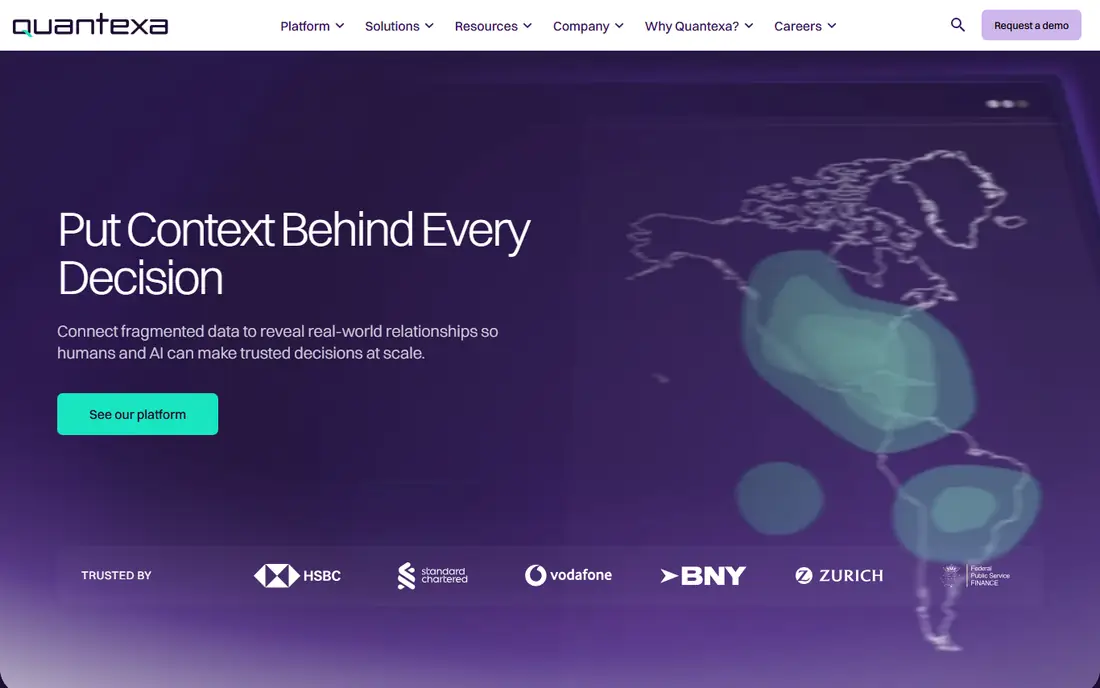
What we like- Quantexa built its name on a single insight: decisions about entities, customers, companies, transactions, fail when the data about them is fragmented. Its platform resolves entities across messy sources, builds the context graph around them, and scores decisions such as fraud referral, money laundering investigation, and credit assessment on the whole picture. Gartner placed it as a Leader in the January 2026 Magic Quadrant, furthest for completeness of vision, and its explainable AI governance is a stated strength in regulated industries.
Watch out for- Quantexa is at its best on entity centric decisions in financial services and the public sector
- A retailer wanting demand planning decisions is shopping in the wrong aisle. Deployments are data engineering projects first, since entity resolution quality decides everything downstream. Pricing and the sales process are enterprise weight, and smaller institutions will feel the minimum viable engagement size.
Starting priceSee website
Free planNo
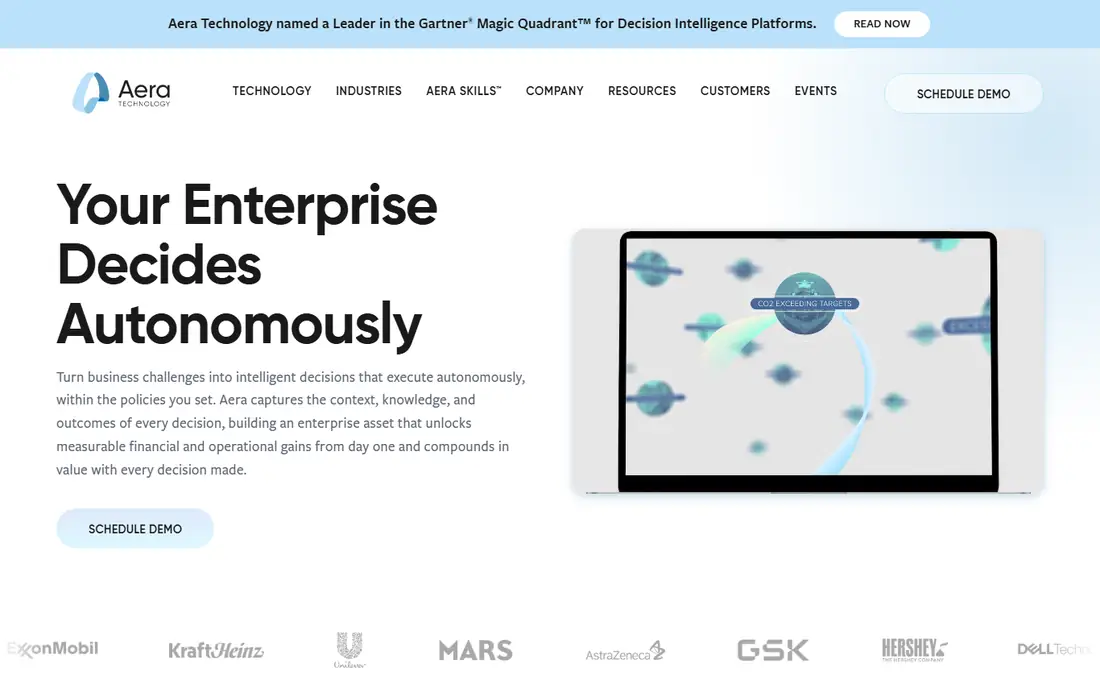
What we like- Aera is the category's pioneer, building decision automation since 2017 and named a Leader in the 2026 Gartner quadrant. Its Decision Cloud watches operational data continuously, and its agents recommend or execute decisions in inventory, demand, procurement, and logistics, recording context and outcome into what Aera calls decision memory, so the system learns which calls worked. For a global manufacturer making thousands of supply decisions a week, the autonomy ceiling here is the highest on this list.
Watch out for- Autonomy is a governance commitment, not a setting: handing execution to agents, even with guardrails and escalation, requires the organisation to trust and audit machine decisions, which is a cultural programme alongside the software one. Aera's strength is operations and supply chain shaped
- It is not a general decisioning engine for credit or fraud. Costs are quote based and assume enterprise scale.
#3
FICO Platform
Best for: Credit and regulated decisioning at volume
Visit fico.com
Starting priceSee website
Free planNo
What we like- FICO is the incumbent of automated decisioning: its platform runs the accept, decline, price, and refer logic behind a large share of the world's consumer credit decisions, combining rules, models, and simulation with the audit trail regulators expect. Named a Leader in Gartner's 2026 decision intelligence quadrant, it brings decades of decision management craft, champion challenger testing, and strategy simulation that newer entrants are still building. If the decision is credit shaped and the regulator is watching, FICO is the default shortlist.
Watch out for- FICO's centre of gravity is financial services decisioning
- Operational or commercial decisions outside that world use a fraction of the platform. The ecosystem rewards commitment: skills, partners, and pricing all assume FICO is a strategic platform rather than a point tool. Organisations wanting a light, self serve product will find the weight of the full platform more than the decision in front of them needs.
#4
Palantir Foundry and AIP
Best for: Bespoke operational decision systems
Visit palantir.com
Starting priceSee website
Free planNo
What we like- Palantir is the option for an organisation whose decision problem does not fit a product: Foundry builds an operational ontology of the business, its assets, orders, patients, or aircraft, and AIP layers AI agents and workflows on top so decisions are proposed and executed inside live operations. Independent comparisons describe it as the only platform here that will build a bespoke operational system rather than configure a product, and its government and industrial deployments are the proof at the hardest scale.
Watch out for- Priced accordingly is the honest summary: Palantir engagements are among the most expensive in enterprise software, with forward deployed engineers part of the model. The ontology build is a serious, months long commitment before the first decision improves. For a bounded, well understood decision, credit rules, an alerts queue, a specialist platform below delivers the same outcome at a fraction of the cost and ceremony.
#5
SAS
Best for: Model driven decisioning with deep governance
Visit sas.com
Starting priceSee website
Free planNo
What we like- SAS brings the analytics establishment's answer: SAS Viya and its decisioning layer let organisations build models, combine them with business rules, deploy decisions into operational systems, and govern the whole estate with the model risk management discipline banks already use for SAS models. Named a Leader in the 2026 Gartner quadrant, it suits institutions whose decision problem is really a model estate problem, thousands of models needing one controlled path into production decisions.
Watch out for- SAS's breadth is its burden: the platform spans statistics, data management, and industry solutions, and buying only decisioning means navigating a large portfolio and a large sales organisation. Modernisation questions follow SAS estates, since long tenured installations can lag the cloud native experience of newer rivals. Pricing is quote based and historically premium.
#6
IBM Decision Intelligence
Best for: Decisions inside an IBM data and AI estate
Visit ibm.com
Starting priceSee website
Free planNo
What we like- IBM's decision intelligence offer, a Leader in Gartner's 2026 quadrant, combines its decision management heritage with the watsonx data and AI platform and its automation portfolio, aiming at complex decision workflows at enterprise scale, particularly where IBM already runs the data estate. Rules driven decision services remain a genuine strength, with the business user authoring that operational decision management pioneered. For an IBM standardised enterprise, the integration argument writes itself.
Watch out for- Independent coverage of the quadrant notes complex pricing and sales processes, and questions how central decision intelligence is within IBM's very broad portfolio, a fair challenge when a multi year platform bet is being placed. The experience is strongest inside the IBM ecosystem and less compelling as a standalone purchase for a heterogeneous estate. Expect a consultative, services led engagement.
Starting priceSee website
Free planNo
What we like- Pyramid approaches from analytics upward: a governed, enterprise grade BI platform with AI assistance and workflow, standardised metric definitions, and hybrid deployment, aimed at organisations whose decisions fail because every department argues from different numbers. Buyer's guides consistently shortlist it where metric standardisation and hybrid estates are the requirement, and self service natural language querying lowers the distance between a question and a defensible figure.
Watch out for- Judged against the strict decision intelligence test, Pyramid is the closest to the dashboard end of this list: it informs and structures decisions more than it executes them, and a buyer needing automated action should compare it carefully against Aera or FICO shapes. Its brand visibility trails the giants in some regions, which affects partner choice. Pricing is quote based.
Starting priceSee website
Free planNo
What we like- Tellius specialises in the moment before the decision: automated root cause analysis that computes why a metric moved, which segments drove the change, and by how much, answering in minutes the question that otherwise consumes an analyst week. Buyer comparisons single it out as the closest genuine specialist in automated insight of the decision platforms, and for commercial teams in consumer goods and pharma, that investigation speed is the bottleneck it removes.
Watch out for- Tellius explains
- It does not execute. Organisations needing the recommendation carried into action will pair it with workflow or decisioning tooling, or graduate to a fuller platform. Its scope is analytics shaped, so operational, real time decisions are outside its design. Pricing is quote based, positioned below the platform giants but still an enterprise sale.
How we chose
We anchored the list in Gartner's inaugural January 2026 Magic Quadrant for Decision Intelligence Platforms, whose Leaders were FICO, SAS, Aera, IBM, ACTICO, and Quantexa, then applied the decision test from buyer literature: does the product model a decision, produce a recommendation or action, record outcomes, and learn. Palantir, Pyramid, and Tellius were included as the category's recognised neighbouring shapes, bespoke operational systems, governed analytics with workflow, and automated root cause, each labelled with what it does not do. ACTICO, a strong regulated industry Leader in Europe, was left off only to keep the list at eight and US buyer focused; it belongs on a European shortlist.
How to choose the right decision intelligence software
Start by naming the decision, in one sentence, with its volume and its cost of error. Approve or decline consumer credit applications, a million times a year, under regulation, points at FICO, SAS, or Quantexa. Rebalance inventory across a network daily, points at Aera. Investigate why sales fell in a region, points at Tellius or Pyramid. A decision that cannot be stated that plainly is not ready for a platform, and buying one first is how this category produces its well documented failed projects; analyst caution that many agentic AI projects will be scrapped applies here in full.
Then test the loop, not the demo. In evaluation, require the vendor to show your decision end to end: the data as it really arrives, the recommendation with its explanation, a human override and what the system learns from it, and the outcome record a regulator or auditor can read. Ask who owns the models after the consultants leave, and what the second decision costs to add, because the first deployment is the down payment on a platform habit. Anchor the business case to one decision with a measurable baseline inside one quarter, and let the platform earn its expansion.
Frequently asked questions
How is decision intelligence different from business intelligence?
Business intelligence describes the business: what sold, where, and how the trend looks. Decision intelligence engineers a specific decision: it models the choice, recommends or takes the action, records the outcome, and feeds that outcome back so the next decision improves. A dashboard that a manager reads before deciding is BI supporting a decision; a system that scores the application, sets the price, logs the result, and adjusts is decision intelligence. Many products blur the line in marketing, which is why the loop test matters.
What did Gartner's 2026 Magic Quadrant change?
It made the category official. Gartner published its first Magic Quadrant for Decision Intelligence Platforms in January 2026, naming FICO, SAS, and Aera Technology as Leaders alongside IBM, ACTICO, and Quantexa, and reported from its chief data officer survey that a third of organisations had already deployed decision intelligence, with most of the rest investigating. For buyers, the practical effect is a defined shortlist and a shared vocabulary, not a verdict: quadrant position says nothing about fit for your specific decision.
How much does decision intelligence software cost?
Nothing in this category carries a public price. Engagements are quoted on decision volume, data estates, and deployment scope, and total cost is usually dominated by implementation and data work rather than licences. Realistic budgeting treats the first decision as a programme, data integration, model and rules build, governance setup, change management, with the platform fee one line among several. Any vendor unwilling to bound the cost of the first decision in writing is telling you something worth hearing.
Can smaller companies use decision intelligence?
The full platforms here are enterprise priced and enterprise weighted, and a mid size company is usually better served by the decision shaped parts: a rules engine for its credit or eligibility calls, automated root cause in its analytics stack, or the decision features bundled into its existing platforms from Microsoft, Salesforce, or its industry software. The discipline, name the decision, record outcomes, review them, costs nothing and captures much of the value. The platforms become rational when decision volume or error cost is measured in millions.
What is the biggest reason these projects fail?
Buying the platform before defining the decision. The recurring pattern is a broad deployment aimed at decision making in general, which produces dashboards nobody's judgement depends on and models nobody owns. The successful pattern is narrow: one high volume, high cost decision with a named business owner, a measurable baseline, and agreement in advance on what the system may decide alone, what it recommends, and what stays human. Governance designed at that scope is achievable; governance for everything is a slogan.
Sources we checked (0)
Is your product missing or out of date?
We review this list regularly. Vendors can request a listing, send updated pricing or ask about featured placement.

Shihab Mia · Founder, Rankite
Shihab has 5+ years in B2B and SaaS SEO. He writes Rankite's software buying guides from pricing pages, documentation and public user reviews. More about Shihab.