How we make this list: we compare pricing pages, product documentation and public user reviews. Ratings come from G2, Capterra or Trustpilot, with the date we checked them.
What is data warehouse software for a small business
Data warehouse software is where a small business puts its data so it can be queried: sales from the shop, orders from the website, spend from the ad account, and support tickets from the help desk, all in one place. It is not a database for running the business day to day, and it is not a dashboard. It stores the data, and a BI tool such as Looker Studio or Metabase reads it and draws the charts. A small business buys it when spreadsheets stop working: when the sales file is too big, when two people need the same numbers, or when a report takes an afternoon to build by hand.
Direct answer: Google BigQuery is the top pick for most small businesses because on-demand pricing at $6.25 per TiB starts at nothing, the first 1 TiB of queries a month is free, and there is no server to run. MotherDuck is the best pick for a team that already uses DuckDB, because its free Lite tier covers 10 GB and 10 compute hours a month. Snowflake is the best pick for a business that wants the most capable warehouse and can control its credit burn, at $2.00 per credit on Standard. Start with BigQuery if the team is new to warehousing; start with MotherDuck if it already runs DuckDB.
Key takeaways
- Google BigQuery charges $6.25 per TiB on-demand, with the first 1 TiB of queries free each month, so a small business can start at $0.
- MotherDuck free Lite covers 10 GB of storage and 10 compute hours a month, and its Business plan starts at $250 a month plus usage.
- Snowflake charges $2.00 per credit on Standard in AWS US East, with storage at $23 per TB a month, so the bill depends on how much compute the business burns.
- Amazon Redshift Serverless charges $0.375 per RPU hour with a 4-RPU minimum, or $1.50 an hour when it runs.
- A warehouse is not a dashboard: every tool here needs a BI tool such as Looker Studio or Metabase to draw the charts.
How we picked
We compared eight tools on five points: starting cost and free tier, ease of setup for a small team, SQL compatibility, scale when the business grows, and integration with common BI tools. A tool scored well when a small business could start at $0 or near it and pay only for what it used. Prices come from vendor pricing pages and vendor supplied directory listings, checked 21 November 2026. Where sources disagree on a price, both figures are printed and the conflict is flagged. Prices are search verified; vendor homepages were not individually opened in the browser for this guide. This guide is scoped to internal small-business analytics, which is distinct from the live best data warehouse for embedded analytics apps page, which covers customer-facing analytics; the tools here are judged on small-team cost and ease of use, not on embedding.
Comparison table
| Tool | Best for | Starting price | Free plan |
| Snowflake | Most capable warehouse, controlled credit burn | $2.00/credit Standard | Free trial |
| Google BigQuery | Starting at $0 with on-demand pricing | $6.25/TiB on-demand | Yes, 1 TiB queries/month |
| Amazon Redshift Serverless | AWS teams with existing data in S3 | $0.375/RPU-hour | Free trial |
| MotherDuck | DuckDB teams that want a managed warehouse | Free Lite | Yes, 10 GB and 10 compute hours/month |
| ClickHouse Cloud | Fast analytics on large event data | From $0.2181/compute unit-hour | Yes, $300 trial credits |
| Firebolt | Low latency analytics on big data | From $0.92/hour | Free trial |
| Dremio | Querying data where it already sits | $0.20/DCU Cloud | Yes, $400 credit/30 days |
| Databricks | SQL analytics plus AI and machine learning | ~$0.70/DBU Serverless | Free trial |
What 1 TB of data costs in a month
A small business with 1 TB of sales and order data, querying 100 GB a month, pays very different amounts on these tools. On BigQuery, the first 1 TiB of queries a month is free, so 100 GB of queries costs $0, and storage for 1 TB is a few dollars a month. On MotherDuck Lite, 10 GB of storage and 10 compute hours a month are free, so a 1 TB business needs the Business plan from $250 a month plus usage. On Snowflake, 1 TB of storage costs $23 a month, and a small warehouse burns about 2 credits an hour, or $4 an hour, so ten hours of queries a month costs $40. On Redshift Serverless, 4 RPU at $0.375 an hour costs $1.50 an hour when it runs, so ten hours costs $15.
Which warehouse is best for a team with no data engineer
A team with no data engineer needs a warehouse that runs itself. BigQuery is the best pick: there is no server, no cluster and no sizing decision, because on-demand pricing bills per TiB scanned and the first 1 TiB a month is free. MotherDuck is the next best: it is a managed DuckDB in the cloud, so a team that already writes DuckDB SQL can move its queries unchanged, and the free Lite tier covers a small business. Snowflake is the most capable but needs the most care: the business must choose a warehouse size, set auto-suspend, and watch credit burn, or the bill grows. A team with no data engineer should start with BigQuery or MotherDuck.
How to choose data warehouse software for a small business
Choose by how much data the business has and who runs it. If the business has under 100 GB and no data engineer, pick BigQuery on-demand or MotherDuck Lite, both of which start at $0. If the business already runs AWS, pick Redshift Serverless, because the data is already in S3 and the team already knows AWS. If the business already runs DuckDB, pick MotherDuck, because the SQL moves unchanged. If the business needs the most capable warehouse and can watch its credit burn, pick Snowflake at $2.00 a credit. If the business needs fast analytics on large event data, pick ClickHouse Cloud or Firebolt.
Quick comparison
| Tool | Best for | Starting price | Free plan |
|---|
 Snowflake | Most capable warehouse, controlled credit burn | $2.00/credit Standard (AWS US East) | Free trial; no free tier |
 Google BigQuery | Starting at $0 with on-demand pricing | $6.25/TiB on-demand | Yes, first 1 TiB of queries free each month |
 Amazon Redshift Serverless | AWS teams with existing data in S3 | $0.375/RPU-hour | Free trial; no free tier |
 MotherDuck | DuckDB teams that want a managed warehouse | Free Lite; Business from $250/month plus usage | Yes, Lite covers 10 GB and 10 compute hours/month |
 ClickHouse Cloud | Fast analytics on large event data | From $0.2181/compute unit-hour (Basic) | Yes, $300 trial credits |
 Firebolt | Low latency analytics on big data | From $0.92/hour (1x S engine) | Free trial; no free tier |
 Dremio | Querying data where it already sits | $0.20/DCU Cloud | Yes, $400 credit/30 days |
 Databricks | SQL analytics plus AI and machine learning | ~$0.70/DBU SQL Serverless (AWS Premium) | Free trial; no free tier |
Is your product missing or out of date?
We review this list regularly. Vendors can request a listing, send updated pricing or ask about featured placement.
These eight tools cover the main ways small businesses warehouse data in 2026.
#1Snowflake
Best for: Most capable warehouse, controlled credit burn4.6/5 on
G2 (762 reviews, checked Oct 2026)
Visit snowflake.com
Starting price$2.00/credit Standard (AWS US East)
Free planFree trial; no free tier
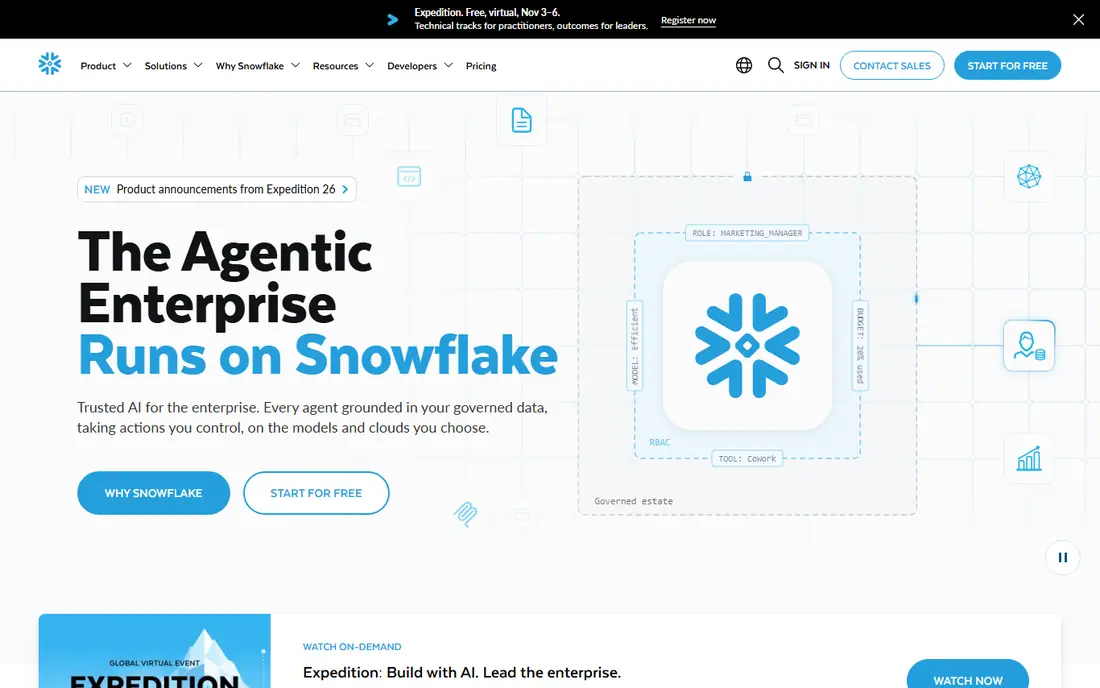
Snowflake is the most capable warehouse on this list, and the one that needs the most care from a small business. Storage and compute are billed separately: storage costs $23 per TB a month, and compute costs $2.00 per credit on Standard in AWS US East, with a small warehouse burning about 2 credits an hour. A business that sets auto-suspend and watches its credit burn can run a small warehouse for tens of dollars a month; a business that leaves a large warehouse running pays hundreds. Snowflake works across AWS, Azure and Google Cloud, and its data sharing lets a business share live data with a partner without copying it.
What we like- Separates storage and compute, scales instantly, strong SQL and sharing features, works across AWS, Azure and Google Cloud
Watch out for- No free tier, credit burn is easy to lose track of, enterprise pricing gets complex, needs care with warehouse sizing
#2Google BigQuery
Best for: Starting at $0 with on-demand pricing4.5/5 on
G2 (1,223 reviews, checked Oct 2026)
Visit cloud.google.com
Starting price$6.25/TiB on-demand
Free planYes, first 1 TiB of queries free each month
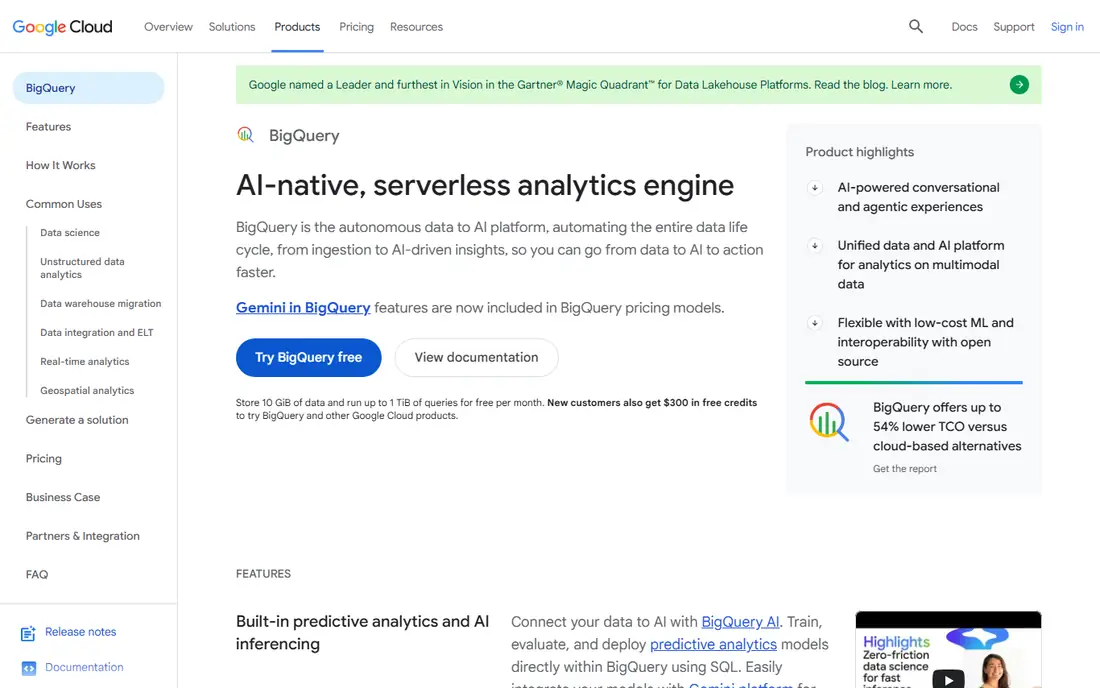
Google BigQuery is the best pick for most small businesses because it starts at $0. On-demand pricing charges $6.25 per TiB scanned, and the first 1 TiB of queries each month is free, so a business querying 100 GB a month pays nothing for compute. There is no server, no cluster and no sizing decision: load the data and run SQL. It integrates with Google Sheets and Looker Studio, so a team can build dashboards without a separate BI tool. The limits are volume: a business that scans terabytes a day will pay more on-demand than on a flat-rate plan. For a small business new to warehousing, BigQuery is the cheapest and simplest start on this list.
What we like- No server to run, first 1 TiB of queries free each month, on-demand pricing starts at $0, integrates with Google Sheets and Looker Studio
Watch out for- On-demand costs grow with query volume, storage and query pricing are separate bills, needs Google Cloud knowledge for advanced use
Starting price$0.375/RPU-hour
Free planFree trial; no free tier
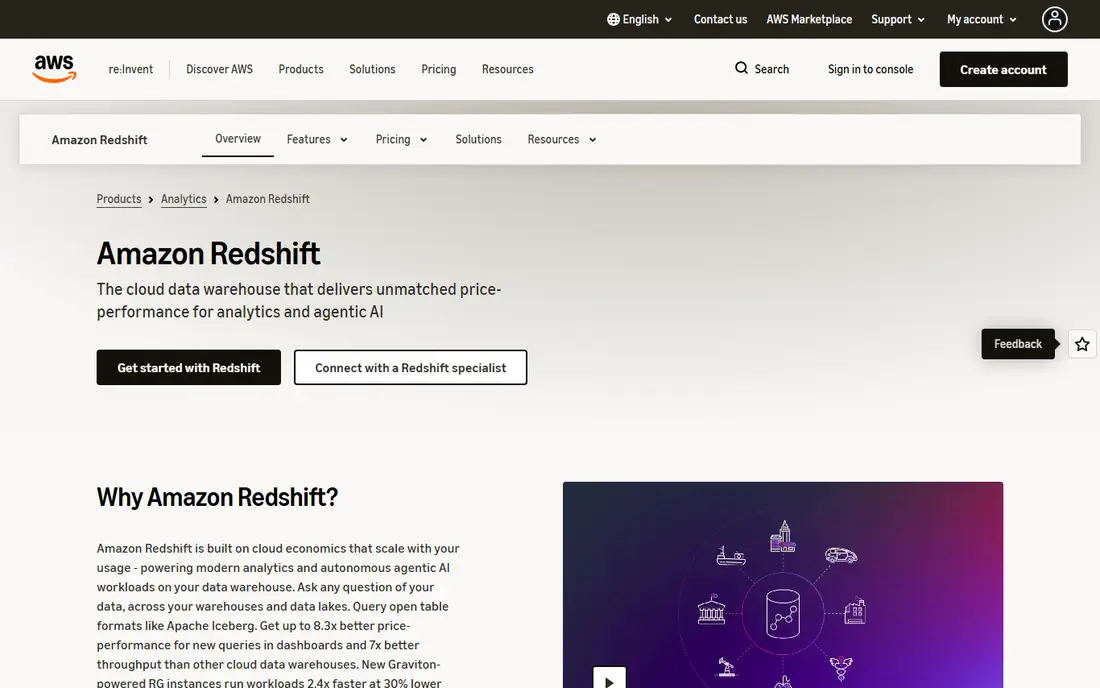
Amazon Redshift Serverless is the warehouse for a business already on AWS. It removes the cluster: the business sets a base capacity and Redshift scales automatically, charging $0.375 per RPU hour with a 4-RPU minimum, or $1.50 an hour when it runs. Data already in S3 loads fast, and it integrates with the rest of the AWS stack, from Glue for ETL to QuickSight for dashboards. The limits are cost and knowledge: the 4-RPU minimum means even a small workload costs $1.50 an hour while it runs, and the team needs AWS knowledge to set it up well. For a business already on AWS with data in S3, Redshift Serverless is the natural pick.
What we like- No cluster to manage, scales automatically, data already in S3 loads fast, integrates with the AWS stack
Watch out for- 4-RPU minimum costs $1.50 an hour when it runs, needs AWS knowledge, no free tier for ongoing use
Starting priceFree Lite; Business from $250/month plus usage
Free planYes, Lite covers 10 GB and 10 compute hours/month
MotherDuck is the managed DuckDB warehouse, and the best pick for a team that already uses DuckDB. The free Lite tier covers 10 GB of storage and 10 compute hours a month, which suits a small business getting started. The Business plan starts at $250 a month plus usage, with compute from $0.60 to $24 an hour depending on instance size. The big advantage is compatibility: SQL written for local DuckDB runs unchanged on MotherDuck, so a team can move its existing queries to the cloud without rewriting them. For a DuckDB team, MotherDuck is the obvious pick; for a team new to warehousing, BigQuery is simpler.
What we like- Managed DuckDB in the cloud, free Lite tier, SQL moves unchanged from local DuckDB, compute from $0.60 to $24 an hour
Watch out for- Business plan from $250 a month plus usage is a jump from free, smaller ecosystem than Snowflake or BigQuery, needs DuckDB knowledge
#5ClickHouse Cloud
Best for: Fast analytics on large event data4.3/5 on
G2 (55 reviews, checked Oct 2026)
Visit clickhouse.com
Starting priceFrom $0.2181/compute unit-hour (Basic)
Free planYes, $300 trial credits
ClickHouse Cloud is the fast analytics warehouse on this list. It is built for large event data: billions of rows, fast aggregations, and real-time dashboards. Pricing starts from $0.2181 per compute unit hour on Basic, according to a third-party report, with $300 in trial credits to start. The open source core means the business can run ClickHouse itself if it wants, and the cloud version removes the operations work. The limits are fit: a small business with under 100 GB of data does not need ClickHouse speed, and usage based pricing is hard to predict without careful monitoring.
What we like- Very fast on large analytical queries, $300 trial credits, open source core, scales to billions of rows
Watch out for- Pricing is usage based and hard to predict, needs ClickHouse SQL knowledge, overkill for a small business with under 100 GB
#6Firebolt
Best for: Low latency analytics on big data4.5/5 on
G2 (14 reviews, checked Oct 2026)
Visit firebolt.io
Starting priceFrom $0.92/hour (1x S engine)
Free planFree trial; no free tier
Firebolt is the low latency warehouse on this list, built for analytics that need to return in milliseconds. Pricing starts from $0.92 an hour for a 1x S engine, according to the vendor, though one figure from the live Rankite embedded analytics page shows $1.84 an hour, which conflicts with the $0.92 figure. It is fast to start, strong on concurrent queries, and built for cloud analytics rather than general purpose warehousing. The limits are fit and price: there is no free tier, and a small business with modest data does not need Firebolt speed. For a business that needs low latency on big data, Firebolt is the best pick.
What we like- Very low latency on large queries, fast to start, strong on concurrent queries, cloud data warehouse built for analytics
Watch out for- One figure from the live Rankite embedded page shows $1.84 an hour which conflicts with the $0.92 figure, no free tier, enterprise focus
Starting price$0.20/DCU Cloud
Free planYes, $400 credit/30 days
Dremio is the warehouse for a business that does not want to copy its data. It queries data where it already sits, in S3, in a data lake or in another warehouse, without moving it into a new store. Cloud pricing is $0.20 per DCU, and a $400 credit for 30 days lets a business try it at no cost. The open source core means the business can run Dremio itself, and the cloud version removes the operations work. The limits are knowledge: Dremio needs data engineering skill to set up well, and pricing by DCU is hard to compare with per-credit or per-TiB pricing.
What we like- Queries data in place without copying it, $400 credit for 30 days to try it, works across S3, data lakes and warehouses, open source core
Watch out for- Needs data engineering knowledge to set up well, pricing by DCU is hard to compare, smaller community than Snowflake or BigQuery
#8Databricks
Best for: SQL analytics plus AI and machine learning4.6/5 on
G2 (1,383 reviews, checked Oct 2026)
Visit databricks.com
Starting price~$0.70/DBU SQL Serverless (AWS Premium)
Free planFree trial; no free tier
Databricks is the analytics and AI platform on this list. Its SQL Serverless product runs SQL analytics without a cluster, at around $0.70 per DBU on AWS Premium, and the same platform runs machine learning, notebooks and data engineering. A small business that wants SQL today and AI tomorrow gets both in one tool. The limits are cost and fit: there is no free tier, pricing by DBU is hard to predict without monitoring, and a small business that only needs SQL is paying for a platform it does not use.
What we like- SQL analytics plus AI and machine learning in one platform, serverless SQL needs no cluster, strong on large data and notebooks
Watch out for- No free tier, pricing by DBU is hard to predict, enterprise focus, overkill for a small business that only needs SQL
Frequently asked questions
What is the best data warehouse software for a small business
Google BigQuery is the best pick for most small businesses because on-demand pricing at $6.25 per TiB starts at nothing, and the first 1 TiB of queries a month is free. MotherDuck is the best pick for a team that already uses DuckDB, with a free Lite tier. Snowflake is the best pick for a business that wants the most capable warehouse, at $2.00 per credit on Standard. Start with BigQuery if the team is new to warehousing.
How much does a data warehouse cost for a small business
BigQuery costs $0 for light use, because the first 1 TiB of queries a month is free. MotherDuck Lite is free for 10 GB and 10 compute hours a month, and Business starts at $250 a month plus usage. Snowflake storage costs $23 per TB a month plus $2.00 a credit for compute. Redshift Serverless costs $1.50 an hour when it runs, at the 4-RPU minimum. A small business should start on a free tier and pay only for what it uses.
Do I need a data engineer to run a data warehouse
No, not on BigQuery or MotherDuck. BigQuery has no server, no cluster and no sizing decision, and MotherDuck is a managed DuckDB that runs a team's existing SQL unchanged. Snowflake and Redshift Serverless need more care: Snowflake needs warehouse sizing and credit monitoring, and Redshift needs AWS knowledge. A team with no data engineer should start with BigQuery or MotherDuck.
What is the difference between a data warehouse and a database
A database runs the business day to day, storing orders, customers and products as they change. A data warehouse stores copies of that data for analysis, so the business can query months of sales without slowing down the live system. A small business uses a database such as Postgres to run its app, and a warehouse such as BigQuery to answer questions about the data.
Can I use a data warehouse with Google Sheets or Excel
Yes. BigQuery integrates with Google Sheets, so a team can query warehouse data from a spreadsheet. Snowflake, Redshift and Databricks all connect to BI tools such as Looker Studio, Metabase and Tableau, which draw the charts. MotherDuck connects to the same BI tools. A warehouse stores the data; a BI tool or a spreadsheet draws the charts.
Sources we checked (8)
- https://www.snowflake.com
- https://cloud.google.com/bigquery
- https://aws.amazon.com/redshift/
- https://www.motherduck.com
- https://clickhouse.com
- https://www.firebolt.io
- https://www.dremio.com
- https://www.databricks.com
Is your product missing or out of date?
We review this list regularly. Vendors can request a listing, send updated pricing or ask about featured placement.

Shihab Mia · Founder, Rankite
Shihab has 5+ years in B2B and SaaS SEO. He writes Rankite's software buying guides from pricing pages, documentation and public user reviews. More about Shihab.