How we make this list: we compare pricing pages, product documentation and public user reviews. Ratings come from G2, Capterra or Trustpilot, with the date we checked them.
What Is Data Versioning Software
Data versioning software records every version of a dataset, table or data lake so a team can return to an earlier state, compare two versions, and reproduce an earlier result exactly. It applies Git-like ideas to data: branches, commits, tags, merges and diffs. A data scientist can train a model on one branch while a colleague tests a cleaning rule on another, and an analyst can query a table as it looked last Tuesday, which is known as time travel.
This matters because data changes constantly. Without versioning, a model that scored well in testing may fail in production because the training data cannot be rebuilt. Versioning gives each dataset a stable identity, so code, data and model versions can be linked together and audited later.
The tools here cover three shapes of versioning: files in object storage, tables in a lakehouse format, and rows inside a database. The right shape depends on where your data lives.
We picked tools that version data itself, not tools that only move data or schedule pipelines. Each tool here offers branching, history or time travel, and each one is available now. We checked prices against vendor pages on 21 Nov 2026. Where the core product is open source, the starting price is free, and any paid tier is noted separately.
We excluded tools that have shut down or been absorbed into another product. XetHub was acquired by Hugging Face in August 2024 and is no longer sold as a standalone product. Data pipeline orchestration and data integration tools move and schedule data, but they do not version it, so they belong in a different guide.
Best Data Versioning Software at a Glance
| Tool | Best for | Versioning level | Starting price | Free plan |
|---|---|---|---|
| DVC | ML teams versioning datasets alongside Git code | Files and datasets | Free (open source) | Yes, full open source core |
| lakeFS | Data lake teams needing Git-like branching at scale | Whole data lake | Free (open source); Enterprise quote | Yes, self-hosted open source |
| Delta Lake | Lakehouse tables with ACID transactions and time travel | Single table | Free (open source) | Yes, full open source format |
| Apache Iceberg | Vendor-neutral tables across many query engines | Single table | Free (open source) | Yes, full open source format |
| Project Nessie | Catalog-level branching for Iceberg and Delta Lake tables | Whole catalog | Free (open source) | Yes, full open source catalog |
| Dolt | SQL teams wanting Git operations inside a database | SQL database | Free (open source); DoltHub Pro $5 per month | Yes, Dolt open source and public DoltHub databases |
| TerminusDB | Knowledge graph and linked data with graph versioning | Knowledge graph | Free (open source); managed quote | Yes, self-hosted open source |
Quick comparison
| Tool | Best for | Starting price | Free plan |
|---|
 DVC | Machine learning teams that want to version datasets, models and experiments alongside Git code | Free (open source) | Yes, the full DVC core is open source under Apache 2.0, with no paid plan for the command line tool itself |
 lakeFS | Data lake teams that need Git-like branching, commits and merges over petabyte-scale object storage | Free (open source); Enterprise quote | Yes, the open source edition can be self-hosted at no license cost |
 Delta Lake | Lakehouse teams on Spark and Databricks that want ACID transactions, time travel and schema checks on Parquet tables | Free (open source) | Yes, Delta Lake is open source, and you pay only for your own storage and compute |
 Apache Iceberg | Teams that want vendor-neutral, versioned tables readable by Spark, Trino, Snowflake, BigQuery and other engines | Free (open source) | Yes, Iceberg is open source under Apache 2.0, with no license fee |
 Project Nessie | Lakehouse teams that want Git-like branches and tags across many Iceberg and Delta Lake tables at once | Free (open source) | Yes, Nessie is open source under the Apache license, with no paid tier for the catalog itself |
 Dolt | SQL teams that want Git operations such as branch, merge, diff and blame directly inside a MySQL compatible database | Free (open source); DoltHub Pro $5 per month | Yes, Dolt itself is free and open source, and public databases on DoltHub are free to host |
 TerminusDB | Teams versioning knowledge graphs, linked data and document data with Git-like branches and history | Free (open source); managed quote | Yes, TerminusDB is open source under Apache 2.0 and free to self-host with Docker |
Is your product missing or out of date?
We review this list regularly. Vendors can request a listing, send updated pricing or ask about featured placement.
#1
DVC
Best for: Machine learning teams that want to version datasets, models and experiments alongside Git code
Visit dvc.org
Starting priceFree (open source)
Free planYes, the full DVC core is open source under Apache 2.0, with no paid plan for the command line tool itself
DVC keeps a small pointer file in Git while the large dataset lives in your own storage, such as Amazon S3 or Google Cloud Storage. When you change the data, DVC records a new version and links it to the Git commit, so checking out an old commit also restores the matching data. That link is why teams choose it for machine learning, where a result is only meaningful if the training data can be rebuilt. lakeFS acquired the project in November 2025, and DVC remains open source.
What we like- Ties each dataset version to a Git commit, works with storage you already own, supports pipelines and experiment tracking, and has a large community and wide integration list
Watch out for- You must manage your own remote storage, and the separate DataChain Studio collaboration layer has a small free team allowance of two collaborators
#2
lakeFS
Best for: Data lake teams that need Git-like branching, commits and merges over petabyte-scale object storage
Visit lakefs.io
Starting priceFree (open source); Enterprise quote
Free planYes, the open source edition can be self-hosted at no license cost
lakeFS sits between your data lake and the tools that read it, and treats the lake like a Git repository. You create a branch to test a new dataset, commit changes when ready, and merge them in one atomic step. If a load goes wrong, you roll back to the previous commit. lakeFS also acquired the DVC project in November 2025, and the vendor offers a 15 day trial of the enterprise edition.
What we like- Brings branches, commits, tags and atomic merges to S3 compatible storage, works with Spark, Trino and other engines, and adds governance and audit trails for AI and agent workloads
Watch out for- The managed cloud and enterprise editions are quote only, so a team cannot budget the hosted service from a published price list, and running it at scale needs solid operations skills
#3
Delta Lake
Best for: Lakehouse teams on Spark and Databricks that want ACID transactions, time travel and schema checks on Parquet tables
Visit delta.io
Starting priceFree (open source)
Free planYes, Delta Lake is open source, and you pay only for your own storage and compute
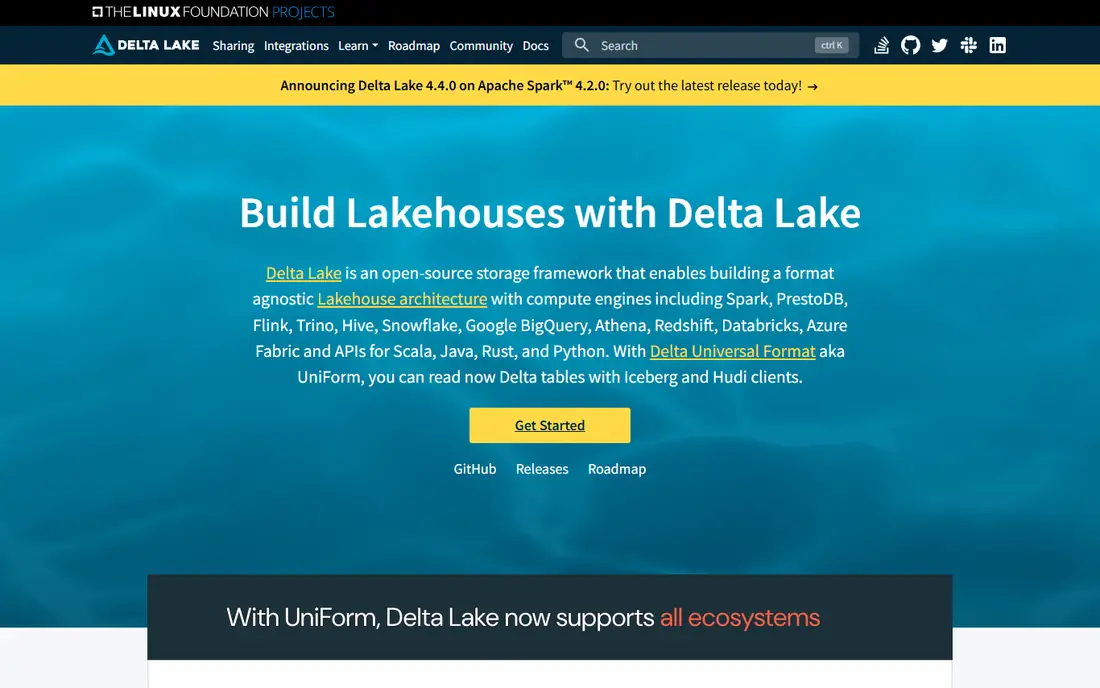
Delta Lake is an open table format, not a standalone application. It stores tables as Parquet files plus a transaction log, and that log makes versioning possible. Every write creates a new table version, which you can query by number or timestamp. You can also roll back a table, enforce a schema, and merge, update or delete rows with normal SQL. It works with any Spark distribution. Managed Databricks compute is billed separately in Databricks Units, such as 0.70 dollars per DBU for serverless SQL in US East.
What we like- Adds transactions, time travel, schema enforcement and upserts to Parquet, is widely supported across Spark and Databricks, and has a large community and mature tooling
Watch out for- Versioning is at table level rather than whole lake level, so cross-table branching needs another layer, and the best managed experience is tied closely to Databricks
#4
Apache Iceberg
Best for: Teams that want vendor-neutral, versioned tables readable by Spark, Trino, Snowflake, BigQuery and other engines
Visit iceberg.apache.org
Starting priceFree (open source)
Free planYes, Iceberg is open source under Apache 2.0, with no license fee
Apache Iceberg is an open table format for large analytic tables on object storage. Like Delta Lake, it records every table version in metadata, so you can query a table as it looked earlier and roll back when a load goes wrong. Its main strength is neutrality: the same table can be read by Spark, Flink, Trino, DuckDB, Snowflake, Databricks and BigQuery, which keeps a team free to change engines later. Vendors charge their normal rates for Iceberg tables, with no separate Iceberg fee.
What we like- Works across many engines without locking tables to one vendor, supports time travel, schema evolution and hidden partitioning, and is supported natively by the major cloud data platforms
Watch out for- Iceberg is a format and a set of libraries, not a complete product, so you still need a catalog, an engine and storage, and the setup is more work than a hosted versioning service
#5
Project Nessie
Best for: Lakehouse teams that want Git-like branches and tags across many Iceberg and Delta Lake tables at once
Visit projectnessie.org
Starting priceFree (open source)
Free planYes, Nessie is open source under the Apache license, with no paid tier for the catalog itself
Project Nessie is a transactional catalog for data lakes with Git-like semantics. Where Delta Lake and Iceberg version one table at a time, Nessie versions the catalog, so a branch can hold consistent versions of many tables together. You can change several tables on a branch, test the result, and merge the whole branch in one atomic commit. It remains available under the Apache 2.0 license, although development has slowed. There is no paid Nessie product; Dremio Cloud is billed separately at 0.20 dollars per Dremio Compute Unit.
What we like- Adds branches, tags and cross-table transactions to a whole catalog, integrates with Iceberg, Delta Lake and Spark, and keeps the branching model separate from any one query engine
Watch out for- Development has slowed, and the project is not an Apache Software Foundation project, so a team should check recent release activity before building a long term plan on it
#6
Dolt
Best for: SQL teams that want Git operations such as branch, merge, diff and blame directly inside a MySQL compatible database
Visit dolthub.com
Starting priceFree (open source); DoltHub Pro $5 per month
Free planYes, Dolt itself is free and open source, and public databases on DoltHub are free to host
Dolt is a SQL database with Git-like version control built into the storage engine. You can branch a database, diff two branches cell by cell, merge them, and roll back to an earlier commit, all with SQL and Git style commands. That makes it useful for teams that version reference data, test data or configuration data in tables. Public databases on DoltHub are free, and DoltHub Pro costs 5 dollars per month once private storage exceeds 100 MB. Older sites still list the old 50 dollar price.
What we like- Brings Git versioning to SQL tables with familiar commands, is MySQL compatible, supports cell level history, and lets teams share and fork databases on DoltHub
Watch out for- Versioning a relational database is heavier than versioning files, performance and tooling differ from plain MySQL in some workloads, and older third party listings still show the old 50 dollar per month figure, which is out of date
#7
TerminusDB
Best for: Teams versioning knowledge graphs, linked data and document data with Git-like branches and history
Visit terminusdb.com
Starting priceFree (open source); managed quote
Free planYes, TerminusDB is open source under Apache 2.0 and free to self-host with Docker
TerminusDB is an open source knowledge graph database with Git-like version control for graphs and vectors. You can branch a graph, change entities and relationships on that branch, merge it back, and inspect the full history of any node. That fits teams that manage product catalogs, master data or research data where relationships matter as much as rows. Self-hosting is free with Docker, under Apache 2.0. Managed hosting is priced by discussion, so ask the vendor for current terms.
What we like- Versions graphs and documents with branches, merges and time travel, combines graph, document and vector data in one store, and is free to run locally or self-host
Watch out for- It is a graph database first, so it is not the right store for large analytic tables or file based ML datasets, and managed hosting is still arranged by talking to the vendor rather than buying a published plan
Start with where your data lives. For files in object storage, DVC and lakeFS are the natural starting points. For tables in a lakehouse, Delta Lake and Apache Iceberg give versioned tables, and Nessie adds branching across them. For rows in a SQL database, Dolt versions the database itself. For a graph, TerminusDB is the specialist choice.
Next, check who needs to read the versions. Iceberg is readable by many engines, Dolt is readable by SQL clients, and DVC fits Git and Python workflows.
Then weigh the operations cost. Every tool here is free to download, but free software still costs time to run. Self-hosting lakeFS or Nessie needs someone to operate the service and manage access. A managed service removes that work and replaces it with a bill. For a small team, the lightest option is usually DVC or Delta Lake on storage and compute you already run.
Finally, test the workflow that matters most before you commit. Branch a dataset, change it, merge it, and roll it back. Query a table as it looked last week. If that loop works cleanly, the tool will hold up in production.
What Data Versioning Is Not
Data versioning is often confused with two neighbouring jobs. Data pipeline orchestration schedules and runs pipelines, and data integration moves data from sources into a warehouse or lake. Both are useful, but neither one versions data. An orchestrator can rerun a pipeline, and an integration tool can copy a table, but neither can show you the table as it looked on a given date.
Versioning also differs from backup. A backup copies data so it can be restored after a failure. Versioning keeps history inside the working system, so every version is queryable and comparable. A backup can restore a file, but it cannot diff two versions or link a data version to a code commit.
Frequently asked questions
What is the best data versioning software for machine learning teams
DVC is the best starting point for most machine learning teams, because it links each dataset version to a Git commit and works with storage you already own. lakeFS is stronger for a shared data lake. A team that versions files in object storage will usually start with DVC, while a team that versions tables will usually start with Delta Lake or Iceberg.
Is data versioning software free
Most leading tools here are open source and free to use, including DVC, lakeFS, Delta Lake, Apache Iceberg, Project Nessie, Dolt and TerminusDB. You still pay for your own storage and compute. Managed hosting and enterprise support are usually quote only. The main cost is usually storage, compute, and the time to run and maintain the software, so check those costs before you commit. DoltHub Pro is the clearest published paid tier, at 5 dollars per month once private storage exceeds 100 MB.
What is the difference between Delta Lake and Apache Iceberg
Both are open table formats that add versioning, transactions and time travel to Parquet tables. Delta Lake grew out of Databricks and Spark, and its managed experience is strongest there. Apache Iceberg is vendor neutral and is read natively by Spark, Trino, Snowflake, BigQuery and DuckDB. A team on Databricks will usually pick Delta Lake, while a team sharing tables across engines will usually pick Iceberg.
Can I version data with Git alone
Git alone is a poor fit for large datasets, because it stores every version as a full copy and struggles with binary files and large tables. Git works well for code and for small pointer files, which is why DVC keeps pointer files in Git and stores the large data elsewhere. lakeFS, Delta Lake and Iceberg store versions efficiently in object storage, so you can query an old version without restoring the whole dataset.
How does data versioning help with reproducibility
Versioning gives each dataset a stable identity, so a model run can record the exact data version, code version and parameters that produced it. When a result is questioned later, the team can check out the same code and data version and rerun the job. Keep the data version, code version and parameters together in one record, so any run can be rebuilt from that record alone. That audit trail is also useful for regulated work, where a team must show which data produced a given decision.
Sources we checked (9)
- https://dvc.org
- https://lakefs.io
- https://delta.io
- https://www.databricks.com/product/pricing
- https://iceberg.apache.org
- https://projectnessie.org
- https://www.dolthub.com
- https://www.dolthub.com/blog/2026-04-24-announcing-dolthub-pro-for-5-dollars-per-month/
- https://terminusdb.com
Is your product missing or out of date?
We review this list regularly. Vendors can request a listing, send updated pricing or ask about featured placement.

Shihab Mia · Founder, Rankite
Shihab has 5+ years in B2B and SaaS SEO. He writes Rankite's software buying guides from pricing pages, documentation and public user reviews. More about Shihab.