How we make this list: we compare pricing pages, product documentation and public user reviews. Ratings come from G2, Capterra or Trustpilot, with the date we checked them.
What is data pipeline orchestration software
Data pipeline orchestration software schedules, runs and watches the jobs that move data. It decides when a pipeline runs, in what order its steps run, what happens when a step fails, and who gets told. It is not the tool that moves the data: Fivetran or Airbyte move it, dbt transforms it, and the orchestrator decides when each of those runs and retries the run when it breaks. A team buys one when a failed nightly load means stale dashboards or when two jobs must run in order.
Direct answer: Apache Airflow is the top pick for most teams because it is free, open source, and the most widely used orchestrator, with the largest library of integrations. Dagster is the best pick for a team that thinks in data assets and wants lineage built in, with Dagster+ Solo from $10 a month plus usage. Prefect is the best pick for a Python team that wants the lightest setup, with a free Hobby tier and Starter at $100 a month. Start with Airflow for the standard choice, Dagster for asset based orchestration, or Prefect for the fastest first pipeline.
Key takeaways
- Apache Airflow is free and open source, and the most widely used orchestrator, with operators for AWS, Google Cloud and Azure.
- Dagster+ Solo costs $10 a month plus $0.040 per credit, and Starter costs $100 a month plus $0.035 per credit, with Serverless compute at $0.010 a minute.
- Prefect Cloud has a free Hobby tier for 2 users and 5 deployments, Starter at $100 a month for 3 users, and Team at $100 per user a month.
- Astronomer Astro bills by the hour, from $0.35 an hour for Developer deployments, with workers from $0.13 an hour.
- Mage Cloud Starter costs $29 a month plus $0.50 per CPU hour, and Kestra, Argo Workflows and Flyte have free open source cores.
How we picked
We compared eight tools on five points: how pipelines are defined, scheduling and retry behaviour, observability when a run fails, the cost of the managed cloud, and how easy it is to leave. A tool scored well when a team could start free, define pipelines in code it already knew, and see why a run failed. Prices come from vendor pricing pages and vendor supplied directory listings, checked 21 November 2026. Where sources disagree, both figures are printed and the conflict is flagged. Prices are search verified; vendor homepages were not individually opened in the browser for this guide. This guide covers workflow orchestrators that schedule and run pipelines, distinct from the live best data pipeline software reviews page, which covers ELT and ingestion tools.
Comparison table
| Tool | Best for | Starting price | Free plan |
| Apache Airflow | Widest adoption and most integrations | Free (open source) | Yes, self-hosted |
| Dagster | Asset based orchestration with lineage | Solo $10/mo + $0.040/credit | Free open source |
| Prefect | Lightest setup for Python teams | Hobby free; Starter $100/mo | Yes, Hobby tier |
| Astronomer | Managed Airflow at scale | Deployments from $0.35/hr | Free trial |
| Mage | Notebook style pipelines with AI help | Cloud Starter $29/mo + $0.50/CPU-hour | Free open source |
| Kestra | YAML declared workflows, no code needed | Free (open source) | Yes, self-hosted |
| Argo Workflows | Kubernetes native orchestration | Free (open source) | Yes, self-hosted |
| Flyte | Type safe ML and data workflows | Free (open source); Union Team $950/mo | Free open source |
What 100 pipeline runs a day costs
A team running 100 pipeline runs a day, or about 3,000 runs a month, pays very different amounts on the managed clouds. On Prefect Cloud Starter at $100 a month, those runs are inside the plan, because Prefect charges by seats and workspaces, not by task volume, and Starter includes 75 hours of Prefect Serverless a month. On Dagster+ Starter at $100 a month plus $0.035 per credit, 3,000 runs cost the $100 plan charge plus the credits for the runs, plus $0.010 a minute for Serverless compute. On Astronomer Astro, a Developer deployment at $0.35 an hour costs about $252 a month if it runs all month, plus workers from $0.13 an hour, and workers scale to zero when no tasks run. On Mage Cloud Starter at $29 a month plus $0.50 per CPU hour, the same runs cost $29 plus the CPU hours the pipelines consume. On Kestra, Argo Workflows, Airflow and Flyte self-hosted, the software costs $0 and the team pays its own cloud bill.
Which orchestrator is best for a team that writes Python
A Python team has three strong picks, and the choice is about style. Apache Airflow is the standard: pipelines are Python files, operators cover every cloud service, and any data engineer the team hires will already know it. Dagster is the best pick when the team thinks in assets, with lineage and data quality checks built in, and Dagster+ Solo starts at $10 a month plus usage. Prefect is the best pick for the lightest start: a Python function becomes a flow with a decorator, Hobby is free for 2 users, and Starter at $100 a month covers 3 users.
How to choose data pipeline orchestration software
Choose by how the team writes pipelines and where they run. If the team writes Python and wants the standard choice with the most integrations, pick Apache Airflow, free and open source, or Astronomer Astro for a managed version from $0.35 an hour. If the team thinks in data assets and wants lineage and quality checks in the same product, pick Dagster, with Solo at $10 a month plus usage. If the team wants the lightest Python setup and a free tier, pick Prefect, with Hobby free and Starter at $100 a month. YAML teams that want no code pick Kestra, free and open source. Kubernetes teams pick Argo Workflows. ML teams that need type safety and caching pick Flyte, with Union.ai Team at $950 a month for a managed control plane.
Quick comparison
| Tool | Best for | Starting price | Free plan |
|---|
 Apache Airflow | Widest adoption and most integrations | Free (open source, Apache 2.0) | Yes, self-hosted with no licence cost |
 Dagster | Asset based orchestration with lineage | Solo $10/mo + $0.040/credit; open source free | Yes, open source self-hosted; 30-day trial of Dagster+ |
 Prefect | Lightest setup for Python teams | Hobby free; Starter $100/mo | Yes, Hobby tier free for 2 users and 5 deployments |
 Astronomer | Managed Airflow at scale | Deployments from $0.35/hr (Developer) | Free trial; no free tier |
 Mage | Notebook style pipelines with AI help | Cloud Starter $29/mo + $0.50/CPU-hour; open source free | Yes, open source self-hosted under Apache 2.0 |
 Kestra | YAML declared workflows, no code needed | Free (open source, Apache 2.0) | Yes, open source self-hosted with unlimited flows and executions |
 Argo Workflows | Kubernetes native orchestration | Free (open source, Apache 2.0) | Yes, self-hosted with no licence cost |
 Flyte | Type safe ML and data workflows | Free (open source, Apache 2.0); Union.ai Team $950/mo | Yes, open source self-hosted with no licence cost |
Is your product missing or out of date?
We review this list regularly. Vendors can request a listing, send updated pricing or ask about featured placement.
These eight tools cover the main ways teams orchestrate data pipelines in 2026, from the standard open source engine to managed clouds.
#1Apache Airflow
Best for: Widest adoption and most integrations4.4/5 on
G2 (130 reviews, checked Oct 2026)
Visit airflow.apache.org
Starting priceFree (open source, Apache 2.0)
Free planYes, self-hosted with no licence cost
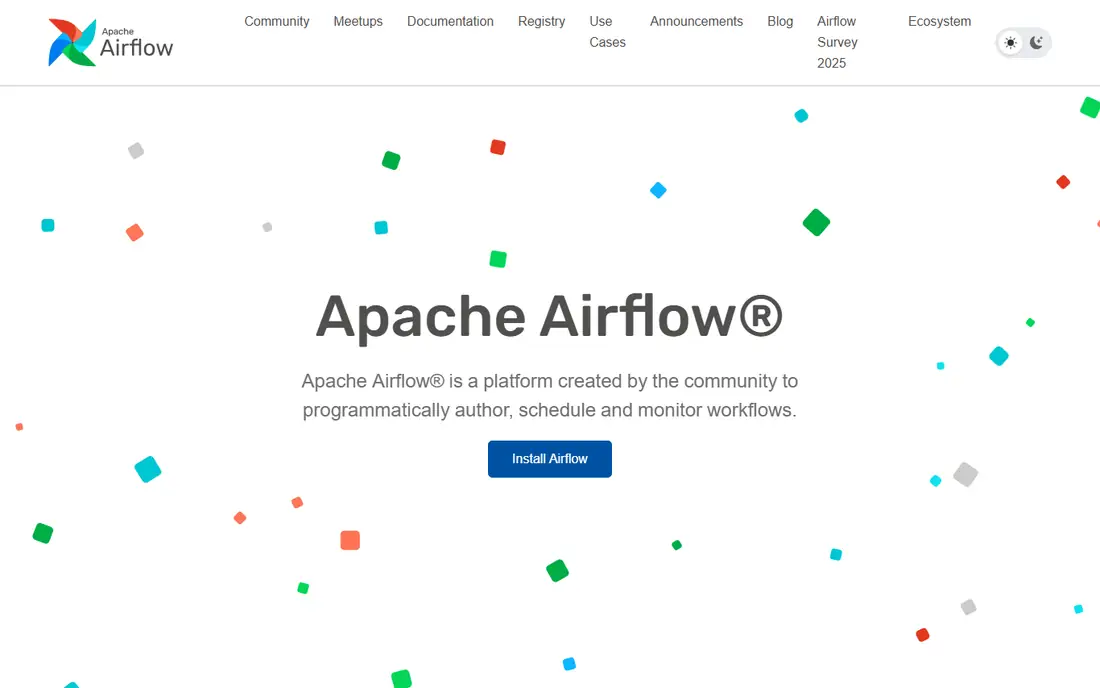
Apache Airflow is the default orchestrator, and the one every other tool on this list is measured against. Pipelines are Python files called DAGs, and the operator library covers almost every data source and destination a team will meet, from S3 and BigQuery to Snowflake and dbt. The community is the largest in the category, so most problems have already been solved. The cost is operational: the team pays for its own infrastructure and runs its own scheduler, web server and database, including upgrades. Managed Airflow from Astronomer or AWS MWAA removes that work for an hourly fee.
What we like- Largest operator library for AWS, Google Cloud and Azure, huge community, every data engineer knows it, runs anywhere Python runs
Watch out for- Self-hosting means the team runs upgrades, scheduling and monitoring itself, the UI shows its age, DAG authoring has a learning curve
Starting priceSolo $10/mo + $0.040/credit; open source free
Free planYes, open source self-hosted; 30-day trial of Dagster+
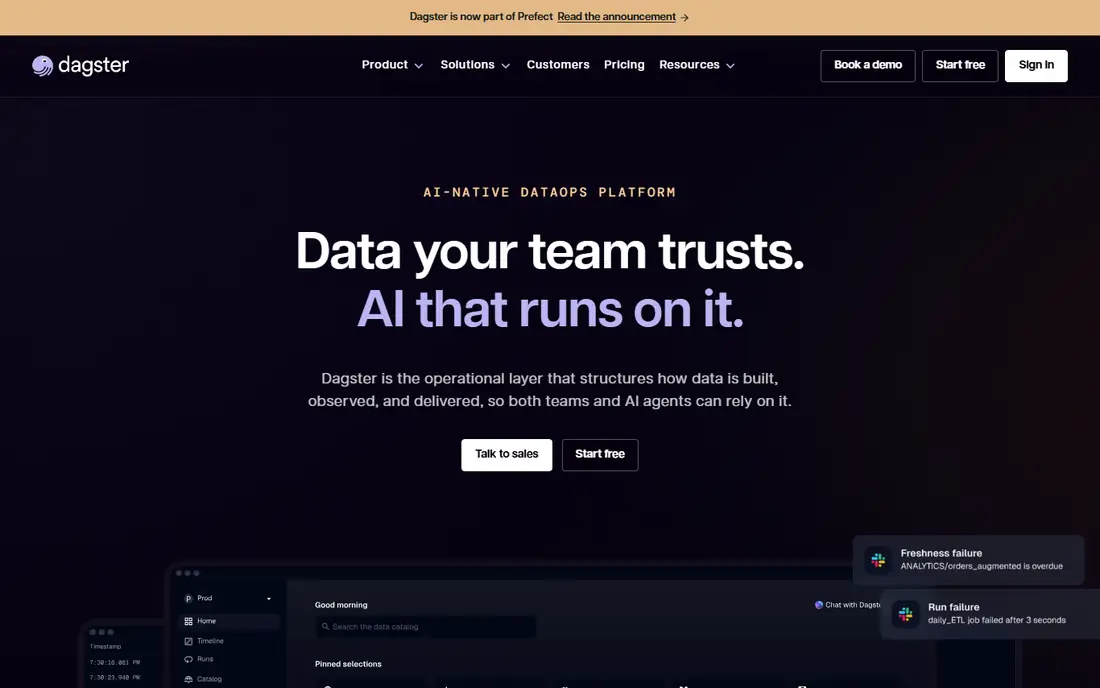
Dagster is the orchestrator for teams that think in assets rather than tasks. A pipeline is defined around the tables, files and models it produces, and Dagster tracks lineage, freshness and quality checks for each asset in a built in catalog. The open source core is free to self-host, and Dagster+ is the managed cloud: Solo costs $10 a month plus $0.040 per credit, Starter costs $100 a month plus $0.035 per credit, and Serverless compute adds $0.010 a minute. One conflict to note: older directory listings show Solo at $120 a month and Starter at $1,200 a month, but the current vendor page lists $10 and $100, so the older figures look discontinued.
What we like- Asset based model with built in lineage and a catalog, data quality checks in the same product, Serverless and Hybrid deployment options, clear per credit pricing
Watch out for- Asset model is a rewrite for teams coming from Airflow DAGs, per credit billing needs modelling to forecast, Pro is quote only, Prefect acquired Dagster Labs in July 2026 so plans may change
#3Prefect
Best for: Lightest setup for Python teams4.5/5 on
G2 (125 reviews, checked Oct 2026)
Visit prefect.io
Starting priceHobby free; Starter $100/mo
Free planYes, Hobby tier free for 2 users and 5 deployments
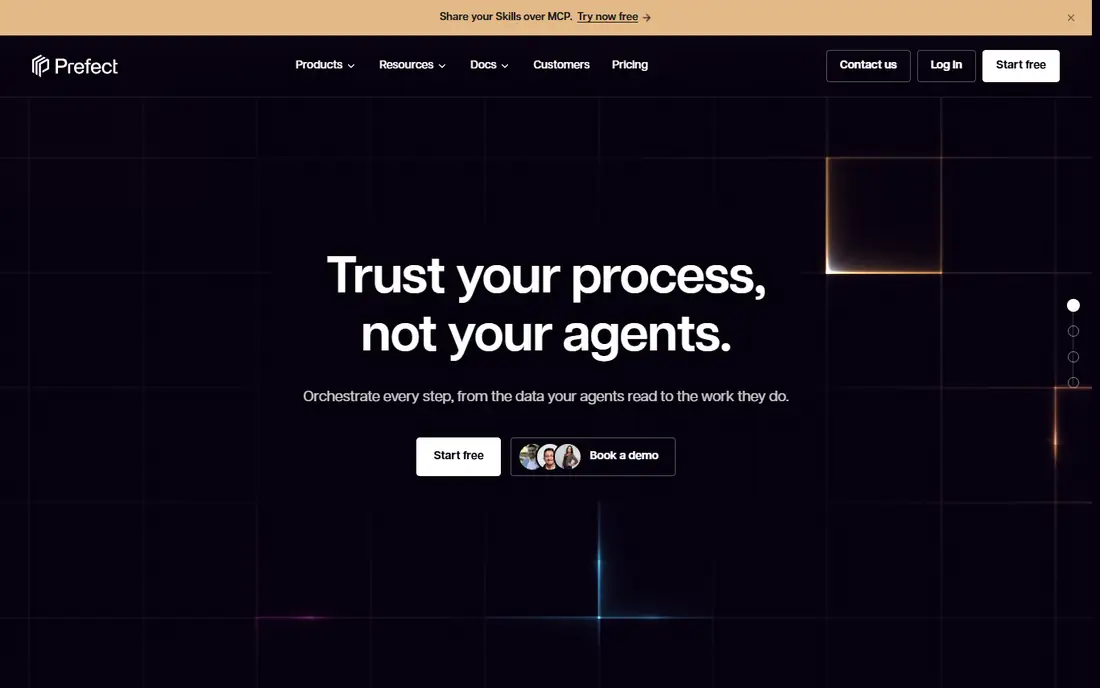
Prefect is the fastest way for a Python team to get a first pipeline running. A plain Python function becomes a flow with a decorator, and the open source server is free to self-host. Prefect Cloud has a free Hobby tier for 2 users, 5 deployments and 500 minutes of Prefect Serverless a month. Starter costs $100 a month for 3 users, 20 deployments and 75 hours of Serverless compute. Team costs $100 per user a month for 4 to 8 users, 100 deployments and 225 hours. Enterprise is custom, with SSO, RBAC, multiple workspaces and a 99.9 percent uptime SLA. Prefect charges by seats and workspaces, not by task volume, which makes the bill predictable.
What we like- A Python function becomes a flow with a decorator, free Hobby tier, pricing by seats not task volume, strong observability and alerting, open source server is free
Watch out for- Team at $100 per user a month gets expensive as the team grows, Enterprise is custom and billed annually, SSO and RBAC sit on Enterprise
Starting priceDeployments from $0.35/hr (Developer)
Free planFree trial; no free tier
Astronomer sells Astro, the managed Apache Airflow platform, for teams that want Airflow without running it. Pricing is pure usage: deployments and workers are billed separately by the hour, metered by the second. Developer deployments start at $0.35 an hour and Team deployments at $0.42 an hour, with workers in seven sizes from $0.13 an hour to $4.16 an hour. Workers scale to zero when no tasks run. Business, Enterprise and Enterprise Business Critical are quote only. One conflict to note: one comparison page lists Astronomer from $0.35 a month, but the vendor page and a second source both show $0.35 an hour, so the monthly figure is a misread.
What we like- Fully managed Airflow with no infrastructure to run, workers scale to zero when idle, dedicated clusters available, strong observability with Astro Observe
Watch out for- Usage based hourly billing needs modelling, Business and Enterprise are quote only, workers cost extra on top of deployments
#5
Mage
Best for: Notebook style pipelines with AI help
Visit mage.ai
Starting priceCloud Starter $29/mo + $0.50/CPU-hour; open source free
Free planYes, open source self-hosted under Apache 2.0
Mage is the orchestrator for teams that like working in notebooks. Pipelines are built from modular blocks in Python, SQL or R, in a notebook style editor, with AI features that generate pipeline code and a dbt integration. The open source core is free to self-host under Apache 2.0. Mage Cloud is the managed option: Starter costs $29 a month plus $0.50 per CPU hour, and Team costs $100 a month plus $0.50 per CPU hour, with up to 10 seats. Enterprise is custom, with private or hybrid deployment.
What we like- Notebook style blocks for Python, SQL and R, AI features for pipeline generation, dbt support, managed cloud from $29 a month
Watch out for- Smaller community than Airflow or Dagster, per CPU hour usage adds up on long runs, Enterprise is custom
Starting priceFree (open source, Apache 2.0)
Free planYes, open source self-hosted with unlimited flows and executions
Kestra is the orchestrator for teams that want workflows without writing code. Flows are declared in YAML, with a visual editor and a no-code builder, and more than 2,600 plugins cover databases, cloud services and APIs. The open source edition is free under Apache 2.0, with unlimited flows and executions, and it self-hosts on Docker or Kubernetes. Kestra Cloud is the managed option, usage based with no published rate and access by request, with a 14 day free period and no card. Enterprise Edition is an annual subscription per instance through sales, adding SSO, RBAC, audit logs and multi-tenancy.
What we like- Workflows declared in YAML with a visual editor, more than 2,600 plugins, event driven scheduling, free open source with no artificial caps
Watch out for- No published price for Cloud or Enterprise, SSO, RBAC, audit logs and multi-tenancy are Enterprise only
Starting priceFree (open source, Apache 2.0)
Free planYes, self-hosted with no licence cost
Argo Workflows is the orchestrator for teams that already run Kubernetes. It is a CNCF graduated project, and workflows run as native Kubernetes resources, so there is no separate scheduler to operate: the cluster is the execution engine. Workflows are declared in YAML, or in Python through the Hera SDK, and the same engine powers CI pipelines, ML training runs and data processing jobs. It is free and open source under Apache 2.0, with no licence cost and no commercial cloud with a published price.
What we like- Runs natively on Kubernetes with no extra scheduler, workflows as YAML or Python, strong for CI and ML pipelines, CNCF graduated project with a large community
Watch out for- Kubernetes only, YAML authoring is verbose for simple jobs, no commercial cloud with a published price
Starting priceFree (open source, Apache 2.0); Union.ai Team $950/mo
Free planYes, open source self-hosted with no licence cost
Flyte is the orchestrator for ML and data teams that need type safety and reproducibility. Workflows are written in pure Python with typed inputs and outputs, and the engine caches task results, retries failures deterministically, and recovers workflows automatically after a crash. Flyte 2, generally available in August 2026, rebuilt the runtime for AI and agentic workloads. The open source engine is free under Apache 2.0 and self-hosts on Kubernetes. Union.ai, the company founded by the creators of Flyte, sells the managed platform: Team costs $950 a month as a minimum credited to usage, with 2 active clusters and 10,000 concurrent actions, and Enterprise is custom with unlimited clusters and 24 by 7 support.
What we like- Type safe workflows with deterministic caching and retries, strong for ML training and data pipelines, durable execution that recovers automatically, Flyte 2 rebuilt for AI workloads
Watch out for- Union.ai Team has a $950 a month minimum, Kubernetes knowledge needed to self-host, smaller community than Airflow, Enterprise is custom
Frequently asked questions
What is the best data pipeline orchestration software
Apache Airflow is the best pick for most teams because it is free, open source, and the most widely used orchestrator, with the largest integration library. Dagster is the best pick for asset based orchestration, with Solo from $10 a month plus usage. Prefect is the best pick for the lightest Python setup, with a free Hobby tier and Starter at $100 a month.
How much does data pipeline orchestration software cost
Self-hosted open source orchestrators cost $0 for the software: Airflow, Dagster, Kestra, Argo Workflows and Flyte are all free to run, and the team pays only for its own infrastructure. Managed clouds start at $10 a month for Dagster+ Solo, $29 a month for Mage Cloud Starter, and $100 a month for Prefect Cloud Starter. Astronomer Astro starts at $0.35 an hour for a Developer deployment, and Union.ai Team starts at $950 a month.
What is the difference between orchestration and a workflow scheduler
A scheduler runs jobs on a timetable, such as cron. An orchestrator adds dependencies between jobs, retries with backoff, alerting, lineage, and a UI that shows every run and why it failed. Cron is fine for one job that never depends on another job. Orchestration is the right tool when jobs depend on each other, when a failure must stop the jobs after it, or when the team needs to see the whole system in one place.
Do I need an orchestrator if I already use Fivetran or Airbyte
Not always. Fivetran and Airbyte have their own schedulers, and a team moving data from a few SaaS apps into a warehouse can run on those schedulers alone. An orchestrator becomes useful when the team adds dbt transformations that must run after the load, when it adds data quality checks, or when several pipelines must run in a strict order. The two categories solve different problems: ELT moves data, orchestration runs the system that moves it.
Can I switch orchestrators later
Yes, but the cost depends on how the pipelines were written. Airflow DAGs, Dagster assets and Prefect flows are all Python, but they use different decorators and APIs, so moving means rewriting the pipeline definitions, not just the schedule. The schedule logic, the SQL and the transformation code move unchanged. Pick the orchestrator that fits the team today, and keep the business logic separate from it.
Sources we checked (9)
- https://airflow.apache.org
- https://dagster.io/pricing
- https://www.prefect.io/pricing
- https://www.astronomer.io
- https://www.mage.ai
- https://kestra.io/pricing
- https://argoproj.github.io/argo-workflows/
- https://flyte.org
- https://www.union.ai
Is your product missing or out of date?
We review this list regularly. Vendors can request a listing, send updated pricing or ask about featured placement.

Shihab Mia · Founder, Rankite
Shihab has 5+ years in B2B and SaaS SEO. He writes Rankite's software buying guides from pricing pages, documentation and public user reviews. More about Shihab.