How we make this list: we compare pricing pages, product documentation and public user reviews. Ratings come from G2, Capterra or Trustpilot, with the date we checked them.
Key takeaways
- The best data orchestration tools in 2026 split by model: Apache Airflow leads on ecosystem breadth, Dagster on asset lineage and quality, Prefect on Python ergonomics, and Astronomer on managed Airflow without the operational load.
- Open source licenses are free, but running the orchestrator is not: self-hosted Airflow means paying for a scheduler, workers, a metadata database, log storage, and the engineer time to handle upgrades.
- Managed pricing differs sharply: Astronomer Astro deployments start at 0.35 dollars an hour, Dagster Plus at 10 dollars a month plus 0.040 dollars per credit, and Prefect Cloud Starter at 100 dollars a month, while MWAA and Composer bill hourly or per compute unit.
- Prefect announced it was acquiring Dagster Labs on 13 July 2026, so Dagster keeps its name and Apache 2.0 license, but buyers should watch how the two products converge.
Quick comparison
Is your product missing or out of date?
We review this list regularly. Vendors can request a listing, send updated pricing or ask about featured placement.
Starting priceFree
Free planYes
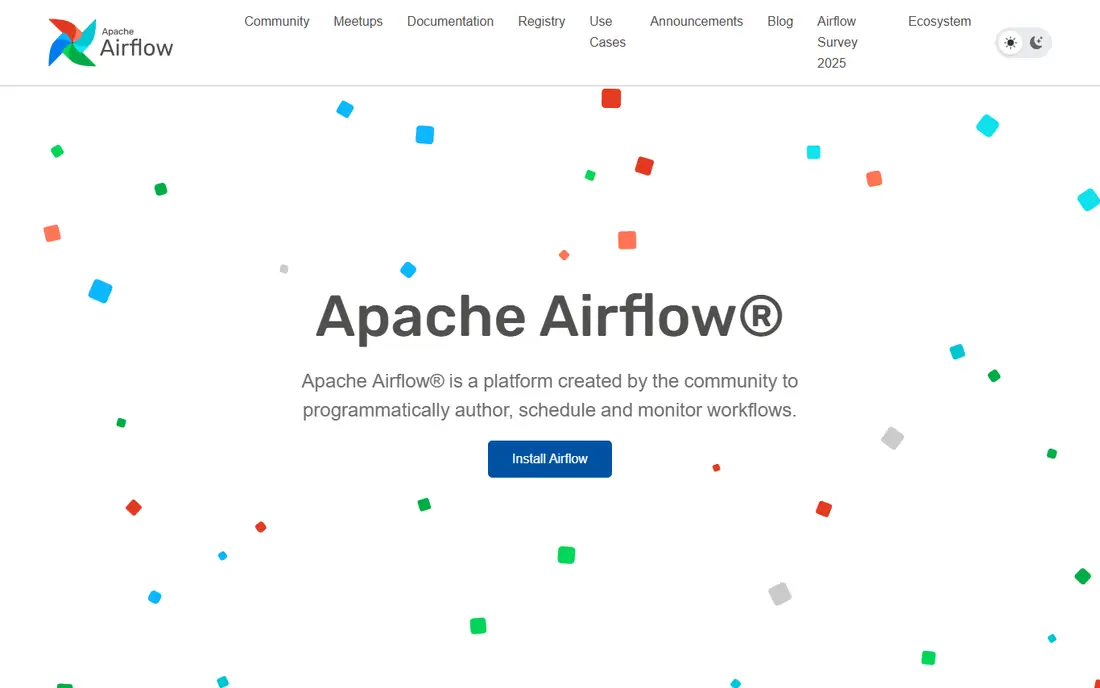
Apache Airflow is the open source orchestration foundation. Its Python-defined DAGs and broad provider ecosystem make it the default choice for large-scale scheduled batch ETL, with about 46,800 GitHub stars and about 30 million monthly PyPI downloads.
The license is free, but running it is not: you pay for a scheduler, workers, a metadata database, and log storage, plus engineer time for upgrades, and the move from Airflow 2 to 3 showed how heavy an upgrade can be. For ecosystem breadth, Airflow leads.
What we like- Largest ecosystem with 1,000 plus community operators and providers
- Python-defined DAGs
- Used by about 80,000 organizations
Watch out for- Steep learning curve and high operational burden
- Scheduler, workers, metadata database, and triggerer to run
- Upgrades can be heavy
Starting price$0.35 per hour
Free planNo
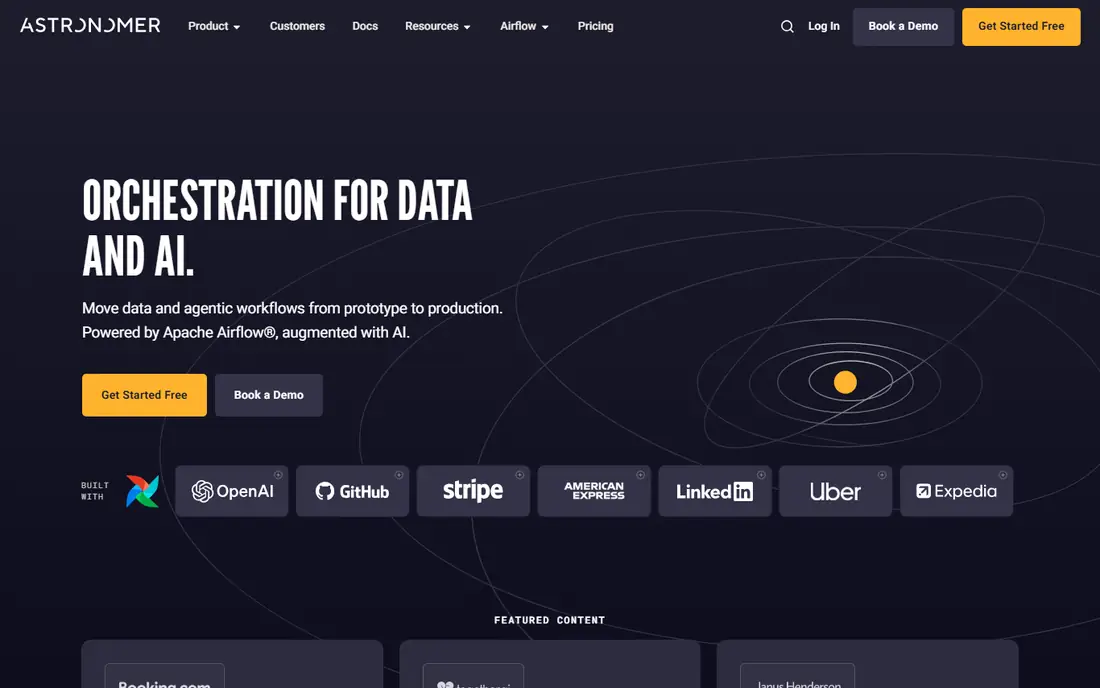
Astronomer Astro is the managed Airflow platform. It handles infrastructure, upgrades, security, and observability that teams typically manage themselves when running open source Airflow, with AI-assisted DAG authoring, preview deployments, and centralized connection management.
Deployments start at 0.35 dollars an hour on Developer or 0.42 dollars on Team, with workers from 0.13 dollars an hour only while tasks run, since they scale to zero. For managed Airflow, Astro is the best pick.
What we like- Managed Airflow without operating every infrastructure component
- Workers scale to zero when idle
- Dbt integration through Cosmos
Watch out for- Hourly pricing bills every hour the deployment is up
- Private networking and HA gated to higher tiers
- Business and Enterprise quoted
Starting price$10 per month
Free planYes
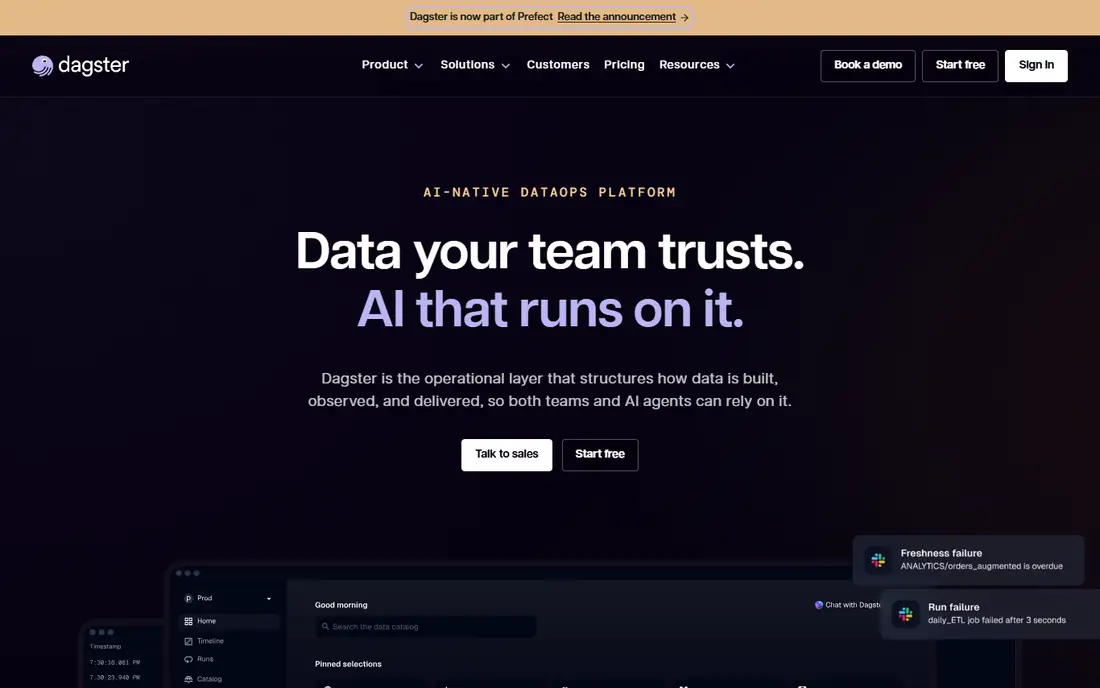
Dagster suits teams that think in data assets rather than tasks. Its software-defined asset model infers dependencies from asset definitions, with built-in lineage and quality checks that Airflow only partly covers through its 3.x assets layer.
Dagster Plus Solo costs 10 dollars a month plus 0.040 dollars per credit, with each asset materialization and op execution counting as a credit, while the open source core is free to self-host. For asset lineage and quality, Dagster leads.
What we like- Software-defined assets with built-in lineage and quality checks
- Deep dbt asset support
- Open source core with managed Dagster Plus
Watch out for- Asset paradigm takes learning
- Smaller catalog than Airflow
- SSO and audit logs need the quoted Pro plan

#4Prefect
Best for: Python-native dynamic pipelines4.5/5 on
G2 (125 reviews, checked Oct 2026)
Visit prefect.io
Starting priceFree
Free planYes
Prefect suits small Python-first teams with no platform engineer. Its dynamic, in-process execution model carries less orchestration overhead for smaller, high-frequency jobs than Airflow's scheduler-and-worker-pool architecture, with flows defined by simple decorators on plain functions.
Prefect Cloud Hobby is free, Starter costs 100 dollars a month, and Team costs 100 dollars a user a month with a 4-user minimum. For Python-native dynamic pipelines, Prefect is the best pick.
What we like- Python ergonomics with flows built at runtime
- Dynamic workflows suit small high-frequency jobs
- Free Hobby tier with 2 users and 5 deployments
Watch out for- Smaller ecosystem and talent pool than Airflow
- Access controls are Cloud-only
- Starter costs 100 dollars a month for up to 3 users
Starting price$0.49 per hour
Free planNo
Amazon Managed Workflows for Apache Airflow suits AWS-native teams. It runs Airflow environments inside AWS, with small environments from 0.49 dollars an hour and large environments at 0.99 dollars an hour, plus worker and metadata storage costs.
A serverless option bills per task with a 1-minute minimum, which suits spiky workloads. For AWS-native Airflow, MWAA leads.
What we like- Managed Airflow inside AWS with no minimum
- Serverless option bills per task
- Fits teams already on AWS
Watch out for- Environment hours by size plus workers and storage add up
- No free tier
- Large environment costs 0.99 dollars an hour
Starting price$0.06 per DCU-hour
Free planNo
Google Cloud Composer suits GCP-native teams. It runs managed Airflow inside Google Cloud, billed at 0.06 dollars per DCU-hour with discounts for 1-year and 3-year commitments, plus database storage at 0.00023287 dollars per GB-hour.
For GCP-native Airflow, Composer is the best pick.
What we like- Managed Airflow inside Google Cloud
- Billed for running time in milli DCU-hours
- Fits teams already on GCP
Watch out for- No free tier
- Database storage adds cost
- GCP-wide support plans only
Starting priceFree
Free planYes
Kestra suits teams that want declarative orchestration without deep Python. Its YAML model lets analysts and engineers read and edit pipelines in a GUI-driven design, with a low barrier to entry for small setups.
The open source core is free, with enterprise features quoted. For declarative orchestration, Kestra leads.
What we like- Declarative YAML model that analysts can read
- Open source with no infra burden for small setups
- GUI-driven design
Watch out for- Smaller ecosystem than Airflow
- Fewer providers than Airflow or Dagster
- Enterprise features quoted
Starting priceFree
Free planYes
Flyte suits engineering-heavy teams running Kubernetes-native workflows. Its code-driven model with strong SDKs suits ML and data workloads at scale, with a free self-hosted option where you pay only your Kubernetes cost.
Setup is slow and engineering-heavy, so small teams should prefer Prefect or Kestra. For Kubernetes-native workflows, Flyte rounds out the list.
What we like- Open source under Apache 2.0
- Kubernetes-native design suits ML and data workloads
- Strong SDKs for code-driven workflows
Watch out for- Engineering-heavy with a slow setup
- No native dbt support
- High distributed-systems barrier to entry
How we chose
We ranked tools by ecosystem breadth, asset and lineage support, developer experience, and value at entry level pricing. We favored tools whose pricing model matches their use case, since billing basis matters more than the headline number: per-credit pricing grows with every asset materialization, hourly pricing bills the deployment for every hour it is up, and per-seat pricing grows with team size.
We also weighed total cost honestly. An Apache 2.0 license is free, but running the orchestrator means paying for servers and engineer time, so test any pricing model against a month of your real runs before committing. Enterprise pricing is usually custom, so check the vendor pricing page before buying.
Buying guide
Start with your cloud stack. AWS teams should pick MWAA, GCP teams Composer, and cloud-neutral teams Airflow, Dagster, or Prefect. A managed service beats self-hosting when your team has no platform engineer, while self-hosting suits teams that already run Kubernetes well.
Next, match the model to your pipelines. Asset-centric teams should pick Dagster for lineage and quality, Python-first teams Prefect for dynamic workflows, and ecosystem-driven teams Airflow for its provider catalog. Count a month of your real runs first, since per-credit and hourly models behave very differently at scale. A pipeline that runs once a day costs little on any model, while a pipeline that runs every minute can multiply per-credit or per-minute charges fast, so measure before you commit to a pricing model.
Finally, plan for governance early. SSO, audit logs, and role-based access often sit behind higher tiers, so check which tier covers them before committing, and watch the Prefect and Dagster convergence after the July 2026 acquisition for roadmap changes. Document ownership for every pipeline, since an unowned pipeline fails silently when its author leaves, and set alerts on every critical pipeline before a failure first strikes, not after a weekend failure.
Frequently asked questions
What is the best data orchestration tool overall?
Apache Airflow leads on ecosystem breadth, Dagster on asset lineage, Prefect on Python ergonomics, and Astronomer Astro on managed Airflow. The best pick depends on your cloud stack, team size, and pipeline model, and teams already on AWS or GCP should start with MWAA or Composer before adding a third vendor.
Is Apache Airflow free?
Yes, the license is free under Apache 2.0. Running it is not free: you pay for a scheduler, workers, a metadata database, log storage, and engineer time for upgrades, which is why managed options such as Astro, MWAA, and Composer exist. Teams that self-host should budget for on-call coverage too, since a failed scheduler blocks every pipeline, and a 2 a.m. failure needs someone who can restart it.
How much does managed Airflow cost?
Astronomer Astro deployments start at 0.35 dollars an hour, Amazon MWAA small environments at 0.49 dollars an hour, and Google Cloud Composer at 0.06 dollars per DCU-hour. Hourly pricing bills the deployment for every hour it is up, even on quiet days, so a deployment that never sleeps costs about 250 dollars a month on Astro Developer before worker charges, which is why Astro workers scaling to zero matters.
Should I pick Dagster or Prefect?
Pick Dagster for asset lineage, data quality checks, and deep dbt support, and Prefect for Python-native dynamic pipelines with less orchestration overhead for small high-frequency jobs. Note that Prefect announced it was acquiring Dagster Labs in July 2026, so watch their roadmaps, since the two products may converge and pricing or feature packaging could change after the acquisition closes.
What is the cheapest way to start with data orchestration?
Self-host Airflow, Dagster, Kestra, or Flyte for a zero license cost, or use Prefect Cloud Hobby free for 2 users and 5 deployments. Budget for servers and engineer time, since a free license does not mean a free system, and a small team can easily spend more on engineer hours than a managed plan would have cost.
Sources we checked (0)
Is your product missing or out of date?
We review this list regularly. Vendors can request a listing, send updated pricing or ask about featured placement.

Shihab Mia · Founder, Rankite
Shihab has 5+ years in B2B and SaaS SEO. He writes Rankite's software buying guides from pricing pages, documentation and public user reviews. More about Shihab.
 Apache Airflow
 Astronomer Astro
 Dagster
 Amazon MWAA
 Google Cloud Composer
 Kestra
 Flyte