How we make this list: we compare pricing pages, product documentation and public user reviews. Rankite is independent; if a vendor ever pays for a featured spot, that listing is clearly labeled Partner.
Key takeaways
- Nlyte, Sunbird and Schneider Electric EcoStruxure IT are the established DCIM choices, each with deep enterprise references.
- Device42 (now a Freshworks company) is the pick when discovery and dependency mapping matter more than facilities monitoring.
- Hyperview is the modern disruptor: cloud DCIM from $125 per month with a 30-day free trial, per its own site.
- RF Code fills the real-time gap: wireless asset tracking and environmental monitoring that feeds into DCIM platforms.
Quick comparison
| Tool | Best for | Starting price | Free plan |
|---|
 Nlyte Nlyte | Large enterprises managing data centers, colo, edge and cloud together | See website (custom quote) | No (demo available) |
 Sunbird DCIM Sunbird DCIM | Data center operators wanting proven asset, capacity and power management | See website (custom quote) | No (demo available) |
 Schneider Electric EcoStruxure IT Schneider Electric EcoStruxure IT | Organizations running Schneider/APC gear that want vendor-neutral monitoring | See website | Free trials available |
 Device42 Device42 | IT teams that need discovery and dependency mapping first | See website (custom quote) | No (demo available) |
 Modius OpenData Modius OpenData | Operators wanting real-time operational intelligence, not just records | See website (custom quote) | Free trial (no credit card required) |
 Hyperview Hyperview | Teams that want modern cloud DCIM without enterprise pricing | From $125/month (per vendor) | 30-day free trial (no credit card required) |
 FNT FNT | European enterprises with strict data-sovereignty requirements | See website (custom quote) | No (demo available) |
 RF Code RF Code | Data centers needing real-time asset tracking and environmental sensing | See website (custom quote) | No (demo available) |
Is your product missing or out of date?
We review this list regularly. Vendors can request a listing, send updated pricing or ask about featured placement.
The best data center infrastructure management software
The capacity report says the data hall is full. The facilities team says there is stranded power everywhere. Both are looking at different spreadsheets, and neither is wrong. Data center infrastructure management software exists to end that argument: one system of record for assets, power, cooling, space and connectivity. These eight platforms cover the category from enterprise suites to modern cloud tools.
#1
Nlyte
Best for: Large enterprises managing data centers, colo, edge and cloud together
Visit nlyte.com
Starting priceSee website (custom quote)
Free planNo (demo available)
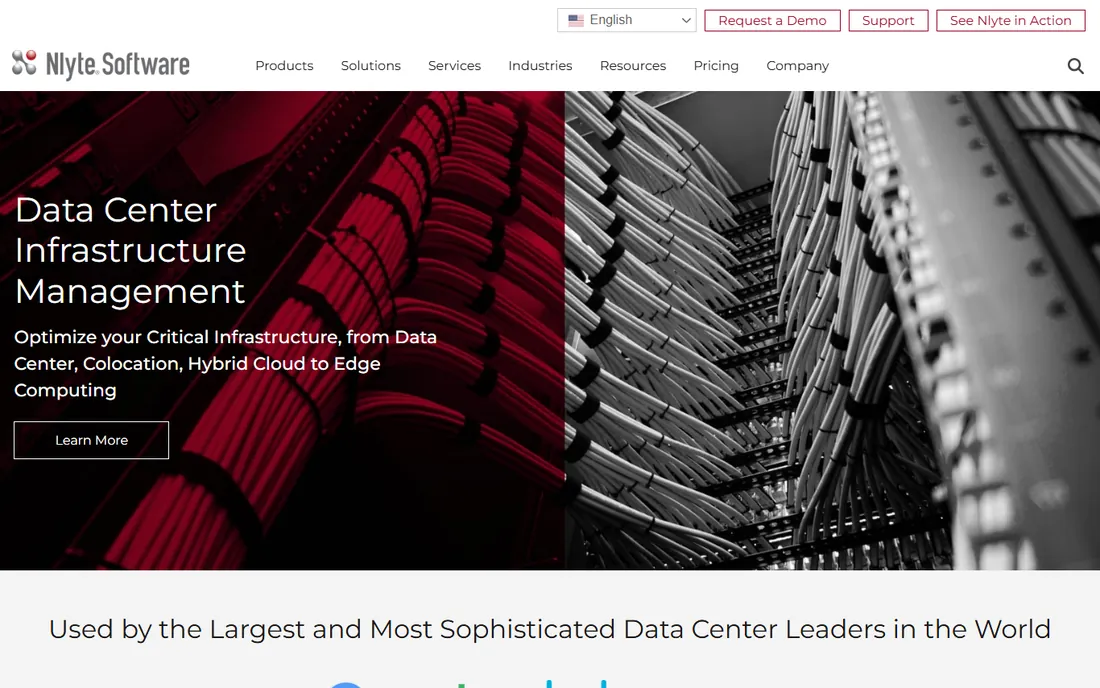
Nlyte is the enterprise DCIM standard-bearer. It manages hybrid infrastructure from desktops to data centers to edge, with monitoring, inventory, workflow and analytics. Customer stories carry weight: Cisco deferred a $20 million data center build using Nlyte capacity data, and TransUnion credits it with faster server installations. The platform now includes operational AI and zero-trust infrastructure security features.
The trade is enterprise everything: pricing, implementation timelines and a learning curve that G2 reviewers note. For a large organization standardizing infrastructure management across facilities, data centers and cloud, Nlyte's breadth and reference base make it the safe choice.
What we like- Broad hybrid infrastructure coverage with workflow automation
- Strong enterprise references (Cisco, IBM, TransUnion)
- 100-plus out-of-the-box integrations
Watch out for- Enterprise pricing and implementation
- Steeper learning curve than newer tools
#2
Sunbird DCIM
Best for: Data center operators wanting proven asset, capacity and power management
Visit sunbirddcim.com
Starting priceSee website (custom quote)
Free planNo (demo available)
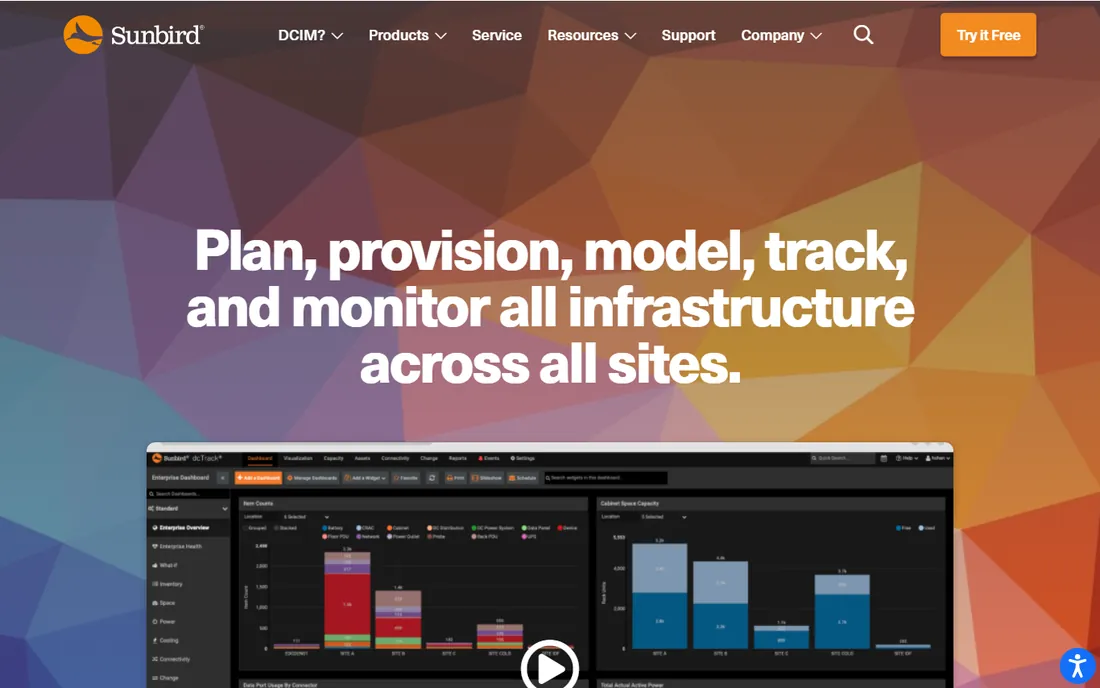
Sunbird focuses on what data center operators actually do: plan, provision, model, track and monitor infrastructure. The dcTrack and Power IQ combination covers asset lifecycle, capacity management, power monitoring and environmental management. New AI copilots auto-calculate power budgets per device from measured load and detect load shifts that threaten redundancy. Reviewers rate it 4.6 on G2.
Sunbird is the DCIM system of record rather than an IT discovery platform: it documents what is in the hall rather than discovering what is on the network. For operators whose pain is capacity planning and power management, that focus is exactly right. Pricing is quote-based.
What we like- Purpose-built DCIM (dcTrack plus Power IQ) with strong reviews
- New AI copilots for power budgeting and load-shift detection
- Easy deployment relative to enterprise suites
Watch out for- Traditional DCIM scope, less IT discovery depth than Device42
- Pricing is custom
#3
Schneider Electric EcoStruxure IT
Best for: Organizations running Schneider/APC gear that want vendor-neutral monitoring
Visit se.com
Starting priceSee website
Free planFree trials available
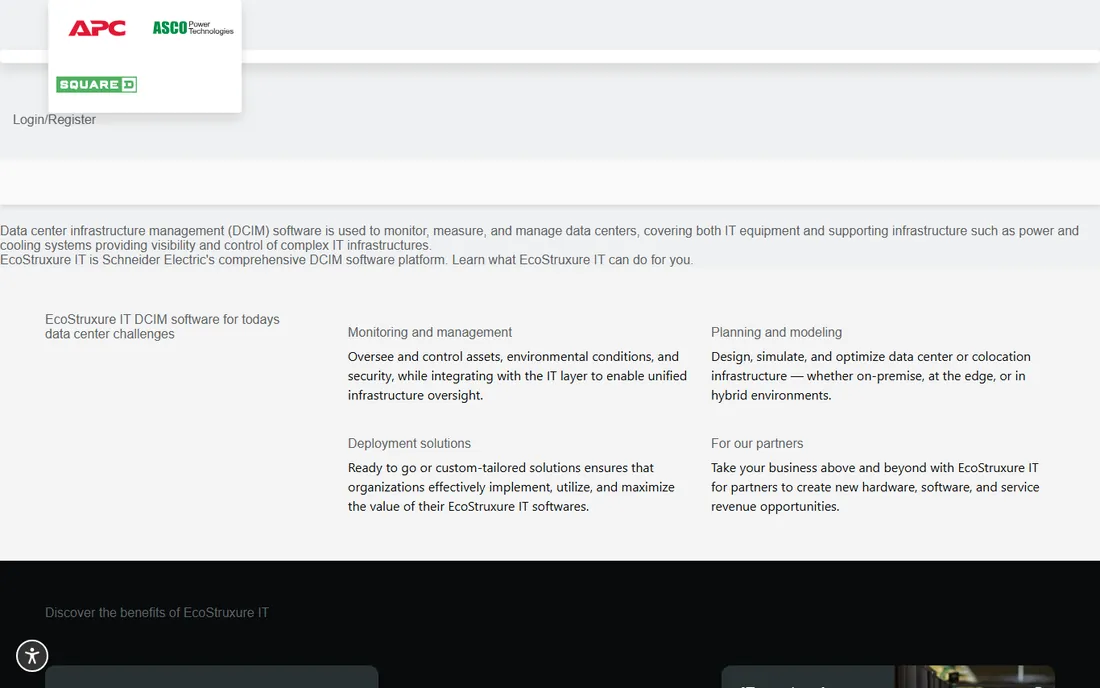
EcoStruxure IT is Schneider Electric's DCIM 3.0 portfolio: IT Expert for cloud-based monitoring, Data Center Expert for on-premises management, IT Advisor for planning and capacity modeling, plus NetBotz environmental monitoring and SmartConnect for UPS fleets. The vendor-neutral design manages third-party equipment alongside Schneider gear, which matters in heterogeneous data centers.
The portfolio approach means matching products to needs: monitoring, planning and business continuity are separate pieces. Free trials are available for several products, which lowers the evaluation barrier. For a Schneider-heavy shop or a team wanting one vendor from UPS to software, the ecosystem argument is strong.
What we like- Vendor-neutral monitoring across Schneider and third-party equipment
- Cloud-based IT Expert plus on-premises Data Center Expert
- Free trials for several products
Watch out for- Portfolio breadth can confuse buyers
- The full DCIM vision spans multiple products
#4
Device42
Best for: IT teams that need discovery and dependency mapping first
Visit device42.com
Starting priceSee website (custom quote)
Free planNo (demo available)
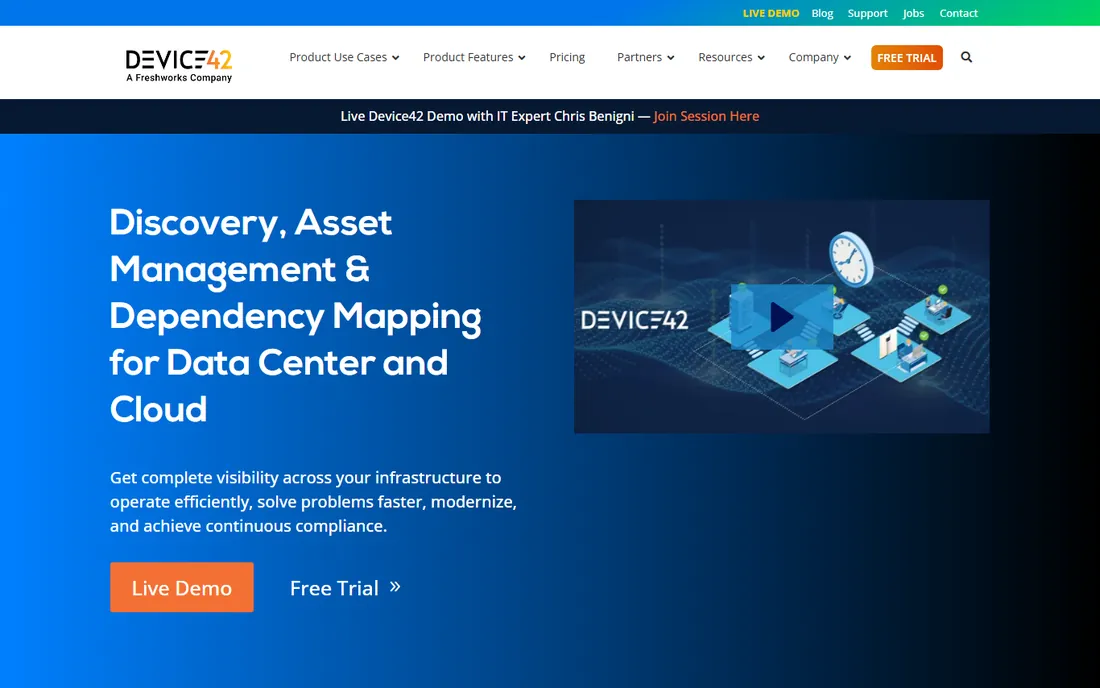
Device42 approaches from the IT side: automated discovery of everything on the network, from mainframes to cloud containers, with dependency mapping that shows what depends on what. For migration planning, audit readiness and ITSM enrichment, reviewers rate it the best in class at 4.7 stars on G2. The Freshworks acquisition adds corporate stability.
The honest framing: Device42 is a discovery and CMDB platform with DCIM capabilities, not a facilities-first DCIM. If the primary need is power and cooling monitoring, Sunbird or Modius fit better. If the need is knowing exactly what is running where and what breaks when it fails, Device42 is unmatched.
What we like- Best-in-class agentless discovery and dependency mapping
- 4.7 stars on G2
- Now backed by Freshworks
Watch out for- DCIM capabilities sit on top of a discovery platform rather than leading
- Pricing is custom
#5
Modius OpenData
Best for: Operators wanting real-time operational intelligence, not just records
Visit modius.com
Starting priceSee website (custom quote)
Free planFree trial (no credit card required)
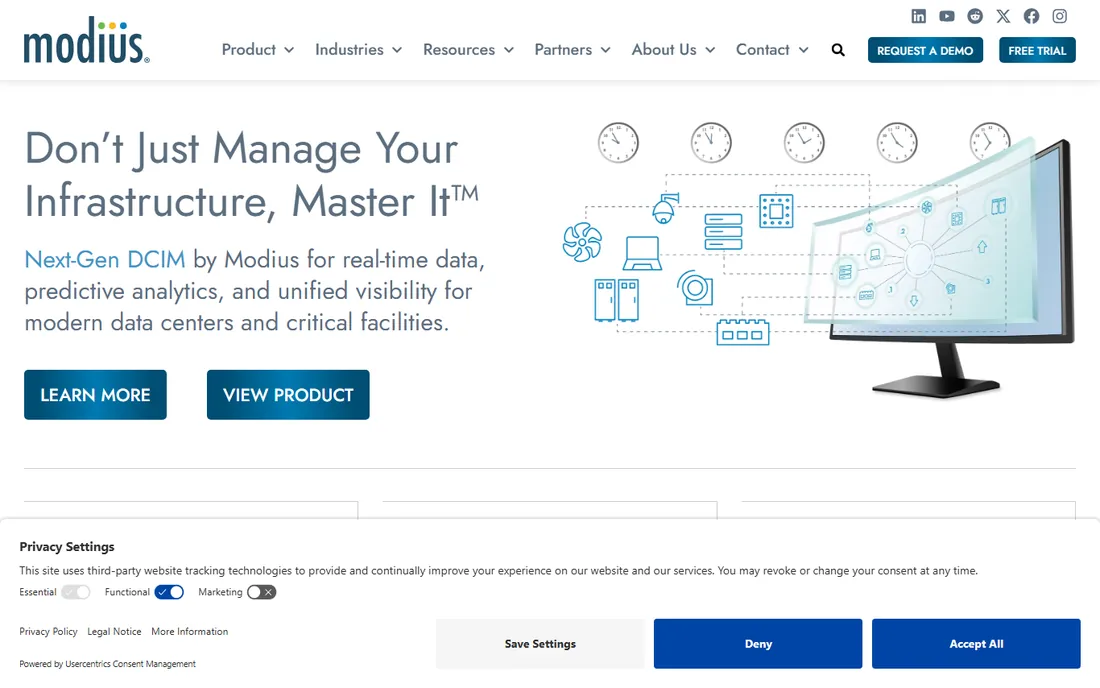
Modius OpenData targets the operational side: real-time data collection from power, cooling, environmental and IT systems, normalized into one pane of glass with predictive analytics and 3D visualization. Native AI and ML analytics plus deep building-management integration (BACnet, Modbus) set it apart from record-keeping DCIM. It runs on-premises or in the cloud and extends beyond data centers into telecom and smart buildings.
The free trial with no credit card makes evaluation easy. For operators whose problem is understanding and predicting performance rather than documenting assets, OpenData's operational intelligence is the stronger mission. Pricing is quote-based.
What we like- Unified IT and OT telemetry with predictive analytics
- Deep BMS integration via BACnet and Modbus
- Free trial with no credit card
Watch out for- Smaller vendor than the giants
- Positioning overlaps traditional DCIM, so evaluations need focus
Starting priceFrom $125/month (per vendor)
Free plan30-day free trial (no credit card required)

Hyperview is the DCIM industry's cloud-native challenger. Asset auto-discovery, power tracking, automated reporting and sustainability reporting in a modern web interface, with transparent pricing starting at $125 per month and a 30-day free trial that needs no credit card. The vendor claims 30 percent operating-cost reduction through power, cooling and capacity management.
The trade is maturity: fewer Fortune 500 references than Nlyte or Schneider. But the value proposition is sharp: DCIM that deploys in minutes, not months, at a published price. For small to mid-size data centers and edge sites priced out of enterprise DCIM, Hyperview is the obvious evaluation.
What we like- Published pricing from $125 per month
- 30-day free trial with full features
- Rapid onboarding with no professional services needed
Watch out for- Younger vendor with a smaller enterprise reference base
- Less depth in edge-case workflows
Starting priceSee website (custom quote)
Free planNo (demo available)
FNT Command is the European DCIM alternative: infrastructure documentation and management from the physical layer through logical and virtual structures to services, with 500-plus customers and 25,000-plus users. The German engineering pitch includes KRITIS suitability, full infrastructure data control and EU legal jurisdiction, which matters for regulated European industries. Flexible licensing covers subscription or perpetual models.
US buyers will find less local presence and fewer domestic references. For European enterprises, especially in Germany's industrial and financial sectors, FNT's data-sovereignty story and deep documentation capabilities make it a natural fit.
What we like- German vendor with EU data-sovereignty credentials
- 500-plus customers including major European enterprises
- Flexible subscription or perpetual licensing
Watch out for- Euro-centric customer base and marketing
- Less visibility in the US market
#8
RF Code
Best for: Data centers needing real-time asset tracking and environmental sensing
Visit rfcode.com
Starting priceSee website (custom quote)
Free planNo (demo available)
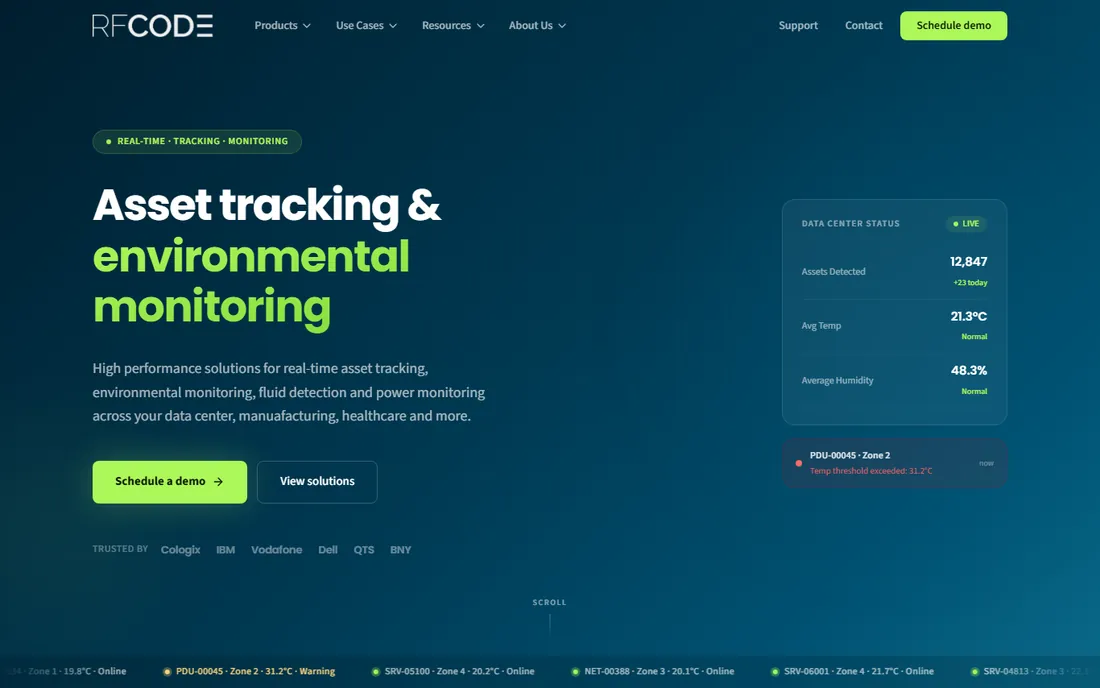
RF Code fills the gap DCIM software alone cannot: knowing where assets actually are, right now. Wireless sensors provide automated continuous asset inventory, rack-level temperature and humidity monitoring, real-time power draw and fluid detection, all feeding into DCIM and ITSM platforms. Customers include IBM, Vodafone, Dell and Cologix.
Think of RF Code as the sensing layer rather than the system of record: it makes Nlyte, Sunbird or ServiceNow data accurate in real time. For data centers struggling with audit accuracy or hotspot detection, the sensor-plus-software combination solves problems pure software cannot see.
What we like- Real-time wireless asset tracking with automated audit
- Rack-level environmental sensors with no wiring
- Integrates with DCIM and ITSM platforms
Watch out for- Sensor hardware is part of the solution, so it is not pure software
- Complements rather than replaces DCIM
How we chose
We started with the searches infrastructure teams run: DCIM software, data center infrastructure management software and data center monitoring software. For each candidate we confirmed the product is live on the vendor's site, checked pricing pages (marking "See website" where the vendor publishes nothing), and weighed G2 reviews and practitioner discussion. Only current, supported products made the list; Vertiv was evaluated but its site could not be verified during research.
DCIM vs. IT monitoring: knowing which you need
Teams often confuse DCIM with infrastructure monitoring, and vendors encourage the confusion. DCIM answers: what assets do we have, where are they, how much power and cooling capacity remains, and what changes are planned. IT monitoring answers: are systems up, how are they performing, and what just broke. Nlyte, Sunbird and Schneider cover the DCIM side; Device42 bridges toward IT operations; tools like Datadog or PRTG cover monitoring.
Many organizations need both, integrated. The DCIM holds the physical truth (assets, power, space); the monitoring holds the operational truth (health, performance). When evaluating, list the five questions your team asks weekly and check which system answers each. Buy the DCIM for the physical questions first.
The capacity planning payoff
The single highest-ROI DCIM use case is capacity planning: knowing exactly how much power, cooling, space and network headroom each site has. Cisco's $20 million deferred build is the famous example, but the everyday version is avoiding a new UPS purchase, delaying a colo expansion, or finding stranded capacity for an AI deployment.
To get there, the DCIM needs accurate data: real power readings (not nameplate ratings), actual space utilization and current cooling loads. This is where Sunbird's AI power budgeting, Modius's real-time telemetry and RF Code's sensors earn their keep. In the demo, ask the vendor to show capacity headroom for one of your actual halls using your data, not their sample set.
Frequently asked questions
How much does DCIM software cost?
Hyperview publishes pricing from $125 per month, the only transparent price in this set. Enterprise DCIM from Nlyte, Schneider and Sunbird is quote-based and typically runs from tens of thousands to six figures annually depending on device count and modules. Always price by monitored device or rack, not by user.
What is the difference between DCIM and a CMDB?
A CMDB (like Device42's) tracks IT configuration items and their relationships for service management. DCIM tracks the physical data center: assets, power, cooling, space and connectivity. They overlap on asset inventory but serve different teams; many enterprises run both, integrated.
Can DCIM software monitor colocation sites?
Yes. Nlyte, Sunbird and Schneider all support multi-site and colocation management, tracking cages, power commits and capacity across providers. Confirm the licensing model covers remote sites without per-site penalties, and check whether power billing reconciliation for colo is included.
Do we need sensors, or is software enough?
Software alone works for asset, capacity and change management based on documented data. Real-time power, temperature and asset-location accuracy needs sensors: RF Code's wireless sensors, Schneider's NetBotz or PDU metering. Most mature deployments combine both.
How long does DCIM implementation take?
Hyperview advertises deployment in minutes; Modius offers rapid onboarding. Enterprise DCIM typically takes 8 to 16 weeks including discovery, data cleanup and integration. The long pole is data quality: the software is only as good as the asset and power data fed into it.
Sources we checked (9)
- https://www.nlyte.com
- https://sunbirddcim.com/
- https://www.se.com/us/en/work/solutions/data-centers-and-networks/dcim-software/
- https://www.device42.com
- https://modius.com
- https://hyperviewhq.com/
- https://fntsoftware.com/
- https://rfcode.com/
- https://www.g2.com/products/nlyte/competitors/alternatives
Is your product missing or out of date?
We review this list regularly. Vendors can request a listing, send updated pricing or ask about featured placement.

Shihab Mia · Founder, Rankite
Shihab has spent more than a decade helping SaaS and e-commerce brands grow through search. He writes Rankite's software buying guides from pricing pages, documentation and public user reviews. More about Shihab.