How we make this list: we compare pricing pages, product documentation and public user reviews. Ratings come from G2, Capterra or Trustpilot, with the date we checked them.
Key takeaways
- The category splits in two: in-app onboarding tools (Userpilot, Appcues, Chameleon, Pendo, Userflow) that teach users inside your product, and client onboarding platforms (Rocketlane, GUIDEcx, OnRamp) that manage implementations with a customer portal.
- Want onboarding plus analytics in one tool? Userpilot starts at $299/month and Intercom starts at $29/seat/month, both with vendor-published prices.
- Userflow publishes the clearest price on this list: $300/month for Essentials with 1,000 monthly active users.
- Appcues, Chameleon, Pendo, Rocketlane, GUIDEcx and OnRamp publish no prices: expect a sales conversation and budget accordingly.
Quick comparison
| Tool | Best for | Starting price | Free plan |
|---|
 Userpilot Userpilot | Product teams wanting onboarding, analytics and feedback in one tool | From $299/month (vendor-listed range: $299 to $799) | No |
 Rocketlane Rocketlane | Services and implementation teams managing many concurrent onboardings | See website (custom quote only) | No |
 GUIDEcx GUIDEcx | Client onboarding teams needing portal, email and mobile participation | See website (custom quote only) | No |
 Appcues Appcues | SaaS teams launching in-app onboarding without engineering | See website (custom quote only) | No |
 Userflow Userflow | PLG teams wanting fast no-code onboarding flows with clear pricing | $300/month (Essentials), $240/month billed annually | No (free trial available) |
 Chameleon Chameleon | Product teams wanting AI-built personalized in-app guidance | See website (custom quote only) | No |
 Pendo Pendo | Mid-market to enterprise teams combining usage analytics with in-app guides | See website (custom quote only) | No |
 Intercom Intercom | Teams already running customer support who want onboarding messaging built in | $29/seat/month, plus $0.99 per AI resolution | No (14-day free trial) |
 OnRamp OnRamp | B2B SaaS teams wanting AI-assisted onboarding playbooks and portals | See website (custom quote only) | No |
Is your product missing or out of date?
We review this list regularly. Vendors can request a listing, send updated pricing or ask about featured placement.
The best customer onboarding software
Picture the usual month. A new account signs up, gets one welcome email, and is never seen again. Meanwhile your implementation team is chasing another enterprise client over email threads for the third week in a row, trying to figure out who owes what. Both problems are called onboarding, and they need completely different tools. The five in-app tools on this list teach users inside your product. The three client platforms run structured implementations through a customer portal. Intercom sits in the middle, onboarding through messaging and support. Buy the wrong half and the tool will sit unused.
#1
Userpilot
Best for: Product teams wanting onboarding, analytics and feedback in one tool
Visit userpilot.com
Starting priceFrom $299/month (vendor-listed range: $299 to $799)
Free planNo
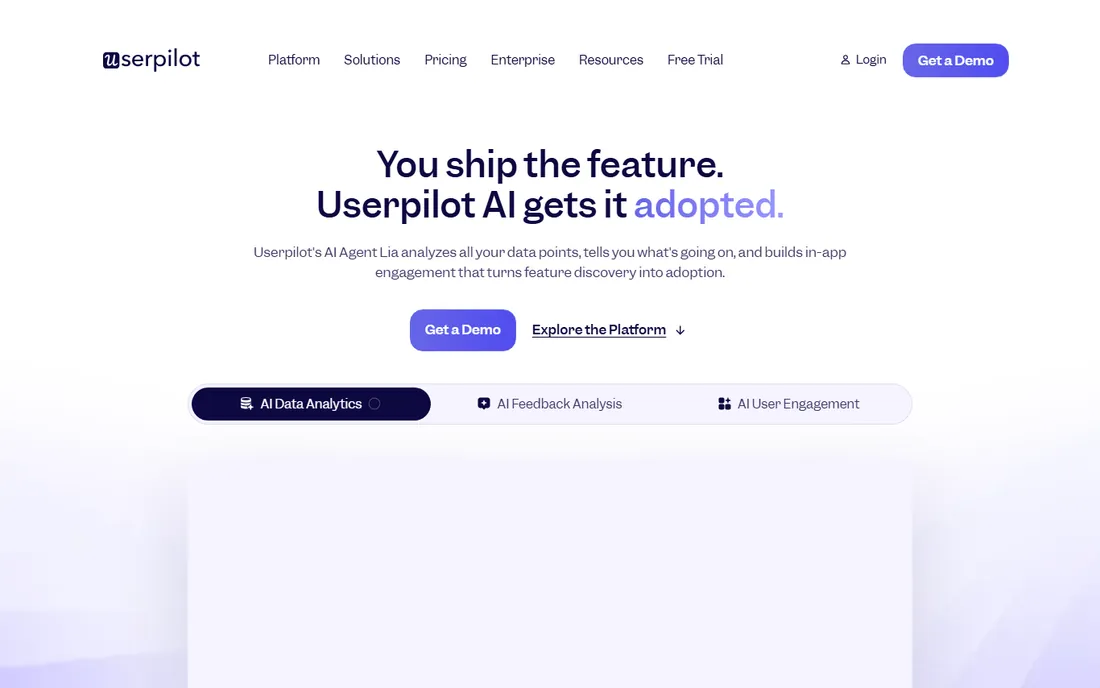
Userpilot covers the most ground of any in-app tool here. You get no-code onboarding flows, tooltips and checklists, plus product analytics, NPS and CSAT surveys, session replays and email workflows, all inside one AI-assisted platform. The vendor lists its price range as $299 to $799, which is rare transparency in this category. For a product team that wants onboarding plus the analytics to measure it, buying one tool beats stitching three together.
The trade is cost and complexity. At $299 a month it is priced for funded startups and up, not side projects. With modules for analytics, engagement, feedback, replays and AI agents, small teams can feel overwhelmed before they launch a single flow. Still, if you need the full stack, this is the most complete in-app pick.
What we like- Combines in-app flows, product analytics, surveys and session replays in one platform
- No-code flow builder that product teams run without engineering
- SOC 2, GDPR and HIPAA compliance built in
Watch out for- The $299 starting price rules out very small teams
- Modular products can get complex
- MAU-based pricing means costs grow with your user base
#2
Rocketlane
Best for: Services and implementation teams managing many concurrent onboardings
Visit rocketlane.com
Starting priceSee website (custom quote only)
Free planNo
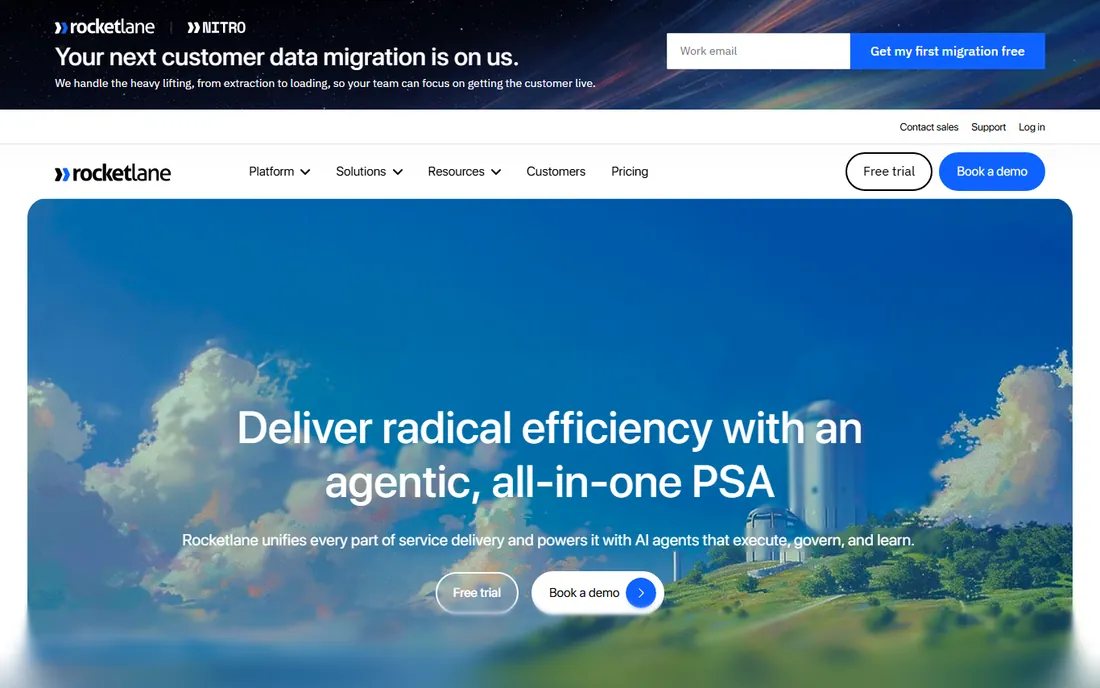
Rocketlane is built for the other half of onboarding: implementations. Instead of teaching end users inside a product, it gives your customers a branded portal where they see progress, complete tasks, review milestones and access documents, while your team manages the same project from one plan. Templates with conditional logic mean one master playbook can serve hundreds of customers without sprawl.
What sets it apart is the professional-services depth. Resource management, time tracking, utilization dashboards and project financials sit alongside the portal, so delivery leaders see margins and staffing risks in real time. That breadth is the point for agencies and B2B SaaS with 20 to 500 concurrent onboardings. If your onboarding is just a checklist, this is too much tool.
What we like- Branded client portal with magic-link access, so customers never learn a new tool
- Dynamic project templates that scale one playbook across hundreds of onboardings
- Salesforce and HubSpot sync that auto-creates projects from closed deals
Watch out for- No published pricing, so expect an enterprise-style sales process
- Breadth (resourcing, time tracking, billing) is overkill for simple checklists
- Smaller teams may find it heavy
#3
GUIDEcx
Best for: Client onboarding teams needing portal, email and mobile participation
Visit guidecx.com
Starting priceSee website (custom quote only)
Free planNo
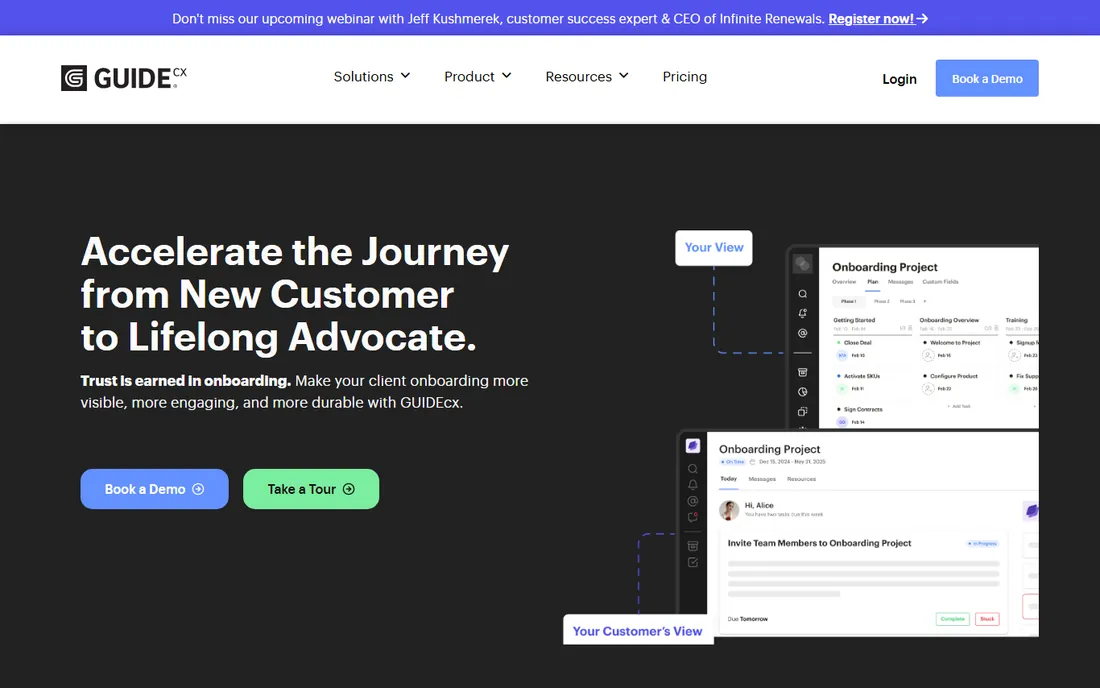
GUIDEcx makes the customer side of onboarding its whole pitch. Clients do not need a login to your systems: they complete tasks, view status and send updates through a portal, by email or on mobile. Automated reminders and clear milestones keep them accountable, and the vendor claims 49 percent faster onboarding cycles and 55 percent faster time to value on its homepage.
It is also investing in AI delivery management. An AI agent monitors projects for risks, and a capacity view helps delivery leaders staff incoming onboardings without guessing at bandwidth. G2 buyers have ranked it at the top of the client onboarding category, which matters for a purchase this size. Talk to sales for pricing, and bring a clear picture of your project volume.
What we like- Customers can participate through the portal, email or a mobile app, so nobody needs to adopt your tool
- Automated tasks, reminders and updates keep both sides accountable
- AI agents and project forecasts flag risks and capacity
Watch out for- No published pricing
- Aimed squarely at implementation-style onboarding, not in-app product tours
- Feature set is broad for teams with simple needs
#4
Appcues
Best for: SaaS teams launching in-app onboarding without engineering
Visit appcues.com
Starting priceSee website (custom quote only)
Free planNo
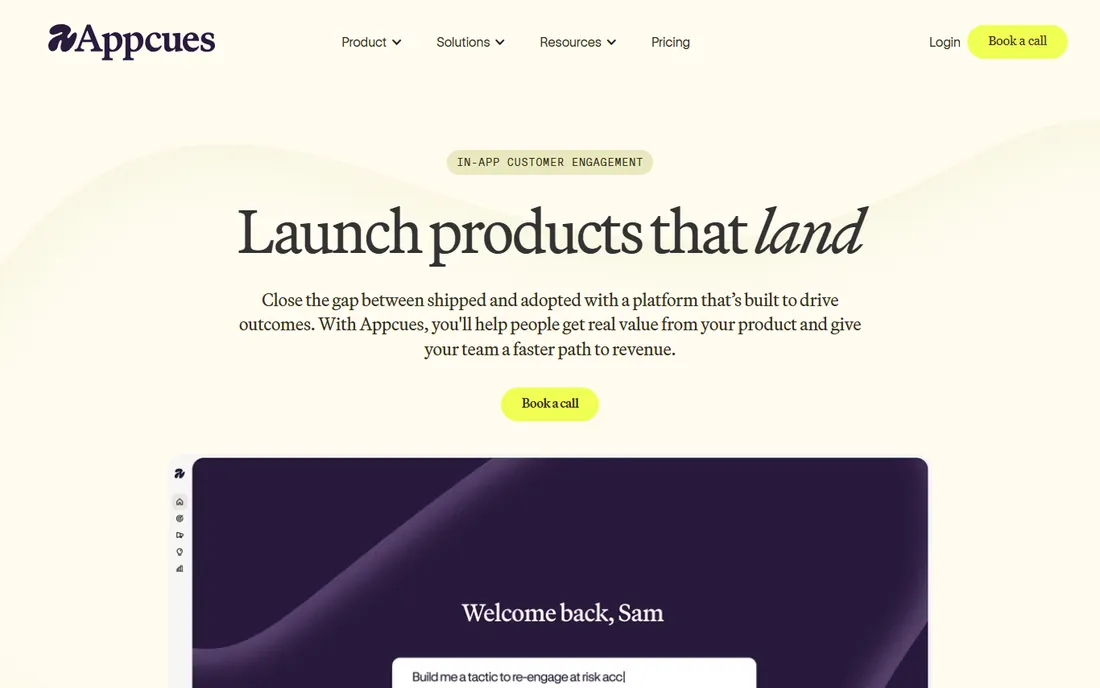
Appcues is the veteran of this category, and it shows in the builder. Non-technical teams create product tours, onboarding checklists, modals, tooltips and in-app surveys through a visual editor, then target them with behavioral segments. Campaign analytics show which messages actually move activation. Recent additions include AI-driven recommendations and an agent-assisted build flow.
The limitation is scope, not quality. Appcues is an in-app engagement platform: it will not manage implementation projects, client portals or onboarding task accountability. Pricing is quote-based, which makes quick comparison harder than with Userpilot or Userflow. If your product is self-serve and your onboarding problem is activation, this remains one of the safest bets in the space.
What we like- Long-standing no-code builder for product tours, checklists and tooltips
- In-app surveys and precise user segmentation for targeted messaging
- AI-assisted experience building and campaign analytics
Watch out for- No published pricing in 2026
- Focused on in-app engagement, so it will not run client implementations
- AI features add learning curve for basic teams
#5
Userflow
Best for: PLG teams wanting fast no-code onboarding flows with clear pricing
Visit userflow.com
Starting price$300/month (Essentials), $240/month billed annually
Free planNo (free trial available)
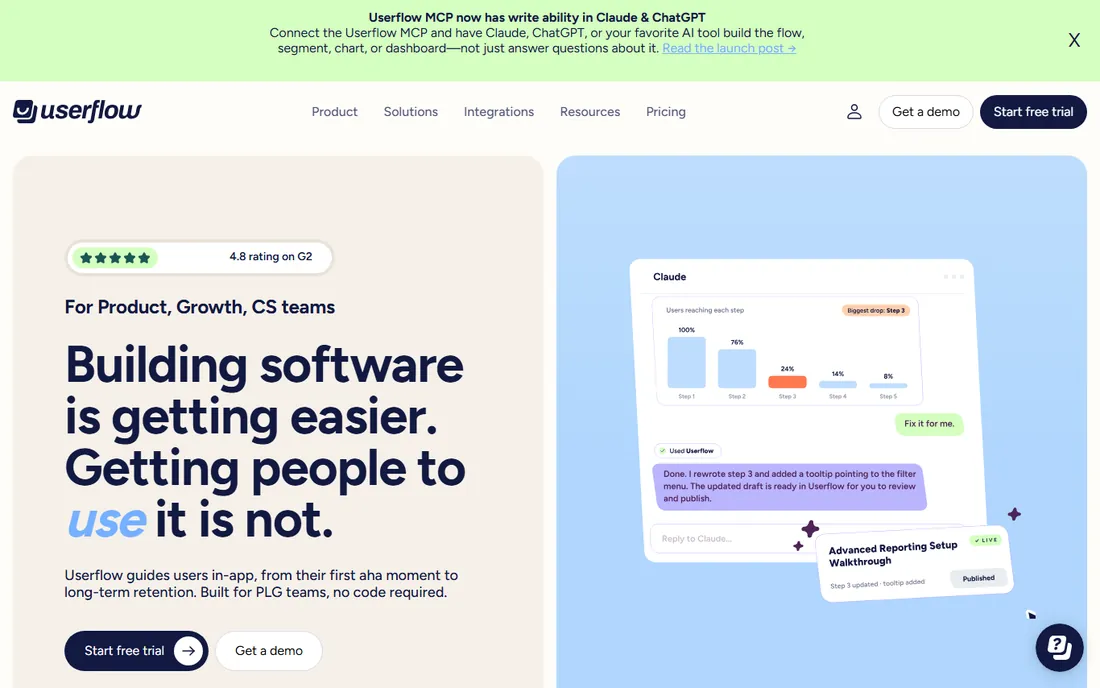
Userflow is the most transparent purchase on this list. Essentials costs $300 a month, or $240 a month billed annually, with 1,000 monthly active users included and a free trial to test it. Studio at $500 a month adds the Adoption Agent, an in-product AI that answers user questions and launches the right walkthrough. Pricing scales as your MAUs grow, which is at least a curve you can see.
Product-wise, it is built for product-led SaaS. Personalized tours, checklists and tooltips trigger from role, plan or behavior; announcements and banners surface new features; and FlowAI flags drop-offs across your flows and recommends fixes. The vendor's homepage even breaks down the FAQ with its own prices. If predictable cost matters as much as the feature set, start here.
What we like- Published pricing with an annual discount and a free trial
- 1,000 monthly active users included on Essentials and Studio
- AI flow builder, drop-off detection and an Adoption Agent that answers users in context
Watch out for- Pricing scales with MAUs, so fast-growing products should model the curve
- Studio tier ($500/month) is where the AI agent features live
- Aimed at self-serve PLG products, less fit for complex enterprise workflows
#6
Chameleon
Best for: Product teams wanting AI-built personalized in-app guidance
Visit chameleon.io
Starting priceSee website (custom quote only)
Free planNo
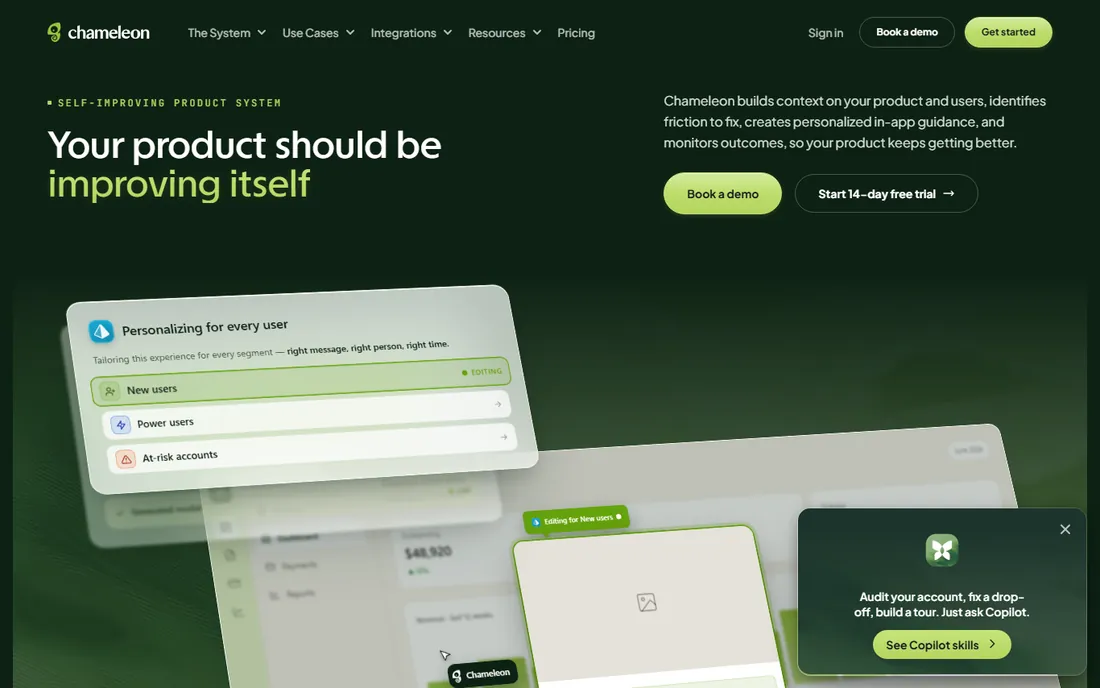
Chameleon has reinvented itself as a self-improving product system. Its Compass agent tracks sessions and builds a context graph of each user's adoption, Copilot ships the in-app guidance or files the fix, and Prism personalizes guidance per user without manual segments. It is an ambitious pitch: guidance that adapts to who each user is and what they care about, with no audience building by hand.
The buyer caution is twofold. Pricing is not published, so you will talk to sales. And because Chameleon now leans into analytics and AI agents, teams already paying for a product analytics tool should check for overlap before adding it. For product teams that want personalized onboarding without building segments forever, the agent approach is genuinely different from the template builders.
What we like- AI agents that build personalized in-app guidance from product context
- Natively tracks sessions and builds per-user context graphs
- MCP server pipes data into your warehouse, analytics tools or AI apps
Watch out for- No published pricing
- Positioning has shifted toward autonomous agents, so evaluate what is live today
- Overlaps with product analytics tools many teams already pay for
#7
Pendo
Best for: Mid-market to enterprise teams combining usage analytics with in-app guides
Visit pendo.io
Starting priceSee website (custom quote only)
Free planNo
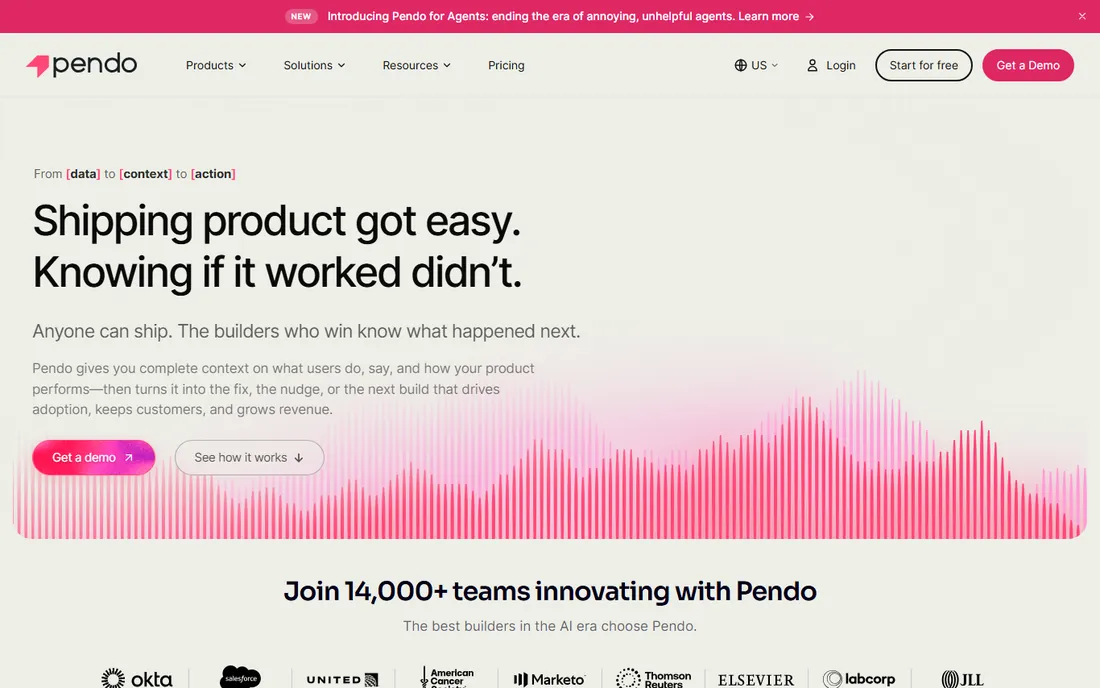
Pendo is the analytics-first option. Where most tools on this list start with guides, Pendo starts with retroactive usage analytics: install a snippet and see what users did before you even asked. Then you build in-app guides, polls and feedback surveys on top of that data, and AI predictions flag at-risk accounts months before renewal. The vendor cites 40 trillion events processed, which tells you the scale it is built for.
That scale is the catch for smaller buyers. Pendo prices by quote, sells through demos, and is designed for companies running multiple products or internal applications. A 50-person SaaS team that only needs onboarding tours will find Userpilot or Userflow faster and cheaper. But if your onboarding strategy depends on knowing exactly where users struggle before you build, nothing here matches Pendo's analytics depth.
What we like- Unifies product analytics, user feedback, in-app guides and AI predictions in one platform
- Retroactive analytics show what users did before you instrumented
- Scales from a single product to entire digital portfolios with SSO and governance
Watch out for- Quote-only pricing and an enterprise-leaning sales motion
- Broad platform can be heavy for teams that only need onboarding flows
- Implementation scope grows with portfolio size
#8
Intercom
Best for: Teams already running customer support who want onboarding messaging built in
Visit intercom.com
Starting price$29/seat/month, plus $0.99 per AI resolution
Free planNo (14-day free trial)
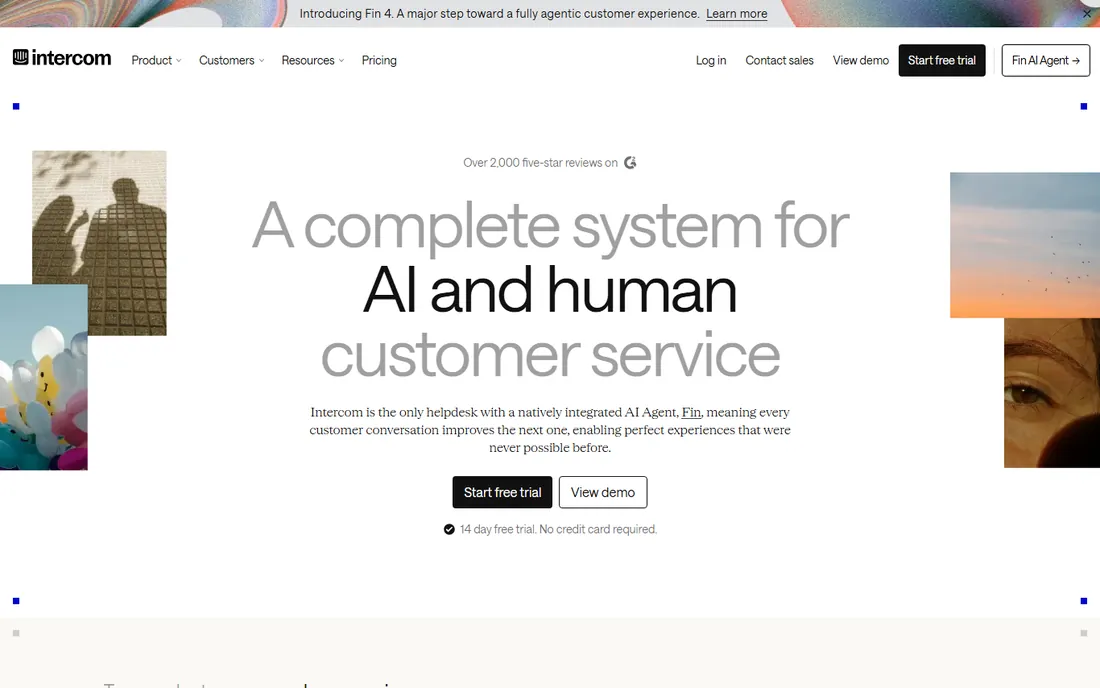
Intercom takes the messaging route to onboarding. Instead of building tours in a separate tool, teams run interactive product tours, onboarding checklists, in-app tooltips and sequenced email and in-product campaigns from the same platform that handles support. Because the helpdesk, knowledge base and AI agent Fin share one customer record, onboarding conversations feed straight into support context.
The pricing is published: $29 per seat per month, with Fin AI resolutions at $0.99 each under spending limits you control. That makes it the cheapest entry point on this list if your team already lives in Intercom. The honest limitation is identity: this is a customer-service platform with onboarding features, not a dedicated onboarding platform. Teams that need client portals or deep product analytics should look at Rocketlane or Pendo instead.
What we like- Onboarding lives inside a full customer-service suite, so support context feeds onboarding
- Product tours, checklists, tooltips and sequenced messaging in one builder
- Published per-seat pricing with usage-based AI costs you can cap
Watch out for- Seat-based pricing stacks as the team grows, plus AI resolution fees
- Onboarding is one module of a big suite, not the product's core
- Buyers wanting a dedicated onboarding platform may find it sprawling
#9
OnRamp
Best for: B2B SaaS teams wanting AI-assisted onboarding playbooks and portals
Visit onramp.us
Starting priceSee website (custom quote only)
Free planNo
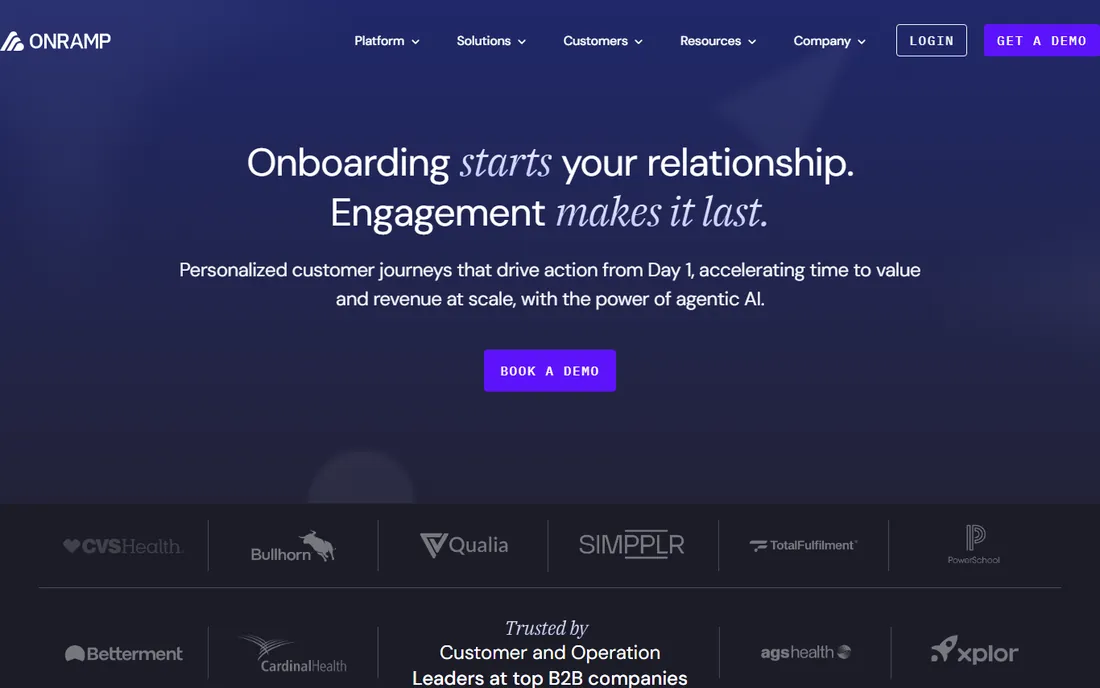
OnRamp is the small-vendor counterweight to Rocketlane and GUIDEcx. It gives B2B SaaS teams structured playbooks and customer-facing portals that adapt in real time to each customer's profile, role and history, plus AI agents that monitor active accounts and re-engage customers who go quiet. Native Salesforce and HubSpot integrations mean a closed deal spins up an onboarding project automatically, with milestone data flowing back into the CRM.
The AI positioning is aggressive: playbooks generated in under an hour from plain-language descriptions, proactive risk alerts, next-best-step recommendations. Treat that as demo material, not brochure fact, and ask to see it on a workflow like yours. Pricing is quote-based. For mid-size B2B SaaS teams that want a portal without enterprise weight, OnRamp is worth a look alongside the bigger names.
What we like- Customer-facing portals that tailor each journey by role and company profile
- AI builds tailored playbooks in under an hour from a spreadsheet or plain language
- Native Salesforce and HubSpot integrations that auto-create onboarding projects
Watch out for- No published pricing
- A smaller, younger vendor, so vet support coverage and roadmap depth
- AI playbook claims deserve a live demo before you buy
The activation trap: why most onboarding fails after signup
Most teams treat onboarding as a checklist, and that is why it fails. The checklist ends at account creation, but the customer is still lost on day three. What actually works is getting the new user to one meaningful outcome as fast as possible, then layering the rest. In-app tools do this with tours that trigger on behavior and checklists that celebrate the first win. Client platforms do it with a visible plan, accountable tasks and a portal the customer actually opens.
Pick your weapon by the shape of your product. Self-serve SaaS with hundreds of signups a month needs in-app guidance that scales without humans: Userpilot, Appcues, Chameleon, Userflow, Pendo, or Intercom if messaging is your channel. High-touch sales with implementations, integrations and data migration needs a portal and a plan: Rocketlane, GUIDEcx or OnRamp. Many companies eventually need both, and that is fine. Buy the half that hurts most first, prove the time-to-value improvement, then expand.
Two implementation tips from teams that do this well. First, instrument the funnel before you build anything: if you cannot see where users drop off, every tour is a guess. Second, keep the first-run experience to one outcome. Five tours, three checklists and a welcome video is not onboarding, it is homework.
In-app guidance or client portal: pick the right half first
Before you compare features, answer one question: does your customer touch your product or your team first? If they sign up and click around on their own, you need in-app onboarding: tours, tooltips, checklists, behavioral nudges, and analytics to measure activation. The buyers for this half are product, growth and customer success teams at self-serve SaaS companies.
If the customer signs a contract and waits for a kickoff call, you need client onboarding: shared project plans, task accountability, document collection, milestones and a portal where the customer sees progress. The buyers here are implementation, onboarding and professional-services teams, often at B2B SaaS, agencies and service businesses.
Budget expectations differ sharply. In-app tools on this list run from $29 per seat to $500 a month for mid tiers, with several publish-or-quote enterprise plans. Client onboarding platforms are all quote-based and priced for teams, not seats. One more filter: check your CRM. If onboarding projects should start from closed deals, Rocketlane, GUIDEcx and OnRamp all sync with Salesforce and HubSpot, which removes the manual handoff that kills most implementations.
How we chose
We started with the categories buyers actually search: customer onboarding software, user onboarding software, client onboarding software and onboarding portal. For each candidate we opened the vendor's homepage, checked pricing against the vendor's own pricing or FAQ pages, read public reviews on G2 and Capterra plus practitioner discussion on Reddit, and compared features, integrations and company-size fit. Where a price could not be verified on the vendor's own site we wrote "See website" rather than guessing. We excluded tools whose current product no longer serves onboarding, even if older reviews still list them.
Frequently asked questions
What is customer onboarding software?
Software that helps new customers reach value faster. It comes in two forms: in-app tools like Userpilot and Userflow that guide users inside your product with tours and checklists, and client onboarding platforms like Rocketlane and GUIDEcx that manage implementations through shared project plans and customer portals.
How much does customer onboarding software cost?
In-app tools on this list run from $29 per seat per month (Intercom) to around $500 per month for mid tiers (Userflow Studio), with Userpilot starting at $299 per month. Client onboarding platforms (Rocketlane, GUIDEcx, OnRamp) and enterprise in-app tools (Appcues, Chameleon, Pendo) are quote-based, so expect a sales conversation before you see a number.
Should I choose in-app onboarding or a client onboarding portal?
Self-serve products with signup flows need in-app onboarding that scales automatically. Contract-based businesses with implementations, migrations and kickoff calls need a client portal with task accountability. Pick the half that matches how your customers actually start, not the one with the prettier demo.
Can a small team use these tools, or are they enterprise-only?
Userflow, Intercom and Userpilot publish prices and sell self-serve, so small teams can start today. Pendo, Rocketlane, GUIDEcx and OnRamp lean toward teams with dedicated onboarding staff, though nothing stops a small B2B team from buying them. Appcues and Chameleon sit in the middle: approachable product, quote-based pricing.
How long does implementation take?
In-app tools can be live in days: add a snippet, build a first tour, launch. Client onboarding platforms take longer because you configure templates, CRM sync and portal branding, typically a few weeks to a first live project. Intercom onboarding can be same-day if your helpdesk is already running.
What should I measure to know onboarding is working?
Activation rate (users who reach the first key outcome), time to value (days from signup to that outcome), onboarding completion rate, and support ticket volume from new accounts. Client onboarding teams should track days to go-live and on-time project delivery. Every tool here reports at least some of these; pick the metrics before you pick the tool.
Sources we checked (11)
- https://userpilot.com/
- https://www.appcues.com/
- https://chameleon.io/
- https://www.pendo.io/
- https://userflow.com/
- https://www.intercom.com
- https://www.rocketlane.com/
- https://www.guidecx.com/
- https://onramp.us/
- https://www.g2.com/categories/customer-onboarding
- https://www.capterra.com/customer-onboarding-software/
Is your product missing or out of date?
We review this list regularly. Vendors can request a listing, send updated pricing or ask about featured placement.

Shihab Mia · Founder, Rankite
Shihab has 5+ years in B2B and SaaS SEO. He writes Rankite's software buying guides from pricing pages, documentation and public user reviews. More about Shihab.