How we make this list: we compare pricing pages, product documentation and public user reviews. Ratings come from G2, Capterra or Trustpilot, with the date we checked them.
Key takeaways
- Deribit is the deepest crypto options market for professional traders, focused on Bitcoin and Ether with portfolio margin and a wide range of expiries.
- Binance, Bybit, and OKX offer stablecoin-settled options inside full exchanges, but their global options products are generally not available to US retail users.
- Crypto.com offers Strike Options in its US app, making it the most accessible regulated-style route for US retail users who want crypto options.
- CME Group offers Bitcoin and Ether options through regulated US market infrastructure, but it suits institutions and experienced traders rather than casual app users.
- Delta Exchange and Gate.io broaden coin choice beyond Bitcoin and Ether, but liquidity is thinner than on Deribit, so spreads and execution deserve a close check.
Quick comparison
| Tool | Best for | Starting price | Free plan |
|---|
 Deribit | Professional crypto options depth | See website | No |
 Binance | All-in-one exchange options | See website | No |
 Bybit | Retail-friendly options interface | See website | No |
 OKX | Multi-product options and strategies | See website | No |
 Crypto.com | US retail Strike Options | See website | No |
 Delta Exchange | Altcoin options beyond BTC and ETH | See website | No |
 Gate.io | Broad coin choice for options | See website | No |
 CME Group | Regulated US BTC and ETH options | See website | No |
Is your product missing or out of date?
We review this list regularly. Vendors can request a listing, send updated pricing or ask about featured placement.
Starting priceSee website
Free planNo
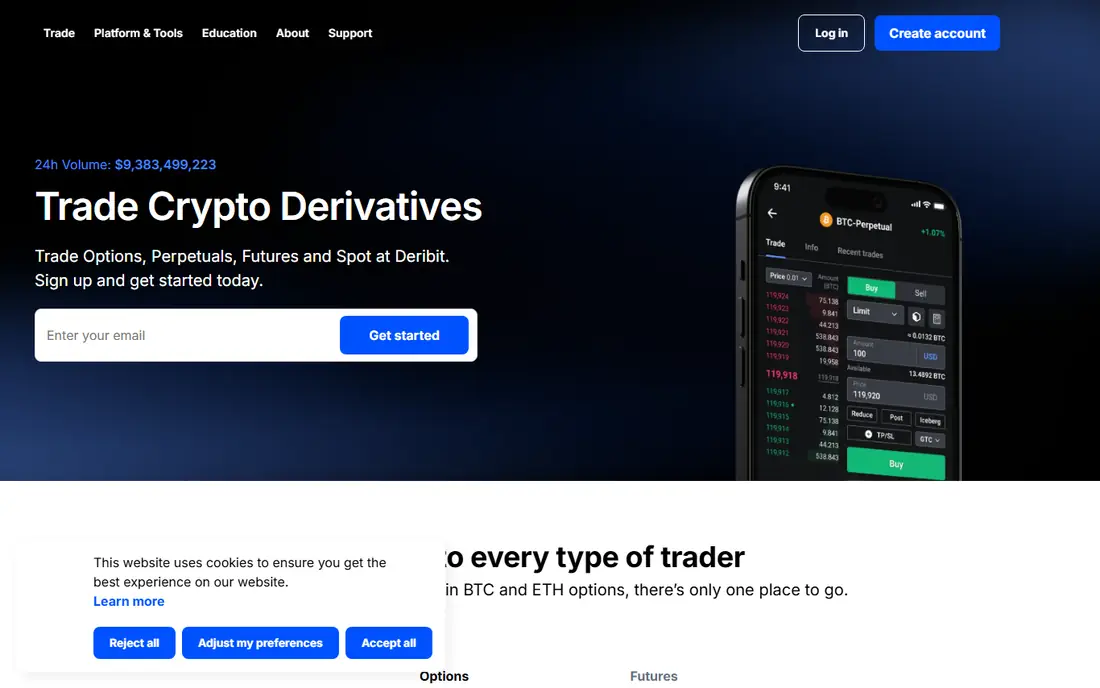
Deribit is the reference point for crypto options, and most serious traders compare other platforms against it. Its Bitcoin and Ether options books are deep, which usually means tighter spreads and better execution for larger orders than on smaller venues. Portfolio margin lets experienced traders offset positions across options, futures, and perpetuals, rather than posting margin for each trade in isolation.
The limits are just as clear. Deribit is not open to US retail users, and its interface assumes you already understand strikes, expiries, implied volatility, and Greeks. Beginners who start here without that background can lose a premium quickly, even when their market view is broadly right, because time decay eats option value each day. If you trade options professionally outside the US, Deribit is the first platform to test. If you are in the US, skip to Crypto.com or CME Group.
What we like- Deepest Bitcoin and Ether options books in public comparisons
- Portfolio margin for experienced traders
- Daily, weekly, monthly, and quarterly expiries
Watch out for- Not available to US retail users
- Complex interface for beginners
- Coin and stablecoin settlement choices need care
Starting priceSee website
Free planNo
Binance suits traders who already hold funds on the exchange and want options without moving to a specialist venue. Its options are European-style and settled in stablecoin, which keeps profit and loss in dollar terms and avoids the extra price move that comes with coin settlement. Coverage includes Bitcoin and Ether plus selected altcoins such as BNB, XRP, and DOGE in public listings, though availability changes by region.
The US point needs emphasis. Binance global derivatives, including options, should not be assumed available to US users, and Binance US does not offer the same options product. Fees are tiered by volume and maker or taker status, so check the current fee schedule on the vendor site rather than relying on a single figure from a review. For non-US traders who value an all-in-one exchange, Binance is a practical choice.
What we like- Options inside a full spot, futures, and earn exchange
- Stablecoin-settled contracts for Bitcoin, Ether, and selected altcoins
- Deep overall exchange liquidity
Watch out for- Global options product is not offered to US users
- Binance US does not offer the same options
- Contract terms vary by coin and expiry
Starting priceSee website
Free planNo
Bybit has built a reputation for a clean derivatives interface, and its options product follows that pattern. Contracts are settled in USDC in many listings, which simplifies accounting for traders who think in dollars, and the platform offers daily and longer expiries for its main coins. Tools for viewing open interest, implied volatility, and option chains are laid out for active traders rather than hidden in menus.
The trade-off is access and scope. Bybit Global excludes US users, so US readers cannot use this as a retail route to crypto options. Coin coverage for options is also narrower than Bybit spot coverage, with Bitcoin, Ether, and Solana as the main names in recent comparisons. Check the fee schedule, margin rules, and settlement terms on the vendor site before trading, because delivery fees and liquidation rules differ from spot trading.
What we like- Clear options interface for retail traders
- USDC-settled options for Bitcoin, Ether, and Solana in listings
- Portfolio margin on higher tiers
Watch out for- Bybit Global excludes US users
- Options coin range is narrower than spot range
- Liquidation and delivery terms need careful reading
#4
OKX
Best for: Multi-product options and strategies
Visit okx.com
Starting priceSee website
Free planNo
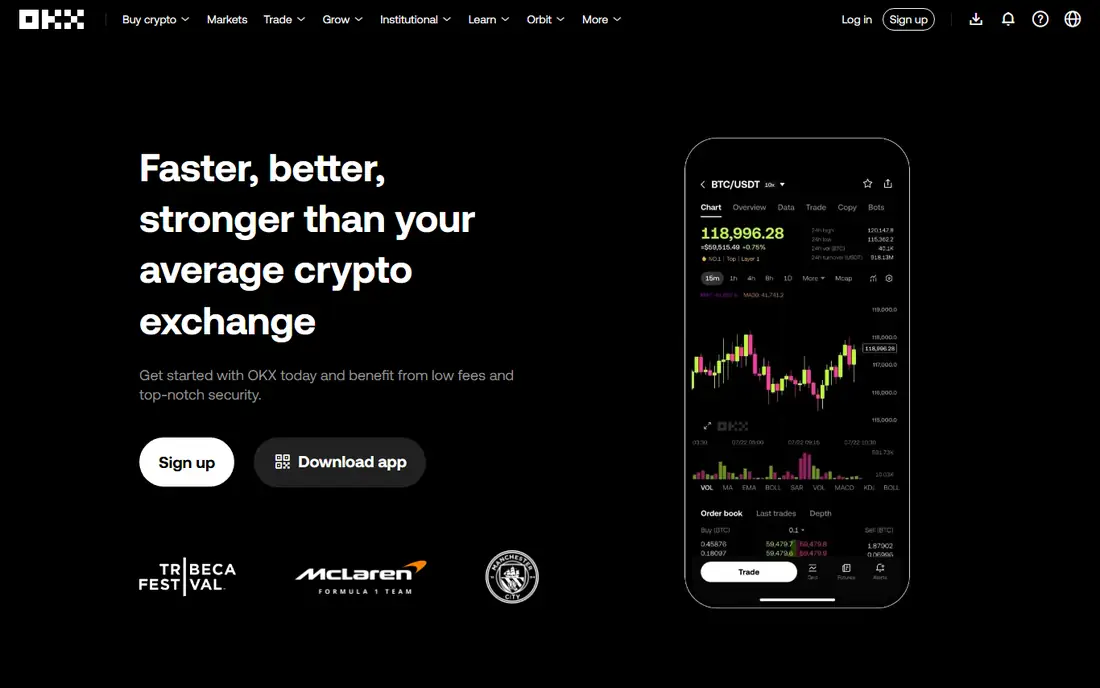
OKX appeals to traders who build multi-leg strategies rather than buying a single call or put. Its options tools include spread builders and a request-for-quote system that lets you ask market makers for a price on a larger or more complex structure, which can improve execution when a standard order book is thin. Having spot, futures, and options in one account also simplifies hedging, because you can offset an options position with a spot or futures trade without moving funds.
The honest weakness is complexity and access. OKX operates in many countries but its global options product is not available to US users, and its fee tiers depend on trading volume and token holdings, so a small trader pays a different rate from a large one. Beginners may find the interface crowded, with many products competing for attention. For experienced non-US traders who want strategy tools, OKX is a strong second venue after Deribit.
What we like- Options, futures, perpetuals, and spot in one account
- Request-for-quote builder for complex structures
- Coin settlement option for some traders
Watch out for- Global options product is restricted for US users
- Tiered fees depend on volume and holdings
- Interface can feel busy for beginners
Starting priceSee website
Free planNo
Crypto.com is the most useful entry in this guide for US readers, because its Strike Options product is designed for US users in the app, unlike the offshore options products above. Strike Options use a simpler format than a full option chain: you pick a direction, a strike, and an expiry, and the contract settles based on the outcome. That simplicity helps beginners understand what they are buying, but it also limits the strategies available compared with Deribit or OKX.
Coin coverage in public listings focuses on Bitcoin and Ether plus selected altcoins, and fees are charged per contract rather than as a percentage of the underlying in the same way as offshore venues. Check the current app terms, contract specifications, and state availability before trading, because US crypto product availability can vary by state. For US retail users who want a legal, app-based route to crypto options, Crypto.com is the first place to look.
What we like- Strike Options available to US users in the app
- Simple up or down contract format
- Integrated with a familiar retail exchange app
Watch out for- Options coin range is narrower than offshore venues
- Contract format is simpler than full option chains
- Fees are product-based, check the app terms
Starting priceSee website
Free planNo

Delta Exchange is a specialist derivatives venue that stands out for coin breadth. While most large venues focus options on Bitcoin and Ether, Delta Exchange lists options on a wider set of altcoins, which suits traders who want to hedge or speculate on smaller coins without using only perpetual futures. Its interface includes advanced order types, portfolio tools, and APIs for systematic traders.
The cost of that breadth is liquidity. Thinner books mean wider spreads, especially on less traded altcoin options, and a contract that looks cheap on paper can be expensive to enter and exit. Delta Exchange is also not available to US users, and its fee schedule is tiered, so check maker, taker, and settlement terms on the vendor site. Use Delta Exchange for specific altcoin exposure, not as a first options venue for a beginner.
What we like- Options on Bitcoin, Ether, and many altcoins
- Futures, options, and interest rate products in one venue
- Advanced order types and APIs
Watch out for- Not available to US users
- Liquidity is thinner than Deribit for many altcoins
- Smaller venue means wider spreads on some contracts
Starting priceSee website
Free planNo
Gate.io is known for listing many coins early, and that breadth extends to its derivatives range, including options on selected coins beyond the usual Bitcoin and Ether pair. For traders who already use Gate.io for spot or futures, adding options in the same account avoids moving funds between venues and simplifies portfolio tracking.
The weakness is uneven liquidity and access. Options on popular coins trade more actively than options on smaller coins, and US users face restrictions on many Gate.io products, so eligibility must be checked before relying on it. Fees are tiered by volume, and contract terms differ by coin, so read the product specification for each contract. Gate.io suits non-US traders who want coin breadth and already accept the complexity of a large exchange.
What we like- Wide coin selection across the exchange
- Options alongside spot, futures, and other derivatives
- Long-running exchange with many markets
Watch out for- US access is region-dependent and restricted for many products
- Options liquidity varies sharply by coin
- Interface is dense for new options traders
Starting priceSee website
Free planNo
CME Group is different from every other venue here, because it is a traditional regulated exchange offering Bitcoin and Ether options, not a crypto-native app. That structure brings established clearing, institutional participation, and US market access through brokers and futures commission merchants, rather than through a crypto exchange account. For funds, family offices, and experienced traders who need regulated exposure, that difference matters more than app design.
The trade-off is accessibility. CME options are not bought in a simple retail app, contract sizes and margin requirements suit larger traders, and coin choice is limited to Bitcoin and Ether. Fees are contract-based and vary by product and participant type, so check the CME product pages and your broker's schedule. US readers who want regulated options exposure and can work through a broker should start here, while casual app users will find Crypto.com simpler.
What we like- Regulated US market infrastructure and clearing
- Deep Bitcoin and Ether derivatives markets
- Suitable for institutions and experienced traders
Watch out for- Not a casual retail app experience
- Contract sizes and margin rules suit larger traders
- Limited coin range compared with crypto exchanges
How we chose
We compared vendor product pages, fee schedules, contract specifications, and public reviews on G2, Capterra, Reddit, and specialist derivatives comparisons, focusing on whether each venue truly offers crypto options, which coins are covered, how contracts settle, and whether US users can access the product. We favoured venues with real options books and clear contract terms over venues that only offer perpetual futures or tokenised stock options.
We did not claim hands-on testing, and we did not invent fee numbers, liquidity figures, or user counts. Fee schedules for options are tiered and change often, so we listed starting price as See website and advised checking the vendor fee page for your volume tier. Where a venue's US status was unclear, we described it as restricted or region-dependent rather than claiming full US access.
Choosing an options venue without losing money to structure
The cheapest fee is not the best deal in options. A low commission does not help if the spread is wide, open interest is low, or the expiry you need does not exist. Check liquidity first, then fees, then margin and settlement terms, in that order.
Liquidity and expiry first
Look for open interest and recent volume in the exact strike and expiry you plan to trade, not just for Bitcoin options in general. Daily options suit short-term views but lose time value fast, while monthly and quarterly options give more room for a view to play out at a higher premium. If you cannot exit a contract at a fair price, you do not have a liquid market, whatever the fee page says.
US access and custody
US readers should start with Crypto.com for app-based access and CME Group for broker-based regulated access, and treat offshore venues as unavailable unless the vendor clearly states otherwise for your state and status. Check whether funds are held by the exchange, what happens in a liquidation, and how withdrawals work. An options profit means little if you cannot withdraw it or if the venue later restricts your account.
Risk controls for every trade
Size positions by premium at risk, not by notional coin value, because a buyer can lose the full premium if the option expires out of the money. Sellers face larger risks, including losses beyond the premium received, and should not sell options without understanding margin calls and assignment or settlement rules. Set a maximum premium per trade, avoid trading on borrowed funds until you understand portfolio margin, and keep a written plan for when you will sell before expiry.
Frequently asked questions
What is the best crypto options trading platform?
Deribit is the deepest venue for professional non-US traders, while Crypto.com is the most accessible US retail route and CME Group is the regulated US route for larger traders. The best choice depends on your location, experience, and whether you need full option chains or a simpler contract format.
Can US users trade crypto options?
Yes, but through limited routes. Crypto.com offers Strike Options to US users in its app, and CME Group offers Bitcoin and Ether options through US regulated market infrastructure and brokers. Most offshore venues, including Deribit, Binance global, Bybit, OKX, Delta Exchange, and Gate.io, restrict US retail access to their options products.
Are crypto options the same as stock options?
The core idea is similar, with calls, puts, strikes, expiries, and premiums, but most crypto options are European-style and cash-settled, while many stock options are American-style and can be exercised early. Crypto options also trade around the clock on crypto venues, which changes margin and liquidation risk compared with stock market hours.
How much money do I need to start trading crypto options?
You need enough to pay the premium plus fees, and to meet any margin requirement if you sell options or use portfolio margin. Buyers risk only the premium paid, plus fees, while sellers can face larger losses. Start with a small premium you can afford to lose in full, and check minimum contract sizes on the vendor site.
What is the difference between coin settlement and stablecoin settlement?
Coin settlement pays profit and loss in the underlying coin, so your payout keeps moving with the coin price, while stablecoin settlement pays a fixed dollar value, which keeps accounting simpler. Deribit offers both for some products, OKX settles many options in coin, and Bybit and Binance use stablecoin settlement for many contracts, so check each product specification.
Is crypto options trading risky?
Yes, options can expire worthless, time decay reduces value each day, and borrowed money amplifies both gains and losses. This guide is not financial advice, and you should only trade with funds you can afford to lose, after reading the contract terms, fee schedule, and margin rules for the venue you choose.
Sources we checked (8)
- https://www.deribit.com
- https://www.binance.com
- https://www.bybit.com
- https://www.okx.com
- https://crypto.com
- https://www.delta.exchange
- https://www.gate.io
- https://www.cmegroup.com
Is your product missing or out of date?
We review this list regularly. Vendors can request a listing, send updated pricing or ask about featured placement.

Shihab Mia · Founder, Rankite
Shihab has 5+ years in B2B and SaaS SEO. He writes Rankite's software buying guides from pricing pages, documentation and public user reviews. More about Shihab.