How we make this list: we compare pricing pages, product documentation and public user reviews. Ratings come from G2, Capterra or Trustpilot, with the date we checked them.
Key takeaways
- Most free apps show VantageScore, while most lenders use FICO, so a free score and a lender score can differ by design.
- Credit Karma covers two bureaus for free, Experian covers its own bureau with a free FICO score, and myFICO is the direct source for FICO scores across all three bureaus.
- Checking your own score through an app is a soft inquiry and does not lower your score.
- Paid plans add three-bureau monitoring, more frequent updates and identity theft insurance, but most people do not need them every month.
- Use one free app for routine tracking and add a paid FICO service only in the months before a mortgage or auto loan application.
Quick comparison
Is your product missing or out of date?
We review this list regularly. Vendors can request a listing, send updated pricing or ask about featured placement.
The best credit score apps for tracking and improving your score
Starting price$0 per month
Free planYes
Credit Karma is the easiest starting point for most people, because it is free, simple and covers two of the three bureaus. You get VantageScore 3.0 scores from TransUnion and Equifax, full reports from those bureaus, alerts when something changes, and tools that show how actions such as paying down a card might move your score. There is no paid credit monitoring tier to upsell you into, which keeps the experience straightforward.
The limits are worth understanding before you rely on the number. Credit Karma does not show an Experian score, and its VantageScore can differ from the FICO score a lender pulls, sometimes by dozens of points. The app earns money through sponsored card and loan recommendations, so treat those offers as advertising, not as advice. For routine tracking and catching report errors early, Credit Karma remains excellent. For a loan application, pair it with a FICO source below.
What we like- Free scores and reports from TransUnion and Equifax
- Weekly updates
- Monitoring alerts and a score simulator
Watch out for- No Experian score
- Shows VantageScore, not FICO
- Product recommendations are sponsored
Starting price$0 per month
Free planYes
Experian is both a bureau and an app, which gives it an advantage no third-party app can match for its own data. The free plan shows your Experian report and a FICO Score 8, updated regularly, plus monitoring alerts for Experian changes. Experian Boost lets you add on-time utility, phone and streaming payments to your Experian file, which can help thin files, though lenders vary in whether they use boosted scores.
Paid IdentityWorks Premium, at $24.99 per month after a trial in recent reporting, adds three-bureau monitoring, daily FICO scores, dark web surveillance and up to $1 million in identity theft insurance. That is a lot to pay every month for routine tracking. Most people should use the free Experian app alongside Credit Karma, which together cover all three bureaus at no cost, and consider the paid plan only when identity protection matters more than price. This article is for general information only and is not financial advice.
What we like- Free Experian FICO Score 8
- Free Experian report
- Experian Boost can add utility and phone payments to your file
Watch out for- Free plan covers only Experian
- Full three-bureau monitoring costs $24.99 per month
- Identity insurance only on paid plans
Starting price$0 per month
Free planYes
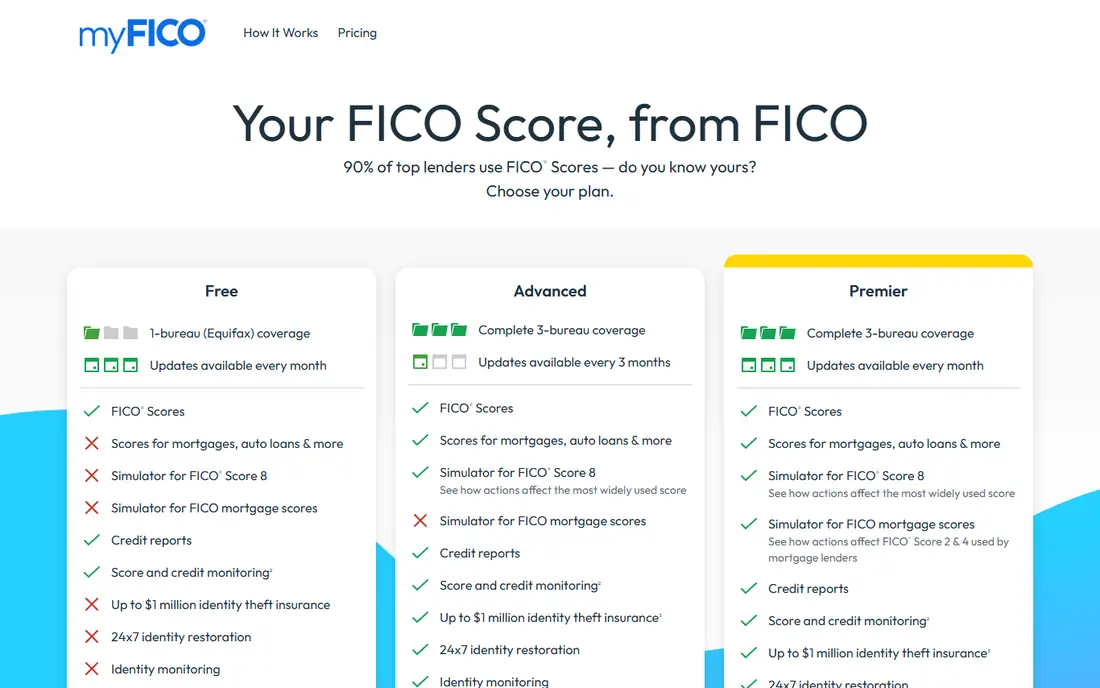
myFICO comes from the company that created the FICO score, and that matters when a lender decision is near. The free plan shows a FICO score from one bureau with monthly updates. Advanced, at $29.95 per month, adds all three bureaus with updates every three months, identity monitoring and up to $1 million in identity theft insurance. Premier, at $39.95 per month, brings three-bureau updates monthly plus mortgage and auto-specific FICO versions.
Those prices are high for everyday tracking, and Advanced users may find quarterly updates frustrating. The value appears in the months before a mortgage or auto loan, when seeing the exact FICO versions lenders use can guide decisions about paying down balances or delaying an application. Outside that window, a free combination of Credit Karma and Experian covers most needs. Use myFICO as a focused tool for major applications, not as a permanent subscription.
What we like- Direct source for FICO scores
- All three bureaus on paid plans
- Score simulator and identity theft insurance on paid plans
Watch out for- Paid plans cost $29.95 to $39.95 per month
- Advanced updates only every three months
- Free plan covers one bureau
Starting price$0 per month
Free planYes
Credit Sesame positions itself as a coach, not just a score display. The free plan shows a TransUnion VantageScore with daily monitoring and a personalized action plan that points to factors such as utilization and payment history. That guidance helps newcomers who know their score is low but are unsure what to fix first. The interface keeps the main score front and center, with report details a tap away.
Coverage is narrower than Credit Karma, since the free plan covers TransUnion only, and full three-bureau access sits behind paid tiers. Some recommendations inside the app lead to partner financial products, so weigh those offers on their own terms. For a user who wants a daily check and a clear next step, Credit Sesame is a solid free choice. For full bureau coverage at no cost, pair it with Experian and Credit Karma rather than paying for an upgrade.
What we like- Free TransUnion VantageScore
- Daily monitoring
- Action plans and credit-building guidance
Watch out for- Free plan covers one bureau
- Paid tiers add cost
- Some guidance leads to partner products
Starting price$0 per month
Free planYes
WalletHub stands out for update frequency and report depth at no cost. The free service shows a TransUnion VantageScore updated daily, a full TransUnion credit report, 24/7 monitoring, and a detailed analysis of what helps or hurts your score. The improvement plan breaks down factors such as credit utilization, payment history and account age in plain language, which suits users who like detail.
As with other free apps, the score is VantageScore from a single bureau, so it will not match every lender score. WalletHub also carries a large number of partner offers, and the site can feel busy compared with the cleaner Credit Karma app. Users who check their score often, or who are working through a specific improvement plan, will value the daily updates. Users who only want a weekly glance may prefer a simpler app.
What we like- Free TransUnion VantageScore with daily updates
- Free full credit report
- Personalized analysis and improvement plan
Watch out for- Covers TransUnion only
- VantageScore, not FICO
- Site includes many partner offers
Starting price$0 per month
Free planYes
CreditWise, from Capital One, is one of the simplest free FICO options available. Anyone can sign up without a Capital One account, and the service shows a TransUnion FICO Score 8 with weekly updates, plus a simulator that estimates how actions such as opening a card or paying down debt might affect the score. The design is clean, with little clutter beyond the score, report factors and alerts.
The tradeoff is scope. CreditWise covers TransUnion only, and it lacks the three-bureau monitoring, dark web scanning and identity insurance found in paid plans. The simulator is also an estimate, and real lender scores can move differently. For a user who wants a free FICO number to watch alongside a VantageScore app, CreditWise fills that gap well. For full coverage, combine it with Experian and Credit Karma, which together show all three bureaus.
What we like- Free TransUnion FICO Score 8
- No Capital One account required
- Weekly updates and a simulator
Watch out for- Covers TransUnion only
- Fewer monitoring extras than paid services
- Simulator is an estimate, not a lender score

#7
Chase Credit Journey
Best for: Free score without a Chase account
Visit chase.com
Starting price$0 per month
Free planYes
Chase Credit Journey offers a free Experian-based score to anyone, not just Chase customers, which makes it a useful third leg in a free tracking set. The service shows a VantageScore 3.0 from Experian, with monitoring alerts and guidance for disputing errors on the Experian report. Chase customers see it inside the Chase app, while non-customers can use the standalone site and app.
The score type is the main limit. It is VantageScore, not the FICO score most lenders use, and some users report refresh intervals longer than the weekly cadence found elsewhere. That makes Credit Journey better as a monitoring alert tool than as a precise loan-readiness gauge. Pair it with CreditWise or Experian for a FICO view, and use its dispute guidance if you spot an error on your Experian file.
What we like- Free Experian VantageScore
- Open to non-Chase customers
- Dispute guidance and identity monitoring features
Watch out for- Covers Experian only
- VantageScore, not FICO
- Score refresh can take up to a month for some users
Starting price$0 per month
Free planYes
TransUnion, as one of the three bureaus, offers direct tools for checking and managing your TransUnion file. Free access typically shows a score and report summary, while paid monitoring adds broader alerts, credit lock features and more frequent updates. Going direct can help when you need to dispute a TransUnion error, place a freeze or lock, or confirm that a correction has actually landed on the bureau file.
For everyday score tracking, TransUnion's free tools are less polished than Credit Karma or WalletHub, and many free displays use VantageScore rather than FICO. The real reason to keep a TransUnion account is control over your TransUnion file itself, especially freezes and locks, which are stronger protections than monitoring alone. Use it alongside a free tracking app, not instead of one, unless you specifically want bureau-direct management.
What we like- Direct access to TransUnion data
- Credit lock options
- Monitoring and score tools from the bureau itself
Watch out for- Free tools are narrower than full paid monitoring
- Paid plans cost extra
- VantageScore on many free displays
How we chose
We compared bureau coverage, score model, update frequency, free versus paid features, and identity protections for each app, using vendor pages, bureau sites and recent 2026 comparison reporting. We favored apps that show a real score and report, not just an estimate, and that a US reader can use without buying a bank product. We noted where a price is a paid tier rather than the free starting point, and we avoided treating VantageScore and FICO as interchangeable, since lenders use them differently. Prices and trial terms can change, so confirm the plan details on the vendor site before paying.
FICO versus VantageScore, in plain terms
FICO and VantageScore both range roughly from 300 to 850, but they weigh report data differently, so the same file can produce different numbers. Most large lenders use FICO for mortgages, auto loans and many cards, while many free apps show VantageScore because it is cheaper to license. A rising VantageScore usually means your credit health is improving, but it does not guarantee the same FICO number. Before a major application, check a FICO source such as Experian or myFICO, and review the actual reports for errors.
What actually moves your score
Payment history and credit utilization carry the most weight in most scoring models. Paying on time every month and keeping card balances low relative to limits helps more than opening new accounts or chasing small score tricks. Opening several accounts at once can lower your average account age and add hard inquiries, while closing an old card can raise utilization by removing available credit. Dispute genuine errors with the bureau that reports them, and keep records of every dispute, since corrections can take a billing cycle or more to appear.
Free versus paid: when to pay
Stay free while you are tracking habits, building credit or monitoring for errors. Pay only for a defined period when you need three-bureau FICO scores before a mortgage or auto loan, when you want identity theft insurance bundled with monitoring, or when you need daily three-bureau updates during a dispute. Cancel paid plans after the application or dispute ends, and set a calendar reminder before any trial converts to a paid plan. A paid plan does not improve your score by itself, and no app can remove accurate negative information early.
Frequently asked questions
Does checking my credit score lower it?
No. Checking your own score through an app is a soft inquiry and does not affect your score. Hard inquiries happen when a lender checks your credit for an application, and those can lower your score slightly for a short period. Monitoring your own credit as often as you like is safe and recommended.
Why do my scores differ between apps?
Scores differ because apps use different bureaus and different scoring models. Credit Karma shows TransUnion and Equifax VantageScores, Experian shows an Experian FICO score, and CreditWise shows a TransUnion FICO score. Different data, different formulas and different update dates all create gaps. Compare trends within one app over time, rather than expecting identical numbers everywhere.
Which app is best for checking my score for free?
Credit Karma plus Experian together give the best free coverage, since they cover all three bureaus at no cost. Credit Karma shows TransUnion and Equifax VantageScores, while Experian shows an Experian FICO score and report. Add CreditWise if you also want a free TransUnion FICO score. That combination beats any single free app alone.
Is a paid credit monitoring plan worth it?
A paid plan can be worth it for a few months before a mortgage or auto loan, when three-bureau FICO scores and frequent updates help you plan. It can also be worth it if you want identity theft insurance and dark web monitoring in one place. For routine tracking, free apps cover the main needs, and a paid plan alone will not raise your score.
How can I dispute an error on my credit report?
Dispute the error with the bureau that reports it, through its website, app or by mail, and include documents that support your case. The bureau generally has about 30 days to investigate. Also contact the creditor that supplied the wrong data if needed. Keep copies of everything, and check that the correction appears on later reports, since an error can return if the source data is not fixed.
Can an app help me build credit from scratch?
An app can track progress and suggest steps, but it cannot create credit history by itself. Secured cards, credit-builder loans and becoming an authorized user on a responsible account are common ways to start, and on-time payments matter most. Experian Boost may help thin files by adding utility payments to your Experian report, though not every lender uses boosted scores. This is general information only and is not financial advice.
Sources we checked (10)
- https://www.creditkarma.com
- https://www.experian.com
- https://www.myfico.com
- https://www.creditsesame.com
- https://www.wallethub.com
- https://www.creditwise.com
- https://www.chase.com
- https://www.transunion.com
- https://money.com/best-credit-monitoring-services/
- https://www.moneylion.com/learn/credit/credit-score/best-credit-score-apps
Is your product missing or out of date?
We review this list regularly. Vendors can request a listing, send updated pricing or ask about featured placement.

Shihab Mia · Founder, Rankite
Shihab has 5+ years in B2B and SaaS SEO. He writes Rankite's software buying guides from pricing pages, documentation and public user reviews. More about Shihab.
 Credit Karma
 Experian
 myFICO
 Credit Sesame
 WalletHub
 CreditWise
 TransUnion