How we make this list: we compare pricing pages, product documentation and public user reviews. Ratings come from G2, Capterra or Trustpilot, with the date we checked them.
Key takeaways
- Ironclad and DocuSign CLM are the heavyweight picks for legal teams that need approval workflows, clause libraries, and a full audit trail.
- PandaDoc and Zoho Contracts publish real per user prices and free tiers, which makes them the practical starting point for small and mid sized teams.
- Juro, Agiloft, and LinkSquares sell by quote only, and purchasing data puts typical contracts in the five figures per year, so budget for a sales process.
- Every platform here includes e-signature, so the real comparison is workflow depth, repository search, and how renewals and obligations get tracked after signing.
Quick comparison
| Tool | Best for | Starting price | Free plan |
|---|
 Ironclad | Enterprise legal workflows | See website | No |
 PandaDoc | Sales led contract workflows | $19 per user per month | Yes |
 DocuSign CLM | Companies already on DocuSign | See website | No |
 Juro | Browser based drafting and negotiation | See website | No |
 Concord | Small teams wanting published pricing | $499 per month | No |
 ContractWorks | A simple, searchable repository | See website | No |
 Agiloft | Highly custom contract workflows | See website | No |
 LinkSquares | AI term extraction and analysis | See website | No |
 Zoho Contracts | Zoho users on a budget | $25 per user per month | Yes |
Is your product missing or out of date?
We review this list regularly. Vendors can request a listing, send updated pricing or ask about featured placement.
The best contract management software
Starting priceSee website
Free planNo
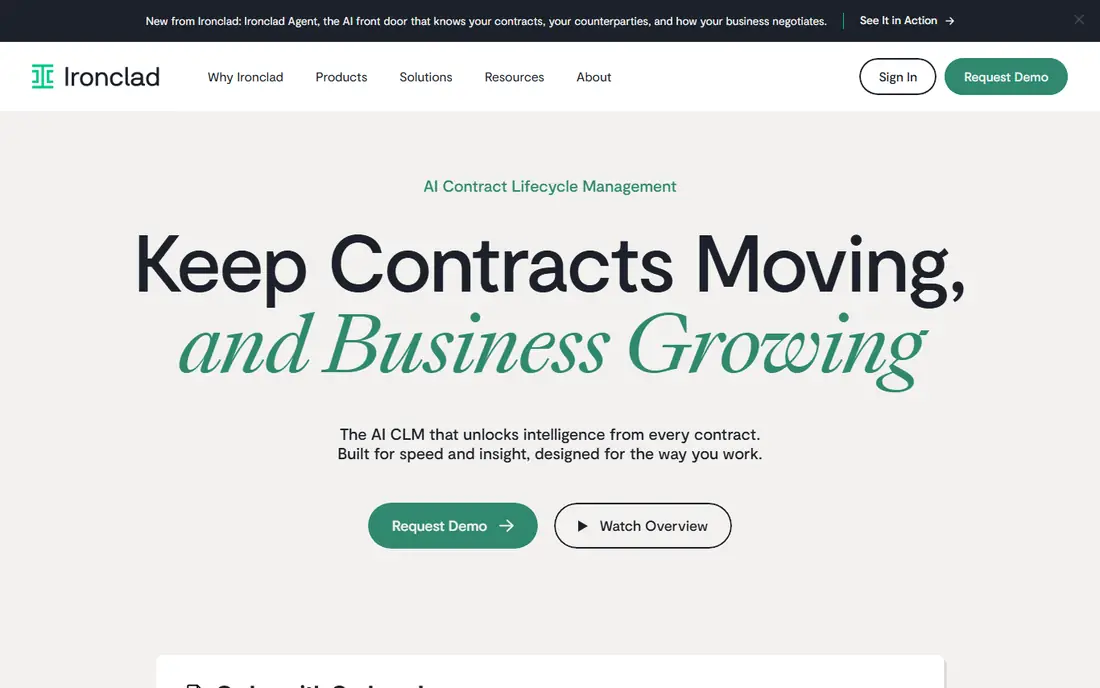
What we like- Ironclad is the reference product for legal led workflow automation. Its workflow designer turns a contract type into a guided intake form, routes drafts through the right approvers, keeps redlines inside the platform instead of email threads, and stores the signed result in a searchable repository with key terms extracted. Newer plans add AI assisted clause review and risk flagging. For a legal team processing hundreds of agreements a quarter, it replaces the shared drive and spreadsheet tracker completely.
Watch out for- Pricing is custom, and purchasing data puts typical deals near 40,000 dollars a year, which ends the conversation for most small businesses. Implementation takes real process design work, measured in months for complex rollouts. There is no free plan or self serve trial, so evaluation runs through a sales cycle.
#2PandaDoc
Best for: Sales led contract workflows4.7/5 on
G2 (3,621 reviews, checked Oct 2026)
Visit pandadoc.com
Starting price$19 per user per month
Free planYes
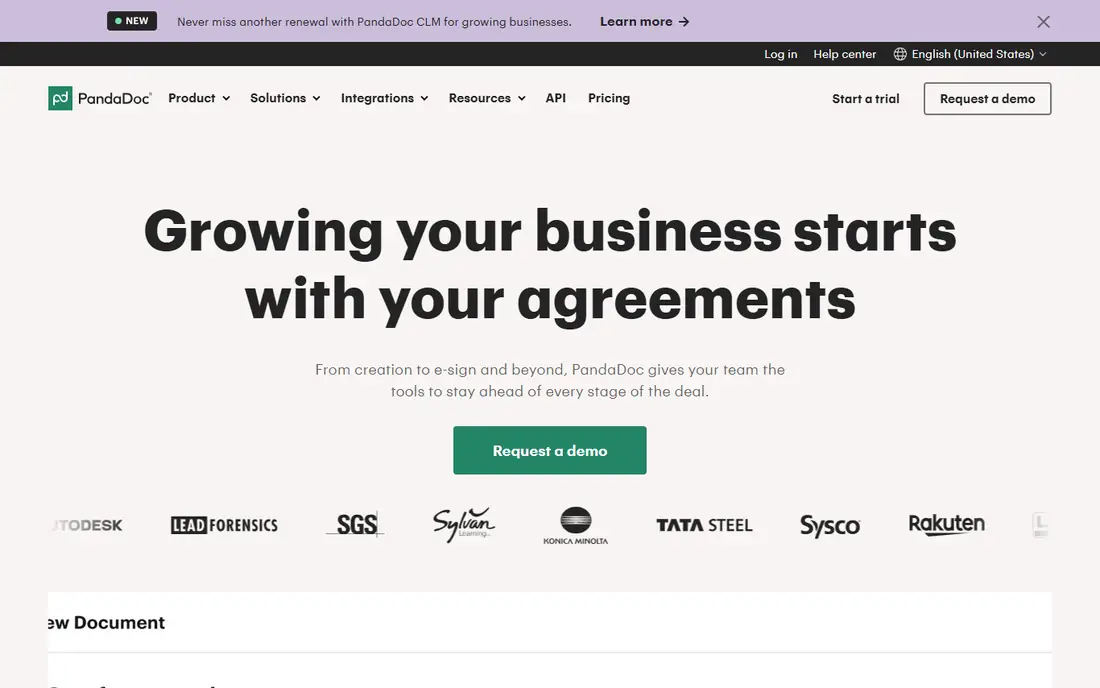
What we like- PandaDoc started in proposals and quotes, and it shows: sales teams build a contract from templates and CRM data, send it, track opens, and collect a signature without leaving one tool. It starts at 19 dollars per user per month billed annually, with Business at 49 dollars adding fuller workflow features, and a free plan covers light e-signature use. Connections to HubSpot, Salesforce, and Pipedrive keep deal data in sync, which is the main reason sales led companies pick it over legal led rivals.
Watch out for- Its contract lifecycle depth is lighter than Ironclad or Agiloft for complex multi entity agreements, and the repository and obligation tracking are not its strength. Per user pricing climbs as occasional signers get added. Companies whose contracts are procurement or employment heavy, rather than sales heavy, will feel the product's origins.
Starting priceSee website
Free planNo
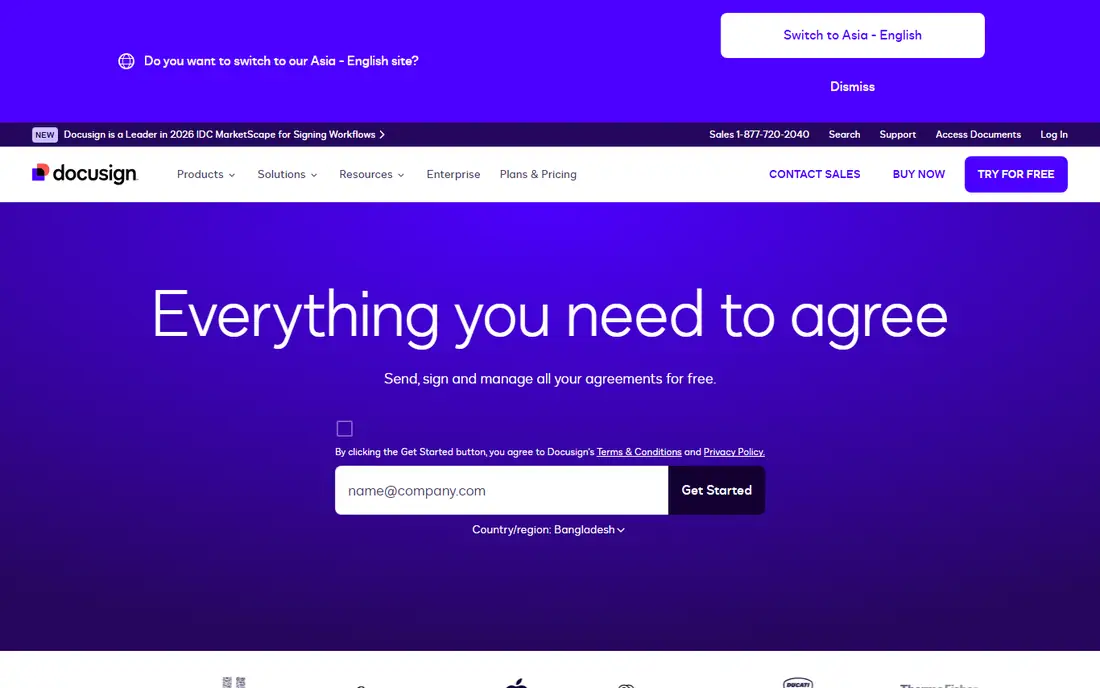
What we like- DocuSign CLM extends the signature product most counterparties already know into generation, workflow, and a repository, with AI term extraction across stored agreements. For an enterprise standardized on DocuSign for signing, it removes a vendor and reuses existing security reviews, identity checks, and integrations with Salesforce, SAP, and Microsoft tools. Approval routing, clause libraries, and obligation reporting cover the standard enterprise checklist.
Watch out for- Pricing is custom and purchasing data spans an enormous range, from about 20,000 dollars a year to well into six figures, so budgeting needs a quote early. The platform's breadth means modules and implementation services add up beyond the licence. Smaller teams generally find the product heavier than their contract volume justifies.
#4Juro
Best for: Browser based drafting and negotiation4.5/5 on
G2 (248 reviews, checked Oct 2026)
Visit juro.com
Starting priceSee website
Free planNo
What we like- Juro's difference is the editor: contracts are drafted, negotiated, and signed in a structured browser document rather than a Word file passed by email, so comments, approvals, and versions stay in one place and non lawyers can self serve standard agreements safely. Users are unlimited on its plans, and pricing is set by monthly contract volume in bands. Purchasing data suggests a median near 31,000 dollars a year. For fast growing companies drowning in sales and hiring contracts, the self serve model is the draw.
Watch out for- Every plan is quote based with annual billing only, and there is no free trial, only a demo. Deeper integrations, including Salesforce and Workday, cost extra. Teams whose counterparties insist on Word redlining will spend change management effort moving negotiation into Juro's format.
#5Concord
Best for: Small teams wanting published pricing4.2/5 on
G2 (133 reviews, checked Oct 2026)
Visit concord.app
Starting price$499 per month
Free planNo
What we like- Concord is the rare full CLM that publishes its prices: plans run from 499 to 1,299 dollars a month billed annually with five users included. It covers drafting, approval workflows, unlimited e-signatures on its plans, deadline reminders, and a repository with audit trails, aimed at small and mid sized companies that want the whole lifecycle without an enterprise sales process. Unlimited signatures matter, because per envelope pricing elsewhere punishes high volume senders.
Watch out for- At 499 dollars a month it costs far more than PandaDoc or Zoho Contracts for a small team, so the value case rests on signature volume and lifecycle features you actually use. Its AI drafting and extraction features are thinner than newer rivals. Five included users is a low ceiling, and added seats raise the bill.
Starting priceSee website
Free planNo
What we like- ContractWorks focuses on the storage half of the problem: a central repository with AI driven tagging that finds clauses and key dates across uploaded contracts, automatic alerts before renewals and deadlines, and permission controls by role. Pricing is flat with unlimited users, which suits companies where hundreds of employees need to look up a contract but few need to draft one. Setup is measured in days, not months, since there is no workflow engine to design.
Watch out for- It is a repository first, so drafting, negotiation, and approval workflows are basic compared with Ironclad or Agiloft. Prices are not published in a form we could confirm, hence see website. Companies that mainly need contracts found and renewals flagged will love it
- Companies that need intake and redlining should look elsewhere.
#7Agiloft
Best for: Highly custom contract workflows4.5/5 on
G2 (110 reviews, checked Oct 2026)
Visit agiloft.com
Starting priceSee website
Free planNo
What we like- Agiloft is built on a no code platform, which makes it the most configurable product here: unusual approval chains, contract types, and business rules can be modelled without custom development. It covers the full lifecycle including AI assisted review, and it has a long track record in healthcare, education, and the public sector where procurement rules are strict. For an organization whose contract process genuinely does not fit standard templates, that flexibility decides the purchase.
Watch out for- Configuration power means implementation effort, and rollouts run to months with process design workshops. Pricing is custom and there is no free tier or published rate card. The interface reflects its platform roots and feels less modern than Juro or Ironclad to business users.
#8LinkSquares
Best for: AI term extraction and analysis4.7/5 on
G2 (438 reviews, checked Oct 2026)
Visit linksquares.com
Starting priceSee website
Free planNo
What we like- LinkSquares built its name on the post signature side: upload your executed contracts and its AI extracts dates, values, renewal terms, and obligations into a searchable system, then its newer drafting tools work back from that data. Legal teams with thousands of legacy agreements in shared drives use it to find out what they have actually signed. It connects to Salesforce, HubSpot, and Microsoft Dynamics, and its reporting suits portfolio level questions such as exposure by clause type.
Watch out for- Pricing is enterprise and quote only, with no published starting figure. The drafting and workflow side is younger than the analysis side, so teams should test both halves against their own contracts in a pilot. Small companies with a few dozen agreements do not have the legacy problem LinkSquares solves best.
Starting price$25 per user per month
Free planYes
What we like- Zoho Contracts brings the lifecycle basics, templates, approval workflows, negotiation, e-signature through Zoho Sign, and obligation tracking, at 25 dollars per user per month billed annually, with a free plan for up to three users. For companies already on Zoho CRM or Zoho Books, the shared data and single vendor make it an easy addition. It covers the needs of a small business whose contracts are mostly standard agreements sent at moderate volume.
Watch out for- Its ecosystem gravity is the limit: outside the Zoho stack, integrations are thinner than PandaDoc or Ironclad. Advanced AI review and analytics are modest compared with the enterprise platforms. Large or heavily regulated companies will outgrow its workflow and reporting depth.
How we chose
We compared platforms on lifecycle coverage, from intake and drafting through renewal tracking, on published versus quote only pricing, repository search quality, and how implementation effort scales with contract volume. We favoured tools with verifiable pricing where it exists and wrote see website where a vendor publishes no rate card, rather than treating other buyers' negotiated deals as prices. We excluded pure e-signature tools with no lifecycle features, and general document tools without contract specific workflows.
How to choose the right contract management software
Start by deciding who owns the problem. If contracts stall in legal review, you need workflow: intake forms, approval routing, and clause libraries, which is Ironclad, Juro, or Agiloft territory. If contracts stall in sales, PandaDoc's CRM driven generation fixes the actual delay. If your problem is that nobody can find signed agreements or renewal dates keep passing unnoticed, a repository tool such as ContractWorks or LinkSquares solves it for less than a full lifecycle platform.
Then model the true cost. For quote only platforms, licences are only part of it: implementation, migration of legacy contracts, and integration work commonly match the first year licence, and repository tools go live in weeks while workflow platforms take months. Count your annual signature volume before choosing between unlimited signature plans and per envelope pricing. Finally, pilot with your own contracts. Bring your messiest agreement type and your standard template to the trial or demo, test the AI extraction against dates and clauses you verify by hand, and involve the legal team from the first evaluation, since a system bought without their workflow input tends to become shelfware. Software speeds up legal work; it does not replace a lawyer's judgment on terms that carry real risk.
Frequently asked questions
How much does contract management software cost in 2026?
Published prices start at 19 dollars per user per month for PandaDoc and 25 dollars for Zoho Contracts, Concord charges 499 dollars a month for a small team, and the enterprise platforms such as Ironclad, DocuSign CLM, and Icertis sell by quote, with purchasing data commonly showing five to six figures a year. Implementation and contract migration add to the first year cost on the larger platforms.
Can contract software replace our e-signature tool?
Usually yes. Every platform here includes e-signature, so the question is cost shape: unlimited signature plans such as Concord's versus per envelope pricing elsewhere. Model your annual signing volume before cancelling a standalone signature subscription, and check whether occasional external signers need paid seats.
How long does implementation take?
Repository first tools such as ContractWorks and ContractSafe typically go live in one to four weeks including contract migration. Workflow platforms such as Ironclad and Agiloft take two to six months because approval chains and clause libraries have to be designed. The quality of the legacy contract migration decides success more than any feature does.
Does AI contract review replace a lawyer?
No. AI extraction and clause flagging speed up review and make it more consistent, but the output is a suggestion, and accuracy varies by contract type. Templates, playbooks, and any agreement carrying real financial or legal risk still need review by qualified counsel, and you should verify AI extracted dates and terms against the signed document before relying on them for renewals.
What is the difference between CLM and a contract repository?
A repository stores signed contracts and makes them searchable, with alerts for key dates. Full CLM adds everything before signing: intake, template based drafting, approvals, negotiation, and signature, plus the repository. Companies often start with a repository to fix visibility, then add workflow once they can see where contracts actually stall.
Sources we checked (0)
Is your product missing or out of date?
We review this list regularly. Vendors can request a listing, send updated pricing or ask about featured placement.

Shihab Mia · Founder, Rankite
Shihab has 5+ years in B2B and SaaS SEO. He writes Rankite's software buying guides from pricing pages, documentation and public user reviews. More about Shihab.