How we make this list: we compare pricing pages, product documentation and public user reviews. Ratings come from G2, Capterra or Trustpilot, with the date we checked them.
Key takeaways
- CMiC is the enterprise pick, with financials and project management on a single database platform, built specifically for construction.
- Viewpoint Vista is the heavy civil pick, with deep multi-entity accounting, union payroll, and complex data configuration for large contractors.
- Acumatica Construction is the growing mid-market pick, with consumption-based pricing and APEX packages starting below 1,500 dollars a month.
- Sage 300 CRE is the US contractor standard for AIA billing and job costing, while Sage Intacct Construction suits cloud-first multi-entity firms.
- Foundation is the mid-size contractor pick, with nearly 40 years of construction-only focus and more than 43,000 professionals using it.
Quick comparison
Is your product missing or out of date?
We review this list regularly. Vendors can request a listing, send updated pricing or ask about featured placement.
The best construction ERP software

#1
Sage 300 CRE
Best for: US contractors and AIA billing
Visit sage.com
Starting priceSee website
Free planNo
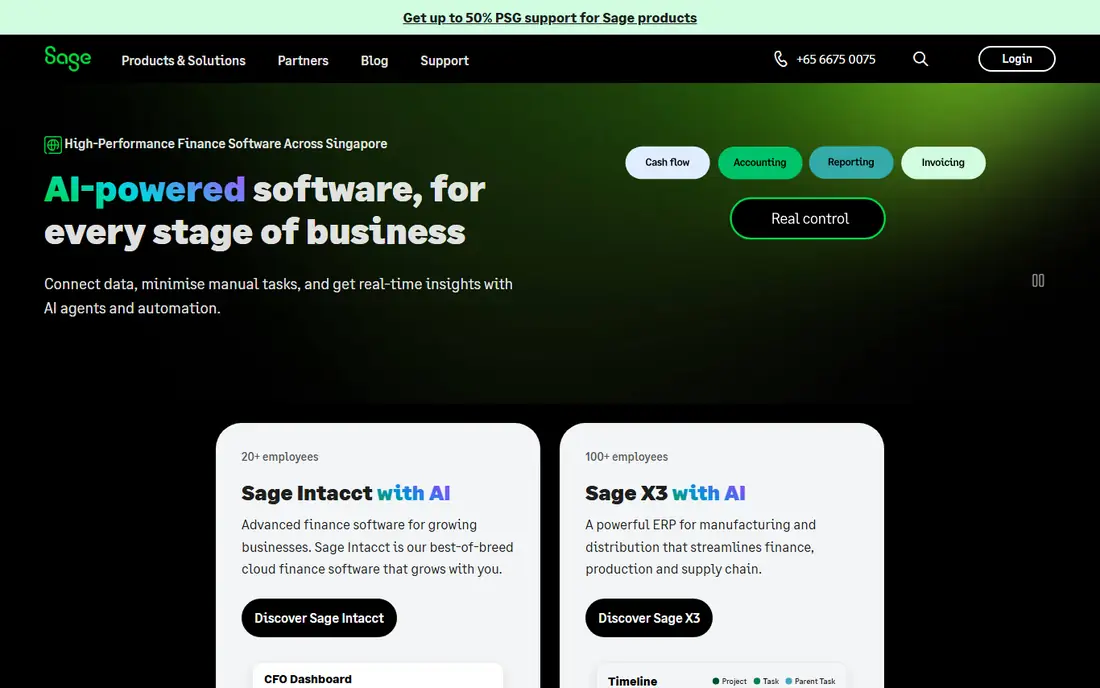
Sage 300 CRE is the US contractor standard, the system that defined construction accounting for generations of American general contractors and specialty contractors. It handles the industry mechanics that generic accounting cannot: job costing by cost code and phase, AIA progress billing, retainage, change orders, certified payroll, and subcontractor compliance.
Sage's homepage confirms construction as a tailored industry solution, with Sage Intacct as its cloud finance platform and a customer quote calling Sage the leader in construction software. Procore's support documentation lists Sage 300 CRE among its 14 supported ERP integrations, so field-to-office collaboration through Procore pairs naturally with Sage books.
The tradeoffs are age: a dated interface, limited mobile experience, and on-premises roots that make cloud migration a project. Sage 300 CRE is the pick for US-based construction firms that want proven AIA billing and job costing and already run Sage.
What we like- Deepest US construction accounting heritage
- AIA progress billing, retainage, and job costing built in
- Procore ERP integration supported
- Large US contractor install base
Watch out for- Dated interface
- Limited mobile experience
- On-premises roots mean cloud migration takes planning
- Pricing is quote-only

#2
Sage Intacct Construction
Best for: Cloud-first multi-entity firms
Visit sage.com
Starting priceSee website
Free planNo
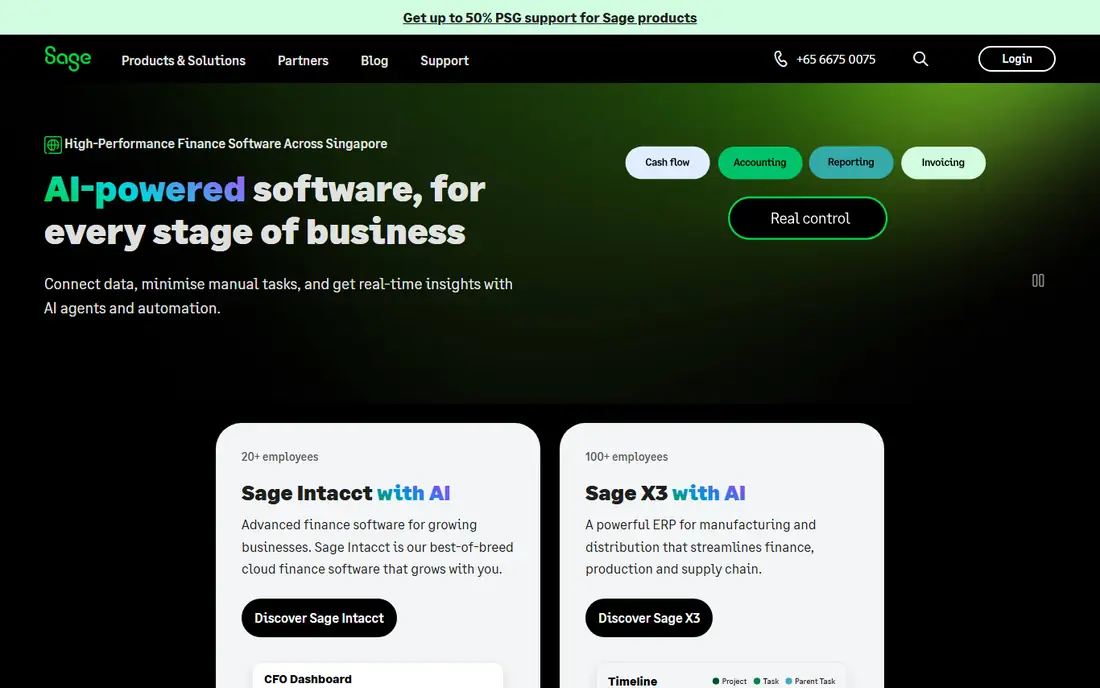
Sage Intacct Construction is the cloud-first answer from the same vendor, built for contractors that run multiple entities and need real-time financial visibility without on-premises servers. Its homepage promises closing up to 90 percent faster with AI, automating 90 percent of manual tasks, up to 5 times payback in as little as 6 months, and built-in audit trails and controls.
The platform scales operations with automated multi-entity accounting and real-time visibility, and Sage positions Intacct as the first and only AICPA preferred finance solution, trusted by more than 30,000 scaling and midsized teams. Construction-specific workflows cover project accounting, job costing, and progress billing through the construction solution built on Intacct.
The tradeoff is depth: construction features come through configuration and implementation partners rather than out-of-the-box trade depth, and field management tools need bolt-ons. Sage Intacct Construction is the pick for cloud-first, multi-entity contractors that prioritize finance over field.
What we like- True cloud multi-entity accounting
- Closes up to 90 percent faster with trusted AI
- First and only AICPA preferred finance solution
- Real-time visibility across entities
Watch out for- Construction depth comes through configuration and partners
- Field tools need bolt-ons
- Pricing is quote-only

#3Viewpoint Vista
Best for: Large and heavy civil contractors4.0/5 on
G2 (137 reviews, checked Oct 2026)
Visit viewpoint.com
Starting priceSee website
Free planNo
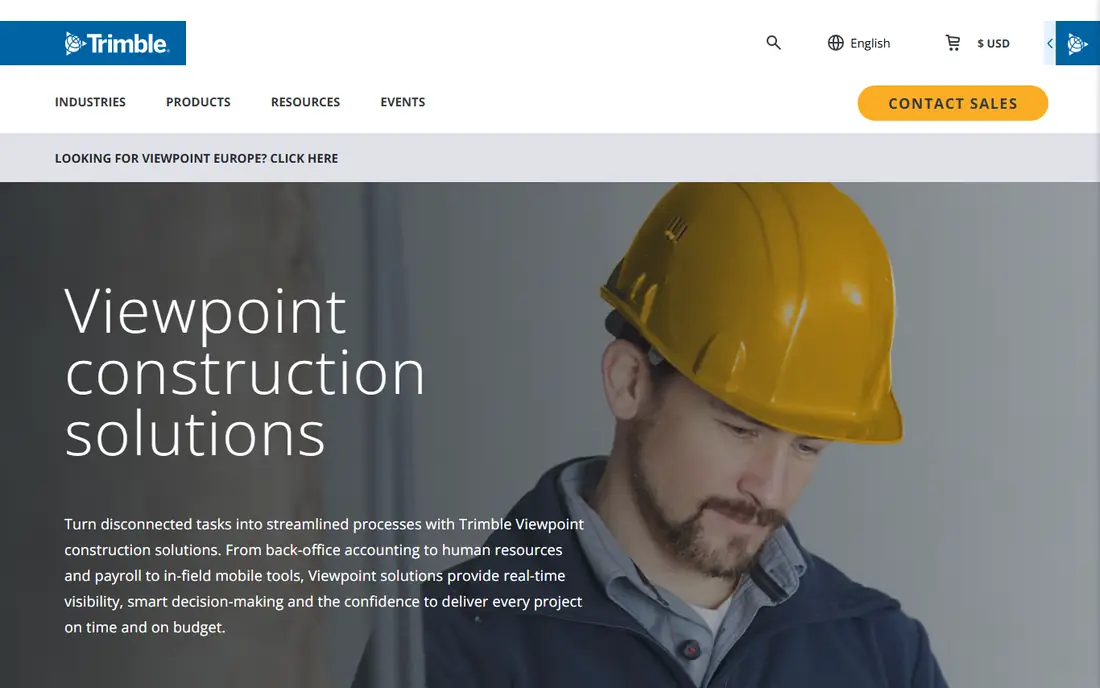
Viewpoint Vista, now part of Trimble Construction One, is the enterprise ERP for large-scale contractors that need deep data configuration. Viewpoint's own FAQ describes Vista as a highly customizable enterprise ERP tailored for large-scale contractors requiring deep data configuration, complex multi-entity accounting, and strong HR and payroll processing.
Vista serves as the financial and operational foundation of Trimble Construction One, connecting back-office accounting with field management, Trimble Pay, and TC1 Analytics under a unified Trimble ID login. The platform cites a 30 percent reduction in project delays, a 75 percent reduction in safety issues, and a 50 percent reduction in time tracking unapproved invoices across its customer base.
Cloud-hosted Vista supports custom Crystal Reports through Vista Remote Link and SQL Server Reporting Services over secure endpoints, with 24/7 support and Trimble Construction Academy training included. Viewpoint Vista is the pick for large and heavy civil contractors with complex payroll, multi-entity, and reporting needs.
What we like- Highly customizable enterprise ERP
- Complex multi-entity accounting
- Strong HR and union payroll
- Part of Trimble Construction One
- 24/7 support and academy training
Watch out for- Heavy for smaller firms
- Implementation is a major project
- Cloud-hosted reporting needs VRL or SSRS configuration

#4CMiC
Best for: Enterprise general contractors4.1/5 on
G2 (122 reviews, checked Oct 2026)
Visit cmicglobal.com
Starting priceSee website
Free planNo
CMiC is the enterprise general contractor pick, built on a single database platform that unifies financials and project management without syncing between systems. Its homepage calls it the first AI-powered construction ERP, with an all-in-one suite of financials and project management designed to optimize key functional areas.
Financials cover construction accounting, project controls, equipment and inventory, opportunity management, and construction payroll plus HCM, while project management covers drawing and construction documents, pre-qualification and procurement, and quality and safety. The platform serves general contractors, subcontractors, and civil and highway firms, with forecasting, payroll and asset optimization, and units-in-place tracking for heavy work.
The tradeoff is enterprise scale: high cost, long rollout, and implementation complexity that only makes sense above a certain size. CMiC is the pick for enterprise general contractors that want deep project controls on one database.
What we like- Financials and project management on one single database platform
- First AI-powered construction ERP
- Deep project controls
- Civil and highway support
- Unified HCM, job costing, and GL
Watch out for- High cost and long rollout
- Enterprise focus means overkill for small firms
- Implementation needs experienced partners
Starting price$1,500 per month
Free planNo
Acumatica Construction is the growing mid-market pick, built on the cloud ERP with the highest customer satisfaction ratings in the industry. Its homepage confirms a Construction Management module with job-cost accounting, project budgets, labor, material, and equipment costs, subcontractor costs, inventory, commitments, forecasting, progress billing, and profitability reporting, all inside the broader ERP.
The pricing model is the differentiator: consumption-based, paying for resources used rather than per user, which suits firms with many occasional field users who would face high per-seat costs elsewhere. Acumatica's 2026 construction page advertises APEX packages with implementation and support starting below 1,500 dollars a month for qualifying configurations, while the general edition starts at 6,396 dollars a year and most mid-market contractors spend 25,000 dollars plus annually.
Acumatica integrates with Procore, Autodesk, ADP, Avalara, and AvidXchange, and customer stories include specialty contractor Spohn Associates scaling with the Construction Edition. Acumatica Construction is the pick for growing firms that want cloud ERP pricing tied to use, not headcount.
What we like- Consumption-based pricing, not per user
- True cloud with unlimited users
- Construction edition with job costing, forecasting, and progress billing
- Procore integration
- Top-rated customer satisfaction
Watch out for- Less field depth than specialist tools
- Implementation needs a skilled partner
- Pricing varies by transaction volume
Starting priceSee website
Free planNo
Foundation, from Foundation Software, is the mid-size contractor pick, built exclusively for contractors for nearly 40 years. Its homepage describes FOUNDATION as construction accounting software bringing together job costing, payroll, invoicing, vendor payments, and financial reporting in one system, trusted by more than 43,000 construction professionals nationwide.
Job costing tracks every dollar, hour, and quantity for every job, with instant reports on project cash flows and work-in-progress, plus automated alerts to avoid budget overruns before they happen. Modules cover accounts payable and receivable, consolidated general ledger, CPA audit tools, equipment, fixed assets, inventory, purchase orders and subcontracts, service dispatch, and unit price billing, with ProjectHQ for project management and Payroll4Construction for payroll.
The tradeoff is breadth: project management and estimating live in companion or partner products rather than one suite. Foundation is the pick for mid-size contractors that want construction-only accounting depth with expert support.
What we like- Nearly 40 years construction-only
- America's number 1 construction accounting software claim
- Real-time job costing with overrun alerts
- In-house construction-expert support
- 43,000 plus professionals
Watch out for- Project management sits in companion products
- Estimating comes through partners
- Quote-only pricing
- Smaller ecosystem than Sage or Trimble
Starting priceSee website
Free planNo
Jonas Construction is the pick for contractors that have outgrown generic accounting tools, spreadsheets, and disconnected systems. Its homepage promises one platform for job costing, work orders, payroll, and financials, with no re-keying from field to back office, payroll in hours rather than days, and one report instead of six spreadsheets.
Accounting and payroll keep labor, burden, and job cost in one ledger with no separate reconciliation later, while project management shares that ledger so job cost reports carry unposted labor and burden. Service management closes the gap between a completed work order and a sent invoice across PMAs, jobs, and work orders, and integrated operations support equipment, purchasing, and multiple companies with one entry and one set of books ready for audit.
Jonas Cloud offers hosted access without on-premises servers, and implementation typically ranges from a few months to a year depending on size and complexity. Jonas Construction is the pick for contractors that need job costing, service, and payroll in one ledger.
What we like- One platform for job costing, work orders, payroll, and financials
- Service management from work order to invoice
- Multi-company and multi-location support
- Jonas Cloud hosting option
Watch out for- Quote-only pricing
- Implementation typically takes months to a year
- Smaller brand than Sage, Trimble, or Oracle

#8Oracle NetSuite
Best for: Cloud-first multi-subsidiary firms4.1/5 on
G2 (4,969 reviews, checked Oct 2026)
Visit netsuite.com
Starting priceSee website
Free planFree trial
Oracle NetSuite is the cloud-first multi-subsidiary pick, the number 1 AI cloud ERP with a unified suite connecting ERP, financials, CRM, and ecommerce in one source of truth. Its homepage confirms NetSuite Next, with built-in conversational intelligence, agentic workflows, and natural-language search, plus a free 3-day test drive.
For construction firms, NetSuite's strength is financial management across subsidiaries: multi-entity consolidation, project accounting, and procurement inside a broader ERP that also handles distribution, services, and manufacturing. The AI positioning matters here: because data lives in one suite, the AI works from a single source of truth rather than guessing across synced systems.
The tradeoff is construction specificity: job costing, AIA billing, and field tools come through configuration, SuiteApps, and implementation partners rather than purpose-built trade depth. Oracle NetSuite is the pick for fast-growing, multi-subsidiary firms that want one cloud ERP for the whole business, not just construction.
What we like- Number 1 AI cloud ERP
- Unified suite across ERP, financials, CRM, and ecommerce
- NetSuite Next with conversational intelligence and agentic workflows
- Free 3-day test drive
Watch out for- Construction tools come via configuration and partners
- Field depth needs bolt-ons
- Pricing is quote-only and climbs with modules
How we chose
We compared construction ERP software using 2026 comparisons and vendor homepages we opened on 27 October 2026 to confirm they load and belong to the vendor. Sage 300 CRE and Sage Intacct Construction are listed separately because they are distinct products, both under sage.com. Procore is not listed as an ERP because it is project management software that integrates with ERPs rather than replacing the general ledger. Pricing is quote-only for most platforms, so get implementation quoted separately. We did not claim hands-on testing.
What to check before you pick
Start from your size and trade. Small contractors need Foundation or Jonas. Growing mid-market firms need Acumatica. Large and heavy civil contractors need Viewpoint Vista or CMiC. Multi-entity cloud-first firms need Sage Intacct or NetSuite. US firms with AIA billing needs start with Sage 300 CRE.
Next, budget implementation separately from licensing. ERP research puts SMB licensing at 15,000 to 60,000 dollars a year with 4 to 12 month implementations, and Jonas notes implementations from a few months to a year. Get both numbers in writing before signing.
Finally, check field-to-office integration before you commit. If your teams use Procore, confirm the ERP integration is supported and priced. If your payroll is union or certified, confirm prevailing wage and certified payroll handling. And confirm who owns the sync when field and finance live in different systems.
Frequently asked questions
What is the best construction ERP software overall?
CMiC for enterprise general contractors, Viewpoint Vista for large and heavy civil work, Acumatica Construction for growing mid-market firms, and Sage 300 CRE for US contractors that prioritize AIA billing. The right pick depends on size, trade, and cloud preference.
What is the difference between construction ERP and construction project management?
ERP holds the books: general ledger, job costing, payroll, and financials. Project management tools like Procore handle drawings, RFIs, submittals, and field collaboration, then integrate with the ERP. Most large contractors run both.
How much does construction ERP cost?
SMB licensing typically runs 15,000 to 60,000 dollars a year, with ERP-tier platforms starting around 10,000 dollars a year and climbing with users and modules, plus implementation quoted separately. Acumatica APEX packages start below 1,500 dollars a month for qualifying configurations.
How long does construction ERP implementation take?
Typically 4 to 12 months for SMB platforms, and from a few months to a year for Jonas depending on size and complexity. Data migration, training, and payroll configuration drive the timeline.
Can QuickBooks handle construction accounting?
QuickBooks Online handles it poorly, while QuickBooks Enterprise with the Contractor edition handles it adequately for small contractors. Past 50 employees or multi-entity operations, purpose-built tools like Foundation, Jonas, or Viewpoint do the job properly.
Do I need ERP or is contractor software enough?
If you need job costing, AIA billing, retainage, and subcontractor compliance inside the same system as your general ledger, you need ERP or purpose-built construction accounting. If you only need scheduling and client communication, lighter tools suffice.
Sources we checked (8)
- https://www.sage.com
- https://www.sage.com
- https://www.viewpoint.com
- https://cmicglobal.com
- https://www.acumatica.com
- https://www.foundationsoft.com
- https://www.jonasconstruction.com
- https://www.netsuite.com
Is your product missing or out of date?
We review this list regularly. Vendors can request a listing, send updated pricing or ask about featured placement.

Shihab Mia · Founder, Rankite
Shihab has 5+ years in B2B and SaaS SEO. He writes Rankite's software buying guides from pricing pages, documentation and public user reviews. More about Shihab.
 Acumatica Construction
 Foundation
 Jonas Construction