How we make this list: we compare pricing pages, product documentation and public user reviews. Rankite is independent; if a vendor ever pays for a featured spot, that listing is clearly labeled Partner.
Key takeaways
- Optro (formerly AuditBoard) remains the standard for internal audit and SOX at large enterprises.
- Vanta is the fastest path to a first SOC 2 for startups, with the broadest integration catalog.
- Drata wins for teams running SOC 2 plus ISO 27001 and HIPAA together, thanks to control crosswalks.
- Thoropass bundles the platform with its own audit team, which can cost less than platform plus separate auditor.
- Sprinto offers the best value for international teams that need many frameworks on a budget.
Quick comparison
| Tool | Best for | Starting price | Free plan |
|---|
 Optro Optro | enterprise internal audit and SOX programs | See website | No |
 Vanta Vanta | startups getting their first SOC 2 | See website | No |
 Drata Drata | teams running several frameworks at once | See website | No |
 Secureframe Secureframe | SMBs that want guided compliance help | See website | No |
 Hyperproof Hyperproof | teams standardizing on common controls | See website | No |
 Sprinto Sprinto | international teams needing value pricing | See website | No |
 Thoropass Thoropass | teams that want the audit included | See website | No |
 Workiva Workiva | public companies combining SOX and financial reporting | See website | No |
Is your product missing or out of date?
We review this list regularly. Vendors can request a listing, send updated pricing or ask about featured placement.
The best compliance audit software
#1
Optro
Best for: enterprise internal audit and SOX programs
Visit optro.ai
Starting priceSee website
Free planNo
Optro is the new name for AuditBoard, rebranded in March 2026. The product is the same one that defined modern audit management: risk-based audit planning, SOX testing, issue remediation and connected workpapers in one cloud platform. More than half of the Fortune 500 run their audit programs on it.
The rebrand added agentic AI features and an AI governance module through the FairNow acquisition. For a mid-market company doing its first SOC 2, Optro is overkill and overpriced. For an enterprise audit team replacing spreadsheets and legacy GRC tools, it is still the default choice. Budget for implementation services on top of the license.
What we like- Deep internal audit and SOX workflows
- Strong cross-module reporting
- Trusted by over half the Fortune 500
Watch out for- Custom pricing with no public tiers
- Implementation often needs dedicated admin time
Starting priceSee website
Free planNo
Vanta is the name auditors and enterprise buyers recognize, which is half the battle for a startup. Connect your cloud, identity and HR tools, and Vanta continuously monitors controls, collects evidence and drafts policies. The trust center and questionnaire automation help close deals while the audit runs.
Pricing is tiered by framework and company size, and the second-year renewal is where buyers report sticker shock. Negotiate multi-year caps up front. Vanta does not replace the audit: you still hire a CPA firm for the attestation, though Vanta's partner network makes that easy. For speed to a first SOC 2, nothing beats it.
What we like- 300+ integrations
- Auditor marketplace
- AI questionnaire automation and trust centers
Watch out for- Costs climb with frameworks and headcount
- Renewal increases are a common complaint
Starting priceSee website
Free planNo
Drata's pitch is simple: map a control once, satisfy SOC 2, ISO 27001 and HIPAA together. The crosswalk feature genuinely saves work when you add a second or third framework, which is why growth-stage companies pick it. The interface is the cleanest in the category, and engineers tolerate it better than most compliance tools.
Like Vanta, Drata does not perform the audit itself. Pricing is custom and roughly comparable. Where Drata pulls ahead is federal-adjacent work: CMMC and FedRAMP support are stronger here. If you know you will need three frameworks within two years, start with Drata and skip the re-platforming pain later.
What we like- Excellent multi-framework control mapping
- Clean continuous-monitoring UX
- Strong CMMC and FedRAMP support
Watch out for- Pricing is opaque
- Smaller integration catalog than Vanta
Starting priceSee website
Free planNo
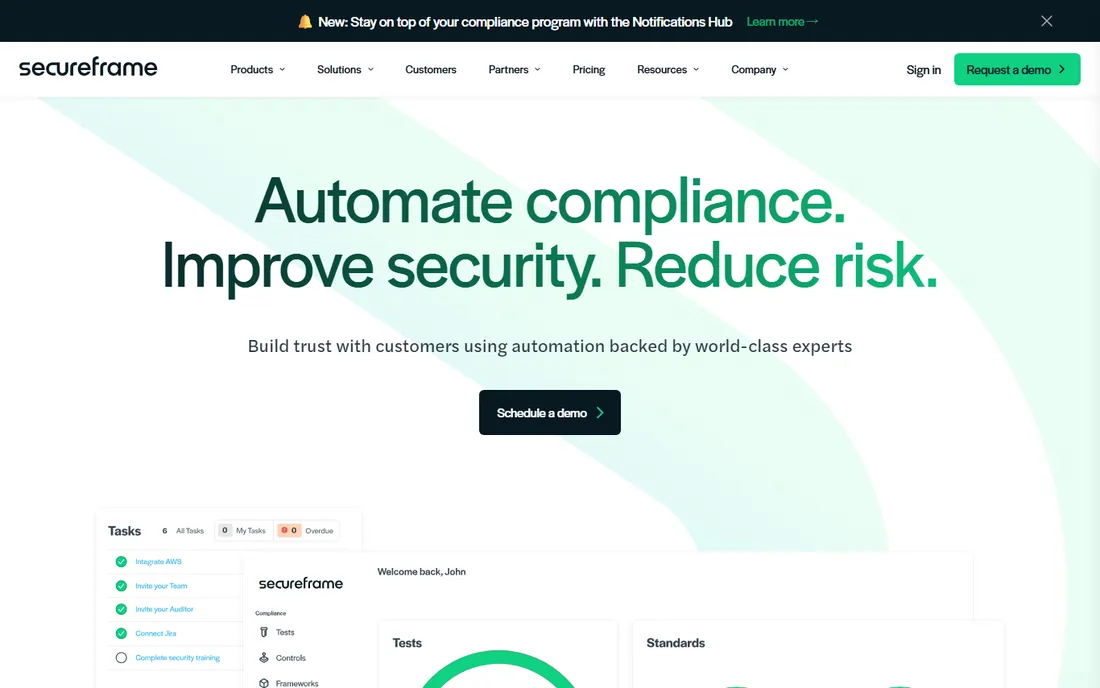
Secureframe positions itself as the guided option. The platform automates evidence collection and monitoring, but the differentiator is the human help: compliance experts assist with setup, policy writing and audit prep. For a 50-person company with no dedicated compliance hire, that hand-holding matters.
The company expanded into defense compliance with Secureframe Defense for CMMC in 2026. Pricing is quote-based, which makes comparison shopping harder. Power users sometimes find the automation less deep than Vanta or Drata. If your team needs a sherpa more than a toolkit, Secureframe fits.
What we like- Strong onboarding and compliance expertise
- AI questionnaire engine
- Good for regulated SMBs
Watch out for- No public pricing
- Automation depth trails Vanta and Drata
Starting priceSee website
Free planNo
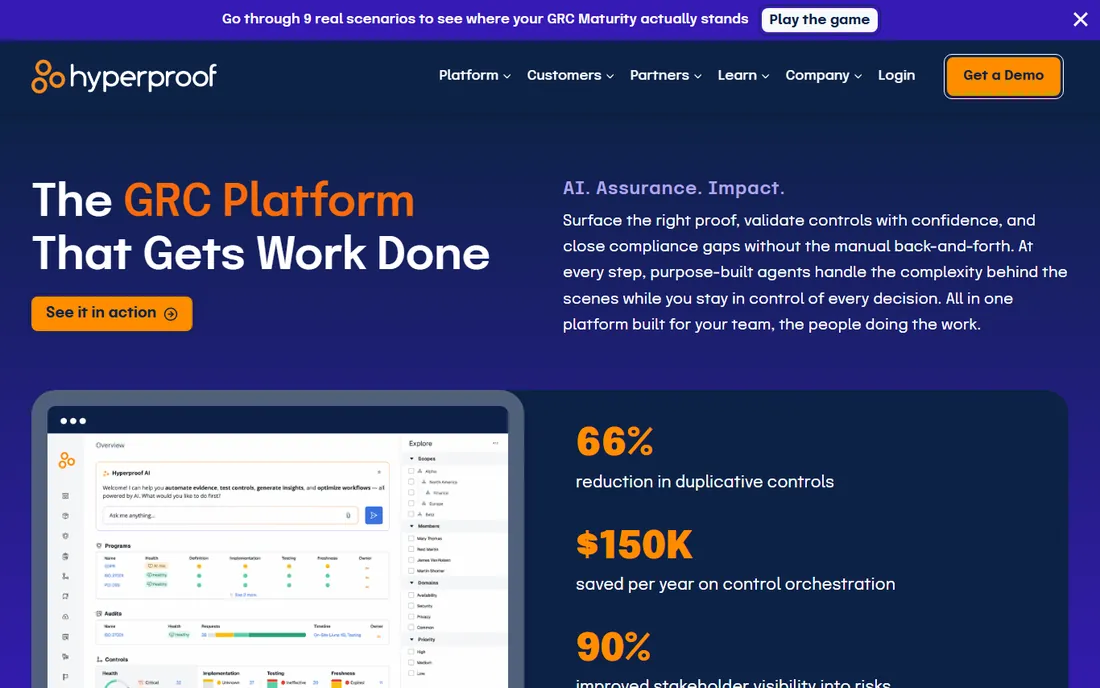
Hyperproof takes the common-controls approach seriously. Define a control once, map it to every framework, and let the platform handle evidence and testing. The framework library is one of the largest available, with strong EU coverage like NIS2 and DORA after its European expansion. Hypersync lets engineers build custom evidence integrations.
It sells like an enterprise platform, with demos and custom quotes, so small teams may find the process slow. But for mid-market and enterprise teams that want one system of record for controls, evidence and risk, Hyperproof is a strong alternative to the bigger names.
What we like- Large framework library including EU frameworks
- Hypersync for custom integrations
- Strong risk linkage
Watch out for- Enterprise sales motion
- Smaller brand recognition than Vanta
Starting priceSee website
Free planNo
Sprinto is the value play in compliance automation. It supports over 200 frameworks, integrates with 300+ systems, and typically costs thousands less per year than Vanta or Drata. For companies outside the US, the international framework coverage and regional data centers are real advantages.
The trade-off is brand recognition. Some US auditors and enterprise buyers have never heard of it, which can add friction to deals. But the product is solid, the autonomous monitoring works, and the price difference funds a lot of patience. Budget-conscious teams should absolutely get a quote.
What we like- 200+ frameworks supported
- Competitive pricing
- Good for APAC and EU teams
Watch out for- Newer brand with less auditor familiarity
- AI features still maturing
Starting priceSee website
Free planNo
Thoropass solves the two-vendor problem by being both the platform and the auditor. Its Audit Lifecycle Platform automates evidence collection, and its own CPA team performs the SOC 2, ISO 27001, PCI or HITRUST audit. The all-in price often beats buying a platform and hiring a separate firm.
The catch is independence and choice. Some buyers prefer to keep their auditor separate from their tooling, and Thoropass cannot audit you if you want a different firm. It also offers penetration testing from the same team. For small teams that want one throat to choke and a signed report at the end, the bundle is compelling.
What we like- In-house audit team bundled with platform
- Pentesting available
- Works with any GRC system
Watch out for- Bundled model means less auditor choice
- Pricing bundles can obscure platform cost
#8
Workiva
Best for: public companies combining SOX and financial reporting
Visit workiva.com
Starting priceSee website
Free planNo
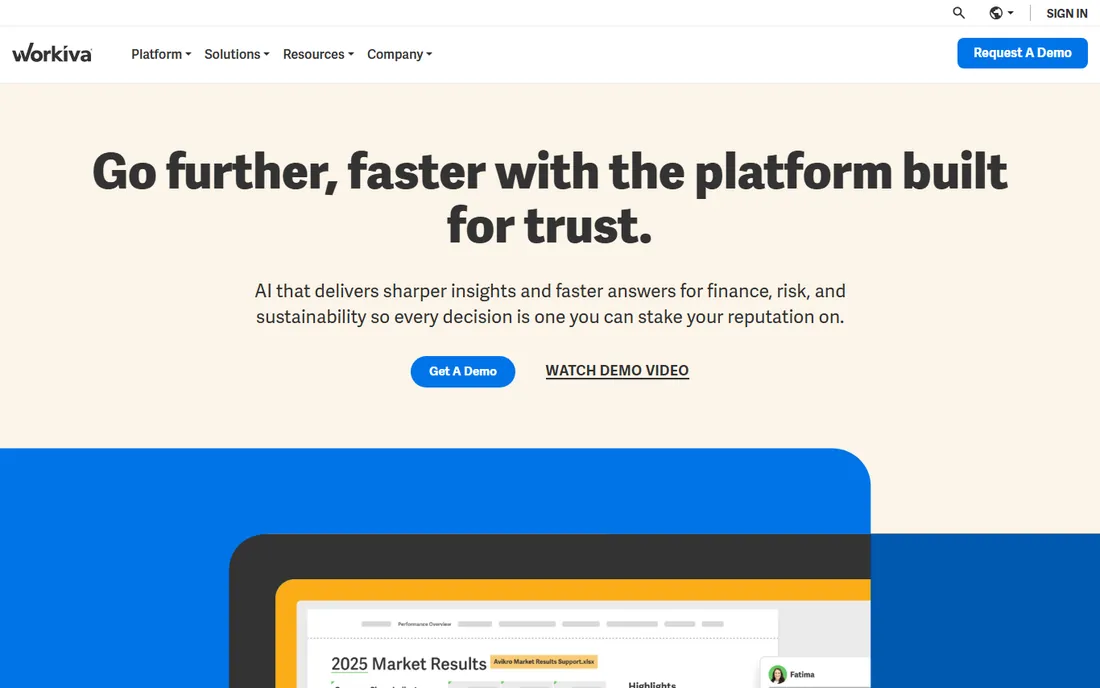
Workiva started in financial reporting and grew into GRC, which makes it unique here. If your compliance program centers on SOX, SEC filings and ESG disclosures, Workiva connects controls directly to the numbers in your reports. The audit trail and version control are built for work that gets filed and regulated.
For a SaaS startup chasing SOC 2, Workiva is the wrong tool: expensive, finance-oriented and heavy. For a public company where the CFO owns compliance, it consolidates reporting and controls in a way no pure-play compliance tool can. Evaluate it against Optro, not Vanta.
What we like- Unmatched financial reporting and SOX controls
- Connected data across filings
- Strong audit trail
Watch out for- Expensive
- Overkill for pure security compliance
Compliance automation vs. audit management: know which you need
These are two different jobs. Compliance automation tools (Vanta, Drata, Secureframe, Sprinto, Hyperproof) prepare you for external audits like SOC 2 and ISO 27001: they monitor controls, collect evidence and keep you audit-ready year-round. Audit management tools (Optro, Workiva) run internal audit programs: planning, fieldwork, SOX testing and issue tracking.
Many companies eventually need both. A SaaS company starts with Vanta for SOC 2, then adds Optro years later when the board demands an internal audit function. Buying the wrong category first wastes a year. If your trigger is a customer asking for a SOC 2 report, you need compliance automation. If your trigger is the audit committee asking for a risk-based audit plan, you need audit management.
How we chose
We focused on platforms that US businesses actually buy for compliance and audit work in 2026, covering both compliance automation and audit management. We read vendor homepages, product documentation and pricing pages, checked public reviews on G2 and Capterra, and reviewed Reddit threads where compliance managers compare notes. We verified the AuditBoard to Optro rename through the company's own announcement. We excluded point tools for single frameworks and platforms with unresolved trust issues. Pricing is custom across the category, so we list See website throughout.
What to ask on every compliance software demo
Ask who performs the audit. Software prepares evidence; only a licensed CPA firm can issue a SOC 2 attestation. If the vendor bundles auditors, confirm the firm's credentials and independence.
Ask about framework number two. The first framework is always the demo; the pain comes when you add ISO 27001 six months later. Make them show you the crosswalk in the live product, not slides.
Ask about renewal pricing. Year-two increases of 20 to 40 percent are the most common complaint in this category. Get a multi-year price cap in writing before you sign.
Ask about evidence ownership. If you leave, can you export your evidence, policies and control mappings in usable formats? Some platforms make exit painful by design. Confirm the export story during the trial, not during the breakup.
Frequently asked questions
What is compliance audit software?
Compliance audit software helps companies prepare for and manage audits. It includes compliance automation platforms that monitor security controls and collect evidence for frameworks like SOC 2 and ISO 27001, and audit management platforms that run internal audit programs, SOX testing and issue remediation.
How much does compliance audit software cost?
Mid-market platform licenses typically run $7,000 to $30,000 per year, while enterprise programs can exceed $50,000 to $150,000. The CPA audit itself is a separate cost, often $15,000 to $80,000. Budget for both, and negotiate renewal caps because year-two increases are common.
Does compliance software replace the auditor?
No. The software prepares evidence and keeps you audit-ready, but the attestation must come from an independent licensed CPA firm. Thoropass is the exception that bundles both, with its own in-house audit team performing the audit.
Vanta or Drata: which should I choose?
Choose Vanta if you want the market leader with the most integrations and the broadest auditor familiarity, especially for a first SOC 2. Choose Drata if you plan to run multiple frameworks from the start, since its control crosswalks make the second and third frameworks much less painful.
What happened to AuditBoard?
AuditBoard rebranded as Optro in March 2026, reflecting its expansion from audit management into AI-powered GRC. The platform and team continue under the new name at optro.ai.
How long does it take to get SOC 2 compliant?
With a compliance automation platform and a cooperative team, startups typically reach audit readiness in 2 to 4 months for SOC 2 Type I. Type II requires a 3 to 12 month observation period on top of that. The biggest delays come from missing policies and slow evidence collection, which is exactly what the software automates.
Sources we checked (10)
- https://optro.ai
- https://optro.ai/blog/meet-optro-auditboard-unveils-new-identity-as-ai-transforms-grc
- https://vanta.com
- https://drata.com
- https://secureframe.com
- https://hyperproof.io
- https://sprinto.com
- https://thoropass.com
- https://workiva.com
- https://kurums.com/best-grc-compliance-software-2026-comparison/
Is your product missing or out of date?
We review this list regularly. Vendors can request a listing, send updated pricing or ask about featured placement.

Shihab Mia · Founder, Rankite
Shihab has spent more than a decade helping SaaS and e-commerce brands grow through search. He writes Rankite's software buying guides from pricing pages, documentation and public user reviews. More about Shihab.