How we make this list: we compare pricing pages, product documentation and public user reviews. Ratings come from G2, Capterra or Trustpilot, with the date we checked them.
Key takeaways
- Every major US brokerage now charges $0 commission on online stock and ETF trades, so research, tools, and service matter more than trade price.
- Fidelity and Charles Schwab are the strongest all-round picks for most investors, with deep research and no account minimums.
- Vanguard suits long-term index fund investors who care most about fund costs, while Robinhood suits mobile-first beginners.
- Interactive Brokers is the pick for advanced and international traders, and Merrill Edge suits Bank of America customers.
Quick comparison
Is your product missing or out of date?
We review this list regularly. Vendors can request a listing, send updated pricing or ask about featured placement.
The best companies for investing
Starting price$0 commission
Free planYes
Fidelity is the strongest all-round pick for US investors who want low costs without giving up research. Its homepage states $0 account fees, $0 commissions on online US stock and ETF trades, and fractional shares from as little as $1, with no minimums to open core accounts. Retirement accounts, HSAs, 529 plans, and taxable accounts all sit in one login, which keeps long-term planning simple.
Research is where Fidelity pulls ahead of simpler apps: screeners, analyst reports, and planning tools help you compare funds and build a portfolio, while zero-expense-ratio index funds keep fund costs low. Support is available around the clock by phone, chat, and in person at branch offices. The app can feel busy for pure beginners, and its active trading tools take time to learn, but for most investors Fidelity is the safest starting point.
What we like- $0 commissions and $0 account fees
- Fractional shares from $1
- Zero-expense-ratio index funds
- 24/7 support
Watch out for- App can feel busy for pure beginners
- Active trading tools take time to learn
Starting price$0 commission
Free planYes
Charles Schwab is the other top all-round brokerage, with $0 commissions on online stock and ETF trades, no account minimum, and the thinkorswim platform for active traders, including paper trading for practice. It is a frequent pick for IRAs and rollovers, and its research and education library covers beginners through advanced traders.
Schwab's platform breadth is its advantage: banking, retirement, and brokerage in one relationship, with strong customer service. Note that its homepage served only an authorization-error page during our check, so we list it on the strength of its public fee schedules and comparison coverage rather than a confirmed homepage load. Fractional shares exist but are more limited than Fidelity's $1 offering, which matters for small regular investments.
What we like- $0 stock and ETF commissions
- Thinkorswim platform for active traders
- 24/7 support
- $0 account minimum
Watch out for- Homepage served only an authorization-error page in our check
- Fractional share options are more limited than Fidelity
Starting price$0 commission
Free planYes
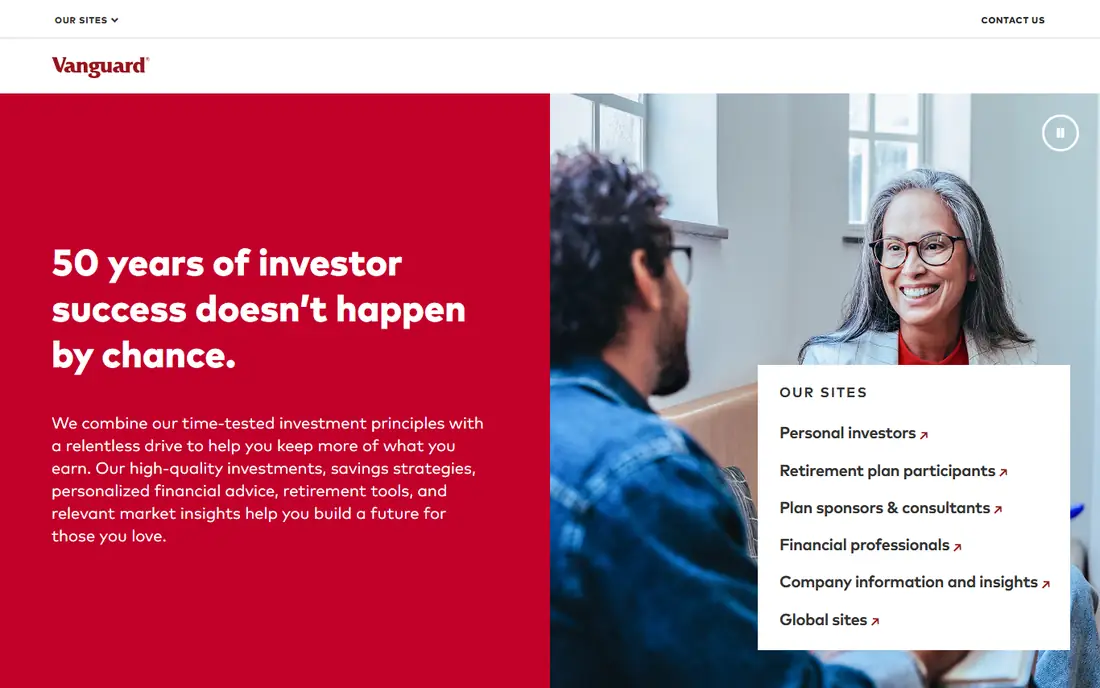
Vanguard is the original passive investing institution, and its pitch is simple: keep more of what you earn by paying less in fund fees. Its homepage notes 50 years of investor success built on time-tested investment principles, high-quality investments, and retirement tools. Online stock and ETF trades carry no commission, and most accounts have no minimum, though some mutual funds require minimum investments.
Flagship index fund expense ratios run as low as 0.03 to 0.04 percent, which compounds into real savings over decades. The trade-offs are a dated platform and mobile app, weaker tools for active traders, and customer service reviews that have slipped. If you plan to buy index funds and hold them for decades, Vanguard's fund costs are hard to beat, and its ETFs trade free at Schwab and Fidelity too.
What we like- Pioneer of low-cost index investing
- Among the lowest fund expense ratios
- Investor-owned fund structure
Watch out for- Platform and app feel dated
- Some mutual funds carry minimums
- Weaker for active traders

#4E*TRADE
Best for: Research and education4.0/5 on
G2 (24 reviews, checked Oct 2026)
Visit etrade.com
Starting price$0 commission
Free planYes
ETRADE from Morgan Stanley offers $0 commissions on stocks, ETFs, and options, with options contracts at $0.65 each, or 50 cents with 30 or more trades per quarter. Its homepage highlights Power ETRADE Web, recognized as the top web trading platform for 14 years running, and a research award from Kiplinger for 2025. Webinars, paper trading, Bloomberg TV embedded in the platform, and over 5,000 no-fee mutual funds round out the education story.
ETRADE suits intermediate traders who want strong tools without the complexity of Interactive Brokers. Transfer-out fees apply ($75 for a full transfer, $25 for partial), so moving an account later costs money. For research-heavy investors who trade options occasionally, ETRADE is a strong middle ground between Fidelity and the advanced platforms.
What we like- $0 commissions on stocks, ETFs, and options
- Power E*TRADE Web rated top web platform
- Strong education and paper trading
Watch out for- Options cost $0.65 per contract
- Account transfer-out fees apply
- Morgan Stanley branding can confuse new users
Starting price$0 commission
Free planYes
Interactive Brokers is the pick for advanced and international traders. Its homepage states commissions starting at $0 across 175 or more markets worldwide, up to 54 percent less on margin, and interest on uninvested cash up to 3.38 percent. The firm reports over 5 million clients worldwide, more than 4 million trades daily, and over $964 billion in client assets, with IBKR Lite providing commission-free trades in US exchange-listed stocks and ETFs.
The platform supports over 100 currencies and tens of thousands of mutual funds, with volume discounts and some of the lowest margin rates available. The cost is complexity: Trader Workstation and the pricing tiers take real learning, and Pro per-share pricing is harder to predict than flat commissions. Beginners should start elsewhere, but serious traders will not outgrow Interactive Brokers quickly.
What we like- Commissions from $0
- Access to 175+ markets worldwide
- Lowest margin rates
- IBKR Lite is commission-free
Watch out for- Platform complexity overwhelms beginners
- Pro pricing is per-share and harder to predict
Starting price$0 commission
Free planYes
Robinhood offers 24/5 commission-free stock trading and investing, with stocks, ETFs, crypto, options, futures, and prediction markets on one platform. Its homepage notes you can get started with as little as $1, and Robinhood Gold at $5 per month adds features such as zero management fees on managed portfolio dollars over $100,000. The IRA match of 1 to 3 percent is a genuine draw for retirement savers.
The app is the cleanest on this list, which is why beginners like it, but research and education are thinner than at Fidelity or Schwab, and there is no paper trading. Crypto offered through Robinhood Crypto is not FDIC insured and carries real volatility risk. Robinhood suits mobile-first beginners who want simplicity, not investors who lean on analyst research.
What we like- Commission-free 24/5 trading
- Start with as little as $1
- IRA match of 1 to 3 percent
- Cleanest mobile app
Watch out for- Research and education are thinner than Fidelity or Schwab
- Crypto is volatile and uninsured
- Gold costs $5 per month
Starting price$0 commission
Free planYes
SoFi Invest suits people who want investing beside banking, loans, and credit cards in one app. Brokerage products run through SoFi Securities LLC, a FINRA and SIPC member, with $0 commissions on stock and ETF trades, fractional shares from $5, and automated investing options. SoFi Plus bundles extra benefits for members who bank with SoFi, and its Relay feature connects external accounts for a full financial picture.
Research and education are lighter than at Fidelity or Schwab, and there is no paper trading for practice. Note that SoFi's homepage served mostly legal disclosure content during our check, so we list it on the strength of its public fee schedules and product pages. SoFi is the best pick here for consolidation, not for deep trading tools.
What we like- $0 stock and ETF commissions
- Investing beside banking, loans, and credit cards
- Fractional shares from $5
Watch out for- Homepage content was mostly legal disclosures in our check
- Research is lighter than Fidelity or Schwab
- No paper trading
Starting price$0 commission
Free planYes
Merrill Edge Self-Directed offers unlimited $0 online stock, ETF, and option trades with a $0 minimum investment, though options carry a $0.65 per-contract fee and ETF sales carry a small transaction fee. Merrill Guided Investing, for investors who want professionals to build and manage a portfolio, starts at $1,000 with a 0.45 percent annual fee, or $20,000 with an advisor at 0.85 percent. Self-Directed was awarded top bank brokerage for 12 years running by StockBrokers.com.
The real advantage is for Bank of America customers: Preferred Rewards ties banking balances to brokerage benefits, and branches offer in-person help. Investors without a Bank of America relationship get little extra here compared with Fidelity or Schwab. For existing Bank of America customers, Merrill Edge is the natural default.
What we like- Unlimited $0 online stock, ETF, and option trades
- $0 minimum investment
- Bank of America Preferred Rewards integration
Watch out for- Options cost $0.65 per contract
- Guided investing starts at $1,000 and costs 0.45 percent
- Weaker for non-Bank of America customers
How we chose
We compared commissions, account minimums, research depth, education, retirement account options, and platform quality, and we opened every homepage listed here to confirm it loads and belongs to the product. Schwab's homepage served only an authorization-error page and SoFi's served mostly legal disclosures during our checks, so we flag both rather than claim full homepage confirmation. We did not rank by past returns, since no brokerage can promise future results, and we favored firms with $0 commissions, no minimums, and strong investor protection.
Investing company buying guide
This article is educational only and is not financial advice. Investing involves risk, including possible loss of principal, and the right brokerage depends on your goals, time horizon, and risk tolerance. Consider speaking with a licensed financial professional before making investment decisions, and never invest money you need soon in volatile assets.
Fees beyond commissions
Commissions are $0 almost everywhere now, so look at the other fees: options contract fees ($0.65 at most firms, $0 at Robinhood and SoFi), fund expense ratios, margin rates, and transfer-out fees. A fund charging 1 percent a year versus a comparable fund at 0.03 percent can cost tens of thousands of dollars over decades. Check the fee schedule before opening an account, not after.
Account types and protection
Make sure the firm offers the accounts you need: taxable brokerage, Roth and traditional IRAs, HSAs, and 529 plans. Brokerage accounts at SIPC member firms are protected up to $500,000 in securities, including $250,000 for cash claims, but SIPC does not protect against market losses. Crypto is generally not SIPC protected. Start with a diversified, low-cost portfolio and a regular contribution habit rather than chasing single stocks.
Frequently asked questions
Which company is best for investing as a beginner?
Fidelity is the best beginner pick overall, with $0 commissions, no minimum, fractional shares from $1, and the strongest education library. Robinhood is simpler if you want a mobile-only start, but its research is thinner.
Is $0 commission really free?
Online stock and ETF trades carry no commission at these firms, but other fees still apply: options contracts, fund expense ratios, margin interest, and transfer-out fees. Read the fee schedule to see the full picture.
Do I need a minimum to start investing?
No, at these firms. All eight have a $0 account minimum for core brokerage accounts, and fractional shares let you start with $1 at Fidelity and Robinhood or $5 at SoFi. Some Vanguard mutual funds still carry minimums.
Are my investments protected if a brokerage fails?
Brokerage accounts at SIPC member firms are protected up to $500,000 in securities, including $250,000 for cash. SIPC does not cover market losses, and crypto is generally not covered. Bank deposits at the same firm are a separate FDIC matter.
Should I pick one brokerage or several?
One brokerage keeps things simple and is enough for most investors. Multiple accounts make sense for specific needs, such as an HSA at one firm and a taxable account at another, but each extra account adds tax paperwork.
Is this article financial advice?
No. This article compares companies and features for education only. It does not recommend any security or strategy, and investing involves risk of loss. Talk with a licensed financial professional about your own situation.
Sources we checked (8)
- https://www.fidelity.com
- https://www.schwab.com
- https://www.vanguard.com
- https://www.etrade.com
- https://www.interactivebrokers.com
- https://robinhood.com
- https://www.sofi.com
- https://www.merrilledge.com
Is your product missing or out of date?
We review this list regularly. Vendors can request a listing, send updated pricing or ask about featured placement.

Shihab Mia · Founder, Rankite
Shihab has 5+ years in B2B and SaaS SEO. He writes Rankite's software buying guides from pricing pages, documentation and public user reviews. More about Shihab.
 Fidelity
 Charles Schwab
 Vanguard
 Interactive Brokers
 Robinhood
 SoFi Invest
 Merrill Edge