How we make this list: we compare pricing pages, product documentation and public user reviews. Ratings come from G2, Capterra or Trustpilot, with the date we checked them.
Key takeaways
- nCino and Abrigo are the strongest starting points for US banks and credit unions that want a complete commercial origination and credit workflow in one system.
- Finastra Loan IQ stands apart for servicing and syndicated lending, while the other tools here focus mainly on origination and credit decisions.
- Baker Hill and MeridianLink suit community institutions that want configurable workflows without the scale and cost of a global platform.
- No vendor here publishes a standard price, so every shortlist needs a scope-based quote that covers users, modules, implementation, and core integration.
- Implementation time and core banking integration matter more than feature lists, since a lending platform that does not connect cleanly to the core will slow every deal.
Quick comparison
| Tool | Best for | Starting price | Free plan |
|---|
 nCino | Complete commercial lending on one cloud platform | See website | No / Demo |
 Finastra Loan IQ | Loan servicing and syndicated lending | See website | No / Demo |
 Abrigo | Governed commercial credit workflow for US institutions | See website | No / Demo |
 Baker Hill | Configurable origination for community banks | See website | No / Demo |
 MeridianLink | Digital lending across consumer and business lines | See website | No / Demo |
 Temenos | Lending inside a broad core banking platform | See website | No / Demo |
 FIS Commercial Lending | Large-bank lending with broad FIS integration | See website | No / Demo |
 Jack Henry | Community banks and credit unions on Jack Henry core | See website | No / Demo |
Is your product missing or out of date?
We review this list regularly. Vendors can request a listing, send updated pricing or ask about featured placement.
The best commercial lending software
#1nCino
Best for: Complete commercial lending on one cloud platform4.2/5 on
G2 (14 reviews, checked Oct 2026)
Visit ncino.com
Starting priceSee website
Free planNo / Demo
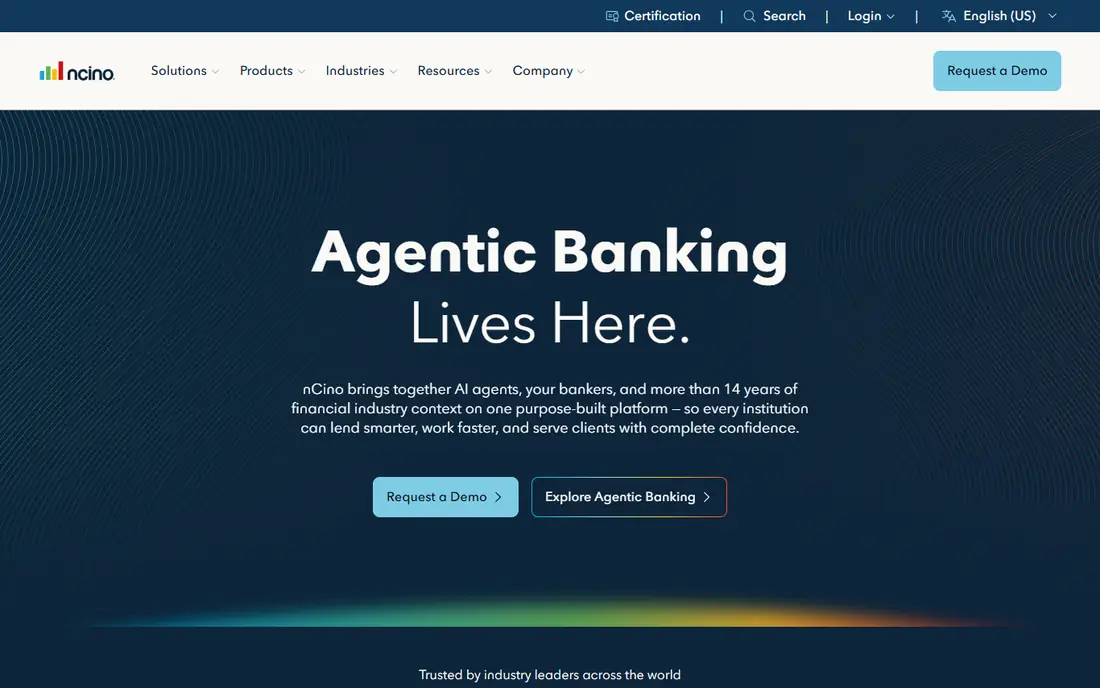
nCino suits a bank or credit union that wants commercial lending handled in one place, from application and document collection through credit analysis, approval, and booking. Its commercial lending workflows tie borrower data, financial spreading, covenants, and committee decisions to a single deal record, which reduces the email and spreadsheet work that slows credit teams. The platform also covers consumer, mortgage, and small business lending, so an institution can standardise on one system over time.
The trade-off is scale. nCino is priced by scope and sold through demos and quotes, and implementation is a real project that needs data migration, core integration, and credit policy configuration. A small community bank should ask for a phased scope and a clear total cost, including users and modules, before assuming nCino fits its budget. For a mid-sized or larger institution that wants one lending platform, though, the breadth is hard to match.
What we like- Single platform for origination, credit, and portfolio work
- Strong US bank customer base
- Growing AI document and spreading tools
Watch out for- Enterprise pricing and implementation effort
- Smaller institutions may pay for breadth they do not use
Starting priceSee website
Free planNo / Demo
Finastra Loan IQ is the pick when servicing, not just origination, drives the decision. It handles disbursement tracking, payment events, amortisation schedules, interest calculation, and syndicated loan structures that simpler origination tools do not cover. Banks with large commercial portfolios, participations, or agency roles need that servicing ledger to stay accurate, and Loan IQ is built around it.
That depth makes Loan IQ a poor fit for a community bank that mainly needs faster origination. It is an enterprise platform with enterprise implementation, and pairing it with a separate origination tool is common. A buyer should judge Loan IQ on servicing accuracy, covenant tracking, and integration with treasury and core systems, rather than on how quickly it can take a simple application.
What we like- Leading servicing depth for complex and syndicated loans
- Strong payment and schedule handling
- Global bank customer base
Watch out for- Heavyweight for simple origination needs
- Implementation and upgrade work can be substantial
#3
Abrigo
Best for: Governed commercial credit workflow for US institutions
Visit abrigo.com
Starting priceSee website
Free planNo / Demo
Abrigo fits US institutions that want commercial credit decisions to follow a clear, auditable path. Its lending tools connect application data, credit memos, document packages, approval routing, and portfolio monitoring, so a credit committee can see the same file the analyst built. That governance matters in exams and audits, and Abrigo pairs lending with risk, financial crime, and analytics tools that many US institutions already use.
Abrigo is not a direct replacement for a servicing ledger such as Loan IQ, and global banks with syndicated portfolios may need both. A buyer should test how Abrigo handles its own credit policy exceptions, approval authority matrix, and document checklists, since those workflows decide whether the system speeds decisions or simply moves paper from one queue to another.
What we like- Strong credit and document workflow for US banks and credit unions
- Risk and compliance focus
- Large US customer base
Watch out for- Less suited to global syndicated servicing
- Pricing requires a scope-based quote
Starting priceSee website
Free planNo / Demo
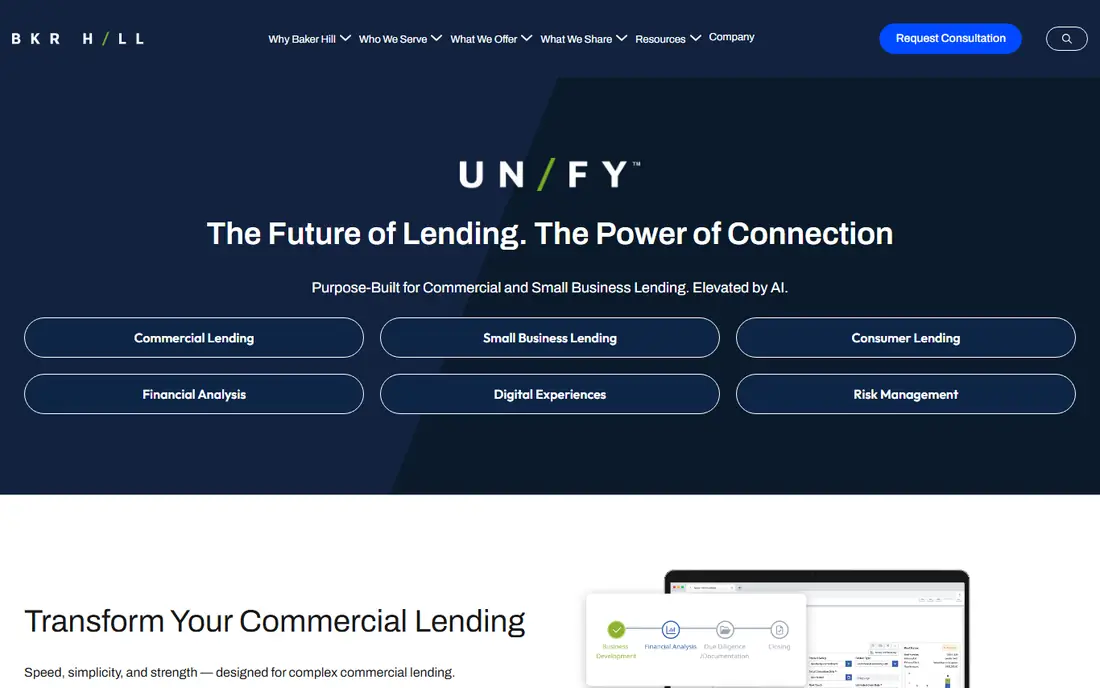
Baker Hill suits community banks and credit unions that want commercial origination shaped around their own credit process. Its NextGen platform covers origination, financial analysis and statement spreading, risk tools, and portfolio monitoring, with pricing and profitability analysis built into the lending workflow rather than bolted on later. That combination helps a smaller institution price a deal with its full cost and risk in view.
The limits are scale and servicing. Baker Hill does not carry the global servicing depth of Loan IQ, and its customer base is smaller than nCino or Abrigo. For a community institution, that can be an advantage, since implementation and support feel closer, but a large bank with syndicated or agency lending should check servicing coverage carefully before shortlisting it.
What we like- Purpose-built for commercial and small business lending
- Configurable workflows
- Pricing and profitability analysis included
Watch out for- Smaller vendor footprint than nCino or Finastra
- Enterprise servicing depth is thinner
Starting priceSee website
Free planNo / Demo
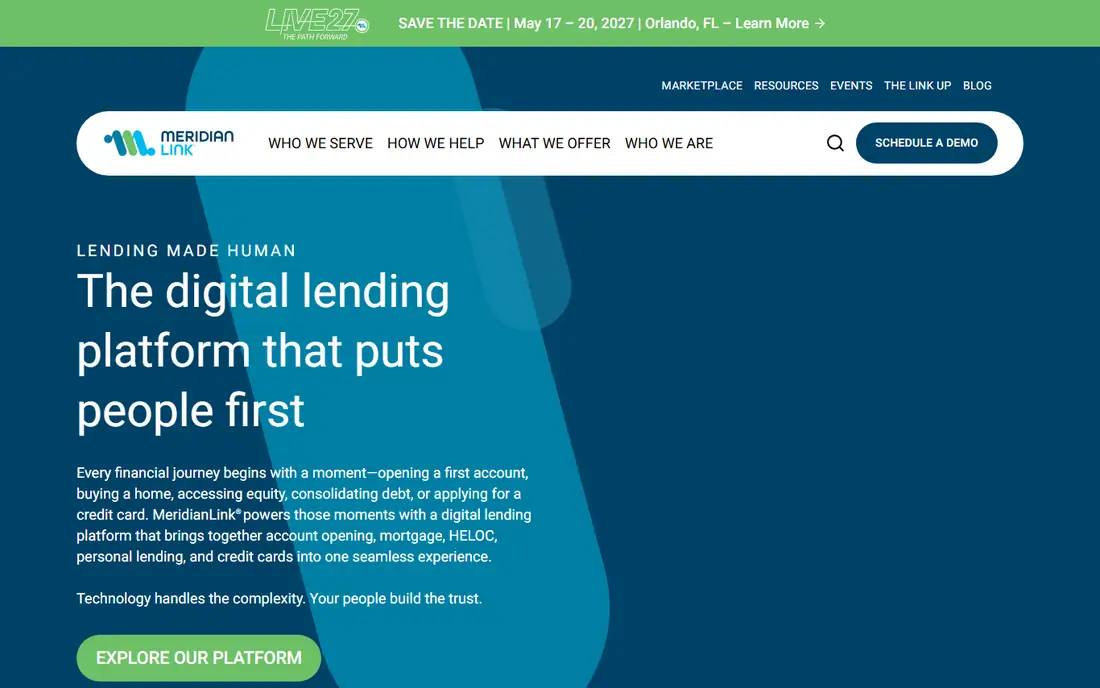
MeridianLink works well for an institution that wants one digital lending platform across consumer, mortgage, business, and account opening work. Its origination workflows, decisioning, and partner integrations help community banks and credit unions take applications online, decide faster, and book loans without juggling separate systems for each product. The platform is widely used by US community institutions, which keeps its roadmap close to their needs.
Commercial lending is one part of a broader suite here, so a bank with complex commercial credit, participations, or heavy covenant monitoring should test those workflows in detail. MeridianLink is strongest when the goal is digital intake, faster decisions, and a consistent borrower experience across products, rather than deep syndicated servicing.
What we like- Broad digital lending coverage
- Strong consumer and mortgage workflows
- Large partner and integration network
Watch out for- Commercial depth varies by product line
- Community focus may not suit large syndicated lenders
#6Temenos
Best for: Lending inside a broad core banking platform4.4/5 on
Capterra (69 reviews, checked Oct 2026)
Visit temenos.com
Starting priceSee website
Free planNo / Demo
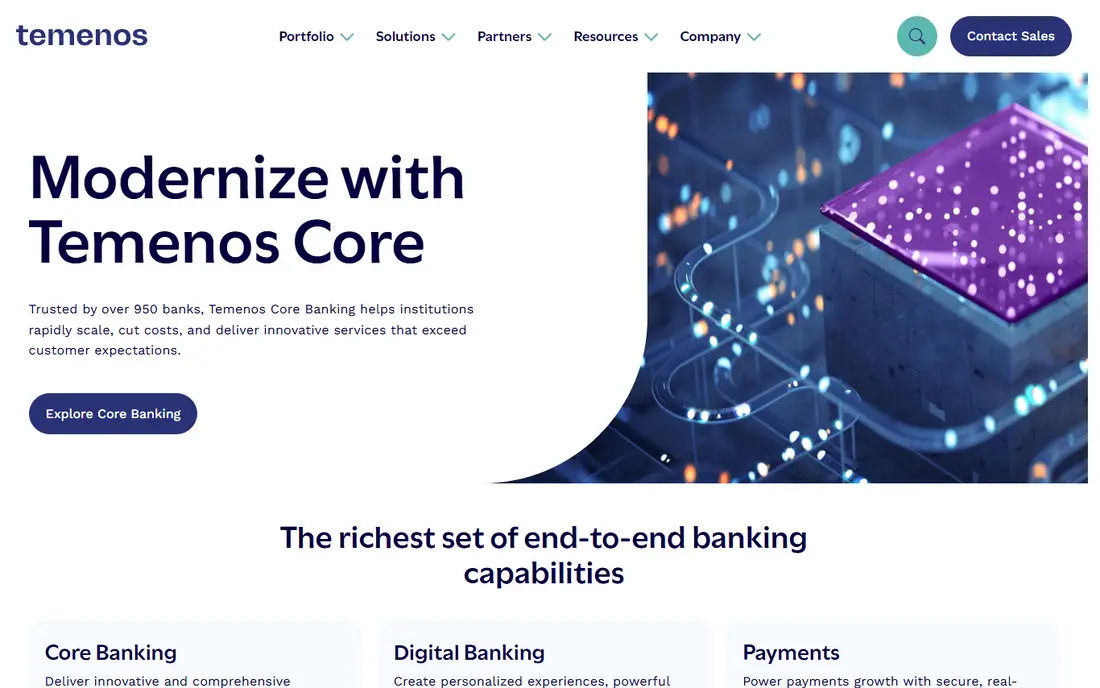
Temenos suits an institution that is already choosing, or already running, Temenos core banking and wants lending to sit inside that same platform. Its lending tools cover retail, corporate, and digital lending within a broader suite that includes core, digital channels, payments, and wealth, which avoids the integration work of connecting a standalone lending tool to a separate core. Cloud delivery through Temenos SaaS is an option for institutions that want managed upgrades.
Buying Temenos for lending alone rarely makes sense. The decision is really a core banking decision, with lending as one module, and the cost, timeline, and change management reflect that. A US community bank should compare Temenos against nCino, Abrigo, and Baker Hill on commercial workflow fit first, and only favour Temenos when the broader core platform is also part of the plan.
What we like- Lending within a complete core and digital banking suite
- Global scale
- Cloud and on-premise options
Watch out for- Lending alone is not the buying reason
- Implementation is a core project, not a quick add-on
#7
FIS Commercial Lending
Best for: Large-bank lending with broad FIS integration
Visit fisglobal.com
Starting priceSee website
Free planNo / Demo

FIS commercial lending fits large banks and institutions that already run FIS core, payments, or treasury systems and want lending to connect with them. Its lending suite covers origination, portfolio management, and servicing workflows, and integration with other FIS products reduces the custom work that standalone tools often need. For a large institution, that ecosystem effect can outweigh a narrower feature advantage elsewhere.
The downside is weight. FIS pricing is scope-based, implementation is a major programme, and a community bank is unlikely to need the full breadth on offer. A buyer should ask FIS to scope lending separately from the wider FIS relationship, with clear module, user, and integration costs, so the lending decision is judged on its own return.
What we like- Broad FIS product and core integration
- Portfolio and servicing coverage
- Global scale
Watch out for- Enterprise scope and pricing
- Smaller institutions may find it heavy and slow to implement
#8
Jack Henry
Best for: Community banks and credit unions on Jack Henry core
Visit jackhenry.com
Starting priceSee website
Free planNo / Demo
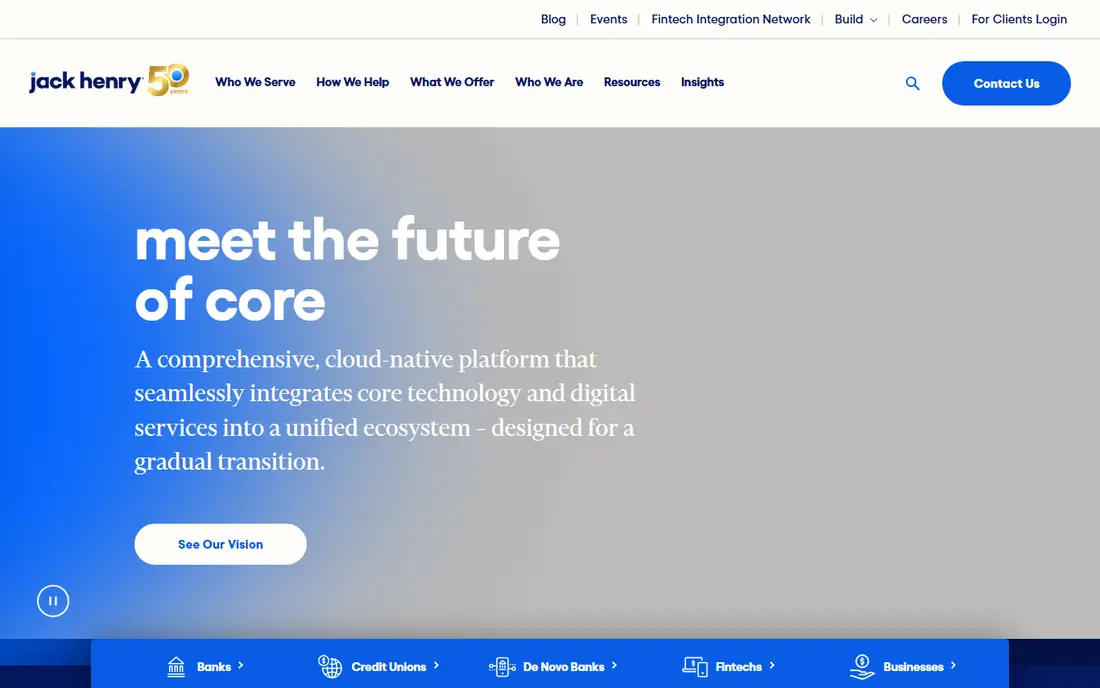
Jack Henry suits a community bank or credit union that already runs a Jack Henry core and wants lending to work with it without a separate integration project. Its lending tools sit alongside core, digital banking, payments, and deposits on the Jack Henry platform, which keeps borrower data, account data, and loan data consistent. For institutions of that size, the combined platform often matters more than any single lending feature.
Outside the Jack Henry ecosystem, the case is weaker. A bank on another core should compare Jack Henry lending against nCino, Abrigo, and Baker Hill on origination and credit workflow alone, since the integration advantage disappears. Inside the ecosystem, though, Jack Henry is a practical, low-friction choice for commercial and small business lending.
What we like- Tight fit with Jack Henry core and digital products
- Community institution focus
- Broad US customer base
Watch out for- Best value only inside the Jack Henry ecosystem
- Standalone commercial depth is narrower than specialist rivals
How we chose
We compared vendor product pages, documentation, and public reviews on G2, Capterra, and industry reports, and we kept only vendors with current commercial lending products used by banks or credit unions. We weighed origination depth, credit governance, servicing coverage, core integration, and implementation effort, and we treated published pricing as unavailable where vendors sell by quote. We did not claim hands-on testing, and every price in this guide is listed as See website because these vendors do not publish standard rates.
This is not financial advice, and it does not replace advice from your credit, compliance, and technology teams. Start by naming the lending problem you are solving, such as slow credit memos, inconsistent pricing, weak covenant tracking, or poor core integration, and test each vendor against that problem with your own deal types. A platform that excels at consumer intake may still struggle with a complex commercial credit package, so use real files in the demo, not the vendor sample deal.
Next, scope the full cost and timeline in writing. Ask for users, modules, implementation, data migration, core integration, training, and annual support as separate lines, and ask how upgrades and regulatory changes are handled. Confirm who owns the credit configuration, how approval authority and policy exceptions are enforced, and what happens to loan history and documents if you leave. A lending platform is a multi-year commitment, and the contract should read like one.
Finally, plan the rollout in phases. Start with one lending line, such as commercial real estate or small business, prove the credit workflow and core booking, then add the next line. That approach surfaces integration and policy problems early, when they are cheap to fix, and it gives credit staff time to learn the system before it carries the whole portfolio.
Frequently asked questions
What is commercial lending software?
Commercial lending software helps banks and credit unions originate, underwrite, approve, document, book, and monitor business loans. It replaces email, spreadsheets, and paper credit files with a single deal record that follows a loan from application through approval, booking, servicing, and renewal.
How much does commercial lending software cost?
Vendors in this guide do not publish standard prices, so cost depends on institution size, users, modules, core integration, and implementation scope. Expect a scope-based quote, and ask for implementation, migration, training, and annual support as separate lines before comparing vendors.
Is nCino or Abrigo better for a community bank?
Both suit US community institutions, but Abrigo leans toward governed credit workflow and risk tools, while nCino leans toward a broader cloud platform that also covers consumer and mortgage lending. A community bank should test its own commercial credit package in both systems and compare total implementation cost, not just the licence quote.
Do I need separate servicing software?
It depends on portfolio complexity. Most origination platforms cover basic booking and monitoring, but banks with syndicated, participated, or agency loans often need a dedicated servicing platform such as Finastra Loan IQ for payment events, schedules, and syndicate handling.
How long does implementation take?
Implementation varies from a few months for a focused origination rollout at a community bank to a year or more for a large bank replacing core-linked lending and servicing systems. Phasing by lending line, cleaning credit data early, and assigning a dedicated project lead all shorten the timeline.
Can commercial lending software connect to my core banking system?
Yes, all vendors here offer core integrations, but the depth and effort vary widely, and the tightest fits sit inside the same vendor ecosystem, such as Jack Henry or FIS. Confirm the specific core, version, and data flows in writing during evaluation, and test booking and payment posting before signing.
Sources we checked (8)
- https://www.ncino.com/solutions/commercial-lending
- https://www.finastra.com/solutions/lending
- https://www.abrigo.com/solutions/lending
- https://www.bakerhill.com
- https://www.meridianlink.com
- https://www.temenos.com
- https://www.fisglobal.com
- https://www.jackhenry.com
Is your product missing or out of date?
We review this list regularly. Vendors can request a listing, send updated pricing or ask about featured placement.

Shihab Mia · Founder, Rankite
Shihab has 5+ years in B2B and SaaS SEO. He writes Rankite's software buying guides from pricing pages, documentation and public user reviews. More about Shihab.