How we make this list: we compare pricing pages, product documentation and public user reviews. Rankite is independent; if a vendor ever pays for a featured spot, that listing is clearly labeled Partner.
Key takeaways
- Aplos is the modern standard for church fund accounting that volunteers can actually use.
- PowerChurch and Church Windows are the long-standing desktop workhorses for church books.
- ChurchTrac bundles bookkeeping with church management at a price small churches afford.
- ParishSOFT serves Catholic parishes; Shelby Systems and ACS cover larger congregations.
Quick comparison
| Tool | Best for | Starting price | Free plan |
|---|
 Aplos Aplos | Modern church fund accounting | See website | Free trial |
 PowerChurch PowerChurch | Complete church office suite | See website | No |
 Church Windows Church Windows | Long-standing church accounting | See website | No |
 ChurchTrac ChurchTrac | Affordable all-in-one | See website | Free trial |
 IconCMO IconCMO | Fund accounting for churches | See website | No |
 ParishSOFT ParishSOFT | Catholic parish accounting | See website | No |
 Shelby Systems Shelby Systems | Larger church financials | See website | No |
 ACS Technologies ACS Technologies | Church management plus finance | See website | No |
 QuickBooks QuickBooks | DIY church bookkeeping | See website | Free trial |
Is your product missing or out of date?
We review this list regularly. Vendors can request a listing, send updated pricing or ask about featured placement.
The best church bookkeeping software
Starting priceSee website
Free planFree trial
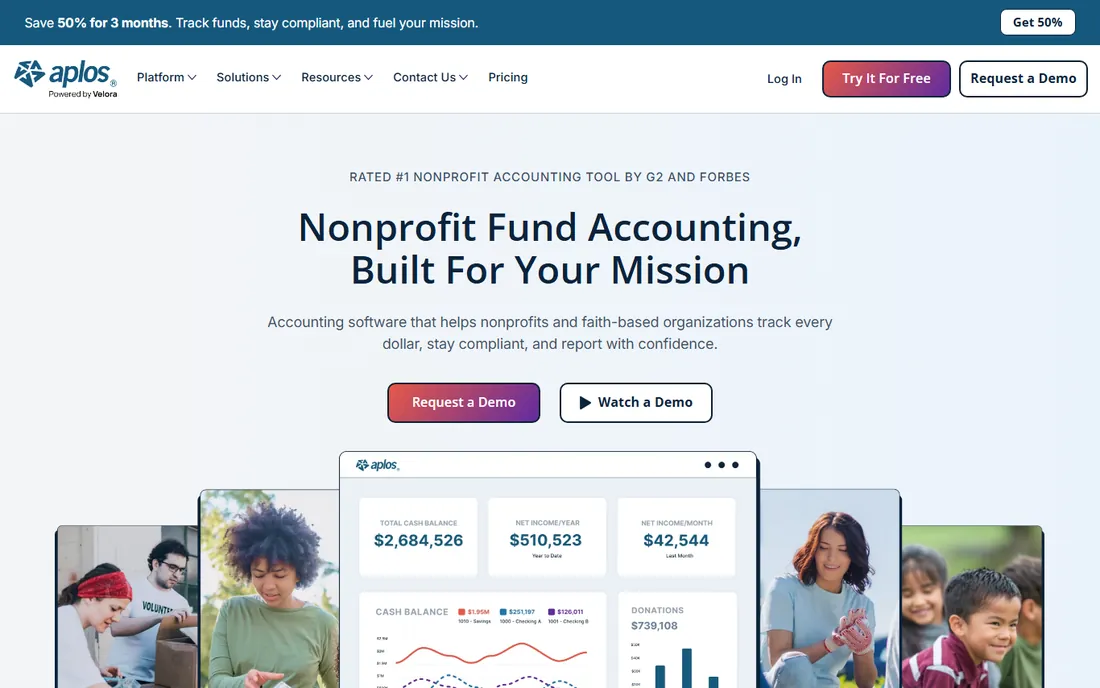
Aplos brings real fund accounting to churches without the accounting degree: track tithes, designated gifts, missions funds and general operations separately, the way church finances actually work. Online donations, contribution statements and basic payroll integrate. Volunteer treasurers learn it quickly.
Legacy desktop systems go deeper on complex accounting. For a church that wants correct fund accounting in the cloud without hiring a bookkeeper, Aplos is the modern standard.
What we like- True fund accounting made simple
- Online donations
- Volunteer-friendly
Watch out for- Less deep than legacy desktop systems
- Subscription pricing
Starting priceSee website
Free planNo
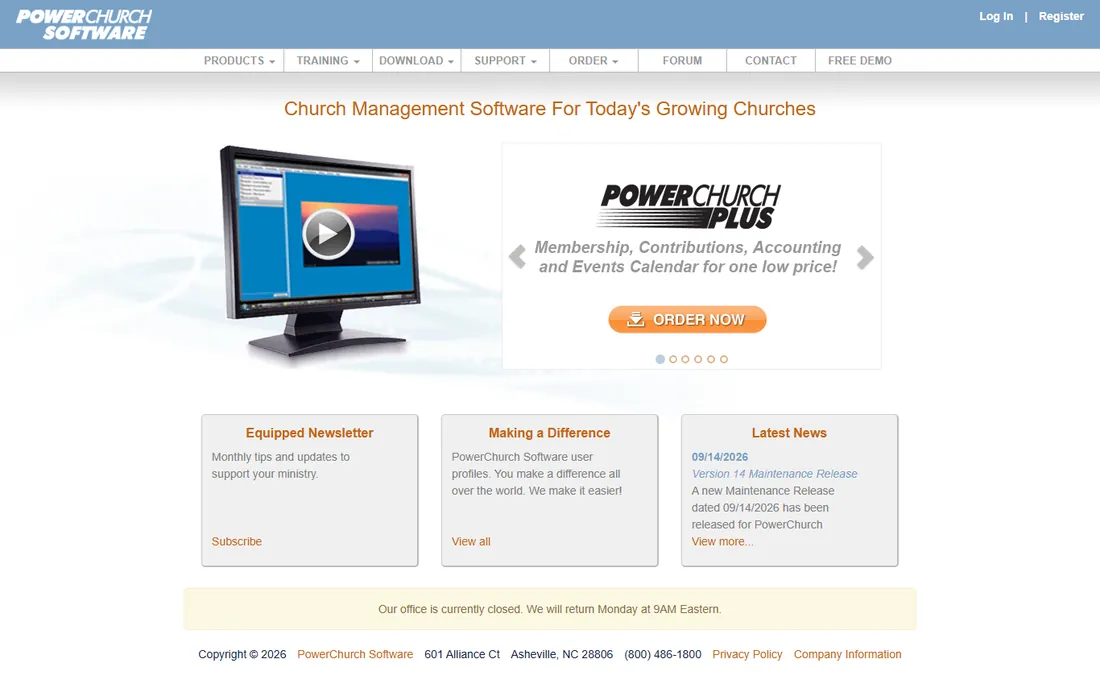
PowerChurch Plus has kept church books for decades: fund accounting, contributions, payroll, accounts payable and membership records in one desktop system. Churches that bought it years ago still run on it reliably. The church-specific design shows in every module.
It is desktop software with a dated interface. For a church comfortable with desktop software that wants accounting and membership together from a proven vendor, PowerChurch endures.
What we like- Accounting plus membership in one
- Decades of church focus
- One-time pricing options
Watch out for- Desktop software
- Interface dated
Starting priceSee website
Free planNo
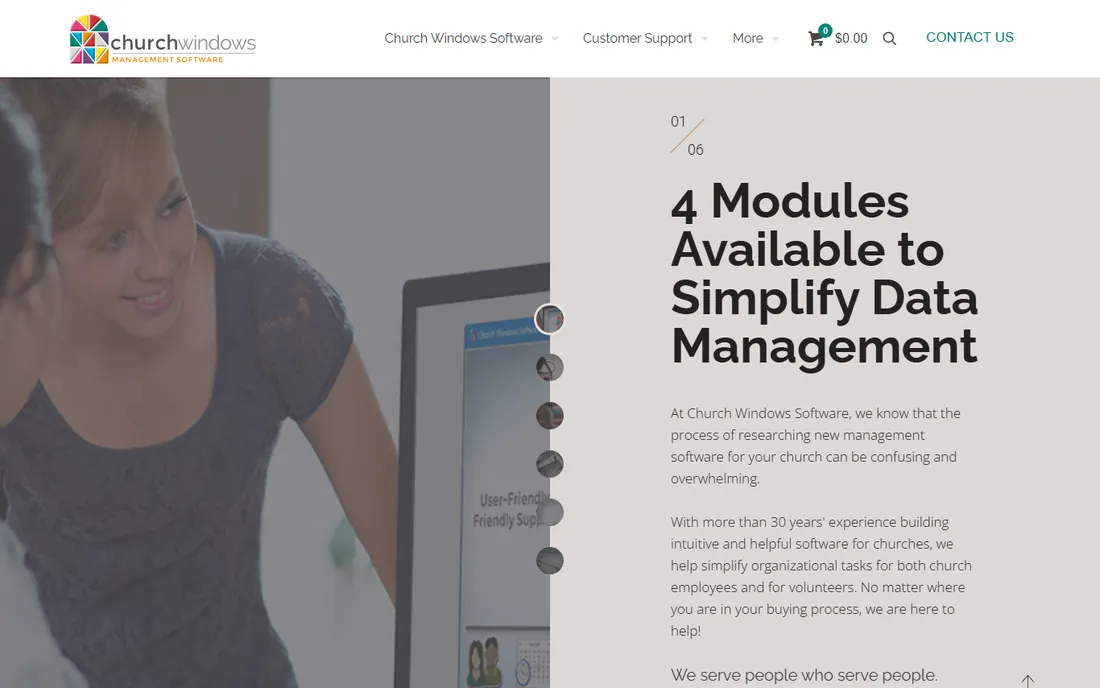
Church Windows Software serves churches with accounting, payroll, contributions and membership: the full back-office for congregations. The accounting depth handles fund tracking, designated gifts and the reporting boards expect. Longtime users value its completeness.
The desktop interface and learning curve reflect its age. For churches wanting deep church accounting from an established vendor, Church Windows remains a serious option.
What we like- Church accounting depth
- Payroll and contributions
- Long track record
Watch out for- Desktop-based
- Learning curve
Starting priceSee website
Free planFree trial
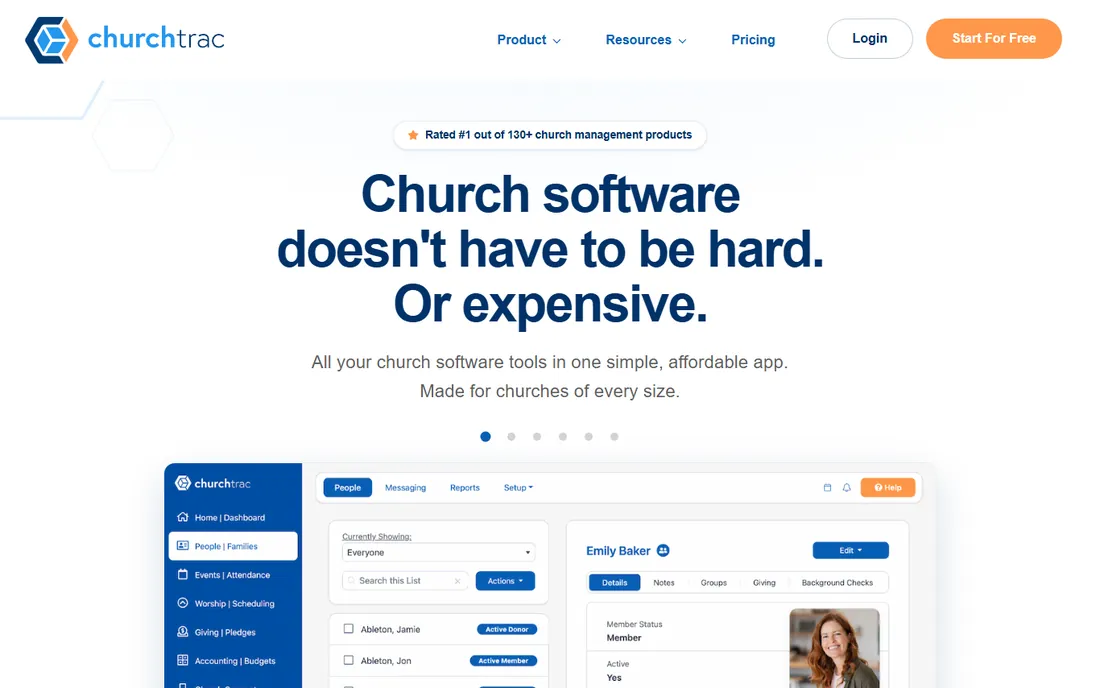
ChurchTrac bundles bookkeeping with church management (people, attendance, giving, communication) at pricing small churches can afford. The accounting covers the essentials: income, expenses, funds, budgets and reports. A part-time administrator can run the church office on it.
Accounting depth is lighter than fund-accounting specialists. For a small church that needs the books plus member management in one affordable package, ChurchTrac is the value pick.
What we like- Very affordable
- Accounting plus church management
- Easy to learn
Watch out for- Accounting lighter than Aplos
- Smaller vendor
Starting priceSee website
Free planNo
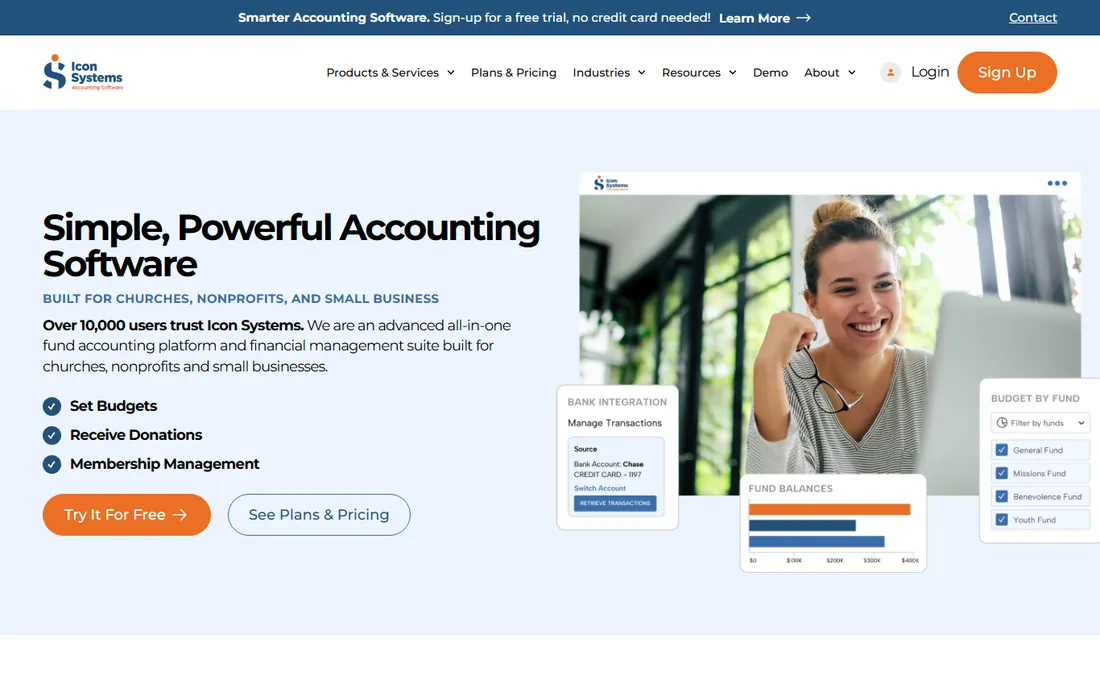
IconCMO (from Icon Systems) provides fund accounting built for churches and nonprofits: general ledger by fund, contributions, payroll, accounts payable and the financial statements boards and auditors expect. The accounting is proper, not simplified.
Pricing requires a conversation and the interface prioritizes function. For churches needing genuine fund accounting rigor (audits, multiple funds, designated giving), IconCMO delivers.
What we like- True fund accounting
- Church and nonprofit focus
- Complete financials
Watch out for- Quote-based
- Interface utilitarian
Starting priceSee website
Free planNo
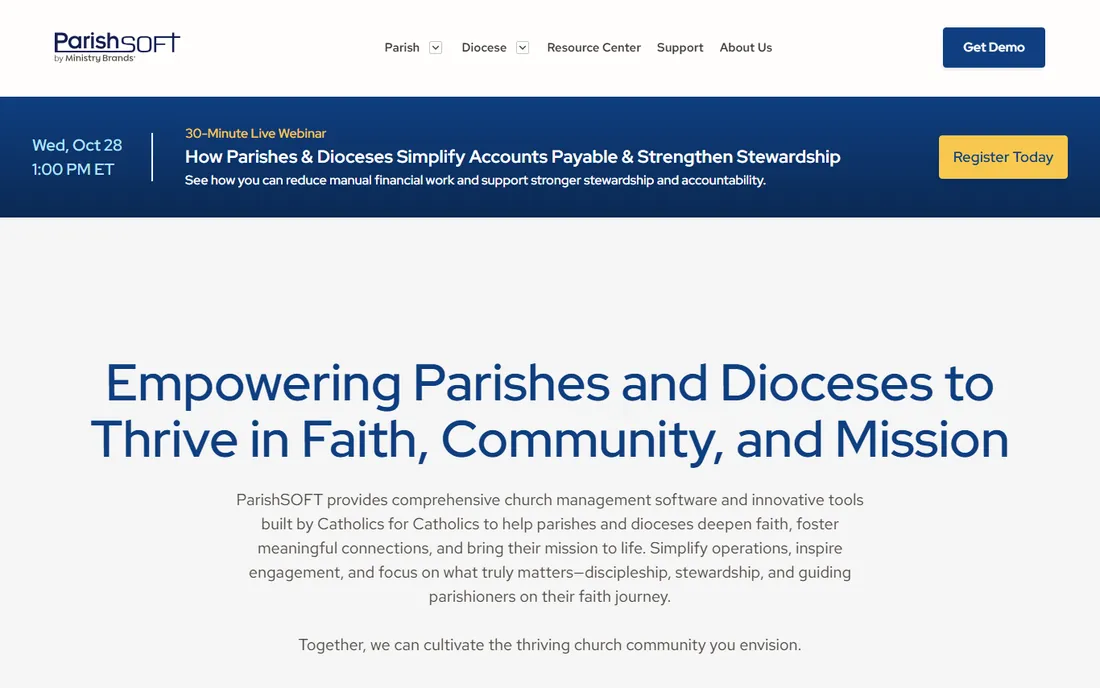
ParishSOFT serves Catholic parishes and dioceses: accounting, contributions, family records and sacramental registers with diocesan reporting built in. The Catholic-specific design (diocesan assessments, parish structures) matches how parishes operate.
Non-Catholic churches should look elsewhere. For Catholic parishes, especially those reporting to a diocese, ParishSOFT's specialized fit is unmatched.
What we like- Built for Catholic parishes
- Diocesan reporting
- Family and sacramental records
Watch out for- Catholic-specific
- Quote-based pricing
Starting priceSee website
Free planNo
Shelby Systems (now part of a larger ministry-tech group) serves mid-size to large churches with financial management plus church management: fund accounting, payroll, contributions, membership and the reporting large staffs need. Multi-campus churches manage consolidated finances.
Small churches will find it oversized and priced accordingly. For growing congregations with real financial complexity, Shelby's scale and history fit.
What we like- Scales to large churches
- Financials plus ChMS
- Long church history
Watch out for- Quote-based
- More than small churches need
Starting priceSee website
Free planNo
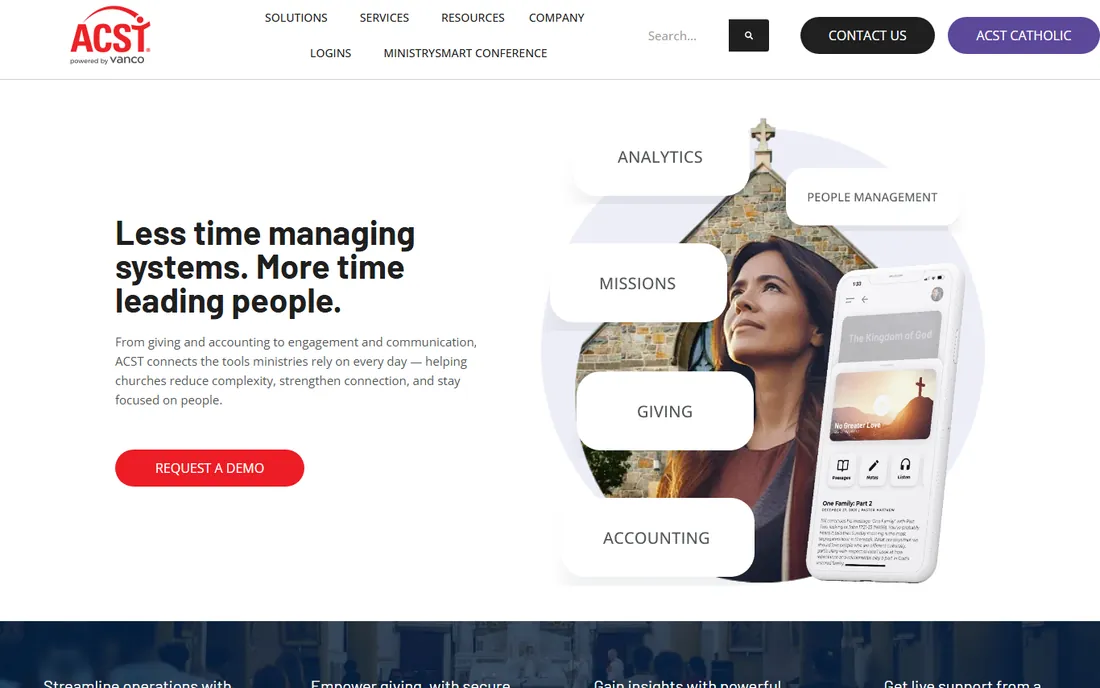
ACS Technologies offers church management with integrated financials: contributions, fund accounting, payroll and reporting inside the broader ACS/Realm ecosystem. Churches already on ACS for membership add finance naturally.
It is a suite commitment with quote-based pricing. For churches standardizing on ACS Technologies, the integrated financials complete the picture.
What we like- Full ChMS with financials
- Realm and ACS suites
- Large church base
Watch out for- Suite commitment
- Quote-based pricing
Starting priceSee website
Free planFree trial
QuickBooks is what many small churches actually use: inexpensive, familiar, and every accountant understands it. With classes or projects standing in for funds, a careful treasurer can keep church books correctly. Bank feeds and payroll add-ons help.
It is not fund accounting; designated gifts and fund reporting need disciplined workarounds. For a small church with a competent volunteer treasurer and simple finances, QuickBooks is the pragmatic budget choice.
What we like- Everyone knows it
- Accountant-friendly
- Inexpensive
Watch out for- Not fund accounting
- Needs workarounds for church specifics
Fund accounting: why churches need it
Churches do not have profit; they have funds. Tithes, building funds, missions designations and benevolence must be tracked separately, and donors expect designated gifts to stay designated. True fund accounting (Aplos, IconCMO, PowerChurch) enforces this structurally. Workarounds in generic software (QuickBooks classes) work only with disciplined bookkeeping. If your church handles designated giving, prioritize real fund accounting.
The treasurer handoff problem
Church treasurers are volunteers who rotate. The software must survive handoffs: clear chart of accounts, documented procedures, cloud access for the new treasurer, and contribution records that outlive any individual. Cloud tools (Aplos, ChurchTrac) handle transitions better than a desktop PC in the old treasurer's office. Plan the handoff process, not just the software.
Contribution statements donors actually understand
Annual giving statements are a legal necessity, but their design affects donor behavior all year. A clear, well-organized statement reinforces the donor's sense of partnership with the church's mission. A confusing one creates anxiety and phone calls. The best statements do three things: report accurately, communicate gratitude, and connect giving to impact. Most church bookkeeping tools generate the numbers correctly; the difference lies in how you present them. Start with the essentials done right: church name, address and tax ID; donor name and address; every gift with date, amount and fund designation; subtotals by fund; and the required substantiation language. Then lift the document from receipt to relationship.
Lead with gratitude, not accounting. A brief pastoral thank-you at the top of the statement (two or three sincere sentences, not a form letter) transforms the experience. Donors give from the heart; acknowledging that before the numbers honors the relationship. Follow with a concise impact summary: what the congregation's giving accomplished this year. Specific beats general: "your giving supported 47 local families through the food pantry and funded the youth mission trip to Guatemala" lands harder than "thank you for supporting our ministries." Work with ministry leaders in December to gather these highlights; the treasurer should not have to invent them in January.
Fund-level detail serves your most engaged donors. Major donors and designated givers want to see their gifts tracked faithfully: the building fund total, missions giving, benevolence disbursements. Present fund subtotals clearly, and for capital campaigns show progress against the goal. This transparency builds the confidence that sustains large gifts. But keep the main statement scannable; donors who want detail can find it, while the typical donor grasps the totals at a glance. If the statement runs to four pages of undifferentiated line items, redesign it. Clarity is a form of respect.
Pledge tracking deserves separate, careful presentation. If your church runs an annual stewardship campaign, donors want to see pledge versus actual side by side. This is sensitive: it is both a helpful reminder and a potential guilt trip. Present it factually without editorializing, and include an easy path to adjust pledges when circumstances change. Life happens; a pledge system that shames people for falling behind damages the relationship the statement should strengthen. Some churches send pledge updates quarterly rather than only annually, which normalizes the conversation and avoids January surprises.
Digital delivery is now the expectation, with paper as the fallback. Email statements as PDFs from the church's domain (not a personal address), with a clear subject line and a note explaining the attachment. Track opens and follow up on bounces; undelivered statements are a January crisis for the donor at tax time. Offer portal access for donors who want to check giving anytime during the year; real-time giving visibility reduces both anxiety and treasurer inquiries. Whatever the method, send by mid-January. The churches that treat statements as ministry rather than paperwork find that donor trust, and giving, grows year after year.
Reconcile giving records against bank deposits every single week, not monthly. Weekly reconciliation catches data entry errors while the offering counters still remember the details, and it keeps the books continuously accurate instead of requiring a painful month-end cleanup. This one discipline, more than any software feature, determines whether January statements come together smoothly or become a crisis. Fifteen minutes weekly saves fifteen hours in January.
Frequently asked questions
How much does church bookkeeping software cost?
ChurchTrac and Aplos run tens of dollars monthly. Legacy desktop systems range from hundreds one-time to annual maintenance. Enterprise suites are quote-based. QuickBooks is the budget option. Match the tool to your transaction volume.
Can it track tithes and designated giving?
Yes, that is the core job. Fund accounting tools track each fund separately and produce contribution statements for donors. Confirm designated-gift handling specifically during evaluation.
Does it handle payroll for pastors?
Most tools here include or integrate payroll, including minister-specific tax handling (housing allowance, self-employment tax). Pastor payroll has quirks; confirm the software handles clergy tax rules.
Can we accept online donations?
Aplos, ChurchTrac and most modern tools include online giving. Legacy desktop systems may need a separate giving platform. Factor processing fees (~2-3%) into the budget.
What reports does our church board need?
Monthly income statement by fund, balance sheet, budget vs actual, and contribution summaries. Annual: full financials and donor statements. Every tool here produces these; check the formats suit your board.
Should we just use QuickBooks?
For simple finances with a skilled treasurer, yes. For designated funds, multiple ministries, or audit requirements, proper church fund accounting software prevents errors that QuickBooks workarounds invite. Be honest about your complexity.
How we chose
We compared the bookkeeping tools churches actually use, from modern fund accounting to legacy desktop systems. Pricing varies widely across the category. We weighted fund accounting correctness, contribution tracking, payroll handling and usability for volunteer treasurers. No hands-on testing was performed; assessments rest on documentation and public reviews.
Sources we checked (9)
- https://www.aplos.com/
- https://www.powerchurch.com/
- https://churchwindows.com/
- https://www.churchtrac.com/
- https://www.iconsystemsinc.com/
- https://www.parishsoft.com/
- https://www.shelbysystems.com/
- https://www.acstechnologies.com/
- https://quickbooks.intuit.com/
Is your product missing or out of date?
We review this list regularly. Vendors can request a listing, send updated pricing or ask about featured placement.

Shihab Mia · Founder, Rankite
Shihab has spent more than a decade helping SaaS and e-commerce brands grow through search. He writes Rankite's software buying guides from pricing pages, documentation and public user reviews. More about Shihab.