How we make this list: we compare pricing pages, product documentation and public user reviews. Ratings come from G2, Capterra or Trustpilot, with the date we checked them.
Key takeaways
- Pulse ($29/month) and LivePlan ($20/month) are the affordable entries for small businesses that want a forecast without a finance team.
- Float ($265/month billed monthly) and Cash Flow Frog are the purest cash flow forecasters here, built to sit on top of QuickBooks or Xero.
- Clockwork ($599/month billed annually) and Jirav (from $50/month on its firm plans) aim at companies that want full financial planning, not just cash.
- Fathom, Agicap and Dryrun price by usage or quote, so shortlist first and ask for numbers second.
Quick comparison
| Tool | Best for | Starting price | Free plan |
|---|
 Float Float | Finance teams running Xero or QuickBooks Online who need a trusted rolling forecast | $265/month (Growth plan, billed monthly; $215/month billed annually) | 14-day free trial (no credit card required) |
 Pulse Pulse | Small business owners who want to understand their cash without finance training | $29/month (plans start at $29, per Pulse's own site) | 30-day free trial (first month free) |
 Dryrun Dryrun | CFOs and advisors who want hands-on control of forecast assumptions | See website (custom quote; no published prices) | See website |
 Clockwork Clockwork | Growing companies that want an AI analyst plus a full financial model | $599/month (Predict plan, billed annually; $749 month-to-month) | 14-day free trial (no credit card required) |
 Fathom Fathom | Accounting firms and multi-entity businesses wanting reporting and forecasting together | See website (priced per company; monthly pay-as-you-go) | See website |
 Agicap Agicap | Mid-market finance teams managing daily cash across banks and entities | See website (custom quote; no published prices) | 24-hour free trial (per Agicap's own site) |
 CashFlow Frog CashFlow Frog | Growing businesses that want long-range forecasts with minimal setup | See website (custom quote; no published prices) | 14-day free trial (no credit card required) |
 Jirav Jirav | Companies that need budgeting, forecasting and reporting in one planning system | $50/month (Controller Essentials, per Jirav's pricing page) | See website |
 LivePlan LivePlan | Business owners who forecast through the business plan and track against it | $20/month (Standard, paid monthly; $15/month billed annually) | No free trial; 35-day money-back guarantee |
Is your product missing or out of date?
We review this list regularly. Vendors can request a listing, send updated pricing or ask about featured placement.
The best cash flow management software
Your accounting software tells you what happened last month. It does not tell you whether payroll clears next month, or what a late-paying client does to December. That gap between the books and the bank account is exactly what cash flow management software fills: a forward-looking view built from your real numbers, updated as they change.
These nine tools span the category, from simple small-business forecasters (Pulse, LivePlan) to full financial planning platforms (Clockwork, Jirav). Prices come from each vendor's own pricing page; where the vendor publishes no number, we say so instead of guessing.
#1
Float
Best for: Finance teams running Xero or QuickBooks Online who need a trusted rolling forecast
Visit floatapp.com
Starting price$265/month (Growth plan, billed monthly; $215/month billed annually)
Free plan14-day free trial (no credit card required)
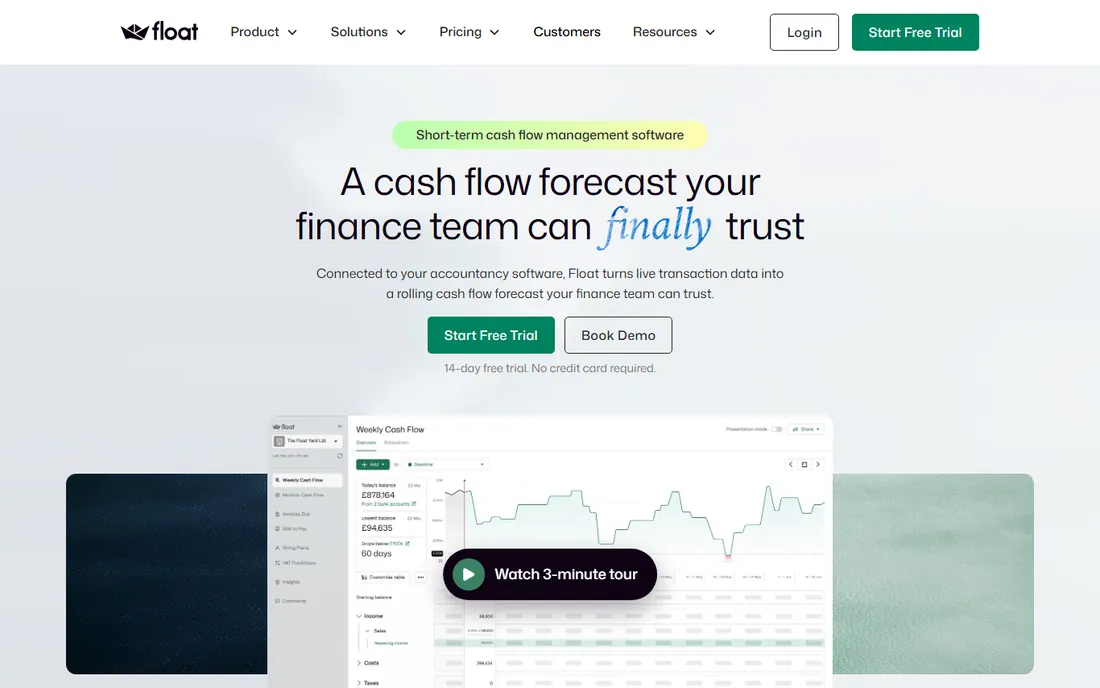
Float sits in the sweet spot for finance teams that live in Xero or QuickBooks Online. It pulls reconciled transactions daily and turns them into a rolling cash flow forecast you can view weekly, monthly or across three years. Scenario planning lets you toggle income and costs to test decisions before you make them, and AR/AP visibility maps exactly when invoices get paid and bills come due.
The pricing tells you who it is for. Growth runs $265 per month billed monthly or $215 billed annually, with a Scale tier above it and an Essentials tier below whose price Float does not publish. A 14-day trial with no credit card makes evaluation easy. If you run a real finance function on Xero or QuickBooks, Float is the reference product.
What we like- Purpose-built cash flow forecasting with 13-week rolling and 3-year monthly views
- Syncs daily with Xero and QuickBooks Online
- Scenario planning, AR/AP visibility and multi-entity consolidation
Watch out for- Priced for finance teams, not solo owners
- The cheaper Essentials tier exists but its price is not published
- Limited to Xero and QuickBooks Online integrations
#2
Pulse
Best for: Small business owners who want to understand their cash without finance training
Visit pulseapp.com
Starting price$29/month (plans start at $29, per Pulse's own site)
Free plan30-day free trial (first month free)
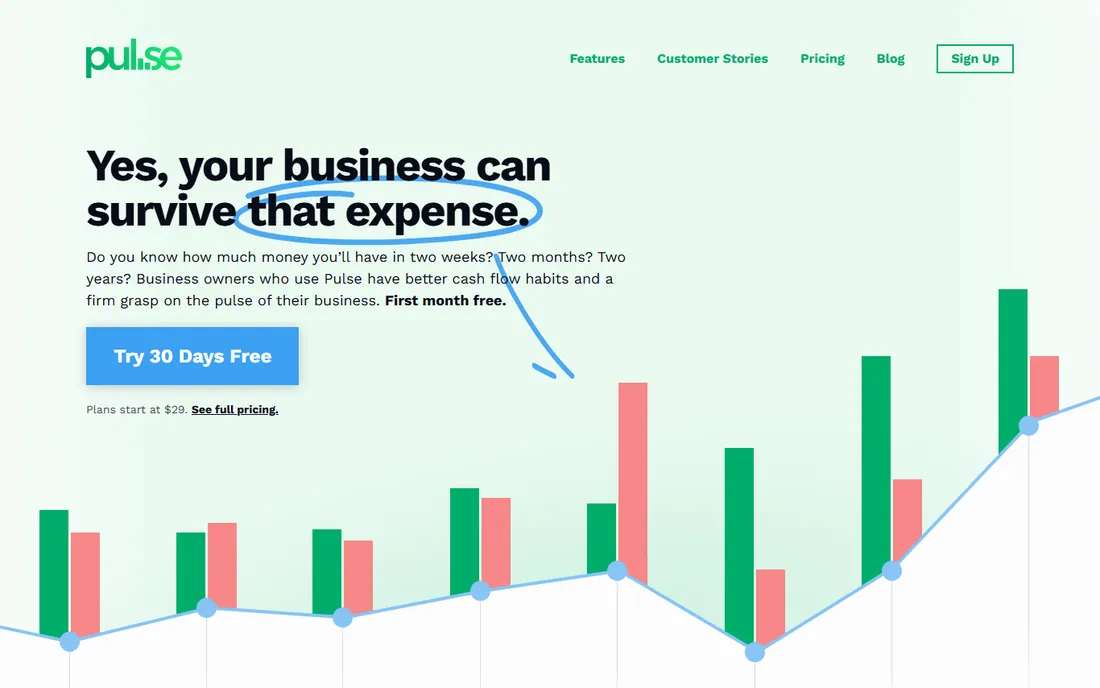
Pulse is the simplest tool on this list, and it knows it. The pitch is aimed at owners, not finance teams: know how much cash you will have in two weeks, two months, two years. You get yearly, monthly, weekly and daily views, scenario toggles that show what happens if income or expenses change, and a direct QuickBooks Online sync that keeps actuals and projections together.
At plans starting at $29 a month with a 30-day free trial, Pulse is also the cheapest way to start forecasting properly. The limits are real: anything outside QuickBooks Online needs manual entry, and the reporting will not satisfy a CFO. But for a service business owner replacing a spreadsheet, Pulse is the gentlest on-ramp here.
What we like- The simplest interface on this list, built for owners not accountants
- Direct QuickBooks Online connection
- Yearly, monthly, weekly and daily cash views with scenario toggling
Watch out for- Manual entry for anything outside QuickBooks Online
- Reporting depth is thin next to Float or Fathom
- Multi-entity and advanced planning are not its game
#3
Dryrun
Best for: CFOs and advisors who want hands-on control of forecast assumptions
Visit dryrun.com
Starting priceSee website (custom quote; no published prices)
Free planSee website
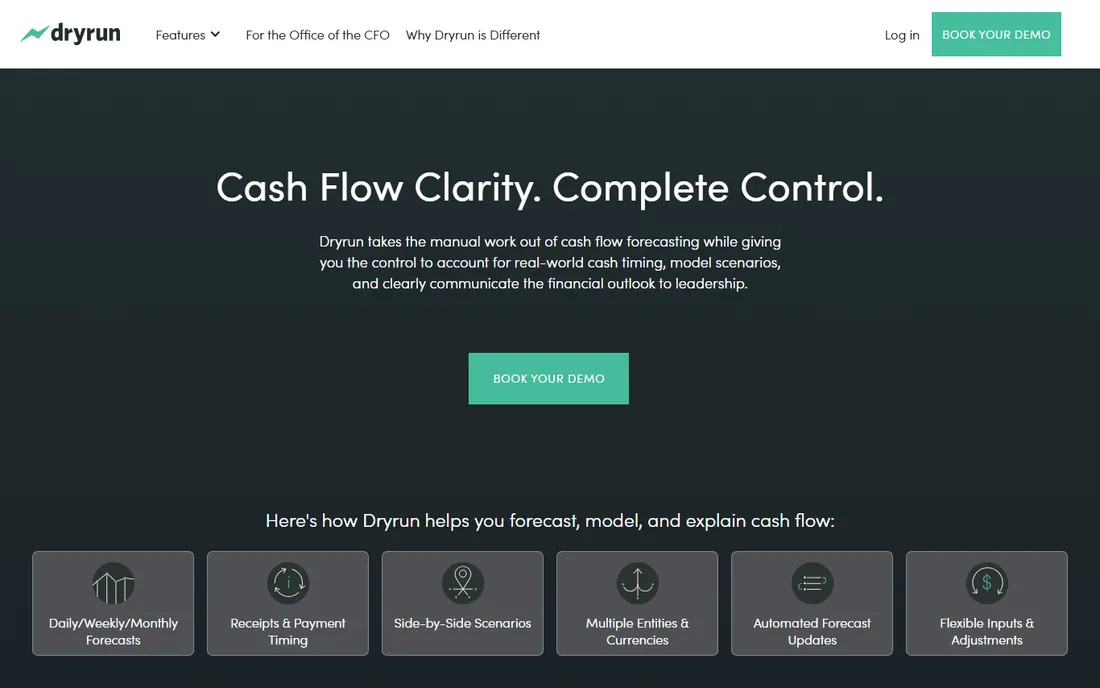
Dryrun starts from a different assumption than the rest: that your forecast is only as good as the judgment you put into it. Instead of fully automating the model, it consolidates your accounting data into a baseline and gives you control over every input and assumption. You add expected projects, planned payroll and debt payments before invoices exist, then compare scenarios side by side for leadership.
That philosophy suits finance people who distrust black boxes. The cost is effort: Dryrun asks more of you than Float or Pulse, and pricing is quote-only with nothing published. For CFOs, fractional CFOs and advisors who want to model decisions rather than just watch cash move, the control is the point.
What we like- Spreadsheet-style modeling with full control over inputs and assumptions
- Blends accounting data, imports and manual projections
- Side-by-side scenario comparison for leadership
Watch out for- No published pricing
- More hands-on than automatic forecasters, so it asks more of the user
- Smaller vendor with a narrower integration footprint
#4
Clockwork
Best for: Growing companies that want an AI analyst plus a full financial model
Visit clockwork.ai
Starting price$599/month (Predict plan, billed annually; $749 month-to-month)
Free plan14-day free trial (no credit card required)
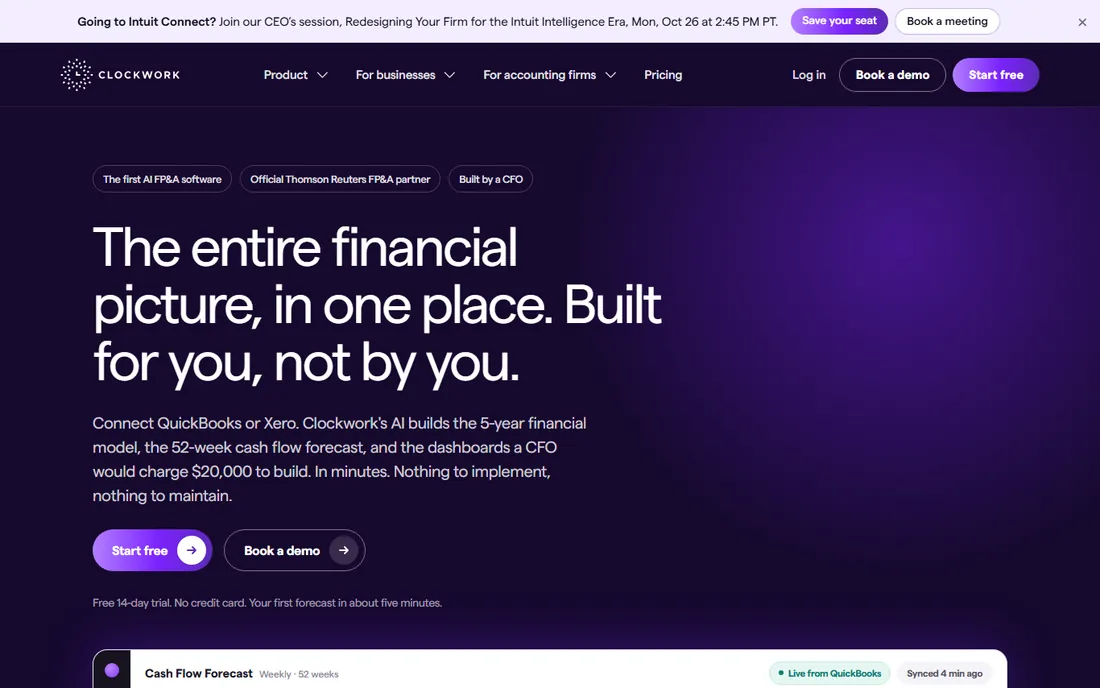
Clockwork wants to be the finance department you cannot afford to hire. Connect QuickBooks or Xero and it builds a 52-week cash flow forecast, a five-year financial model and live dashboards on day one, no consultants and no account mapping. Mira, its AI analyst, runs forecasts, builds scenarios and explains why the numbers look the way they do.
The price matches the ambition: Predict starts at $599 per month on annual billing ($749 month-to-month), with Advance and Ultimate tiers above. A 14-day free trial with no credit card softens the evaluation. This is not a tool for watching cash; it is a tool for planning the company. Buy it when forecasting has become a leadership function.
What we like- 52-week cash flow forecast plus a 5-year financial model built from your books
- Mira, an AI analyst that runs forecasts and explains the numbers
- Connects QuickBooks, Xero or Excel in minutes
Watch out for- The priciest entry point on this list by a wide margin
- Overkill if you only need cash visibility
- Firm plans are a separate, higher-priced track
#5
Fathom
Best for: Accounting firms and multi-entity businesses wanting reporting and forecasting together
Visit fathomhq.com
Starting priceSee website (priced per company; monthly pay-as-you-go)
Free planSee website
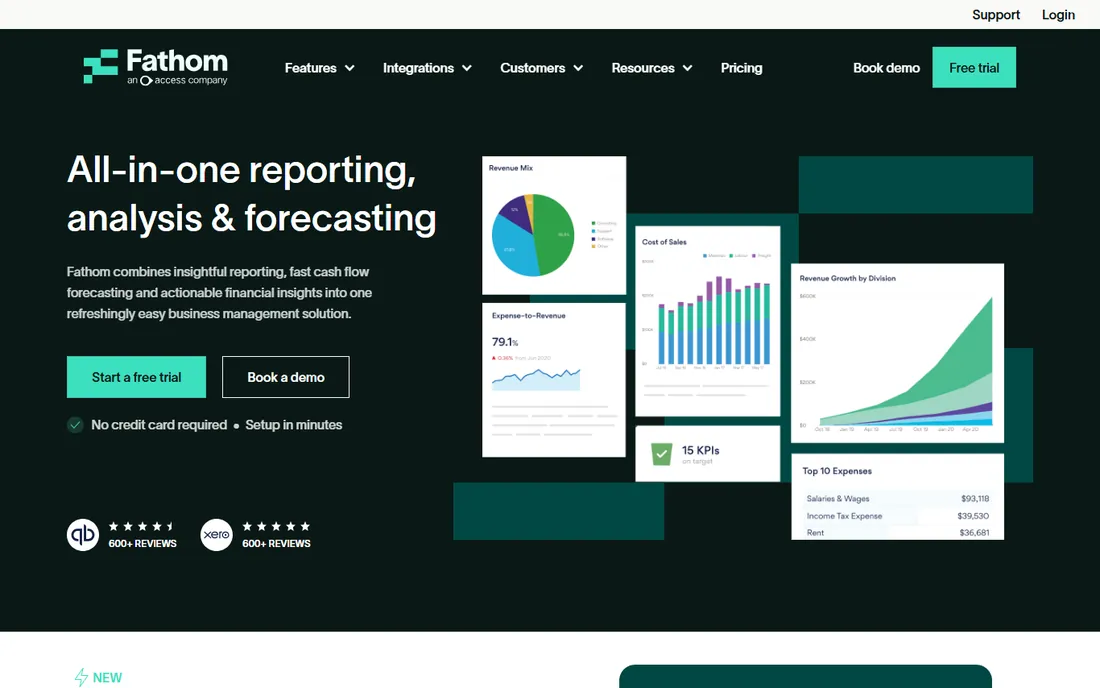
Fathom began as a reporting tool and grew into forecasting, which shows in the product. You get visual management reports, rolling cash flow forecasts and consolidations for up to hundreds of entities, all fed from your accounting data. For accounting firms, the Portfolio plan adds cheap client-wide oversight without a full subscription per client.
Pricing is usage-based: it scales with the number of companies, billed monthly with no contracts, so the only way to know your number is the pricing calculator on Fathom's site. That makes Fathom harder to compare at a glance but fair in practice. It fits advisors, franchises and multi-entity businesses better than it fits a single small company.
What we like- Combines management reporting, cash flow forecasting and consolidations in one tool
- Monthly pay-as-you-go with no contracts
- Portfolio plan gives firms cheap oversight across whole client bases
Watch out for- No single published price, since cost scales with company count
- Aimed more at advisors and firms than at solo owners
- Forecasting depth varies by plan tier
#6
Agicap
Best for: Mid-market finance teams managing daily cash across banks and entities
Visit agicap.com
Starting priceSee website (custom quote; no published prices)
Free plan24-hour free trial (per Agicap's own site)
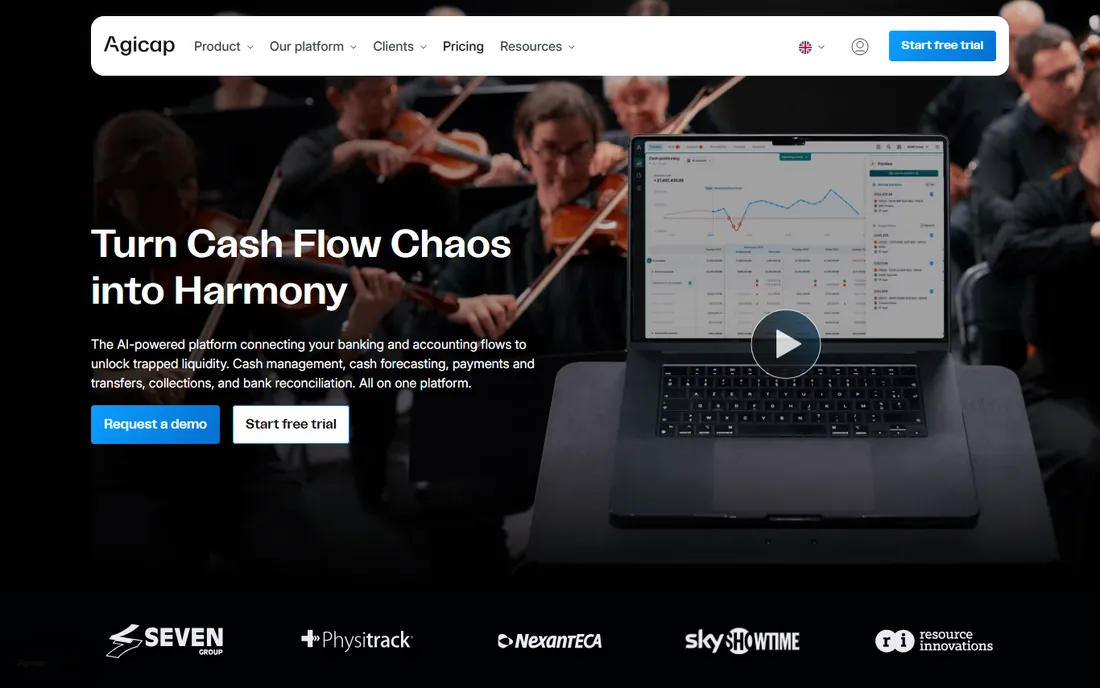
Agicap comes from the treasury world rather than the accounting world. The focus is daily cash operations: centralizing positions across banks and entities, forecasting 13 weeks ahead from actual data, and managing intercompany flows. With bank connectivity through SWIFT and host-to-host alongside ERP integrations, it is built for companies where cash management is someone's job.
That positioning sets the price conversation: custom quotes, mid-market budgets, and a sales-led process. The 24-hour free trial on Agicap's site is barely enough to click around. If you run one company on QuickBooks, look at Float or Pulse instead. If you run a group with multiple entities and bank accounts, Agicap is the specialist.
What we like- Treasury-grade daily cash management with 13-week forecasts
- Connects banks, ERPs and accounting tools (300+ integrations claimed)
- Built for multi-entity groups, not single companies
Watch out for- Quote-only pricing aimed at mid-market budgets
- 24-hour trial is short for a serious evaluation
- More treasury tool than small-business forecaster
#7
CashFlow Frog
Best for: Growing businesses that want long-range forecasts with minimal setup
Visit cashflowfrog.com
Starting priceSee website (custom quote; no published prices)
Free plan14-day free trial (no credit card required)
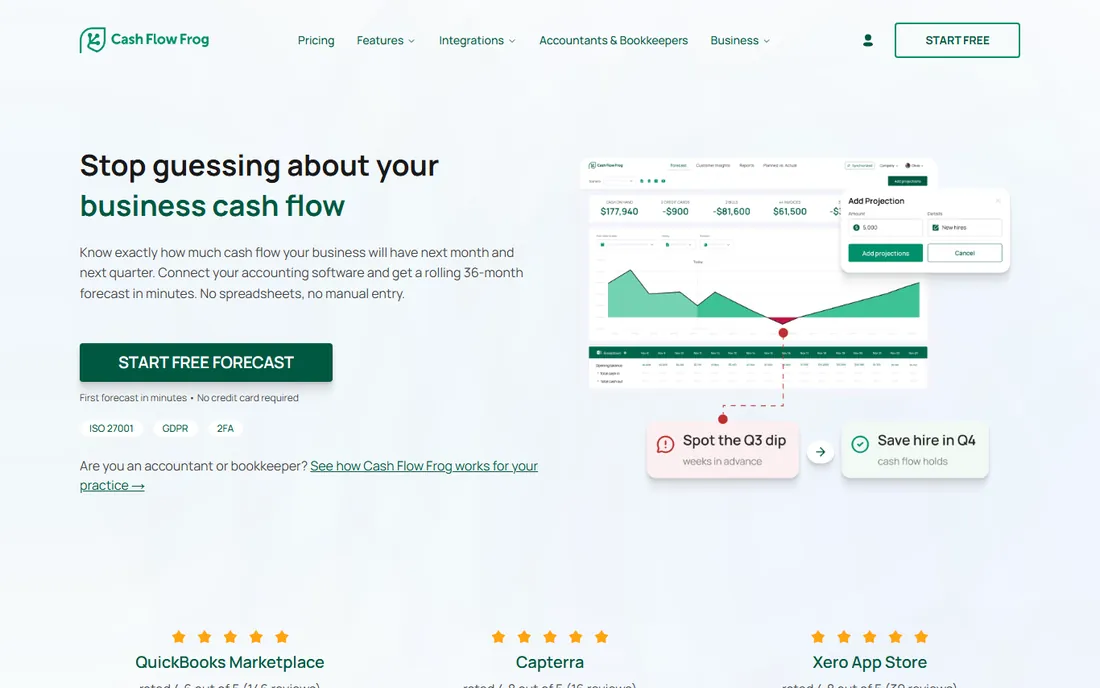
Cash Flow Frog promises the fastest path from signup to forecast: connect your accounting software and get a rolling 36-month view in minutes, with no spreadsheets and no manual entry. Scenario planning, customer insights, VAT/GST projections and planned-vs-actual analysis round out a package aimed squarely at growing businesses rather than enterprises.
Two things stand out. First, the AI connector lets you work the forecast through Claude, ChatGPT or other assistants in plain conversation. Second, the commercial terms are buyer-friendly: 14-day free trial with no credit card and a 30-day money-back guarantee. Pricing is not published, so you will talk to sales. For growth-stage companies that want depth without enterprise weight, it is a strong shortlist candidate.
What we like- Rolling 36-month forecast generated in minutes from your accounting data
- Syncs QuickBooks, Xero, Sage Intacct and more
- AI assistant connector plus planned-vs-actual tracking
Watch out for- No published pricing
- Younger product with a smaller track record than Float or Fathom
- Long-range forecasts are only as good as the assumptions behind them
#8
Jirav
Best for: Companies that need budgeting, forecasting and reporting in one planning system
Visit jirav.com
Starting price$50/month (Controller Essentials, per Jirav's pricing page)
Free planSee website
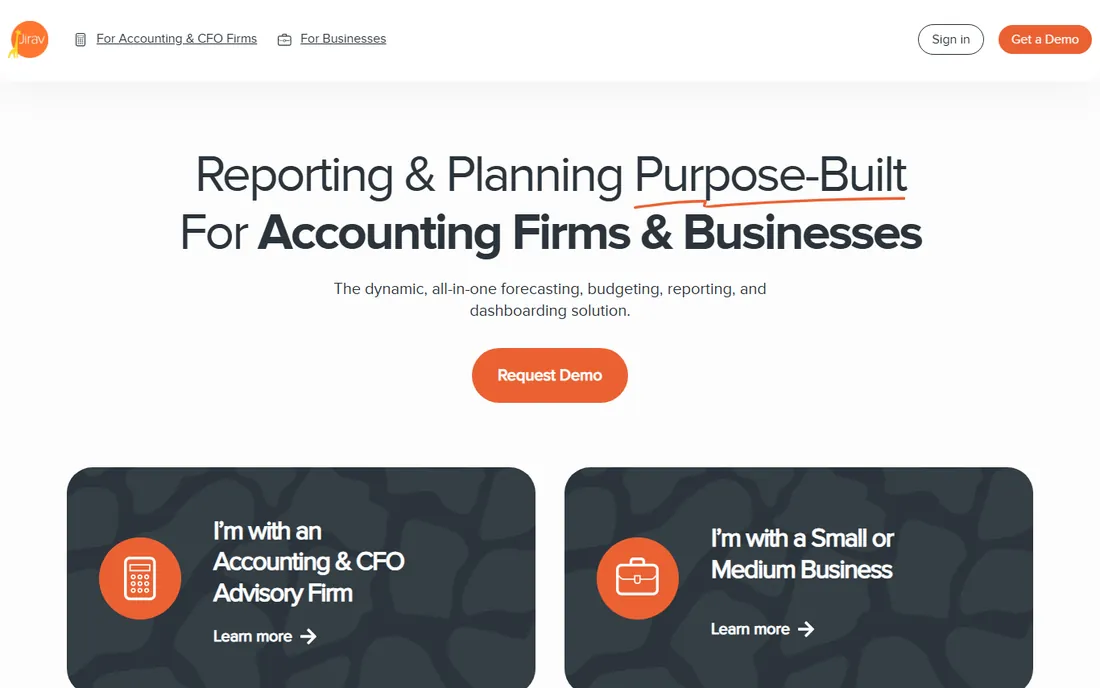
Jirav is what you buy when cash flow forecasting is one chapter of a bigger planning book. It does driver-based budgeting, workforce planning, scenario modeling and board-ready reporting across the full financial statements, with cash flow forecasting and runway analysis built in. Industry templates get small and midsize companies started without building models from scratch.
Unusually for this category's upper end, Jirav publishes starting prices: Controller Essentials from $50 a month and CFO Enterprise from $150 a month on its pricing page (firm wholesale plans). The trade-off is scope: this is a planning platform, and companies that only need cash visibility will find it heavier than Float or Pulse. Buy Jirav when the budget process, not just the bank balance, needs fixing.
What we like- Full 3-statement modeling across P&L, balance sheet and cash flow
- Driver-based planning, workforce planning and rolling forecasts
- Published starting prices on its pricing page
Watch out for- Cash flow is one module of a bigger FP&A platform, so pure forecasters are simpler
- The pricing page targets accounting firms, which complicates direct comparison
- Real deployments need onboarding effort
#9
LivePlan
Best for: Business owners who forecast through the business plan and track against it
Visit liveplan.com
Starting price$20/month (Standard, paid monthly; $15/month billed annually)
Free planNo free trial; 35-day money-back guarantee

LivePlan approaches cash flow sideways, through the business plan. You build forecasts as part of planning the business: the income statement, balance sheet and cash flow stay connected, so changing one assumption flows through everything. Premium adds QuickBooks and Xero sync with Plan vs. Actual comparisons, so the forecast stays honest after launch.
The price is the story here: Standard at $20 a month paid monthly or $15 billed annually, Premium at $40 or $30. That is the cheapest paid entry on this list after Pulse. There is no free trial, but the 35-day money-back guarantee covers evaluation. If you are writing a plan for a lender or investor anyway, LivePlan folds the forecast into work you are already doing.
What we like- Business planning plus forecasting in one subscription from $15/month billed annually
- QuickBooks/Xero sync with Plan vs. Actual tracking on Premium
- Pitch deck builder and AI-assisted planning
Watch out for- Cash flow is part of a planning suite, not a dedicated forecaster
- Real-time cash positioning is thinner than Float or Cash Flow Frog
- No free trial, only the money-back guarantee
When cash flow software is not the answer
A forecasting tool cannot fix books that are three months behind. If your reconciliations are not current, every tool on this list will happily project from bad data. Get the bookkeeping clean first, whether that means a bookkeeper or a cleanup project, then buy the forecaster.
It also cannot fix a profitability problem. If the business loses money on every job, a 13-week forecast just shows you the losses arriving on schedule. Forecasting tells you when cash gets tight; pricing, costs and collections decide whether it does. And if what you actually need is a finance hire, software will not replace one: Clockwork and Jirav get closest, but judgment still lives with people.
Start with your accounting platform. Float, Pulse and Cash Flow Frog live on QuickBooks and Xero data; if you run something else, check the integration list before anything else, because manual entry kills adoption. Agicap is the pick for bank-heavy, multi-entity operations.
Next, match the forecast horizon to the decisions you make. Weekly payroll and supplier payments need a 13-week rolling view (Float, Agicap). Hiring, expansion and fundraising need multi-year modeling (Clockwork, Jirav, LivePlan). Buying a five-year model to watch next week's payroll is overkill in the other direction.
Then test the scenario engine during the trial. Every tool here claims scenario planning; the difference is whether you can model a late-paying client, a new hire and a price increase in minutes or in an afternoon. Finally, price against the cost of being wrong: a $599-a-month tool that prevents one cash crunch pays for itself, and a $29 tool nobody opens is expensive at any price.
How we chose
We started with the searches buyers actually run: cash flow management software, cash flow forecasting software and cash flow planning software. For each candidate we opened the vendor's homepage and pricing page, read the feature documentation, and checked public reviews on G2 and Capterra plus practitioner discussion on Reddit. We compared forecast horizons, accounting integrations, scenario planning depth, multi-entity support and company-size fit. Where a vendor publishes no price, we wrote "See website" rather than repeating third-party estimates.
Frequently asked questions
How much does cash flow management software cost?
Published prices range from $20 per month (LivePlan Standard, paid monthly) and $29 per month (Pulse) to $265 per month (Float Growth, billed monthly), $599 per month (Clockwork Predict, billed annually) and up. Fathom prices per company, while Dryrun, Agicap and CashFlow Frog are quote-based.
Do I still need my accounting software?
Yes. Every tool here sits on top of QuickBooks, Xero or another accounting platform; none of them replace bookkeeping. The forecaster reads your reconciled data and projects forward. Without current books, the forecast is fiction.
What is the difference between a cash flow forecast and a budget?
A budget sets spending targets, usually annually. A cash flow forecast tracks when money actually moves in and out, week by week. You can hit your budget and still miss payroll if clients pay late. Businesses need both; the tools here handle the second one.
How far ahead should I forecast?
Thirteen weeks is the standard for operational decisions like payroll, hiring and supplier payments. Twelve to thirty-six months suits strategic decisions like expansion or fundraising. Most small businesses should run a 13-week rolling forecast and update it weekly.
Can cash flow software replace my accountant or CFO?
No. It replaces the spreadsheet and the manual model-building, and it gives your accountant or CFO better material to work with. The judgment calls (which scenarios matter, what to do about a shortfall) still need a person. Fractional CFOs often pair tools like Dryrun, Jirav or Clockwork with their advisory work.
Which tool is best for a business with several entities?
Float and Fathom both handle multi-entity consolidation well, and Agicap is built for groups managing cash across banks and entities. Compare them on how consolidation is priced: per-company pricing can surprise you as entities grow.
Sources we checked (11)
- https://floatapp.com/pricing
- https://pulseapp.com/pricing
- https://dryrun.com/
- https://www.clockwork.ai/pricing
- https://www.fathomhq.com/pricing/calculator
- https://agicap.com/
- https://cashflowfrog.com/
- https://www.jirav.com/pricing
- https://www.liveplan.com/pricing
- https://www.g2.com/categories/cash-flow-management
- https://www.capterra.com/cash-flow-management-software/
Is your product missing or out of date?
We review this list regularly. Vendors can request a listing, send updated pricing or ask about featured placement.

Shihab Mia · Founder, Rankite
Shihab has 5+ years in B2B and SaaS SEO. He writes Rankite's software buying guides from pricing pages, documentation and public user reviews. More about Shihab.