How we make this list: we compare pricing pages, product documentation and public user reviews. Ratings come from G2, Capterra or Trustpilot, with the date we checked them.
Key takeaways
- Strategy, formerly MicroStrategy, now centers on Mosaic, a governed semantic layer that keeps AI answers consistent with dashboards.
- SAP Analytics Cloud, Oracle Analytics and IBM Cognos suit enterprises already running those vendors' platforms.
- Sisense leads for embedded analytics inside customer-facing products, with governed AI answers under your own brand.
- Mode, now part of ThoughtSpot, unites SQL analysis and self-service reporting for data teams.
- Holistics and Looker Studio are the most accessible options: Holistics for analytics as code, Looker Studio free for Google-connected reporting.
Quick comparison
| Tool | Best for | Starting price | Free plan |
|---|
 Strategy | Governed semantic layer for BI and AI | See website | No |
 SAP Analytics Cloud | SAP-centric enterprises | See website | No |
 Oracle Analytics | Oracle Cloud and Fusion shops | See website | No |
 IBM Cognos Analytics | Enterprise reporting with AI assistance | See website | No |
 Sisense | Embedded analytics in products | See website | No |
 Mode | Data teams doing SQL and self-service | See website | No |
 Holistics | Analytics as code with governed metrics | See website | No |
 Looker Studio | Free Google-connected dashboards | Free | Yes |
Is your product missing or out of date?
We review this list regularly. Vendors can request a listing, send updated pricing or ask about featured placement.
Starting priceSee website
Free planNo
Strategy is the new name for the MicroStrategy software business, and its current focus is Mosaic, a universal semantic layer that sits between your data and your tools. It turns raw tables into governed business definitions, so revenue, customer or churn mean the same thing whether the question comes from a dashboard, a BI tool or an AI agent. The vendor reports 35 years in production at enterprise scale, with Pfizer running 15,000 users across 27 markets on Mosaic.
Note the naming split: strategy.com now presents the company's Bitcoin treasury metrics, while the software business lives at microstrategy.com. For enterprises whose AI answers must match their dashboards exactly, Mosaic's governed approach is the strongest semantic layer story here.
What we like- Mosaic semantic layer defines metrics once for BI and AI alike
- 35 years at Fortune 500 scale
- Deterministic SQL engine gives the same answer every time
- 200 plus native connectors
Watch out for- Homepage now focuses on the semantic layer rather than classic dashboards
- Enterprise pricing not published
- Strategy.com itself now shows the Bitcoin treasury business, not software
#2SAP Analytics Cloud
Best for: SAP-centric enterprises4.2/5 on
G2 (908 reviews, checked Oct 2026)
Visit sap.com
Starting priceSee website
Free planNo
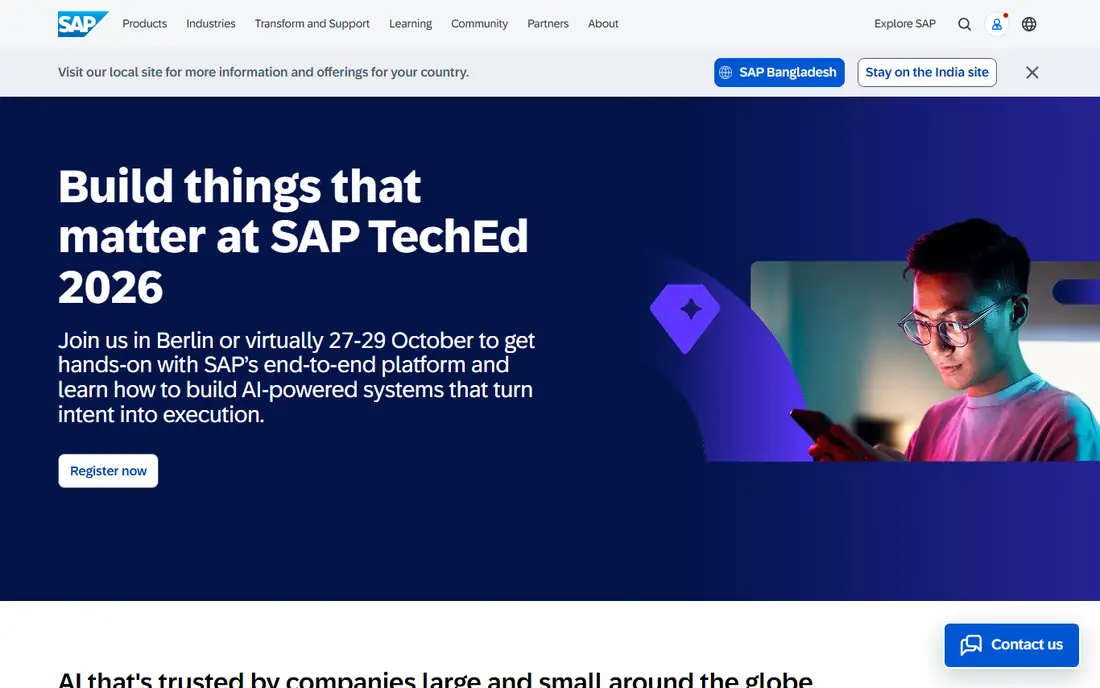
SAP Analytics Cloud acts as the analytics hub for organizations running SAP systems, pulling together business planning, consolidation, finance, ERP and supply chain data into one platform with in-app data modeling. It combines business intelligence, planning and predictive analytics, with rich visualization libraries and templates that reviewers rate highly for dashboarding.
The trade-off is ecosystem fit: performance and integration shine with SAP data, while teams outside the SAP world may find setup slower and pricing opaque, since plans are quote-based with a trial available. For SAP shops, though, no other tool connects planning and analytics to SAP data as directly.
What we like- Native hub for SAP ERP, finance, supply chain and planning data
- Combines BI, planning and predictive analytics
- Strong visualization and dashboarding
- 30-day trial available
Watch out for- Homepage extract is thin and JS-driven
- Best value requires SAP data
- Pricing not published
- First-mile experience can frustrate outside the SAP ecosystem
#3Oracle Analytics
Best for: Oracle Cloud and Fusion shops4.1/5 on
G2 (332 reviews, checked Oct 2026)
Visit oracle.com
Starting priceSee website
Free planNo
Oracle Analytics is the cloud platform for the entire analytics process: it ingests, models, prepares, enriches and visualizes data, with embedded machine learning and natural language technology to increase productivity. It runs on-prem, in Oracle Cloud or hybrid, and connects deeply to Oracle databases, Fusion applications and third-party systems through its AI Data Platform vision.
For organizations standardized on Oracle, the integration advantage is real: governed enterprise data, business semantics and AI development share one environment. For teams without Oracle infrastructure, the platform's breadth and enterprise pricing make simpler tools more attractive.
What we like- Full analytics process from ingestion to visualization in one cloud platform
- Embedded machine learning and natural language features
- Available on-prem, cloud or hybrid
- Deep Oracle database integration
Watch out for- Pricing not published on the homepage
- Strongest inside Oracle environments
- Enterprise complexity for small teams
#4
IBM Cognos Analytics
Best for: Enterprise reporting with AI assistance
Visit ibm.com
Starting priceSee website
Free planNo
IBM Cognos Analytics is the enterprise reporting workhorse, now with AI assistance for exploring data in natural language. It covers governed dashboards, pixel-perfect reporting, scheduling and distribution at scale, and pairs with IBM Planning Analytics for budgeting and forecasting, as shown by customers like Volkswagen Group Services cutting monthly reporting time dramatically.
Cognos suits organizations that need governed, scheduled, widely distributed reporting with strict access control, rather than fast self-service exploration. Smaller teams will find the enterprise setup heavier than modern cloud-native alternatives, but for regulated large enterprises, Cognos remains a safe, proven choice.
What we like- Long-established enterprise reporting and dashboarding
- AI assistant for natural-language exploration
- Strong governance, scheduling and distribution
- Integrates with IBM Planning Analytics
Watch out for- Pricing not published
- Classic enterprise feel with a learning curve
- Best suited to large organizations rather than small teams
#5Sisense
Best for: Embedded analytics in products4.2/5 on
G2 (1,063 reviews, checked Oct 2026)
Visit sisense.com
Starting priceSee website
Free planNo
Sisense is the leader in embedded analytics: it puts AI-powered analytics inside your product, under your brand, for your customers. Its governed distribution layer grounds AI in approved metrics, context and access rules, so customer-facing AI answers stay consistent with dashboards, with tenant-safe security keeping each customer's data separate at the query layer.
With more than 20 years in embedded analytics and 500 plus 5-star reviews, Sisense suits SaaS companies that need to ship analytics as a product feature rather than an internal tool. Internal-only BI buyers may prefer a simpler dashboarding tool, but for product teams, Sisense is the most mature embedded option.
What we like- 20 plus years powering analytics in customer-facing products
- Governed semantics keep AI answers consistent
- Flexible embed options with Compose SDK and APIs
- Tenant-safe row-level security
Watch out for- Pricing not published
- Embedded focus means less appeal for internal-only BI
- AI positioning is newer than its dashboarding heritage
#6Mode
Best for: Data teams doing SQL and self-service4.5/5 on
G2 (330 reviews, checked Oct 2026)
Visit mode.com
Starting priceSee website
Free planNo
Mode is the central hub where data teams and business teams meet around data. Analysts query with SQL, R and Python, iterate rapidly and publish curated datasets, while business users explore with self-service reporting on the same platform, without long implementation times or tedious maintenance. The vendor promises teams can be up and running in 30 minutes or less.
The headline on the homepage notes ThoughtSpot's acquisition of Mode, which shapes its future direction toward collaborative BI under ThoughtSpot. For data teams that live in SQL and want business users on the same platform, Mode remains a strong, analyst-friendly choice.
What we like- SQL, R, Python and visualization connected in one hub
- Ad hoc analysis plus self-service reporting together
- Fast setup in 30 minutes or less
- Strong data team workflows
Watch out for- ThoughtSpot has acquired Mode, so the roadmap now sits under ThoughtSpot
- Pricing not published
- Less suited to non-technical business users alone
#7Holistics
Best for: Analytics as code with governed metrics4.3/5 on
G2 (15 reviews, checked Oct 2026)
Visit holistics.io
Starting priceSee website
Free planNo
Holistics helps data teams stand up self-service BI where the AI answers and the point-and-click answers actually match, because both read from metrics defined once in a governed semantic layer. Models, metrics and dashboards are defined as code, versioned in Git and exposed to AI agents over MCP and APIs, so a change goes through branch, pull request and production like software.
Its composable metrics handle running totals, rolling windows and nested aggregations inside the semantic layer, where most tools fall back to table calculations or raw SQL. For modern data teams using Snowflake, BigQuery, Databricks or dbt who want governance without giving up self-service, Holistics is the most developer-friendly option here.
What we like- Self-service AI analytics where AI and point-and-click answers match
- Programmable semantic layer defined as code in Git
- Composable metrics without raw SQL fallbacks
- Embedded analytics with per-tenant security
Watch out for- Pricing not published
- Code-first approach suits data teams more than casual users
- Smaller vendor than SAP, Oracle or IBM
Starting priceFree
Free planYes
Looker Studio, formerly Google Data Studio, is the free way to turn data into interactive reports and dashboards. Built-in and partner connectors reach Google Analytics, Sheets, BigQuery, databases and marketing platforms, and reports can be shared with individuals, teams or the world, collaborated on in real time and embedded on any web page.
The limits are governance and depth: there is no enterprise semantic layer, and advanced modeling needs Looker itself rather than the free Studio. For small teams, marketers and startups that need shareable dashboards at zero cost, especially on Google data, Looker Studio is unbeatable value.
What we like- Completely free
- Built-in and partner connectors to virtually any data
- Interactive reports and dashboards shareable in real time
- Embeds on any web page
Watch out for- Thinner governance and semantic modeling than enterprise tools
- Best with Google data sources
- Limited advanced analytics compared to paid platforms
How we chose
We compared vendor homepages, pricing pages and documentation against public comparisons and user reviews. Every tool here had its official homepage opened and confirmed, and each one is a genuine business analytics platform, not a single-purpose reporting add-on. Where a vendor does not publish a price on its homepage, we recorded "See website" instead of repeating third-party estimates. Note that SAP's homepage extract was thin and JS-driven, and that strategy.com now shows the Bitcoin treasury business while the software business lives at microstrategy.com.
What to weigh before you buy
Start with your existing stack. SAP, Oracle and IBM tools pay off fastest inside their own ecosystems, while Sisense, Holistics and Mode suit cloud data warehouses and product teams. Then check the semantic layer: if AI answers and dashboards must agree, Strategy Mosaic and Holistics offer the strongest governed approaches.
Finally, trial with your own data. Connect your warehouse, build one dashboard your executives actually use, and test the AI question-answering on it. The tool whose numbers your finance team trusts is the one to buy, whatever the feature list promises.
Frequently asked questions
What is a business analytics tool?
A business analytics tool connects to your data sources, models and visualizes the data in dashboards and reports, and increasingly answers natural-language questions, so teams can understand performance, find drivers of change and make decisions from evidence rather than guesswork.
What is a semantic layer and why does it matter?
A semantic layer defines business metrics like revenue, churn or customer once, in one governed place, so every dashboard, report and AI answer uses the same definition. Without it, different teams compute the same metric differently and nobody trusts the numbers.
Which business analytics tool is best for small teams?
Looker Studio is free and excellent for Google-connected reporting, while Holistics suits small data teams that want governed self-service. Enterprise platforms like SAP, Oracle and IBM are priced and built for larger organizations.
Is MicroStrategy now called Strategy?
Yes, the company renamed itself Strategy, but its software business still lives at microstrategy.com, where it now centers on the Mosaic semantic layer. The strategy.com site currently presents the company's Bitcoin treasury metrics instead of software.
Do I need a data warehouse before buying a BI tool?
Not always: tools like Looker Studio connect directly to spreadsheets and SaaS apps. But for governed, large-scale analytics, a warehouse like Snowflake, BigQuery or Databricks plus a semantic layer gives cleaner, more consistent results.
Sources we checked (8)
- https://www.microstrategy.com
- https://www.sap.com
- https://www.oracle.com
- https://www.ibm.com
- https://www.sisense.com
- https://mode.com
- https://www.holistics.io
- https://lookerstudio.google.com
Is your product missing or out of date?
We review this list regularly. Vendors can request a listing, send updated pricing or ask about featured placement.

Shihab Mia · Founder, Rankite
Shihab has 5+ years in B2B and SaaS SEO. He writes Rankite's software buying guides from pricing pages, documentation and public user reviews. More about Shihab.